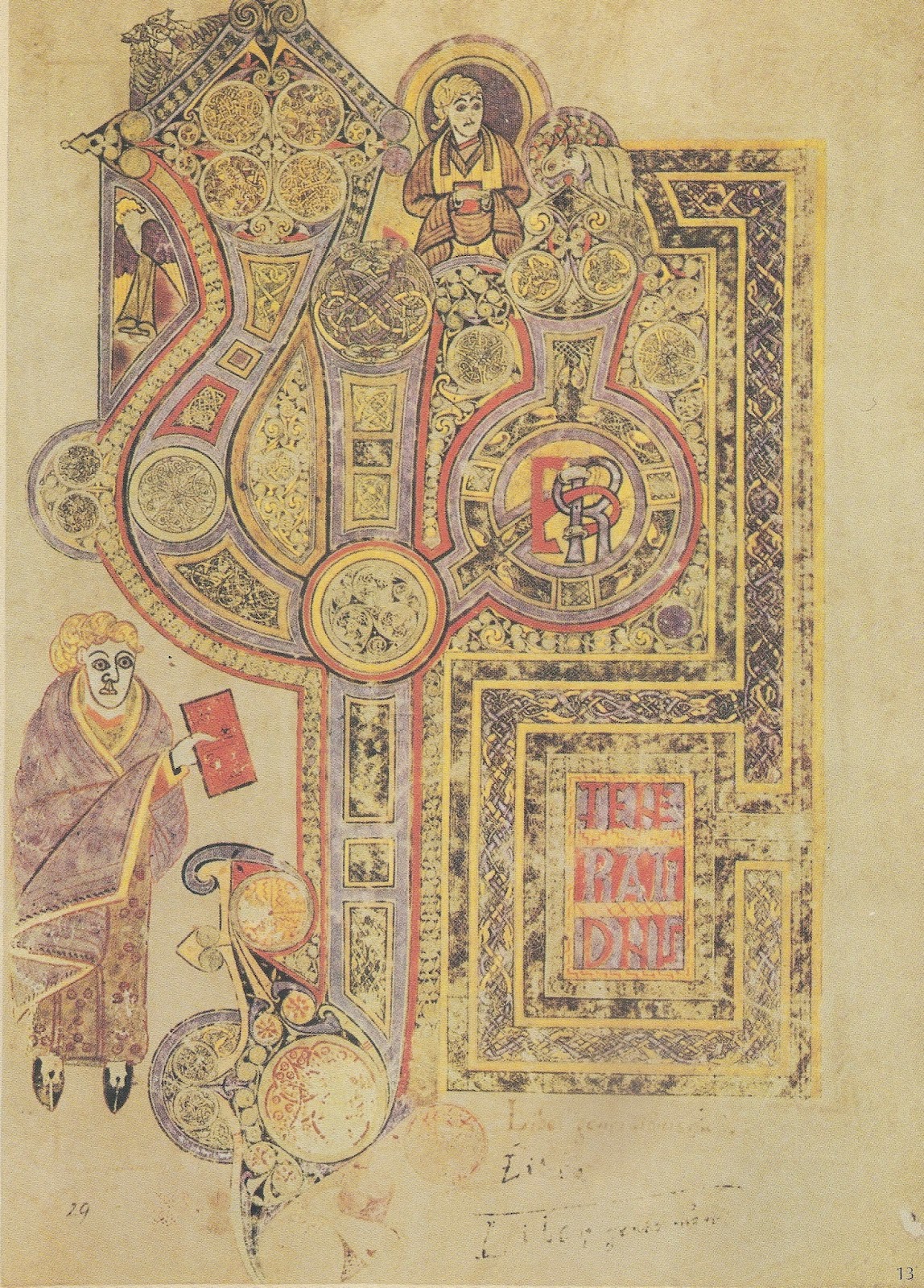
'There are many unfinished portions in the whole page; for instance, the
small face to the left of the upper limb of the L, the piece of the border of
the same limb just above and to the right of the face, and possibly the space into
which the right elbow of the upper figure projects.'
'But more noticeable than
all these is the unfinished condition of the intertwined letters ER in the
circle which forms the lower portion of the antique and curiously formed B. The
dark line surrounding the red E is only half completed. The interruption of so
very simple a feature of the work seems to tell a tale of perhaps even tragic
significance.'
BOOKS FROM RUBBISH DUMPS
Joyce also parodies Sullivan at length in Finnegans Wake Book One, Chapter 5, which he called 'Hen'. J.S.Atherton has a good description of this chapter, in which a hen, Belinda of the Dorans, scratches a letter out of a 'midden' or 'mudmound':
'This midden is a symbol, elaborated later, for the inhabited world in which men have left so many traces. The letter stands as a symbol for all attempts at written communication including all other letters, all the world's literature, the Book of Kells, all manuscripts, all the sacred books of the world, and also Finnegans Wake itself. One reason why The Book of Kells is included here is that it was once 'stolen by night...and found after a lapse of some months, concealed under sods' (Sullivan)' The Books at the Wake p62-3
Literature discovered in a rubbish heap reminded me of
Oxyrhynchus in Egypt. Since 1896, vast amounts of papyrus have been excavated from
the dumps here. Discoveries included poems by Sappho, several plays by Menander and part of a satyr play by Sophocles. But I can't find any specific reference to this in the Wake.
 |
A.L.Hunt's photograph of the his Oxyrhynchus dig in 1903
|
THE ASHPIT BOOKS
 |
| From Vivien Igoe's James Joyce's Dublin Houses |
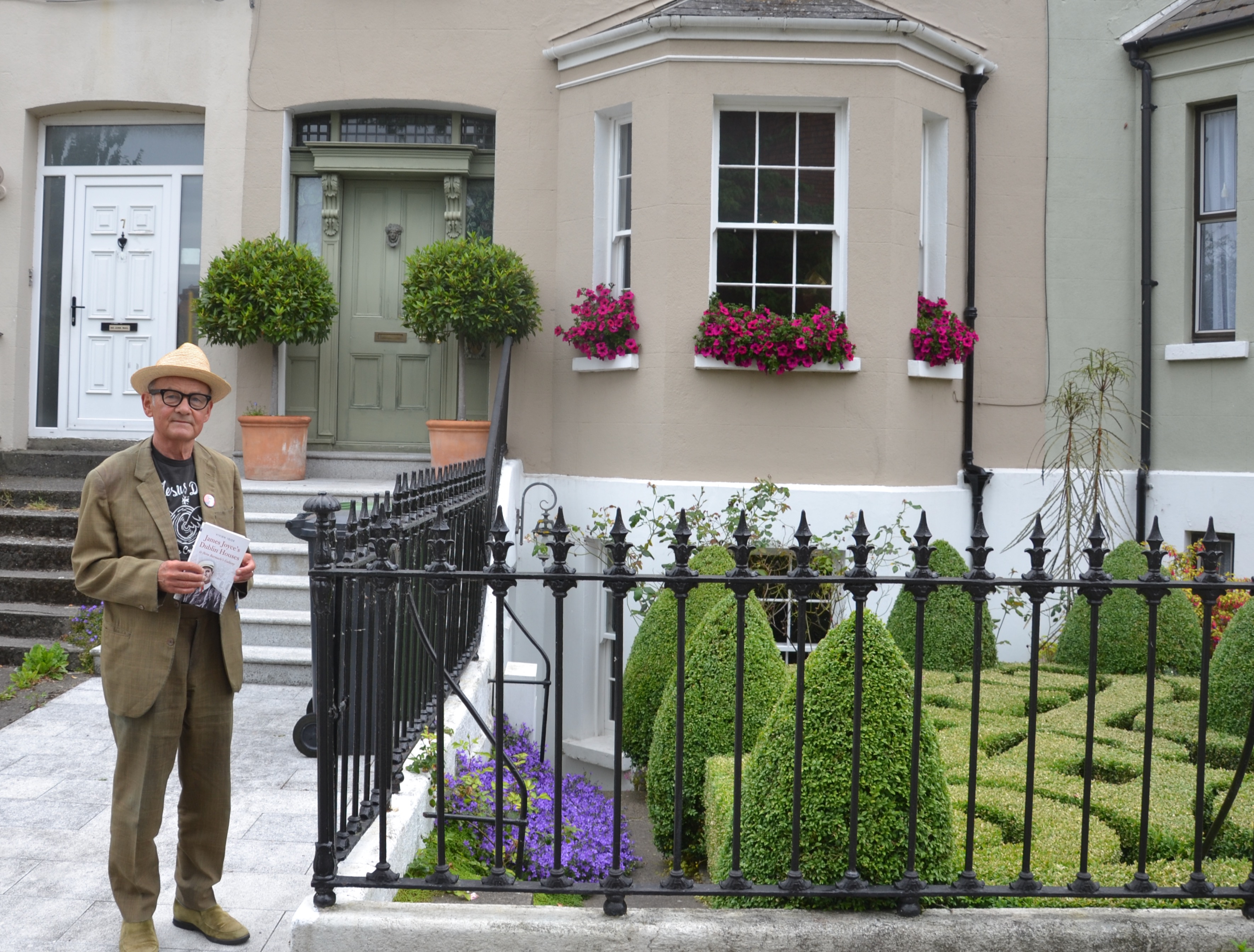
Joyce's dour brother, Stanislaus (a model for Shaun in the Wake) has a story of the younger Joyce children finding two books in the ashpit of their house at 8 Royal Terrace, Fairview (right). The children called these the 'ashpit books':
'Somebody found at the end of the garden two books which the children nicknamed 'the ashpit books'. One was a song-book, the first pages of which were missing. It contained a large and miscellaneous collection of classical and traditional songs, popular ballads and many so-called comic songs, the humour of which always remained a mystery to me. The other was a closely and badly printed collated edition of the four gospels in a red cloth cover...'
My Brother's Keeper, p112
The street is now called Inverness Road. I visited the house in June 2022 - it looks very different from the photo in Vivien Igoe's book. It's been beautifully restored by Stephen D'Arcy, a gardener. There are new Georgian style windows, a fancy front door and a miniature maze in the front garden.
And is that Anna Livia on the new door knocker?These ashpit books must be one inspiration for the Hen chapter.
In 2013, I learned from PQ's excellent A Building Roam blog that archaeologists have excavated the ash pit in this house, and found magic lantern slides!
When Stephen D'Arcy was replanting the back garden, he found fragments of glass slides, mainly on religious subjects, used in magic lantern shows. He called in archaeologists from the National Museum of Ireland. Read about what they found here.
The document discovered by the hen in the Finnegans Wake dump appears to be an everyday letter from an Irish family in Boston to relatives back home in Dublin. Over time, it has been transformed by 'heated residence in the heart of the orangeflavoured mudmound' (111.33), taking on a life of its own, like Joyce's book. It's compared to a melting photographic negative. As PQ writes, this makes the discovery of photographic slides in Joyce's own ashpit an amazing synchronicity.
RED RADDLED OBELI
Here's part of Joyce's great description of the letter's appearance, which goes on for four and a half pages:
'Look at this prepronominal funferal, engraved and retouched and edgewiped and pudden-padded, very like a whale’s egg farced with pemmican, as were it sentenced to be nuzzled over a full trillion times for ever and a night till his noddle sink or swim by that ideal reader suffering from an ideal insomnia: all those red raddled obeli cayennepeppercast over the text, calling unnecessary attention to errors, omissions, repetitions and misalignments...' 120.09-16
'Obelus' is a Latin term for a critical mark, placed by an editor beside spurious or misplaced text. Obeli were first used in the 2nd century BCE by Aristarchus of Samothrace, in editing Homer. Joyce's 'red raddled obeli' come from Sullivan's text:
'One important instance of correction is to be found on fol. 219 R., where the text of the preceding page, fol. 218 V., has been erroneously repeated. Attention is drawn to the error by four obeli in red, running down the middle of the page between the lines, and others round the margins, and red lines about the corners.'
 |
Kells obeli - the red crosses in folio 218.v. |
They are 'raddled' because of Sullivan's discussion on the sources of the pigments, here quoting a Professor Hartley:
'Of red hæmatite of an earthy nature, such as is termed raddle, there is a plentiful supply in the County Antrim'
Joyce's whole description is modelled on Sullivan's, which begins like this.
Here's part of the Gospel of John from The Book of Kells. At the bottom centre, just to the right of the griffin, there's a symbol like a big green C. Sullivan describes its purpose:

'The symbol C, known in Irish MSS. as "head under the wing" or "turn under the path" ...indicates that the words immediately following it are to be read after the end of the next full line.'
Joyce parodies this at 121.08:
'the curious warning sign before our protoparent’s ipsissima verba (a very pure nondescript, by the way, sometimes a palmtailed otter, more often the arbutus fruitflowerleaf of the cainapple) which paleographers call a leak in the thatch or the aranman ingperwhis through the hole of his hat, indicating that the words which follow may be taken in any order desired'
So the sign reminded Joyce of an Aranman whispering ('ingperwhis') through his hat or a thatched roof with a leak on it.
The comparison of this 'warning sign' with a 'palmtailed otter' (121.10) is taken from Sullivan's description of the Monogram Page (34r):
'A strange group of animals will be observed between the bottom of the P and the up line of the X — two rats nibbling the Eucharistic bread under the eyes of a pair of cats....Slightly to the right will be seen an otter-like creature with a fish in its mouth. The animal has been described as rat-like, but its size, shape and colouring are all against the suggestion.' 15-16
Looking at the Monogram Page in January 2021, with the Glasgow Finnegans Wake Reading Group, I was impressed when Davy Cunningham found the otter. You can see that the enclosing yellow shape resembles the warning sign.
Davy also suggested that ''Palmtailed' could refer to palmier biscuits, for the shapes either side of the otter'.
THE TUNC PAGE