Tuesday, 12 August 2014

Awake all Finnegans!

Finnegans of the world have been called to unite to bring to life one of Ireland's most well known yet hardest to read books.
  • Share

Finns, Fionas, Finnbars, Fintons and Finnualas are also invited to get involved in what has been heralded as the first full length public performance of James Joyce's epic novel Finnegans Wake.
- See more at: http://www.independent.ie/world-news/and-finally/festival-invite-for-every-finnegan-30411651.html#sthash.JDAho8Hp.dpuf

'Finnegans of the world have been called to unite to bring to life one of Ireland's most well known yet hardest to read books. Finns, Fionas, Finnbars, Fintons and Finnualas are also invited to get involved in what has been heralded as the first full length public performance of James Joyce's epic novel Finnegans Wake. The live reading of the complex and famously impenetrable work will take place over a week and a half in Enniskillen, Co Fermanagh, next month. Titled 'Awake All Finnegans', the marathon venture will see each participant read, whisper, shout or sing four pages of the book.' 

That's a story I read in the Irish Independent this July. 'What a wonderful stunt!', I thought. But would the accident of being called Finnegan be enough to make you to travel to Enniskillen to perform Ireland's 'hardest to read book'?

My wife Lisa loves Ulysses, but thinks Finnegans Wake is nuts. But she's also a theatre reviewer, for Total Theatre, and she loved the sound of the Beckett festival. Performances take place on islands on Lough Erne, in caves and in disused churches. The whole town gets involved: the barbers offer Beckett haircuts, and one sandwich shop sells Krapp sandwiches. We agreed that it would make a great alternative to Edinburgh this year. 

The festival was launched on 1 August, with another splendid news stunt from Sean Doran, the artistic director.  Here's how the Belfast Telegraph covered the story:

 
Happy Days Festival: Beckett, Joyce...and a dog called Finnegan
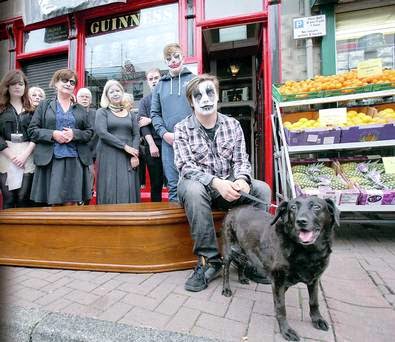

'A dog named Finnegan was one of the more unlikely respondents to a worldwide call for participants for an epic performance of an Irish literary classic. Part of the Happy Days Festival is dedicated to Beckett's mentors, and this year it is Joyce's turn.

Sean Doran, director of the festival, revealed the diverse response to the call for Finnegans to assemble. "We have had a very good response, ranging from somebody who wants to bring their dog called Finnegan to three actors," he said. "It's a varied response, beyond your imagination. And it's going to be very much an informal and sort of rough and ready reading, that's going to be handled like a relay."

Mr Doran admitted he did not know what to expect from the canine Finnegan. "We'll put the book in front of him and see how he gets on," he joked. With around 160 readers needed, the director said he had made preparations if not enough Finnegans turned up. "When we run out of Finnegans we are inviting artists and audiences and the local community to become a Finnegan for the day," he said.'


Finnegans of the world have been called to unite to bring to life one of Ireland's most well known yet hardest to read books.
  • Share

Finns, Fionas, Finnbars, Fintons and Finnualas are also invited to get involved in what has been heralded as the first full length public performance of James Joyce's epic novel Finnegans Wake.
The live reading of the complex and famously impenetrable work will take place over a week and a half in Enniskillen, Co Fermanagh, next month.
Titled 'Awake All Finnegans', the marathon venture will see each participant read, whisper, shout or sing four pages of the book.
- See more at: http://www.independent.ie/world-news/and-finally/festival-invite-for-every-finnegan-30411651.html#sthash.2p8BRKNz.dpuf
So they'd already relaxed the rule, announced in the brochure, that only Finnegans could take part.

Here's the page in the brochure, with the crest of the Finnegans on the left and an impressive parody of the Wake at the bottom.


We flew into Belfast on Wednesday, picked up a hire car and Lisa drove us south and west to Enniskillen, along roads reeking of cow poo, through towns flying union flags and the Red Hand of Ulster.  Then it was up the main street to Blake of the Hollow, a beautiful Victorian pub.


This is a good place for a Wake reading, for the young Joyce identified with the poet William Blake, and Stephen Dedalus quotes him several times in Ulysses. In his 1912 lecture on Blake, Joyce is clearly talking about himself when he says, 'Blake, like many other men of great genius, was not attracted by cultivated and refined women....In his unlimited egotism, he wanted the soul of his loved one to be entirely a slow and painstaking creation of his own.' That's how Joyce thought about his Nora.

I had a delicious pint of Guinness, beautifully embellished with a shamrock, and costing just £2.70 (the price rises to £3.30 after 7pm). We met a friendly local, who'd had a go at the Wake readings, and proudly told us about the pub. It has one of the great Victorian pub interiors. You can read all about Blake's pub here.


Lisa at the bar.


On the tables there were flyers inviting anybody to be an honorary Finnegan.


Ronan Doyle (from the festival facebook page)
The reading took place in the upstairs bar, which has a gothic interior, and, like a proper Irish wake, a table with a coffin resting on it. Here we met the Sligo actor, Ronan Doyle, who's been in charge of the readings.  He's had the task of cajoling the locals downstairs into coming up and having a go.

Ronan said that, on the first day, only three genuine Finnegans showed up. 'If only he'd called it Murphy's Wake,' he said, 'we'd have had no trouble!'

I asked Ronan, was there really a dog called Finnegan? 'There is now!', he said.

Sean Doran, director of the festival, revealed the diverse response to the call for Finnegans to assemble.
"We have had a very good response ranging from somebody who wants to bring their dog called Finnegan to three actors," he said.
- See more at: http://www.independent.ie/world-news/and-finally/dog-among-cast-at-joyce-reading-30474719.html#sthash.x5GmqfSB.dpuf
Sean Doran, director of the festival, revealed the diverse response to the call for Finnegans to assemble.
"We have had a very good response ranging from somebody who wants to bring their dog called Finnegan to three actors," he said.
- See more at: http://www.independent.ie/world-news/and-finally/dog-among-cast-at-joyce-reading-30474719.html#sthash.x5GmqfSB.dpuf
Sean Doran, director of the festival, revealed the diverse response to the call for Finnegans to assemble.
"We have had a very good response ranging from somebody who wants to bring their dog called Finnegan to three actors," he said.
- See more at: http://www.independent.ie/world-news/and-finally/dog-among-cast-at-joyce-reading-30474719.html#sthash.x5GmqfSB.dpuf

We arrived to find the reading in the middle of the Anna Livia Plurabelle chapter - the one Joyce made a record of. Anna Livia is a woman who is also the River Liffey.

The first reader we heard was Beate Hein, who's German but now lives in the USA. She's the dramaturg with the Yiddish prodution of Waiting for Godot, being staged in Beckett's old school, Portora.  Here she is reading about Anna Livia's first sexual experiences, including the meeting with a local hermit, Michael Arklow, who plunges his hands into her hair/waters.

'he plunged both of his newly anointed hands, the core of his cushlas, in her singimari saffron strumans of hair, parting them and soothing her and mingling it, that was deepdark and ample like this red bog at sundown.'

Beate was followed by her partner, Moshe Yassur. He's Romanian, and the director of the Yiddish Godot.

He read Anna Livia's toilette:

'First she let her hair fal and down it flussed to her feet its teviots winding coils. Then, mothernaked, she sampood herself with galawater and fraguant pistania mud, wupper and lauar, from crown to sole. Next she greesed the groove of her keel, warthes and wears and mole and itcher, with antifouling butter-scatch and turfentide and serpenthyme and with leafmould she ushered round prunella isles and eslats dun, quincecunct, allover her little mary.'

I read the next bit 'Well, arundgirond in a waveney lyne aringarouma she pattered and swung and sidled, dribbling her boulder through narrowa mosses, the diliskydrear on our drier side and the vilde vetchvine agin us, curara here, careero there...'
  
Lisa was up next, and she should have got the final pages of the chapter, which ought be enough to show anyone that Finnegans Wake isn't 'nuts'.  Defending the book to his patroness, Joyce wrote,  'Either the end of (Anna Livia) is something or I am an imbecile in my judgement of language.' 

Unfortunately, the pages had gone missing, so Lisa had to read the beginning of the next chapter, 'The Mime of Mick Nick and the Maggies', which is written as a theatre programme: 
   
 'Every evening at lighting up o’clock sharp and until further notice in Feenichts Playhouse. (Bar and conveniences always open, Diddlem Club douncestears.) Entrancings: gads, a scrab; the quality, one large shilling. Newly billed for each wickeday perfumance. Somndoze massinees. By arraignment, childream’s hours, expercatered. Jampots, rinsed porters, taken in token....'


There were three more readers that afternoon, including Shane Baker, an American actor, who plays Vladimir in the Yiddish Godot, and who also translated the play. He describes himself as 'the foremost Episcopalian on the Yiddish stage.'

Shane had to read the list of theatre props in the production, which includes 'Kopay pibe by Kappa Pedersen' . That reminded him of Pozzo in Godot saying 'I've lost my Kapp and Peterson!'  Kapp and Peterson were famous Dublin pipemakers.

After the reading, we had a drink in the bar downstairs with Moshe and Beate, and talked about the resonances of Godot in Yiddish. Aged 29, Moshe worked with Roger Blin on a production of Beckett's Play in 1963. He saw Beckett, but he was too shy to approach him. Read an interview with Moshe here.

Then we were joined by Adrian Dunbar, who had brought the Yiddish play to the festival, having seen it in New York. He entertained us with a beautifuly told joke about Moses promising to part the Red Sea. It had a Biblical build-up and the punch-line being a press agent popping up and saying, 'If you can do that, Moses, I'll get you two pages in the Old Testament!'

This was the beginning of three wonderful days in Enniskillen. 

We went back the following day for another reading, and I had to read this fearsome line from p.254, 'Ricqueracqbrimbillyjicqueyjocqjolicass? How sowesthow, dullcisamica? A and aa ab ad abu abiad. A babbel men dub gulch of tears.'

The final reader I heard, on Friday evening, was an Irish lady (left) who had the misfortune to have to read one of Joyce's hundred-letter thunderwords:

'Bothallchoractorschumminaroundgansumuminarumdrumstrumtruminahumptadumpwaultopoofoolooderamaunsturnup'


This is on p314, exactly half-way through the book. So they had just two days left to get through the second half of Finnegans Wake!


What came across to me from the festival was the fun of reading and listening to Finnegans Wake in a pub. Even the most incomprehensible pages had lines which got laughs from the listeners. I was reminded of the words of Robert Anton Wilson, which I've quoted before on this blog:
 
The best way to approach Finnegans Wake is in a group.  It has to be stalked like a wild animal, and you need a hunting party.  I’d been reading Finnegans Wake alone for many years before I discovered this....It was Tindall, I think, who was the first to say Finnegans Wake has to be read aloud. The second thing is - it’s best in groups.  And the third law, which I discovered, is it’s best in groups with several six packs of Guinness on the table.  The more Guinness you drink the clearer Finnegans Wake gets.   


Back home in Brighton, I got this email:

'Come all to celebrate the close of Happy Days 2014 with award winning actress Olwen Fouere. 

Olwen flies into from Edinburgh where she's performing her sell out show 'riverrun' based on Finnegans Wake, to read the last ten pages concluding Awake All Finnegans, the festival's durational reading of Finnegans Wake at Blakes of the Hollow.

Free. With Music. 21:00 hours. Duration 40 minutes.'

What a coup! What a perfect way to end the festival!


Monday, 4 August 2014

'This way to the Museyroom!'

Thomas Wolfe in 1937, photographed by Carl van Vechten
On 22 September 1926, James Joyce visited the battlefield of Waterloo. We know all about this visit because, by a lucky chance, the 25-year-old Thomas Wolfe was also on the tour bus. Wolfe was a big fan of Joyce's, but was too shy to talk to him. Straight after the visit, he wrote an excited description of the day to his lover, Aline Bernstein.

'I took the day off and went to Waterloo in a bus – the first trip I've made. There were seven or eight of us – two or three English, two or three French, and your old friend* James Joyce. He was with a woman about forty, and a young man, and a girl. I noticed him after we had descended at Waterloo – I had seen his picture only a day or two ago in a French publisher's announcements: he was wearing a blind over one eye. He was very simply – even shabbily – dressed. We went into a little café where the bus stopped to look at the battle souvenirs and buy postcards: then we walked up what was once the Sunken Road to a huge circular building that had a panorama of the battle painted around the sides;'

Elizabeth Knowell, (ed)The Letters of Thomas Wolfe p114


*Aline Bernstein had put on a production of Exiles the previous year, and had visited Joyce in London to pay royalties.

The circular panorama building, with the mound behind
 
Here's part of the panorama, a 110m-long canvas painted by Louis Dumoulin in 1912, to commemorate the centenary of Waterloo. It shows a key moment in the battle - Marshall Ney's charge against the English infantry squares around Wellington.


Could this panorama be in Finnegans Wake?:

'the whole panoromacron picture.' 318.09

'— A lambskip for the marines! Paronama! The entire horizon cloth!' 502.36

Back to Thomas Wolfe, who now describes visiting the 40 metre-tall lion mound, built by King William I of the Netherlands to mark the position where his son, Prince William of Orange, was wounded in the battle. The 'young man' referred to here is Giorgio Joyce:

'then we ascended the several hundred steps up the great mound which supports the lion and looks out over the field.  The young man, who wore horn-rim spectacles, and a light sporty-looking overcoat, looked very much like an American college boy: he began to talk to me going up the steps – I asked him if he knew the man with the eye blind. He said he did, and that it was Joyce. I commented briefly that I had seen Joyce's picture and read his book; after this the young fellow joined me at every point.'


 'Walking back down the road to the café, I asked him if Joyce's sight was better – he said it had greatly improved. He said that Joyce was working on a new book, but thought it impossible to say when it was finished. We went back to the café – they sat down at a table and had tea – the young man seemed about to ask me to join them, and I took a seat quickly at another table, calling for two beers. They all spoke French together – he told them all about it, and they peeked furtively at me from time to time – the great man himself taking an occasional crafty shot at me with his good eye. As they had tea, they all wrote postcards. As they got up to go into the bus, the young man bowed somewhat grandly to me – I don't blame him; I'd be pleased too. I judge the people are Joyce's family – he is a man in his middle forties – old enough to have a son and a daughter like these. The woman had the appearance of a thousand middle class French women I've known – a vulgar, rather loose mouth; not very intelligent looking. The young man spoke English well, but with a foreign accent. It was tragic to see Joyce – one of the gods at the moment – speaking not one word of the language his fame is based on. The girl was rather pretty – I thought at first she was an American flapper.'
 
James and Lucia Joyce in Ostend in 1924, from Bob Cato and Greg Vitiello's Joyce Images

'Joyce was very simple, very nice. He walked next to the old guide who showed us around, listening with apparent interest to his harangue delivered in broken English, and asking him questions. We came home to Brussels through a magnificent forest, miles in extent – Joyce sat with the driver on the front seat, asked a great many questions. I sat alone on the back seat – it was a huge coach; the woman sat in front of me, the girl in front of her, the young man on one side. Queer arrangement, eh?
  Joyce got a bit stagey on the way home, draping his overcoat poetically around his shoulders. But I liked Joyce's looks – not extraordinary at first sight, but growing. His face was highly colored, slightly concave – his mouth thin, not delicate, but extraordinarily humorous. He had a large powerful straight nose – redder than his face, somewhat pitted with scars and boils.
  When we got back to Brussels, and stopped in front of the bus office. the young man and two women made a little group, while Joyce went inside. The young man was looking at me, and I was swimming in beer. I made a dive for the nearest place, which was under a monument: they are more respectable here than in Paris.
  Anyhow it was too good to spoil: the idea of Joyce and me being at Waterloo at the same time, and aboard a sight-seeing bus, struck me as insanely funny. I sat on the back seat making idiot noises in my throat, and crooning all the way back through the forest.
  I think they really might have been a little grand about it if they had known they were discovered. But they were just like common people out sight-seeing.'

The Joyces in 1924, from Joyce Images

What jumps out of this letter to me is the description of Joyce climbing a great mound on the battlefield of Waterloo. Just two months later, he wrote the opening chapter of Finnegans Wake, which contains a visit to the 'Willingdone Museyroom', which is located beneath a mound!

'a proudseye view is enjoyable of our mounding’s mass, now Wallinstone national museum, with, in some greenish distance, the charmful water-loose country and the two quitewhite villagettes who hear show of themselves so gigglesomes minxt the follyages, the prettilees! Penetrators are permitted into the museomound free.'  7.36-8.05

This 'museomound' sounds like a mixture of the Waterloo battlefield panorama building and lion mound with the Wellington monument in the Dublin's Phoenix Park. It's also another version of the 'orangeflavoured mudmound' (111.34), where Belinda the Hen discovers the letter. Joyce came up with the mudmound before visiting Waterloo, but he must have been struck by the coincidence of finding a mound on the battlefield commemorating a Prince of Orange!  (He'd also called the mound 'the orangery' at 110.27).

The Wellington Monument in the Phoenix Park
 
What follows is the voice of the janitrix, Kathe, describing the contents of the Museyroom, where the battle of Waterloo is re-imagined as another version of HCE's sin in the park. HCE becomes 'Willingdone on his same white harse'. The three soldiers become the 'lipoleum boyne' (bringing in another William of Orange and the Battle of the Boyne). The two girls are called 'jinnies'.  Joyce drew a plan of the battle in his manuscript.


Note the word 'tip' written to the right centre

You can read the text of the Museyroom, and annotations here in fweet. To give you a feel of the style, here's the opening, from Joyce's fair copy of 29 November 1926.


Is this the 'harangue' of the 'old guide' who showed the Joyces and Thomas Wolfe around the battlefield? Did the guide ask for a 'tip'?

A ROYAL DIVORCE


J.S.Atherton discovered that 'Willingdone on his same white harse' was inspired by Joyce's memories of seeing W.G.Wills once popular play A Royal Divorce, about Napoleon and his two wives, at the Gaiety Theatre in Dublin. It toured for years with the actor manager W.W.Kelly playing Napoleon to his wife's Josephine. 


Here's Napoleon caught between his two wives - a scene you can see in sigla form in Joyce's diagram, with HCE facing two 'jinnies' (shown as the upside down T's - isolde's sigla). Though HCE is 'Willingdone' rather than Napoleon.


Is that the mound in the middle?

'the truly catholic assemblage gathered together in that king’s treat house of satin alustrelike above floats and footlights from their assbawlveldts and oxgangs unanimously to clapplaud (the inspiration of his lifetime and the hits of their careers) Mr Wallenstein Washington Semperkelly’s immergreen tourers in a command performance by special request with the courteous permission for pious purposes the homedromed and enliventh performance of problem passion play of the millentury, running strong since creation, A Royal Divorce.' 32.23

The 'king's treat house' is the Gaiety Theatre, in South King's Street.

J.S.Atherton, who tracked a manuscript copy of the play down, describes the play's astonishing final tableau of the Battle of Waterloo:


'A backcloth showing the scene of Waterloo was pierced with holes which were 
intermittently lit up to represent the firing of cannon. In front of this models of cavalrymen were wound forward on glass runners while 'Pepper ghosts' of cuirassiers produced by a sort of magic lantern, fell dramatically to their death in the clouds of white smoke that filled the stage. In the foreground on a big white horse, rode Napoleon, or sometimes - apparently when Mr Kelly wanted a rest - Wellington. It made no difference to the play who was on the horse as nothing was said.'  


The Books at the Wake.