'(Joyce) devoured the reviews of Finnegans Wake, but quickly grew disappointed and even morose. As each one was read he listened intently, then sighed.'
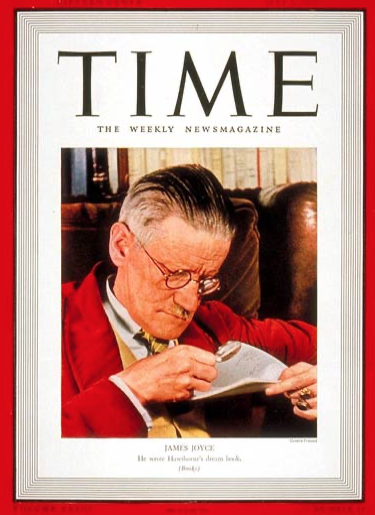
The May 1939 issue of Time magazine carried a lengthy profile of Joyce by Whittaker Chambers. This part should be read out loud, preferably in the voice of Orson Welles:
'Generations of diviners, black magicians, fortune tellers and poets have made night and dreams their province, interpreting the troubled images that float through men’s sleeping minds as omens of good and evil....Only of late have psychologists asserted that dreams tell nothing about men’s future, much about their hidden or forgotten past. In dreams, this past floats, usually uncensored and distorted, to the surface of their slumbering consciousness.This week, for the first time, a writer had attempted to make articulate this wordless world of sleep. The writer is James Joyce; the book, Finnegans Wake — final title of his long-heralded Work in Progress....
 |
| Whittaker Chambers |
But Joyce’s method is new. Dreams exist as sensation or impression, not as speech. Words are spoken in dreams, but they are usually not the words of waking life, may be capable of multiple meanings, or may even be understood in several different senses by the same dreamer at the same moment. Since dreams take place in a state of suspended consciousness, out of which language itself arises, Joyce creates, in Finnegans Wake, a dream language to communicate the dream itself.'
So the Time cover says 'He wrote Hawthorne's dream book'.
Chambers also writes, 'At present Joyce is not writing. His wife is trying to get him started on something, because when he is not working he is hard to live with.'

The Atlantic Monthly June 1939
 B. Ifor Evans, in the Manchester Guardian, found the book impossible to review. But, unlike Aldington and Muggeridge, he preferred to suspend judgement:
'Mr. Joyce's "Finnegans Wake," parts of which have been published as "Work in Progress," does not admit of review. In twenty years' time, with sufficient study and with the aid of the commentary that will doubtless arise, one might be ready for an attempt to appraise it....The easiest way to deal with the book would be to become "clever" and satirical or to write off Mr. Joyce's latest volume as the work of a charlatan. But the author of "Dubliners," "A Portrait of an Artist," and "Ulysses" is obviously not a charlatan, but an artist of very considerable proportions. I prefer to suspend judgment. If I had had to review Blake's "Prophetic Books" when they first appeared I would have been forced to a similar decision....
This book is nothing apart from its form, and one might as easily describe in words the theme of a Beethoven symphony....One concluding note. Mr. Joyce in a parody of Jung and Freud ("Tung-Toyd") mentioned "Schizo-phrenia." One might imagine that Mr. Joyce had used his great powers deliberately to show the language of a schizophrenic mind, and then he alone could explain his book and, I suppose, he alone review it.'
The American poet, Louise Bogan looked at Joyce's claim that he was writing about the night and unconscious. She was also the first genetic critic, comparing the published text with earlier versions:
 'There is nothing whatever to indicate that Joyce has any real knowledge of the workings of the subconscious, in sleep or otherwise....The later versions of the fragments already published seem to be changed out of sheer perversity: a clause is omitted leaving nothing but a vestigial preposition; a singular noun is shifted to the plural and the meaning is thereby successfully clouded....The most frightening thing about the book is the feeling, which steadily grows in the reader, that Joyce himself does not know what he is doing; and how, in spite of all his efforts, he is giving himself away....
 The only reviewer who claimed to understand the book was Edmund Wilson, who bizarrely argued that Finnegans Wake had 'a realistic foundation':
'Let me try to establish some of the most important facts which provide the realistic foundation for this immense poem of sleep. The hero of Finnegans Wake is a man of Scandinavian blood...Humphrey Chimpden Earwicker, who keeps a pub called the Bristol in Dublin. He is somewhere between fifty and sixty, blond and ruddy, with a walrus moustache, very strong but of late years pretty fat.....'
'The Dream of Earwicker', The New Republic, 28 June 1939
'We are continually being distracted from identifying and following Earwicker, the humble proprietor of a public house, who is to encompass the whole microcosm of the dream, by the intrusion of all sorts of elements – foreign languages, literary allusions, historical information – which could not possibly be in Earwicker's mind....What about the references to the literary life in Paris and to the book itself as Work in Progress, which take us right out of the mind of Earwicker and into the mind of Joyce?'
Alfred Kazin challenged Wilson's idea that the book was Earwicker's dream (first expressed in Axel's Castle in 1931):
 'How, you will ask, can Joyce know a dream? The answer of course is that he can't. In reality Finnegans Wake is a stupendous improvisation, a great pun. Even in sleep one cannot imagine an Irish-Norwegian brewer remembering words in a language he has never read....It is the sleep, not of one man, but of a drowsing humanity. All cultures have a relation to it, all minds, all languages nourish its night speech....As one tortures one's way through Finnegans Wake an impression grows that Joyce has lost his hold on human life....He has created a world of his own, that night world in which all men are masters and all men dupes, and he has lost his way in it. For extraordinary a feat of language as Finnegans Wake is, what may we expect to follow it? the denigration has been too complete; after this twisting, howling, stumbling murk, language so convulsed, meaning so emptied, there is nothing.'
New York Herald Tribune, 21 May 1939

‘For the past seventeen years the author of “Ulysses” has been at work on a new book, released this week as “Finnegans Wake.” The world would doubtless be amazed at Mr. Joyce’s achievement, assuming the world understood it. But one doubts that “Finnegans Wake” will be grasped—at least in our time—except by a few conscientious philologists and a small lunatic fringe of autohypnotic Joyceans who seem able to hurl themselves into a trance of intuitive comprehension.
Imagine the challenge to the first reviewers of describing such a book!
'A COMPLETE FIASCO'
The laziest reviewer was Malcolm Muggeridge, who seems to have read only the opening page:
 'Mr. James Joyce's Finnegans Wake faces the reviewer with peculiar difficulties. In the first place he cannot read it, only battle through a page or so at a time without pleasure or profit. This would not, in itself, matter so much; but he does not know what the book is about. The dust jacket, which might be expected to help, says nothing except that Finnegans Wake has taken sixteen years to write, that it has been more talked about and written about during the period of its composition than any previous work of literature, and that it would inevitably 'be the most important event in any season in which it appeared'.... Considered as a book, and considering the object of a book to be by means of written symbols to convey the author's emotions to the reader, Finnegans Wake must be pronounced a complete fiasco. Such a word as 'bababadalgharaghtakamminarronnkonnbronntonnerronntuonnthunntrovarrhounawnskawntoohoohoordenenthurnuk!' is not merely senseless, it is absurd. How many mornings Mr Joyce devoted to coining this particular word, I do not know; perhaps it only took him one morning or just an hour or so; but in any case he was wasting his time as surely as, more surely than, a village idiot trying to catch a sunbeam.'
TIme and Tide, 20 May 1939

TIme and Tide, 20 May 1939
The book jacket was indeed of no help to the reviewers.

'GHASTLY STODGE'
Richard Aldington was just as contemptuous as Muggeridge, but much angrier. He'd taken his job seriously and actually read the book:
 'Common honesty compels this reviewer to state that he is unable to explain either the subject or the meaning (if any) of Mr Joyce's book; and that, having spent several hours a day for more than a fortnight in wretched toil over these 628 pages, he has no intention of wasting one more minute of precious life over Mr Joyce's futile inventions, tedious ingenuities, and verbal freaks....

What Mr Joyce has written is 628 pages of pedantic nonsense....This heavy compost is frequently infected with that lecherous suggestiveness of which Joyce is a master, which was defended in Ulysses as germane to the characters, but which seems here to have no purpose more interesting than the author's morose delectation...
Such are the main ingredients of this ghastly stodge, repeated over and over again. The boredom endured in the penance of reading this book is something one would not inflict on any human being, but far be it from me to discourage any reader who prefers to use a perfectly good five-dollar bill to buy Finnegans Wake rather than to light a cigarette with it. (The latter of course will give more lasting satisfaction.)
Translated into native Tasmanian, this book should have a well-deserved sale.'
The Atlantic Monthly June 1939
'DOES NOT ADMIT OF REVIEW'

'Mr. Joyce's "Finnegans Wake," parts of which have been published as "Work in Progress," does not admit of review. In twenty years' time, with sufficient study and with the aid of the commentary that will doubtless arise, one might be ready for an attempt to appraise it....The easiest way to deal with the book would be to become "clever" and satirical or to write off Mr. Joyce's latest volume as the work of a charlatan. But the author of "Dubliners," "A Portrait of an Artist," and "Ulysses" is obviously not a charlatan, but an artist of very considerable proportions. I prefer to suspend judgment. If I had had to review Blake's "Prophetic Books" when they first appeared I would have been forced to a similar decision....
This book is nothing apart from its form, and one might as easily describe in words the theme of a Beethoven symphony....One concluding note. Mr. Joyce in a parody of Jung and Freud ("Tung-Toyd") mentioned "Schizo-phrenia." One might imagine that Mr. Joyce had used his great powers deliberately to show the language of a schizophrenic mind, and then he alone could explain his book and, I suppose, he alone review it.'
Manchester Guardian, 12 May 1939
'THERE ARE BETTER GODS THAN PROTEUS'
The American poet, Louise Bogan looked at Joyce's claim that he was writing about the night and unconscious. She was also the first genetic critic, comparing the published text with earlier versions:

The book cannot rise into the region of true evocation – the region where Molly Bloom's soliloquy exists imortalluy – because it has no human base....To read the book over a long period of time gives one the impression of watching intemperance become addiction, become debauch.
The book's great beauties, its wonderful passages of wit, its variety, its marks of genius and immense learning are undeniable....But whatever it says of man's past it has nothing to do with man's future, which, we can only hope, will lie in the direction of more humanity rather than less. And there are better gods than Proteus...'
Nation 6 May 1939
Nation 6 May 1939
'A REALISTIC FOUNDATION'

'Let me try to establish some of the most important facts which provide the realistic foundation for this immense poem of sleep. The hero of Finnegans Wake is a man of Scandinavian blood...Humphrey Chimpden Earwicker, who keeps a pub called the Bristol in Dublin. He is somewhere between fifty and sixty, blond and ruddy, with a walrus moustache, very strong but of late years pretty fat.....'
'The Dream of Earwicker', The New Republic, 28 June 1939
Wilson then criticised Joyce for ignoring his realistic foundation, and writing a dream that this publican could not be having!
'We are continually being distracted from identifying and following Earwicker, the humble proprietor of a public house, who is to encompass the whole microcosm of the dream, by the intrusion of all sorts of elements – foreign languages, literary allusions, historical information – which could not possibly be in Earwicker's mind....What about the references to the literary life in Paris and to the book itself as Work in Progress, which take us right out of the mind of Earwicker and into the mind of Joyce?'
I've written another post about this review, which influenced many later writers on the Wake.
'TWISTING, HOWLING, STUMBLING MURK'
Alfred Kazin challenged Wilson's idea that the book was Earwicker's dream (first expressed in Axel's Castle in 1931):

New York Herald Tribune, 21 May 1939
'A GOD TALKING IN HIS SLEEP'
In The New Yorker, Clifton Fadiman, US public intellectual, came up my favourite review title:
 |

‘For the past seventeen years the author of “Ulysses” has been at work on a new book, released this week as “Finnegans Wake.” The world would doubtless be amazed at Mr. Joyce’s achievement, assuming the world understood it. But one doubts that “Finnegans Wake” will be grasped—at least in our time—except by a few conscientious philologists and a small lunatic fringe of autohypnotic Joyceans who seem able to hurl themselves into a trance of intuitive comprehension.
I have enough sense to know that the man who wrote “Ulysses” is a great artist. I cannot believe, though some do, that he would spend seventeen years in the elaboration of a gigantic hoax. And, anyway, “Finnegans Wake” is so extraordinary that it’s worth talking about even if, like myself, you understand precious little of it….
One of Joyce’s most earnest commentators, Eugene Jolas, declares that his master wants nothing less than to “hammer out a verbal vision that destroys space and time.” In a sense, the attempt is successful, but since time, space, and the individual are the loci, as it were, of human interest, Joyce is forced to forgo all attempts at appealing to our sensibilities. Even if you could understand “Finnegans Wake,” you would not be moved by it. A god, talking in his sleep, might have written it. The only attitude a god could well have toward human affairs is irony, and dehumanized irony seems to me the keynote of every one of these strange pages.’

 The Irish Times had an anonymous review which, John McCourt has revealed, was written by the novelist, and friend of Flann O'Brien, Brinsley MacNamara:
The Irish Times, 3 June 1939
 Joyce's friend Padraic Colum - who had helped him write the 'Haveth Childers Everywhere' section, described the pleasures of reading the book in The New York Times:
'Accept what looks like Volapuk on the pages, I would say to one who has got "Finnegans Wake," and turn to the last section in the first part, the section that begins 'O tell me all about Anna Livia!'....The reader who is not looking for usual connotations, for logical structure, can find something delightful here: he can experience the child's surprise at flowing water and all that goes on beside it.....Even if he does not understand all that is on any one page (the reader) will find sentences lovely in their freshness and their beauty and sentences that one can chuckle over for months. We have novels that give us greatly a three dimensional world: here is a narrative that gives a new dimension.'
The Scottish poet Edwin Muir wrote a lyrical and perceptive review:
 'It is an enormous lingual feat; it does give the feeling sometimes that one is moving in a world where everything, including language and syntax and the principles of mental association, are different; it is an attempt never attempted before, which could only have been undertaken by a man of Mr Joyce's genius and perseverance....
The Wake's avoidance of storytelling was also discussed by Harry Levin, in Joyce's favourite review:
 'As a novelist he is, though not a failure, perhaps a bankrupt. He can no longer narrate; he can only elaborate....he has no story to tell. He merely effects a poignant kind of cross-reference.... Among the acknowledged masters of English – and there can be no further delay in acknowledging that Joyce is among the greatest – there is no one with so much to express and so little to say.... Sooner or later it gives a prejudiced reader the uncanny sensation of trying to carry on a conversation with an omniscient parrot.'
'On First Looking into Finnegans Wake', New Directions in Prose and Poetry, 1939
The Observer had the inspired idea to commission Oliver St John Gogarty - Buck Mulligan himself! - to review Finnegans Wake. He looked at Joyce's motives for writing the book, and found the answer in the character of the man he'd known in 1904:

'When I think of the indomitable spirit that plodded on, writing Ulysses in poverty in Trieste, without a hope of ever seeing it published, I am amazed at the magnitude of this work, every word of which in its 628 pages had to be weighed, twisted, and deranged in order to bring up associated ideas in the mind....The immense erudition employed, and the various languages ransacked for pun and word-associations is almost incredible to anyone unaware of the superhuman knowledge the author had when a mere stripling. In some places the reading sounds like the chatter during the lunch interval in a Berlitz school. Every language living and dead in Europe gabbles on and on. But what is the motive force behind this colossal production? Finnegan’s wake [sic] may be the wake, that is the funeral celebration, as well as the panegyric, of civilisation. Resentment against his upbringing, his surroundings, and finally against the system of civilisation throughout Europe, perhaps against Life itself which Finnegan may represent, created this literary Bolshevism which strikes not only at all standards and accepted modes of expression whether of Beauty or Truth but at the very vehicle of rational expression. This arch-mocker in his rage would extract the Logos, the Divine word or Reason from its tabernacle, and turn it muttering and maudlin into the street. It is impossible to read the work as a serial. It may have a coherency and a meaning. What is wrong with the meaning that it cannot be expressed? Ripeness cannot be all in this instance, nor can a myriad-minded man full of infinite suggestion satisfy the reader with suggestions alone. Perhaps it is wrong to look for a meaning where there is every meaning. It may be unmodern to expect sense. Lewis Carroll stopped short brilligly, but this goes on lapsing as everlastingly as Anna Livia. There is nothing new under the sun: it is only exaggerated. This is the most colossal leg-pull in literature since McPherson’s Ossian. Mr. Joyce has had his revenge.’
Joyce liked this review. He told Frank Budgen, 'Gogarty is an athlete, a cyclist and a swimmer. He should know what staying power is.'


One of Joyce’s most earnest commentators, Eugene Jolas, declares that his master wants nothing less than to “hammer out a verbal vision that destroys space and time.” In a sense, the attempt is successful, but since time, space, and the individual are the loci, as it were, of human interest, Joyce is forced to forgo all attempts at appealing to our sensibilities. Even if you could understand “Finnegans Wake,” you would not be moved by it. A god, talking in his sleep, might have written it. The only attitude a god could well have toward human affairs is irony, and dehumanized irony seems to me the keynote of every one of these strange pages.’
I love his description of the 'lunatic fringe of autohypnotic Joyceans'!
A MISTAKEN THEORY OF LANGUAGE
Archibald Anderson Hill, Professor of Linguistics at the University of Texas at Austin, looked at the book's linguistic experiments. He concluded that Joyce was following a mistaken and naive theory of language:
'The monstrosity of “Finnegans Wake” makes it seem impossible that a sane man could have written it, yet the early passages seem normal enough. The difference is that what appears in the early work as a preoccupation only, is in the later carried out with the relentlessness of a man demonstrating a theory. The theory is about language, and it is mistaken. But it is by no means abnormal or even very recondite, since it is shared by most naive people. Joyce believes that there is, or should be, a real connection between the sound and the thing. His theory rests in part on an exaggerated notion of the possibilities of onomatopoeia. Imitation by means of sound occurs to some extent in language, but is thoroughly successful only when the thing imitated is another sound....
Joyce has apparently set out in “Finnegans Wake” to create a language which attempts to be really instead of nominally expressive....The attempts at onomatopoeia rest on a denial of the first fundamental characteristic of language, its arbitrariness; the puns rest on a similar denial of the second, its social basis....Joyce writes “lucalizod” for “localized” because his personal experience includes the names of two Irish villages of which the word “localized” reminds him. It makes no difference to him that the majority of his readers have never heard of the two villages. Since to him language is not social, any personal association between words is valid. It is a paradox that a man who thinks that he is creating a language of universal symbols should make constant use of associations of the most narrowly personal kind....
It is difficult to judge the artistic effectiveness of the style in “Finnegans Wake,” apart from the faithfulness with which it represents the subconscious. To me, however, it is a complete failure, since the humor and the poetic beauty of much of “Ulysses” are here absent or rudimentary. Apparently, in representing the hypnoid mind, Joyce felt that it would be a mistake to tell a connected story, or to make his jokes too good. Consequently most of the humor is on the level of “peacisely.” Or if there is a good bit, it is lost in such a mass of turgid and opaque viscosity that it is impossible to laugh at it....Further, the book does not impress me as profoundly learned, in spite of the opinions of many critics....No amount of learning in languages, theology, or Celtic legend, will help the reader much. The only man who can really follow the puns is Joyce himself, because only he has formed the associations which made the puns possible.'

'ENDLESSLY EXCITING IN ITS IMPENETRABILITY'

'The writing of "Finnegans Wake” took sixteen years, short enough, perhaps, beside the stretch of time that could be spent in trying to understand it....Nothing moves, or appears, or is said, as ever before in any book, it is endlessly exciting in its impenetrability....The work is described as a novel, and, although in their essence all the stories of the world may be here, there is no single story that one can grasp. It may be a novel to end novels for, if there is shape at all, it is the shape of a superb annihilation - as of some gigantic thing let loose to destroy what we had come to regard as a not unnecessary part of civilisation. One feels its power, the kind of gleaming genius behind it, but no communication of anything is achieved, perhaps simply because it is just not intended....
There are moments of beauty, the measured sounds of lyrical prose which beat upon the ear, but which do not come into the understanding, and always an airy gesture beyond the words which make it as if Mr. Joyce had greatly enjoyed doing all this despite the torture of the sixteen years' labour that it took. Yet pleasure never altogether reaches to the reader; he is faced with an acute bewilderment from the beginning, which is no beginning, to the end, which is no end.
The reader begins to reject constructively the formlessness which is all around him; he tries to find a way out, to relate to some kind of plan of his own, even one of these, embedded pages. There are lingering lovely passages like flickers of gold. By following the small light they give there may be real illumination a little further on. But the light fails, and he is left to wander round and round in the maze....
It is a game which only Mr. Joyce can play, for he alone knows the rules, if there are any. He will take a word and twist and turn it, and chase it up and down through every language that he knows – English, French, German, Gaelic, Latin, Greek, Dutch, Sanskrit, Esperanto. The sounds of words in infinite variety fascinate him...
We may be face to face in Finnegans Wake with one of the great milestones of literature, and in this book a new language may have been born....The extent to which Finnegans Wake may begin to influence the English language will be the measure of its reality and the only proper test of its importance.... This book could be imitated only by Mr Joyce himself. It may appear, therefore, in the ultimate view, that although after Ulysses he had no more to say, in Finnegans Wake he went on saying it'
The Irish Times, 3 June 1939
In Consuming Joyce, John McCourt quotes a 1947 'Irishman's Diary' column by the paper's editor, R.M.Smyllie:
'Brinsley MacNamara reviewed it for the Irish Times, and I still have somewhere a letter from Joyce himself, congratulating the paper on the excellence of the review. Praise from Joyce was high praise indeed. I wonder how many of its other reviewers can boast that they were congratulated by this remarkable, if wayward, genius.'
'A NEW DIMENSION'
 Joyce's friend Padraic Colum - who had helped him write the 'Haveth Childers Everywhere' section, described the pleasures of reading the book in The New York Times:
'Accept what looks like Volapuk on the pages, I would say to one who has got "Finnegans Wake," and turn to the last section in the first part, the section that begins 'O tell me all about Anna Livia!'....The reader who is not looking for usual connotations, for logical structure, can find something delightful here: he can experience the child's surprise at flowing water and all that goes on beside it.....Even if he does not understand all that is on any one page (the reader) will find sentences lovely in their freshness and their beauty and sentences that one can chuckle over for months. We have novels that give us greatly a three dimensional world: here is a narrative that gives a new dimension.'
'MR JOYCE'S ENORMOUS BAROQUE MOAT'
The Scottish poet Edwin Muir wrote a lyrical and perceptive review:

The book has the qualities of a flowing stream, sound and rhythm; the rhythm is sometimes beautiful, as can be tested by reading passages aloud....There are parodies of the sagas, skits on almost every style of writing, enormous catalogues in the vein of Rabelais, snippets of folk-lore, echoes of music-hall songs, all slightly dissolved, all tending to flow into each other, and producing a continuous effect of storytelling while continuously avoiding the commission of a story. To dip into this flux for a little is refreshing, but to stay in for long is to be drowned, 'with winkles, whelks and cocklesent jelks', in Mr Joyce's enormous Baroque moat. A reader might well cry 'Lifeboat Alloe, Noeman's Woe, Hircups Emptybolly!'
The Listener, 11 May 1939
The Listener, 11 May 1939
'CONVERSATION WITH AN OMNISCIENT PARROT'
The Wake's avoidance of storytelling was also discussed by Harry Levin, in Joyce's favourite review:
'On First Looking into Finnegans Wake', New Directions in Prose and Poetry, 1939
'THE MOST COLOSSAL LEG-PULL IN LITERATURE'
The Observer had the inspired idea to commission Oliver St John Gogarty - Buck Mulligan himself! - to review Finnegans Wake. He looked at Joyce's motives for writing the book, and found the answer in the character of the man he'd known in 1904:

'When I think of the indomitable spirit that plodded on, writing Ulysses in poverty in Trieste, without a hope of ever seeing it published, I am amazed at the magnitude of this work, every word of which in its 628 pages had to be weighed, twisted, and deranged in order to bring up associated ideas in the mind....The immense erudition employed, and the various languages ransacked for pun and word-associations is almost incredible to anyone unaware of the superhuman knowledge the author had when a mere stripling. In some places the reading sounds like the chatter during the lunch interval in a Berlitz school. Every language living and dead in Europe gabbles on and on. But what is the motive force behind this colossal production? Finnegan’s wake [sic] may be the wake, that is the funeral celebration, as well as the panegyric, of civilisation. Resentment against his upbringing, his surroundings, and finally against the system of civilisation throughout Europe, perhaps against Life itself which Finnegan may represent, created this literary Bolshevism which strikes not only at all standards and accepted modes of expression whether of Beauty or Truth but at the very vehicle of rational expression. This arch-mocker in his rage would extract the Logos, the Divine word or Reason from its tabernacle, and turn it muttering and maudlin into the street. It is impossible to read the work as a serial. It may have a coherency and a meaning. What is wrong with the meaning that it cannot be expressed? Ripeness cannot be all in this instance, nor can a myriad-minded man full of infinite suggestion satisfy the reader with suggestions alone. Perhaps it is wrong to look for a meaning where there is every meaning. It may be unmodern to expect sense. Lewis Carroll stopped short brilligly, but this goes on lapsing as everlastingly as Anna Livia. There is nothing new under the sun: it is only exaggerated. This is the most colossal leg-pull in literature since McPherson’s Ossian. Mr. Joyce has had his revenge.’
Joyce liked this review. He told Frank Budgen, 'Gogarty is an athlete, a cyclist and a swimmer. He should know what staying power is.'
'THE BIGGEST MASTERPIECE OF THIS CENTURY"
Patricia Hutchins looked at Faber's news cuttings files, and found the following delightful quotes:
'It was in the by-ways that the book found friends. Mr Beddow, assistant editor of The Schoolmaster and Woman Teacher's Chronicle, wrote, 'I have in my hands the biggest masterpiece of this century.'....The Library Assistant strongly recommended the book and an interesting review in Theology declared, 'the eye must indeed be blind that does not see in this author's lonely journeying a spiritual pilgrimage.''
Hutchins, James Joyce's World, Methuen, 1957, p238
'SWADDLED EYE SHEETS'
Henry W Clune, in his witty 'Seen and Heard' column in the Rochester Democrat and Chronicle, reviewed the reviewers:
'James Joyce, the Dublin expatriate, who over a period of 16 to 17 years wrote a book in Paris called ''Finnegans Wake'', which runs to 628 pages, sells for $5, and which was brought out last week on a tide of hundreds of thousands of words by the book critics, opens in this wise: 'riverrun past Eve and Adam's from swerve of shore to bend of bay' and closes with this red hot tag line 'A way alone a last a loved a long the'.... Mr Joyce is called one of the great modern literary artists, and last week got his picture on the front cover of ''Time'', a distinction of sorts....But no review I have read of Mr Joyce's opus has told precisely of what Mr Joyce was writing about. Still, the reviewers wrote very thoughtfully. They couldn't quite get at the thing but seemed to think that it must be significant. They felt a brilliant panorama lay before them if only they could get the swaddled eye sheets off their heads and have a long penetrating look....
But for the life of me I can't see how anyone who is unable to understand Mr Joyce (and I have read of no who does understand him) should pay $5 for his book.'
Here's the whole column by Clune:
Henry W Clune, in his witty 'Seen and Heard' column in the Rochester Democrat and Chronicle, reviewed the reviewers:
'James Joyce, the Dublin expatriate, who over a period of 16 to 17 years wrote a book in Paris called ''Finnegans Wake'', which runs to 628 pages, sells for $5, and which was brought out last week on a tide of hundreds of thousands of words by the book critics, opens in this wise: 'riverrun past Eve and Adam's from swerve of shore to bend of bay' and closes with this red hot tag line 'A way alone a last a loved a long the'....
Mr Joyce is called one of the great modern literary artists, and last week got his picture on the front cover of ''Time'', a distinction of sorts....But no review I have read of Mr Joyce's opus has told precisely of what Mr Joyce was writing about. Still, the reviewers wrote very thoughtfully. They couldn't quite get at the thing but seemed to think that it must be significant. They felt a brilliant panorama lay before them if only they could get the swaddled eye sheets off their heads and have a long penetrating look....
But for the life of me I can't see how anyone who is unable to understand Mr Joyce (and I have read of no who does understand him) should pay $5 for his book.'
But for the life of me I can't see how anyone who is unable to understand Mr Joyce (and I have read of no who does understand him) should pay $5 for his book.'
Here's the whole column by Clune: