It is indeed. There are three illustrations, which all appear in the Studies chapter, where Shem, Shaun and Issy are having their lessons in the room above the Chapelizod pub.
 |
| The Euclid diagram from page 293 |
Joyce to Frank Budgen, July 1939
(Letters, I,406)
In Greek mythology 'Gaia', the earth, was the great mother, and geometry means 'measuring the earth'. So Joyce's geometry lesson is all about revealing ALP, the great mother in Finnegans Wake. The Euclid diagram represents her pubic triangle, which Shem tricks Shaun into drawing. He says, 'I'll make you to see figuratleavely the whome of your eternal geomater.' 296.36. I'll make you see figuratively (plus fig leaf) the womb/home/who of your eternal mother (Gaia matêr: mother Earth plus geometry). The upper triangle represents ALP's apron, which the twins have lifted ('the maidsapron of our A.L.P.' 297.11). The lower triangle is her exposed 'muddy old triagonal delta' (297.24). Later it's called 'her bosky old delltangle' (465.03).
The image with two intersecting circles is called a Vesica Piscis (fish bladder), which was seen as a symbol of the womb in Eastern mysticism.
Here's Joyce's first sketch of it, from David Hayman's A First Draft Version of Finnegans Wake.

The two 'funny drawings' appear at the very end of the chapter, drawn by Issy as footnotes to a count of ten above, which Joyce gives as 'Aun, Do, Tri, Car, Cush, Shay, Shockt, Ockt, Ni and Geg'. This is based on the Irish: aon, dó, trí, ceathar, cúig, sé, seacht, ocht, naoi, deich = 1, 2, 3, 4, 5, 6, 7, 8, 9, 10.
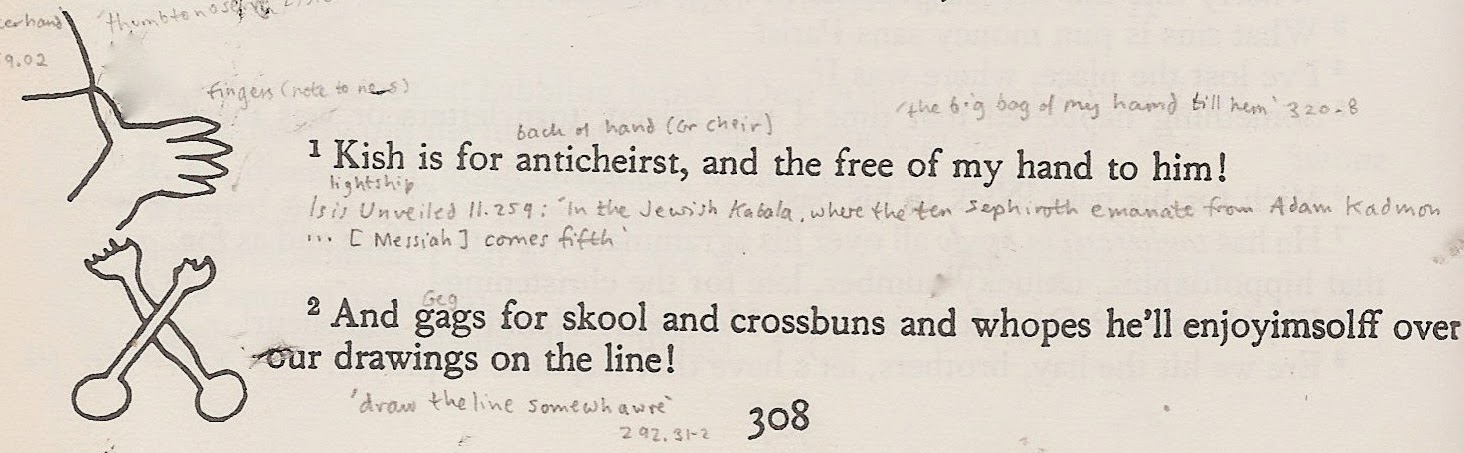
'THUMBTONOSERY'

Issy's gesture, with five digits (thumb and fingers) accompanies the footnote to 'Cush', standing for the number five in the count above. Elsewhere, Joyce gives us 'reechoable mirthpeals and general thumbtonosery' (253.28). 'The free of my hand to him!' is an offered slap.

'SCHOOL AND CROSSBUNS'

Underneath, there's a pair of crossed bones, a memento mori, familiar from tombstones and the skull and crossbones on pirate flags. This is a footnote to 'Geg' the number 10 in the list above, so the crossed bones can stand for the Roman numeral, X. John Gordon in his blog sees the crossed bones as 'one of the X's which which FW's letter always ends.'
'JOYCE NEEDED A GENUINE GIRL'S DRAWING'
The story is told by Fritz Senn:
'I think it was through Carola Giedion-Welcker that I once had a brief conversation with Hans von Curiel. He used to be the director of the Corso Theatre in Zurich, and Joyce may have paid him a tribute, at least Carola Giedion-Welcker told me so, in the Wake, where 'Hans the Curier' may figure as an avatar of Shaun the Post. What he told me, and it is worth passing on, is that Joyce called on him one night and requested a childish drawing to be put at the end of The Mime of Mick, Nick and the Maggies (sic); it is the marginal illustration at the bottom of page 308 in Finnegans Wake. Joyce needed a genuine girl's drawing, and it was done by Hans von Curiel's daughter, significantly named Lucia.'
Joycean Murmoirs (2007). p48.
(The Mime of Mick, Nick and the Maggies is actually the chapter before the one with the drawings).
'Hans the Curier' can be found at 125.14
Joyce had already drawn his own version of these doodles, which is in
his first draft, reprinted in the James Joyce Archive volume (53.281).
He then got Lucia von Curiel to copy his pictures.
These drawings first appeared in transition 23 July 1935, where the final pages of the chapter looked like this.

The Nightletter, which comes before the drawings in Finnegans Wake, looks like a colophon here.
Two years later they were republished in Storiella as She is Sying by the Corvinus Press in 1937, which also has an initial letter drawn by Lucia Joyce.

So this book begins and ends with drawings by two Lucias!


'Every dimmed letter in it is a copy and not a few of the silbils and wholly words....The last word in stolentelling!' Finnegans Wake, 424.32
'Really it is not I who am writing this crazy book,' Joyce told a party of friends. 'It is you, and you, and you, and that man over there, and that girl at the next table.'
Eugene Jolas, 'My Friend James Joyce' in James Joyce: Two Decades of Criticism (ed Givens), 1948
'The book was indeed his life and he believed that he was entrapping some part of the essence of life within its pages....Joyce was not in his own opinion simply writing a book, he was also performing a work of magic.'
J.S.Atherton, The Books at the Wake

Judging by the first page of 'Storiella' (1937) - even
ReplyDeletethe dropped second line: "haltagain, By recourse..." -
the text seems identical to the published book. The
First Draft Version of this section is available on the
Wisconsin site. But what was the text of 'The Muddest
Thick That Was Ever Heard Dump' (1929) ? What were
the famous lines that Joyce gave to the printer to have
a correct final page layout ?
'The Muddest Thick That Was Ever Heard Dump' is pages 282-304 of Finnegans Wake - the piece that Joyce called 'The Triangle', in which Shem teaches Shaun the Euclid problem. Joyce first wrote that in 1926.
ReplyDelete'Storiella' is made up of the beginning and end of the chapter -. pages 260-275 and 304-308.
Pages 275-9 were the last bit to be written, in November-December 1937.
This chapter has a very convoluted history, and was the hardest one to write. Danis Rose describes this period as 'the final painful years when the words came out like drops of blood and seemingly of interest to no-one but himself and his one staunch friend and helpmate, Paul Leon.' (The Textual Diaries of James Joyce)
Don't know about 'famous lines' though...
I saw a provocative suggestion somewhere recently that Lucia's schizophrenia might have been toxoplasmosis from the family cats...
ReplyDeleteI'm skeptical the thumbing nose was drawn by a schoolgirl-- it's too elegant. And the crossbones' asymmetry still needs explaining.
Coincidences are infinite and free, so what additional labor did Joyce demand of himself, to shape them? He listened for poetic echoes in unusual turns of phrase, and in the Twenties he worked wonders recombining them. But in the Thirties it's mostly "But his actual tootle is of come into the garner, mauve, and thy nice are crimsome flowers and buy me a bunch of iodines because it is the month of brums." Humbug.