
'Mr. Joyce has a cloacal obsession. He would bring back into the general
picture of life aspects which modern drainage and modern decorum have
taken out of ordinary intercourse and conversation.'
H.G.Wells, review of A Portrait of the Artist as a Young Man, The New Republic, 10 March 1917
'Cloacal obsession!' said Joyce. 'Why it's Wells's countrymen who build water-closets wherever they go.'
Frank Budgen, James Joyce and the Making of Uysses, 1934
'Cloacal' comes from the Latin cloaca (sewer).
H.G.Wells had a point though. Joyce did describe himself as the sewer of Literary Dublin in his 1904 poem, 'The Holy Office':
But all these men of whom I speak
Make me the sewer of their clique.
That they may dream their dreamy dreams
I carry off their filthy streams....
Thus I relieve their timid arses,
Perform my office of Katharsis.
(Katharsis is a Greek word for a purge, accelerating defecation)
He also named his first volume of poetry, Chamber Music, after the tinkling sound of urine in a chamber pot ('Chamber music. Could make a pun on that', thinks Bloom).
It's hard now to think of A Portrait as very cloacal, but there's a bedwetting scene on the opening page ('When you wet the bed first it is warm then it gets cold'). It seems so innocent now, but it was daringly new in 1916.
Wells would also have been thinking of scenes like this:
...he found in himself no instinctive repugnance to bad odours whether they were the odours of the outdoor world, such as those of dung or tar, or the odours of his own person among which he had made many curious comparisons and experiments. He found in the end that the only odour against which his sense of smell revolted was a certain stale fishy stink like that of long-standing urine
Wells wrote about this cloacal obession a year before Joyce came up with the most famous bowel movement in literature – Leopold Bloom's in Ulysses:
...he allowed his bowels to ease themselves quietly as he read, reading still patiently, that slight constipation of yesterday quite gone. Hope it's not too big to bring on piles again. No, just right. So. Ah....He read on, seating calm above his own rising smell.
I think Joyce was the first writer to allow a character to defecate since Swift in Gulliver's Travels in the 1720s.
There's a memorable bowel movement in Finnegans Wake too. It takes place on page 185 in chapter 7, the attack on Shem the Penman (James Joyce) by his respectable and prudish brother, Shaun the Post.
The story begins with the 1912 destruction of Dubliners, by Joyce's publisher, George Roberts, of Maunsel and Company, and his printer, John Falconer.
'when Robber and Mumsell, the pulpic dictators, on the nudgment of their legal advisers, Messrs Codex and Podex, and under his own benefiction of their pastor Father Flammeus Falconer, boycotted him of all muttonsuet candles and romeruled stationery for any purpose, he winged away on a wildgoup’s chase across the kathartic ocean and made synthetic ink and sensitive paper for his own end out of his wit’s waste'
Deprived of any outlet for his writing, Shem makes ink out of his own dung and urine, and uses it to write his masterpieces 'over every square inch of the only foolscap available, his own body'.
To spare the reader's blushes, Shaun tells us that he'll be explaining how Shem made this ink in Latin. The story will be 'cloaked up' (a play on cloaca):
Let manner and matter of this for these our sporting times be cloaked up in the language of blushfed porporates that an Anglican ordinal, not reading his own rude dunsky tunga, may ever behold the brand of scarlet on the brow of her of Babylon and feel not the pink one in his own damned cheek.
Joyce is hitting back here at The Sporting Times, subtitled 'The Pink 'Un', which published a hilarious attack on Ulysses in 1922 (on April Fools Day). The snooty reviewer, 'Aramis', said that the book 'appears to have been written by a perverted lunatic who has made a speciality of the literature of the latrine....The main contents of the book are enough to make a Hottentot sick'.
The pink colour of the cover suggested to Joyce that the paper itself was blushing. Here's a photo of the blushing paper from the 2004 Ulysses centenary exhibition at the University of Buffalo.

This kind of headline was good for publicity, and Sylvia Beach displayed the poster on the wall of Shakespeare and Sons.

Here's Shem's bowel movement, on page 185 of the Wake:
Primum opifex, altus prosator, ad terram viviparam et cuncti-potentem sine ullo pudore nec venia, suscepto pluviali atque discinctis perizomatis, natibus nudis uti nati fuissent, sese adpropinquans, flens et gemens, in manum suam evacuavit (highly prosy, crap in his hand, sorry!), postea, animale nigro exoneratus, classicum pulsans, stercus proprium, quod appellavit deiectiones suas, in vas olim honorabile tristitiae posuit, eodem sub invocatione fratrorum gemino-rum Medardi et Godardi laete ac melliflue minxit, psalmum qui incipit: Lingua mea calamus scribae velociter scribentis: magna voce cantitans (did a piss, says he was dejected, asks to be exonerated), demum ex stercore turpi cum divi Orionis iucunditate mixto, cocto, frigorique exposito, encaustum sibi fecit indelibile (faked O’Ryan’s, the indelible ink).
Here's a translaton (combined from those given in Roland McHugh's Annotations, by Robert S Boyle in The James Joyce Quarterly, and on reddit by an anonymous Latin scholar):
First, the artist, the high first-sower/high prose writer pulled himself towards the life-giving and all-powerful earth without any shame or pardon/permission, and pulling up his raincoat/chasuble and unbuttoning his trousers, his buttocks naked as they were born, crying and moaning, evacuated his bowels into his hand (highly prosy, crap in his hand, sorry!), then, relieved of the black animal, he sounded the trumpet and placed his own dung, which he called his dejections, into an urn once used as an honoured mark of sadness, and under the invocation of the twin brothers Medard and Godard pissed cheerfully and mellifluously therein, whilst singing with a great voice the psalm which begins, "My tongue is the pen of a scribe writing swiftly (did a piss, says he was dejected, asks to be exonerated), finally, from that foul dung mixed with the cheerfulness of the divine Orion/ urine, baked and then exposed to the cold, he made for himself an indelible ink (faked O’Ryan’s, the indelible ink).
H.G.Wells, review of A Portrait of the Artist as a Young Man, The New Republic, 10 March 1917
'Cloacal obsession!' said Joyce. 'Why it's Wells's countrymen who build water-closets wherever they go.'
Frank Budgen, James Joyce and the Making of Uysses, 1934
'Cloacal' comes from the Latin cloaca (sewer).
H.G.Wells had a point though. Joyce did describe himself as the sewer of Literary Dublin in his 1904 poem, 'The Holy Office':
But all these men of whom I speak
Make me the sewer of their clique.
That they may dream their dreamy dreams
I carry off their filthy streams....
Thus I relieve their timid arses,
Perform my office of Katharsis.
(Katharsis is a Greek word for a purge, accelerating defecation)
He also named his first volume of poetry, Chamber Music, after the tinkling sound of urine in a chamber pot ('Chamber music. Could make a pun on that', thinks Bloom).
It's hard now to think of A Portrait as very cloacal, but there's a bedwetting scene on the opening page ('When you wet the bed first it is warm then it gets cold'). It seems so innocent now, but it was daringly new in 1916.
Wells would also have been thinking of scenes like this:
...he found in himself no instinctive repugnance to bad odours whether they were the odours of the outdoor world, such as those of dung or tar, or the odours of his own person among which he had made many curious comparisons and experiments. He found in the end that the only odour against which his sense of smell revolted was a certain stale fishy stink like that of long-standing urine
Wells wrote about this cloacal obession a year before Joyce came up with the most famous bowel movement in literature – Leopold Bloom's in Ulysses:
...he allowed his bowels to ease themselves quietly as he read, reading still patiently, that slight constipation of yesterday quite gone. Hope it's not too big to bring on piles again. No, just right. So. Ah....He read on, seating calm above his own rising smell.
I think Joyce was the first writer to allow a character to defecate since Swift in Gulliver's Travels in the 1720s.
There's a memorable bowel movement in Finnegans Wake too. It takes place on page 185 in chapter 7, the attack on Shem the Penman (James Joyce) by his respectable and prudish brother, Shaun the Post.
The story begins with the 1912 destruction of Dubliners, by Joyce's publisher, George Roberts, of Maunsel and Company, and his printer, John Falconer.
'when Robber and Mumsell, the pulpic dictators, on the nudgment of their legal advisers, Messrs Codex and Podex, and under his own benefiction of their pastor Father Flammeus Falconer, boycotted him of all muttonsuet candles and romeruled stationery for any purpose, he winged away on a wildgoup’s chase across the kathartic ocean and made synthetic ink and sensitive paper for his own end out of his wit’s waste'
Deprived of any outlet for his writing, Shem makes ink out of his own dung and urine, and uses it to write his masterpieces 'over every square inch of the only foolscap available, his own body'.
To spare the reader's blushes, Shaun tells us that he'll be explaining how Shem made this ink in Latin. The story will be 'cloaked up' (a play on cloaca):
Let manner and matter of this for these our sporting times be cloaked up in the language of blushfed porporates that an Anglican ordinal, not reading his own rude dunsky tunga, may ever behold the brand of scarlet on the brow of her of Babylon and feel not the pink one in his own damned cheek.
Joyce is hitting back here at The Sporting Times, subtitled 'The Pink 'Un', which published a hilarious attack on Ulysses in 1922 (on April Fools Day). The snooty reviewer, 'Aramis', said that the book 'appears to have been written by a perverted lunatic who has made a speciality of the literature of the latrine....The main contents of the book are enough to make a Hottentot sick'.
The pink colour of the cover suggested to Joyce that the paper itself was blushing. Here's a photo of the blushing paper from the 2004 Ulysses centenary exhibition at the University of Buffalo.

This kind of headline was good for publicity, and Sylvia Beach displayed the poster on the wall of Shakespeare and Sons.

Here's Shem's bowel movement, on page 185 of the Wake:
Primum opifex, altus prosator, ad terram viviparam et cuncti-potentem sine ullo pudore nec venia, suscepto pluviali atque discinctis perizomatis, natibus nudis uti nati fuissent, sese adpropinquans, flens et gemens, in manum suam evacuavit (highly prosy, crap in his hand, sorry!), postea, animale nigro exoneratus, classicum pulsans, stercus proprium, quod appellavit deiectiones suas, in vas olim honorabile tristitiae posuit, eodem sub invocatione fratrorum gemino-rum Medardi et Godardi laete ac melliflue minxit, psalmum qui incipit: Lingua mea calamus scribae velociter scribentis: magna voce cantitans (did a piss, says he was dejected, asks to be exonerated), demum ex stercore turpi cum divi Orionis iucunditate mixto, cocto, frigorique exposito, encaustum sibi fecit indelibile (faked O’Ryan’s, the indelible ink).
Here's a translaton (combined from those given in Roland McHugh's Annotations, by Robert S Boyle in The James Joyce Quarterly, and on reddit by an anonymous Latin scholar):
First, the artist, the high first-sower/high prose writer pulled himself towards the life-giving and all-powerful earth without any shame or pardon/permission, and pulling up his raincoat/chasuble and unbuttoning his trousers, his buttocks naked as they were born, crying and moaning, evacuated his bowels into his hand (highly prosy, crap in his hand, sorry!), then, relieved of the black animal, he sounded the trumpet and placed his own dung, which he called his dejections, into an urn once used as an honoured mark of sadness, and under the invocation of the twin brothers Medard and Godard pissed cheerfully and mellifluously therein, whilst singing with a great voice the psalm which begins, "My tongue is the pen of a scribe writing swiftly (did a piss, says he was dejected, asks to be exonerated), finally, from that foul dung mixed with the cheerfulness of the divine Orion/ urine, baked and then exposed to the cold, he made for himself an indelible ink (faked O’Ryan’s, the indelible ink).
First the artist, the high first sower
'Altus Prosator' is the opening line of a 7th century Hiberno-Latin hymn attributed to Saint Columba. It means 'high first-sower', and is an invented title for God. This is typical of the linguistic inventiveness of Hiberno-Latin.
dierum et ingenitus
erat absque origine
primordii et crepidine
est et erit in sæcula
sæculorum infinita
(High creator, Ancient of Days, and unbegotten, who was without origin at the beginning and foundation, who was and shall be in infinite ages of age)
The hymn is also 'abecedarian', with each verse beginning with a successive letter of the alphabet.
'The artist, like the God of the creation, remains within or behind or beyond or above his handiwork...'
The hymn is also 'abecedarian', with each verse beginning with a successive letter of the alphabet.
But, since the Renaissance, 'prosator' has also meant prose writer. Imagine how delighted Joyce must have been to find a Latin title for God that also meant this!
'The artist, like the God of the creation, remains within or behind or beyond or above his handiwork...'
McHugh translates 'altus prosator' as 'the eminent writer'. Shaun in his parenthesis translates it as 'highly prosy'. Robert S Boyle's version is 'the old Father', which brings in a nice echo of the final lines of A Portrait, which Stephen addresses to his namesake, Daedalus:
'Old father, old artificer, stand me now and ever in good stead.'
Danis Rose and John O'Hanlon, in the Digital Archive's chicken guide, translate the phrase as 'In the beginning the master magician and arch-artificer'.
pulling up his raincoat
The Latin 'pluviale' was originally a gown worn as a rain covering. Later it was applied to an ecclesiastical chasuble, worn by a priest when celebrating Mass.
The twin brothers Medard and Godard
The Latin 'pluviale' was originally a gown worn as a rain covering. Later it was applied to an ecclesiastical chasuble, worn by a priest when celebrating Mass.
The twin brothers Medard and Godard
These two were French saints. According to Roman Catholic Martyrology, they were born on the same day, made bishops on the same day, and they died on the same day. Medard was a saint responsible for weather and rain (and so invoked to help Shem piss?)

foul dung mixed with the cheerfulness of the divine Orion
Orion = Shem's urine. Orion was born after Zeus, Poseidon and Hermes urinated on a bull-hide and buried it in the earth to give King Hyrieus a son. Orion's name may be from ourios (urine). 'Orina' is also Latin for urine.
Shem's dung, which he creates while crying and moaning, represents his dejections/ suffering. His urine (the divine Orion) stands for his joys in creation. The artist needs both to create perhaps.
While pissing he joyfully sings the opening of Psalm 45, "My tongue is the pen of a scribe writing swiftly."
In Finnegans Wake, Joyce uses the alchemist as well as the priest as the transmuter. The Latin description of mixing dung and urine in an urn, and baking and cooling it, is alchemical. Alchemists believed that the basic ingredient for creating the Philosopher's Stone could be dung. Read Agnieszka Rec's excellent blog post, 'Dung? Alchemy is full of it':
'The philosopher Morienus described the starting material of the Philosophers’ Stone as “of cheap price and found everywhere” and “trodden underfoot.” Medieval alchemists took that description literally and used the manure found all over their streets.'


foul dung mixed with the cheerfulness of the divine Orion
Orion = Shem's urine. Orion was born after Zeus, Poseidon and Hermes urinated on a bull-hide and buried it in the earth to give King Hyrieus a son. Orion's name may be from ourios (urine). 'Orina' is also Latin for urine.
Shem's dung, which he creates while crying and moaning, represents his dejections/ suffering. His urine (the divine Orion) stands for his joys in creation. The artist needs both to create perhaps.
While pissing he joyfully sings the opening of Psalm 45, "My tongue is the pen of a scribe writing swiftly."
TRANSMUTATION
Joyce often described his role as an artist as someone who transmutes matter. From his Catholic background, he took the priest at Mass as his model. In A Portrait, Stephen Dedalus describes himself as 'a priest of the eternal imagination transmuting the daily bread of experience into the radiant body of everliving life.'
In Finnegans Wake, Joyce uses the alchemist as well as the priest as the transmuter. The Latin description of mixing dung and urine in an urn, and baking and cooling it, is alchemical. Alchemists believed that the basic ingredient for creating the Philosopher's Stone could be dung. Read Agnieszka Rec's excellent blog post, 'Dung? Alchemy is full of it':
'The philosopher Morienus described the starting material of the Philosophers’ Stone as “of cheap price and found everywhere” and “trodden underfoot.” Medieval alchemists took that description literally and used the manure found all over their streets.'
In the wonderful passage that follows the Latin, Shem, described as 'the first till last alshemist', produces the ink like a squid from his own unheavenly body:

'when the call comes, he shall produce nichthemerically from his unheavenly body a no uncertain quantity of obscene matter not protected by copriright in the United Stars of Ourania or bedeed and bedood and bedang and bedung to him, with this double dye, brought to blood heat, gallic acid on iron ore, through the bowels of his misery, flashly, aithly, nastily, appropriately, this Esuan Menschavik and the first till last alshemist wrote over every square inch of the only foolscap available, his own body, till by its corrosive sublimation one continuous present tense integument slowly unfolded all marryvoising moodmoulded cyclewheeling history (thereby, he said, reflecting from his own individual person life unlivable, transaccidentated through the slow fires of consciousness into a dividual chaos, perilous, potent, common to allflesh, human only, mortal) but with each word that would not pass away the squidself which he had squirtscreened from the crystalline world waned chagreenold and doriangrayer in its dudhud.'
The 'quantity of obscene matter not protected by copriright in the United Stars of Ourania' is Ulysses, which was pirated in the USA by Samuel Roth's Two Worlds Monthly.
Copriright has Greek copros = dung.
The 'continuous present tense integument slowly unfolded all marryvoising moodmoulded cyclewheeling history' is Finnegans Wake.
Copriright has Greek copros = dung.
The 'continuous present tense integument slowly unfolded all marryvoising moodmoulded cyclewheeling history' is Finnegans Wake.
'with
each word that would not pass away the squidself which he had
squirtscreened from the crystalline world waned chagreenold and
doriangrayer in its dudhud.'
This is the cost to Joyce of transforming his life into art. Green and grey are the colours of Joyce's glaucoma and cataracts. His words live, but his squidself wanes, like the increasingly revolting picture of Dorian Gray.
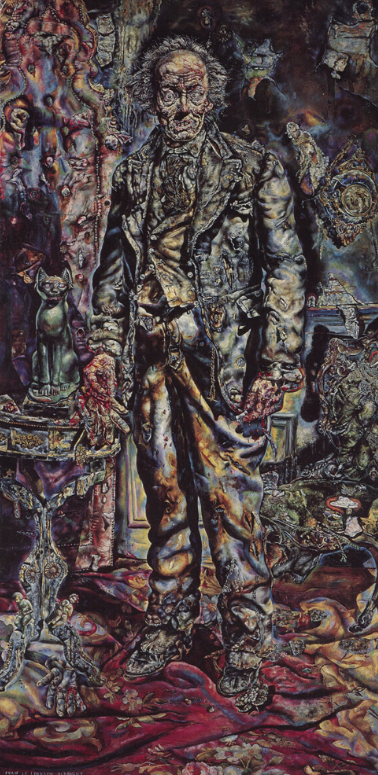 |
| Ivan Albright's ortrait of Dorian Grey from the 1945 film |
You can have fun working out what it all means using the notes given here in fweet.


