Sunday, 4 May 2014

Happy Birthday Finnegans Wake!

Finnegans Wake is 75 years-old today!  It was officially published on 4 May 1939, though Joyce had received the first copy from Faber on 30 January, in time for his birthday party on 2 February.  It was simultaneously published in London, by Faber and Faber, and New York, by the Viking Press.  Publication also meant the revelation of a secret, which Joyce had kept for seventeen years - the title of the book.


 This is the Viking Press cover.


Here's Faber and Faber's version. What they share is the reddish brown colour of the River Liffey, which Joyce had previously chosen for the Anna Livia Plurabelle booket.


Apart from the covers, the texts are the same, and both publishers' names appear on the title page. This is the copy owned by Marsh's library in Dublin, where the young Joyce read medieval books  ('The stagnant bay of Marsh's Library where you read the fading prophecies of Joachim Abbas.' Ulysses)


For publicity, Joyce agreed to a photo session for Time magazine with Gisèle Freund, in March 1939. This was the only time that Joyce was photographed in colour. 

Joyce also looks reddish brown, just like his book!

Here's Freund's account of the session.


'He opened the door for me. He was dressed for his colour portrait in a wine-coloured velvet jacket; on his long and sensitive hands he was wearing several jeweled rings. He seemed thoroughly miserable at the thought of being photographed in colour and he glanced uneasily at my elaborate old-fashioned lighting equipment as if it were some enormous beast ready to attack him. Nervously I began to stumble over the wires and drop things; the atmosphere became more and more tense.
  Suddenly, as Joyce groped his way to the chair I had arranged for him, he hit his head on the lamp. He cried out as if he had been stabbed and clasped his hand to his head.
  'I'm bleeding. Your damned photos will be the death of me,' he exclaimed, forgetting in his pain that he had made it a rule never to swear in the presence of a lady.
  'Nora,' have you got some scissors?' I called out to his wife in the next room.
She came in – quiet, motherly, soothing Joyce as if he were a frightened child.   We pressed the cold steel against the almost imperceptible scratch to prevent swelling, a remedy I remembered from my youth.
  Calmer now, Joyce sat down and studied a page of proof with a magnifying glass, a characteristic pose. I snapped the button and captured the cover photograph that Time had asked for.  In a few minutes, working as quickly as possible in order to protect Joyce from fatigue, I finished my film and promised him I would never trouble him again, ever.
  Joyce held me there for a while, apparently relieved to be released from the ordeal; he talked about Finnegans Wake, speculating on its possible reception by critics and the public. Suddenly his voice changed and became weaker, exhausted, and he spoke of death – his death – predicting that it would be his last book. I tried to reassure him....But he refused to be comforted, and a note of melancholy hung over our farewell.
  I ran downstairs, hailed a taxi, and asked the driver to rush to my laboratory, where a technician was waiting to develop the precious film so that the best portrait could be sent special delivery to New York. The taxi driver was so eager to please that as we turned a corner he lost control of the wheel and we crashed into another car. I was thrown to the floor and showered with falling glass, but, worst of all – a veritable catastrophe – my camera was smashed.
  With bloodstains on my face and tears of frustration and rage blurring my eyes, I arrived home and telephoned Joyce.
  'Mr Joyce.' I said weeping now, 'you damned my photos – you put some kind of a bad Irish spell on them and my taxi crashed. I was almost killed and your photos are ruined. Now are you satisfied?'
  Joyce gasped, and I knew I had guessed rightly. he was indeed a very superstitious man; he had wished me bad luck and now he felt responsible. Contrite, he begged me to return the next day so that he could pose again.'

Freund took a second set of pictures, in which Joyce wore a black velvet jacket and different rings. However the first set proved to be undamaged, and so one of these was used on the Time cover. 

'When the Time cover came out in May, Joyce, like a delighted child, showed it to to everyone who came to the house. Best of all, friends told me how amused he had been when he retold the story of my accident, adding, 'I said I would never be photographed in colour. Well Mrs B caught me, not once but twice. She's stronger than the Irish.' 


Gisèle Freund, James Joyce in Paris: His Final Years, 1965
 

Time magazine put Joyce on their cover on 8 May. They have a framed copy on the wall of the Palace bar in Dublin (left).

Here's what Time had to say about the book:

'All children are afraid of the night; when they grow up, they are still afraid, but more afraid of admitting it. In this frightening darkness men lie down to sleep and dream. Generations of diviners, black magicians, fortune tellers and poets have made night and dreams their province, interpreting the troubled images that float through men’s sleeping minds as omens of good & evil. Only of late have psychologists asserted that dreams tell nothing about men’s future, much about their hidden or forgotten past. In dreams, this past floats, usually uncensored and distorted, to the surface of their slumbering consciousness. This week, for the first time, a writer had attempted to make articulate this wordless world of sleep. The writer is James Joyce; the book, Finnegans Wake — final title of his long-heralded Work in Progress.'

You can read the whole article here. 

The Observer had the inspired idea to commission Oliver St John Gogarty - Buck Mulligan himself! - to review Finnegans Wake. Here's part of the review:

'‘When I think of the indomitable spirit that plodded on, writing Ulysses in poverty in Trieste, without a hope of ever seeing it published, I am amazed at the magnitude of this work, every word of which in its 628 pages had to be weighed, twisted, and deranged in order to bring up associated ideas in the mind....The immense erudition employed, and the various languages ransacked for pun and word-associations is almost incredible to anyone unaware of the superhuman knowledge the author had when a mere stripling. In some places the reading sounds like the chatter during the lunch interval in a Berlitz school. Every language living and dead in Europe gabbles on and on. But what is the motive force behind this colossal production? Finnegan’s wake [sic] may be the wake, that is the funeral celebration, as well as the panegyric, of civilisation. Resentment against his upbringing, his surroundings, and finally against the system of civilisation throughout Europe, perhaps against Life itself which Finnegan may represent, created this literary Bolshevism which strikes not only at all standards and accepted modes of expression whether of Beauty or Truth but at the very vehicle of rational expression. This arch-mocker in his rage would extract the Logos, the Divine word or Reason from its tabernacle, and turn it muttering and maudlin into the street. It is impossible to read the work as a serial. It may have a coherency and a meaning. What is wrong with the meaning that it cannot be expressed? Ripeness cannot be all in this instance, nor can a myriad-minded man full of infinite suggestion satisfy the reader with suggestions alone. Perhaps it is wrong to look for a meaning where there is every meaning. It may be unmodern to expect sense. Lewis Carroll stopped short brilligly, but this goes on lapsing as everlastingly as Anna Livia. There is nothing new under the sun: it is only exaggerated. This is the most colossal leg-pull in literature since McPherson’s Ossian. Mr. Joyce has had his revenge.’' 

Joyce loved this review. He told Frank Budgen, 'Gogarty is an athlete, a cyclist and a swimmer. He should know what staying power is.'

FW 75 A HUBBUB CAUSED IN JOYCEBOROUGH
 
Throughout May, in Dublin, Finnegans Wake's 75th birthday is being celebrated with talks, exhibitions and performances.The great Joyceborough website has a list of their events here.

The James Joyce Centre is also joining the celebrations, with their own programme. Their main event, on Saturday 10 May, is a whole day devoted to the book. It's called Wakey Wakey: A Day ofJoyce's Night Book at the Joyce Centre.

It starts at midday with a talk by Vincent Deane, ‘The Formation of a Truly Criminal Stratum: Crime in Finnegans Wake'.  

Deane is a brilliant literary detective, and an expert on Joyce's working notebooks. He's tracked down many Wake sources to obscure articles in Irish newspapers from the 1920s. It was Deane who first identified Joyce's use of the Bywaters-Thompson murder case.

'We’ll close the day at 5pm with a panel on ‘Why Read Finnegans Wake?’ A panel discussion chaired by James Joyce Centre Research Scholar Terence Killeen asking the question often thought but rarely discussed: is Finnegans Wake actually a ‘good’ book?'

Oh to be in Dublin this month!

Friday, 25 April 2014

'our drawings on the line!'

'What's this about Finnegans Wake being illustrated?' I hear you ask. 'Isn't it an illustrated book to start with?!'

It is indeed. There are three illustrations, which all appear in the Studies chapter, where Shem, Shaun and Issy are having their lessons in the room above the Chapelizod pub.


The Euclid diagram from page 293
The technique here is a reproduction of a schoolboy's (and schoolgirl's) old classbook complete with marginalia by the twins, who change sides at half time, footnotes by the girl (who doesn't), a Euclid diagram, funny drawings etc. It was like that in Ur of the Chaldees too, I daresay' 

Joyce to Frank Budgen, July 1939
(Letters, I,406)

In Greek mythology 'Gaia', the earth, was the great mother, and geometry means 'measuring the earth'. So Joyce's geometry lesson is all about revealing ALP, the great mother in Finnegans Wake. The Euclid diagram represents her pubic triangle, which Shem tricks Shaun into drawing. He says, 'I'll make you to see figuratleavely the whome of your eternal geomater.' 296.36.  I'll make you see figuratively (plus fig leaf) the womb/home/who of your eternal mother (Gaia matêr: mother Earth plus geometry). The upper triangle represents ALP's apron, which the twins have lifted ('the maidsapron of our A.L.P.' 297.11). The lower triangle is her exposed  'muddy old triagonal delta' (297.24). Later it's called 'her bosky old delltangle' (465.03).

The image with two intersecting circles is called a Vesica Piscis (fish bladder), which was seen as a symbol of the womb in Eastern mysticism.

Here's Joyce's first sketch of it, from David Hayman's  A First Draft Version of Finnegans Wake.


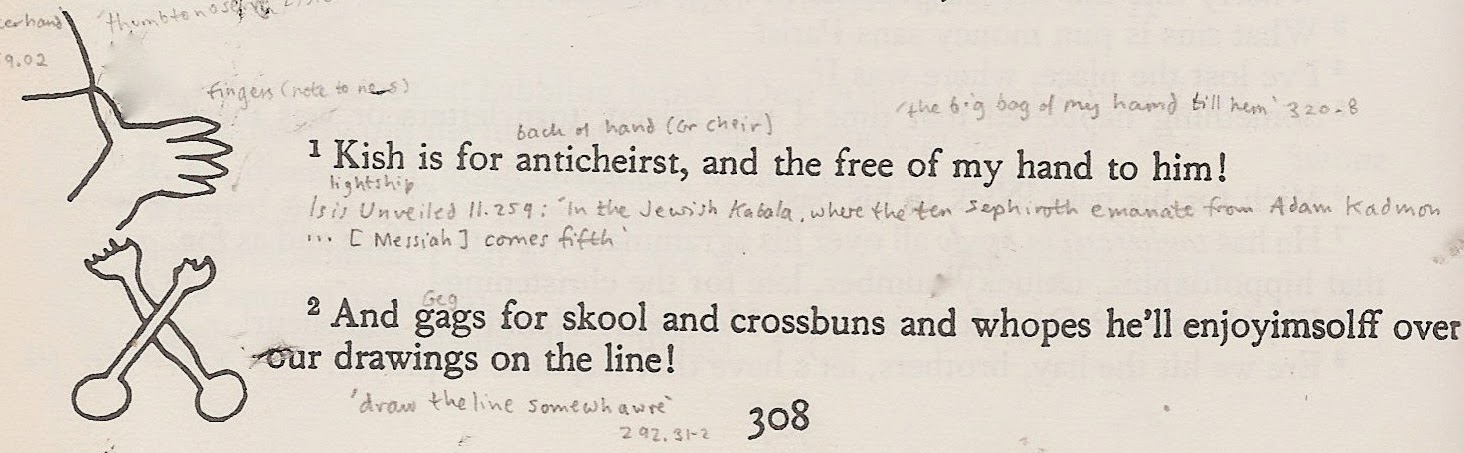
The two 'funny drawings' appear at the very end of the chapter, drawn by Issy as footnotes to a count of ten above, which Joyce gives as 'Aun, Do, Tri, Car, Cush, Shay, Shockt, Ockt, Ni and Geg'. This is based on the Irish: aon, dó, trí, ceathar, cúig, sé, seacht, ocht, naoi, deich = 1, 2, 3, 4, 5, 6, 7, 8, 9, 10.


'THUMBTONOSERY'


Issy's gesture, with five digits (thumb and fingers) accompanies the footnote to 'Cush', standing for the number five in the count above. Elsewhere, Joyce gives us 'reecho
able mirthpeals and general thumbtonosery' (253.28). 'The free of my hand to him!' is an offered slap.

This gesture is Issy's final verdict on the quarrelling twins and the whole lesson. This is also called 'cocking a snook', though nobody knows why.

This illustration is from 'On the Introduction of Pantomime into the English Language', Punch 17 July 1841 which is online here.  Jeroen Arendson says in his  'Indecent Fan Proposals' blog that the gesture was once called Queen Anne's Fan, and may mimic the spreading of a fan.

See also Mike Brubaker's TempaSenzaTempo blog where he shares a delightful French postcard from his collection of five female entertainers making the gesture. 

'SCHOOL AND CROSSBUNS'


Underneath, there's a pair of crossed bones, a memento mori, familiar from tombstones and the skull and crossbones on pirate flags.  This is a footnote to 'Geg' the number 10 in the list above, so the crossed bones can stand for the Roman numeral, X. John Gordon in his blog sees the crossed bones as 'one of the X's which which FW's letter always ends.' 

The bones here look like they've been nibbled at the top, maybe suggested by the line above 'Their feed begins'. Are the children eating their parents?  


'JOYCE NEEDED A GENUINE GIRL'S DRAWING'


I'd always imagined that these were drawn by Joyce. However, it turns out that they are a real girl's drawings, commissioned by James Joyce in Zurich!

The story is told by Fritz Senn:

'I think it was through Carola Giedion-Welcker that I once had a brief conversation with Hans von Curiel. He used to be the director of the Corso Theatre in Zurich, and Joyce may have paid him a tribute, at least Carola Giedion-Welcker told me so, in the Wake, where 'Hans the Curier' may figure as an avatar of Shaun the Post. What he told me, and it is worth passing on, is that Joyce called on him one night and requested a childish drawing to be put at the end of The Mime of Mick, Nick and the Maggies (sic); it is the marginal illustration at the bottom of page 308 in Finnegans Wake. Joyce needed a genuine girl's drawing, and it was done by Hans von Curiel's daughter, significantly named Lucia.' 

Joycean Murmoirs (2007). p48. 

(The Mime of Mick, Nick and the Maggies is actually the chapter before the one with the drawings). 

'Hans the Curier' can be found at 125.14

Joyce had already drawn his own version of these doodles, which is in his first draft, reprinted in the James Joyce Archive volume (53.281). He then got Lucia von Curiel to copy his pictures.

These drawings first appeared in transition 23 July 1935, where the final pages of the chapter looked like this.

The Nightletter, which comes before the drawings in Finnegans Wake, looks like a colophon here.

Two years later they were republished in Storiella as She is Sying by the Corvinus Press in 1937, which also has an initial letter drawn by Lucia Joyce. 


So this book begins and ends with drawings by two Lucias!


The colophon pays tribute to the first Lucia.


Why did Joyce need a genuine girl's drawing? I think it's for the same reason that he largely assembled Finnegans Wake out of phrases taken from other writings, and also accepted coincidence as a collaborator. Joyce's book was a collective undertaking, in which he saw himself as a channel rather than the author.

'Every dimmed letter in it is a copy and not a few of the silbils and wholly words....The last word in stolentelling!' Finnegans Wake, 424.32

'Really it is not I who am writing this crazy book,' Joyce told a party of friends. 'It is you, and you, and you, and that man over there, and that girl at the next table.'  

Eugene Jolas, 'My Friend James Joyce' in James Joyce: Two Decades of Criticism (ed Givens), 1948


'The book was indeed his life and he believed that he was entrapping some part of the essence of life within its pages....Joyce was not in his own opinion simply writing a book, he was also performing a work of magic.'

J.S.Atherton, The Books at the Wake 


Thursday, 24 April 2014

Finnegans Wake, Illustrated!

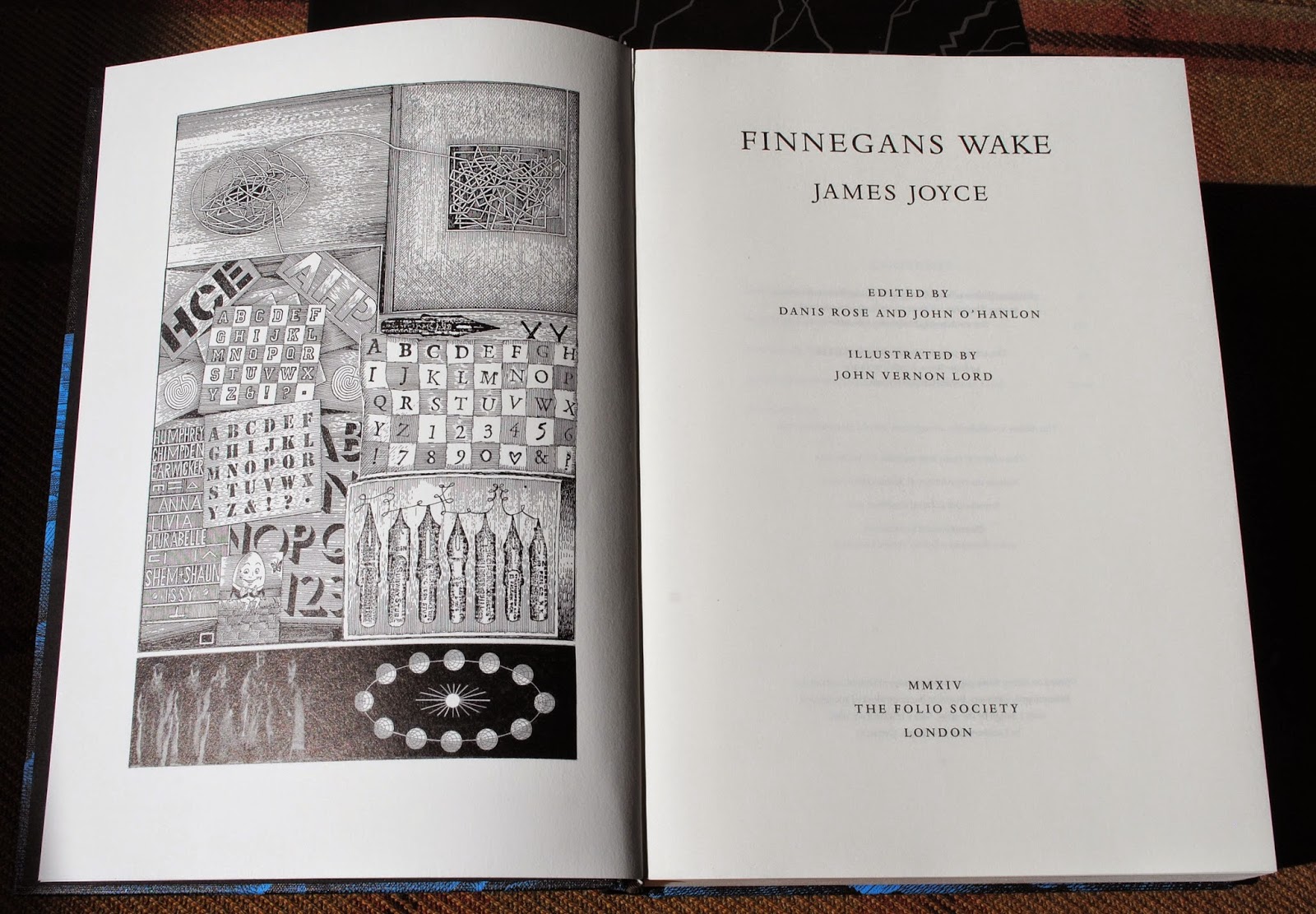
The postman recently brought me an object of great beauty - a review copy of the new Folio Society edition of Finnegans Wake, illustrated by John Vernon Lord. I was delighted to get hold of this, not least because it costs £99!

The book weighs 5lbs and stands a foot tall in its black slipcase. It's black because Finnegans Wake is a night book. There's a bolt of lightning shooting down from the top left corner, standing for the 100 letter thunderclaps that blast their way through the book. In his introduction, Lord says that he was also thinking of Anna Livia Plurabelle, the personification of the river Liffey:


'As 'lightning' the image appears to go diagonally downwards towards the earth, representing the Fall. Alternatively, seen as a river, the tributaries go upwards and join together as a kind of resurrection.'

That quotation shows just what a lot of thought that Lord has put into his illustrations, and what a great interpreter of the Wake he is too. He's thinking like Joyce here! 


Sliding the book out of its case reveals a night scene, with a full moon and clouds above an endless ocean - where the Liffey pours its water at the end of Finnegans Wake. Hovering above are Joyce's sigla - the symbols he used to indicate the characters. On the back there is also the constellation of the Great Bear, whose pattern is echoed in the arrangement of the sigla. 

In his introduction, Lord talks about the many uses of the stars and clouds in the book:

'We have 'Nuctumbulumbumus', which suggests cumulonimbus thunderclouds and, at the same time (through the Latin ambulabamus), the notion of us ambling in the night.'


Here's the very first illustration - a general treatment of the nature of writing and Finnegans Wake as a 'nightmaze' and a 'jungle of woods.'   Humpty Dumpty appears here and in several other illustrations.

The narrow strip at the bottom is a 'predella', something you find at the bottom of medieval altarpieces, like this one by Carlo Crivelli. Lord uses these predellas as a link between the illustrations.


Lord has picked eleven pivotal moments in the book to illustrate. The first one is the great Fall from the book's opening page. It's the fall of the hod carrier, Tim Finnegan, from his ladder in the comic ballad.


'One morning Tim was rather full.
His head felt heavy, which made him shake.
He fell from a ladder and he broke his skull
And they carried him home, his corpse to wake'


It's also the fall of the giant Finn MacCool, Adam, Humpty Dumpty, Parnell, Lucifer and all other falls through history, including Wall Street crashes.  In the background, towers are being erected - the New York Woolworth building, the Tower of Babel and the Eiffel Tower.

'Oftwhile balbulous, mithre ahead, with goodly trowel in grasp and ivoroiled overalls which he habitacularly fondseed, like Haroun Childeric Eggeberth he would caligulate by multiplicab-les the alltitude and malltitude until he seesaw by neatlight of the liquor wheretwin twas born, his roundhead staple of other days to rise in undress maisonry upstanded (joygrantit!),a waalworth of a skyerscape of most eyeful hoyth entowerly, erigenating from next to nothing and celescalating the himals and all, hierarchitectitiptitoploftical, with a burning bush abob off its baubletop and with larrons o'toolers clittering up and tombles a'buckets clottering down.'  4.34-5.05

The giant Finn falls, forming the city of Dublin, with his 'humptyhillhead' at Howth and his feet in the Phoenix Park. That's Howth Castle in the predella at the bottom.


I particularly love this second illustration, which shows HCE's encounter with a cad in the Phoenix Park - an event which leads to his own fall and disgrace. On the left, the cad is greeting HCE in Gaelic.

Here's Lord's description of the illustration.

'It is alleged in this ‘chapter’ that HCE behaved improperly in Phoenix Park, indecently exposing himself (behaving ‘with an ongentilmensky immodus’) in front of ‘a pair of dainty maidservants in the swoolth of the rushy hollow’. The cad tells his wife about HCE’s alleged lewd behaviour and his wife tells a priest over a cup of tea, who in turn tells a professor at the races, who lets everybody know about it. The all-seeing eyes among the trees, the pointing fingers and the four sets of mouths all represent this cycle of snooping, accusation, rumour and gossip about HCE. The ‘thunderword’ appearing diagonally across the illustration makes the sound of glass breaking, perhaps representing the collapse of Earwicker’s world.'

The illustration also shows how HCE got the name Earwicker, given to him by a king who met him trapping earwigs.

The predella at the bottom shows Oliver Cromwell, and Humpty Dumpty falling from the Magazine Wall in the Park - illustrations of the ballad mocking HCE on page 44.


The next illustration is of the hen, another version of ALP, scratching a teastained letter out of a midden, as described in Book One, Chapter Five.

Lord writes, 'It seems as if the whole of the world’s existence is being brought out of the earth, foraging for a record of the past: ‘where in the waste is the wisdom?’'

Here's J.S.Atherton's description of the Hen chapter:

This midden is a symbol, elaborated later, for the inhabited world in which men have left so many traces. The letter stands as a symbol for all attempts at written communication including all other letters, all the world's literature, the Book of Kells, all manuscripts, all the sacred books of the world, and also Finnegans Wake itself. One reason why The Book of Kells is included here is that it was once 'stolen by night...and found after a lapse of some months, concealed under sods' (Sullivan)  The Books at the Wake  p62-3


That's the Tunc page of the Book of Kells at the bottom.


Here's Lord's illustration of Joyce's fable of the Mookse and the Gripes, a retelling of Aesop's fable of the Fox and the Grapes.  The Mookse and the Gripes are the rival twins, Shaun and Shem, and Space and Time. It's also a fable about Pope Adrian IV, the English pope who granted Ireland to King Henry II of England.

The challenge here is to depict the 'gripes' - Shem in the form of a bunch of grapes. Lord gives us straightforward grapes, but have a look at Ralph Ziegerman's solution here.

Lord's description:

'The Mookse is represented by Pope Adrian IV (Nicholas Brakespear, or ‘Bragspear’), the only English Pope. He is sitting on a stone, ‘pompifically’. He finds the overripe gripes (grapes) wrapped around a tree by the edge of a ‘boggylooking stream’. Above them is Nuvoletta, as a cloud on a balcony, spraying mist: ‘Nuvoletta in her lightdress, spunn of sisteen shimmers, was looking down on them, leaning over the bannistars and listening all she childishly could....The Gripes is also a representation of Shem, with Shaun as the Mookse. Their arguments descend into insults, and the two arguers eventually metamorphose into an apron and a handkerchief on the bank of the river Liffey.’.

Nuvoletta is Issy, the daughter in Finnegans Wake.

For the next few I'll quote Lord's descriptions of them.

'This illustration is mostly based on the Latin episode when Shem mixes ‘ink’ from his own excrement and urine and ‘through the bowels of his misery’ he writes ‘over every square inch of the only foolscap available, his own body’. It appears that whilst Shem prepared the ‘ink’ he chanted ‘fermented words’, possibly 'Lingua mea calamus scribae velociter scribentis', which is from Psalm 45:1, ‘My tongue is the pen of a ready writer.’ This is represented in my version of a twelfth-century psalter illumination from St Albans. The expression ‘fermented words’ could of course be alluding to the text of Finnegans Wake itself, having the same initials as well as being something of a description of its text.'


  'Here we can see the two washerwomen gossiping about Earwicker and Anna Livia Plurabelle by the banks of the Liffey. The river expands into a map of Dublin Bay, thus illustrating how the women become further apart from each other during the course of their gossiping. Bats fly above them (‘The chittering waters of. Flittering bats, fieldmice bawk talk’), and salmon are swimming in the river, a recurring theme throughout the book: ‘like any gay lord salomon, her bulls they were ruhring, surfed with spree’. Below the moon, a few stones can be seen on the sheet below the large rock, representative of the transformation of one of the washerwomen and symbolising the static state of permanence. ‘I feel as heavy as yonder stone,’ she says. A butcher’s apron hangs from the smaller tree; a tree that represents the transformation of the other washerwoman, symbolising growth, movement and eventual death. ‘I feel as old as yonder elm,’ she says.'


'This is closing time in the tavern: the landlord, Earwicker, has drunk his customers’ leftovers, sucking up ‘whatever surplus rotgut . . . was left by the lazy lousers in the different bottoms of the various different replenquished drinking utensils’. Earwicker’s manservant, Sackerson, holds the key to the tavern door: 'Ere the sockson locked at the dure. Which he would, shuttinshore. And lave them to sture.' Finally he calls out, "Tide, genmen, plays'. The group of customers ‘all pour forth’ from the tavern. Each of the four singing old men (‘the fore olders’) are walking out of the frame in different directions: ‘North’, ‘Soother’, ‘Eats’ and ‘Washte’. There is a strip of sixteen composers’ portraits across the top of the illustration, brought into the text in the form of wordplay. The first three, from the left, are Rossini (‘rosescenery’), Haydn (‘haydyng’) and Meyerbeer (‘mere bare’).'

This is a wonderful illustration of my favourite chapter, Mamalujo, in which the ship-board lovemaking of Tristan and Isolde is witnessed by the four senile old men.

I laughed aloud when I spotted the four old men at the bottom.

'Tristan and Isolde are ‘kiddling and cuddling’ as they sail away from the aged King Mark of Cornwall (‘Kram of Llawnroc’). Above them, mocking seagulls are crying out: ‘The winging ones, overhoved, shrillgleescreaming. Seahawk, seagull, curlew and plover, kestrel and capercailzie.’ The four old men, among the waves with their donkey, are known as Mamalujo: in this chapter Matt Gregory, Marcus Lyons, Luke Tarpey, and Johnny MacDougall. In another guise they hover at the top of the picture as the four gospels (‘gastspiels’), represented here in a similar way to their appearance in the Book of Kells. They spy on the lovers, having much to say but only little of value, ‘all their mouths making water’.'  


Here's another of Joyce's fables, the Ondt and the Gracehoper, which is about Time and Space.  The feckless grasshopper is Shem, Joyce and Time. The respectable ant is Shaun, Wyndham Lewis and Space. Time gets the last word: 
 

Your feats end enormous, your volumes immense,
(May the Graces I hoped for sing your Ondtship song sense!),
Your genus its worldwide, your spacest sublime!
But, Holy Saltmartin, why can't you beat time?
419.5-8

 
Here's Lord again:

'The Ondt and the Gracehoper is based on the well-known fable, The Ant and the Grasshopper. Shem is the Gracehoper (represented as an artist, author, painter and musician – wasting his time), and his brother Shaun is the Ondt, the practical businessman for whom money matters most. Attributes of the artist (easel, guitar and pen) surround the Gracehoper, whilst the Ondt is coughing and asking questions, with his hoard of cash situated behind him. In the end Shaun falls into a barrel, which rolls backwards into the river Liffey. Some of the philosophers mentioned in the text have also been incorporated into the illustration: Confucius, Melanchthon, Aristotle, Schelling, Plato, Schopenhauer, Vico, Kant, Maeterlinck and Leibniz. Wyndham Lewis, who is also mentioned, is between Kant and Maeterlinck.'


 'Shaun has now been ‘metandmorefussed’ into Yawn: ‘Pure Yawn lay low. On the mead of the hillock he lay, heartsoul dormant mid shadowed landshape…’ He is put through an inquisition by the four old men, accompanied by their donkey, who hold a ‘starchamber quiry’ over his character. The ‘Mamalujo’ are represented on the four sides of the illustration, as the four symbols of the Evangelists (based on how they appear in the Book of Armagh). The four ‘apostles’ are also ‘quartermasters’, standing for the four provinces of Ireland (here depicted by their flags). They cross-examine Yawn about the fall of his father, Earwicker. Later Yawn seems to become HCE, boasting about his feats, as well as his accomplishments as a builder. The interlacement design is based on one by Leonardo da Vinci, and represents the ‘spreading abroad’ of the ‘drifter nets, the chronies, gleamy seiners’ nets’ by the four inquisitors.'


Lord has a very controlled and orderly style - he's described his influences as Paul Klee and Victorian steel engravings. It's interesting to compare his approach with Clinton Cahill's looser Wake illustrations, for the James Joyce Centre, Dublin. Cahill has also given us the scene with Yawn and the Four Old Men (right).

These are two very different ways of representing the dream state. Lord's method reminds me of Hitchcock who, talking of the dream sequence in Spellbound, said he wanted to represent dreams not with the misty style usually favoured by Hollywood, but with hard edges and sharpness of daylight.  

Cahill gives us the murky dreamscape.

For examples of other Wake illustrators, read PQ's excellent Finnegans, Wake! blog.

Here's John Vernon Lord's final illustration, using superimposition to show a woman who is also a river. Lord writes:

 'Anna Livia Plurabelle’s face merges with the sea as she delivers her monologue at the end of the book. She is a personification of the river Liffey, which flows, as a dissolving dream, into the vast ocean at the dawn of a new day. ‘This baylight’s growing,’ she says, hence the strip of light across her forehead. After a sequence of drawn illustrations we now have an image based on a photograph in order to indicate wakefulness and reality after the dream. The photograph is of Nora, Joyce’s wife, an inspiration for Anna Livia Plurabelle. Anna’s last line of the book is ‘A way a lone a lost a last a loved a long the’. This, an incomplete sentence, completes itself at the very start of the book as ‘riverrun, past Eve and Adam’s, from swerve of shore to bend of bay, brings us by a commodious vicus of recirculation back to Howth Castle & Environs’. The book finishes where it began; the endless cycle of time goes on.'


A lot of research has gone into these illustrations, as you can see from Lord's beautiful working notebooks, which the Folio Society have put on their website.


THE CORRECTED TEXT  


The book uses Danis Rose and John O'Hanlon's 'Corrected Text', which has around 9,000 changes to the 1939 published version. Unlike all other editions of the Wake, it has different pagination, so it can't be used alongside critical resources, such as McHugh's Annotations or Fweet. But Rose and O'Hanlon write in the preface, 'It is not a replacement for the 1939 edition...but an alternative to it.' 

My only objection to this version is that they've broken up the final chapter into separate sections. They argue that, 'Each sub-episode has an individual style, a beginning, and an end, whose poetry and poignancy can only be appreciated when they are set off, as they are in the 2010 edition.' But that's just as true of the opening chapter, which was meant to parallel the closing one. If Joyce had wanted it to set out in sections, he would have had it laid out like that. 

Despite this, all Joyceans should get a copy of the Corrected Text. I can't think of any better way of buying it than with John Vernon Lord's wonderful illustrations.