Saturday, 9 May 2015

Lucia's Chapters of Coming Forth By Day

'Bad news, I'm dead!', says Lucia Joyce (Maria Tucci) in the opening scene of  'Lucia's Chapter's of Coming Forth by Day'. This latest Wake inspired play, by the New York theatre company, Mabou Mines, has been brought to my home town as part of this year's Brighton Festival. I went to see it at the Theatre Royal on Thursday.

It's written and directed by Sharon Fogarty who, like Olwen Fouéré in her play riverrun, has been inspired by the parallels between Finnegans Wake and the Egyptian Book of the Dead. The original title of this guidebook to the afterlife was 'Chapters of Coming Forth by Day'. The Egyptians saw death as the beginning of a long journey through a dark and dangerous underworld, which would end with them 'coming forth by day' into a new life. Joyce associated this with what happens to us every night when we sleep, and so Finnegans Wake, a night book, is full of echoes of the Book of the Dead.


The play places Lucia in the afterlife, with her own personal Book of the Dead. But she's also metaphorically dead because she's spent almost fifty years in mental institutions. There's a strong sense of entrapment. She's unable to escape from the institution and from the shadow of her famous father, James Joyce (Paul Kandel), who appears for most of the play in silhouette behind a screen. The men she falls in love with, such as Samuel Beckett, are more interested in her father than in her. She is frustrated in love and in her attempts to express herself as an artist. 

Lucia was silenced in life and even after death, when her nephew destroyed all her letters. So the play, like Carol Loeb Schloss's biography, Lucia Joyce: To Dance in the Wake, is an attempt to give her back her voice.
 
There's wonderfully atmospheric music and sound from Carter Burwell, who scores the Coen Brothers' films, and dynamic visual projections on multiple screens by Julie Archer. At one point Lucia is completely engulfed in projected text. Jim Clayburg has designed the set with a cantilevered chair, on which Lucia sometimes takes off, swooping through the air.


The play was originally created as a collaboration with the late Ruth Maleczech, who, according to Fogarty, was 'a fierce and defiant Lucia with a Vesuvian anger simmering away.' You can see from the trailer on Vimeo that she was also very funny. Maria Tucci gives us a more fragile and child-like Lucia.

The text includes quotations from the Wake, reflecting Lucia's state of mind. At one point, the whole stage is lit up by flashes of lightning and, in a rage, Lucia shouts out the mighty thunderword from the book's opening page:

'bababadalgharaghtakamminarronnkonnbronntonnerronntuonnthunntrovarrhounawnskawntoohoohoordenenthurnuk!'

Maria Tucci and Paul Kandel as Lucia and James Joyce, from the theatre programme

In my favourite part of the play, Joyce comes out from behind the screen, to deliver to his daughter the lovely lyrical passage in which Nuvoletta, the cloud girl, falls to earth as a drop of rain:

'Then Nuvoletta reflected for the last time in her little long life and she made up all her myriads of drifting minds in one. She cancelled all her engauzements. She climbed over the bannistars; she gave a childy cloudy cry: Nuée! Nuée! A lightdress fluttered. She was gone. And into the river that had been a stream (for a thousand of tears had gone eon her and come on her and she was stout and struck on dancing and her muddied name was Missisliffi) there fell a tear, a singult tear, the loveliest of all tears (I mean for those crylove fables fans who are ‘keen’ on the prettypretty commonface sort of thing you meet by hopeharrods) for it was a leaptear. But the river tripped on her by and by, lapping as though her heart was brook: Why, why, why! Weh, O weh! I’se so silly to be flowing but I no canna stay!' 

The last line here is spoken by Lucia.

This feels like a description of Lucia, with 'all her myriads of drifting minds'. But, although she was a model for Nuvoletta, Joyce wrote this passage in 1927, three years before his daughter became ill. Joyce believed that Finnegans Wake had the power to predict the future. Had he predicted Lucia's illness here? 

At the time, Lucia was 'struck on dancing'. She was making a career for herself as an avant-garde dancer in Paris. Here she is dancing at the Bullier Ball in Paris in 1929, when the audience shouted, 'Nous réclamons l'irlandaise!' (We're calling for the Irish girl!)

She's wearing a shimmering silver fish costume she made herself. 'It was in silver sequins edged with green. One leg was covered to the heel and the other came right through the costume, so that when she put one behind the other, she created the illusion of a fish tail. Green and silver were entwined in her hair.' James Knowlson, Damned to Fame: The Life of Samuel Beckett, p 110.

Lucia also speaks the Wake's ending, as Anna Livia, the river Liffey, flowing out of Dublin to unite with her father, the sea.

'And it’s old and old it’s sad and old it’s sad and weary I go back to you, my cold father, my cold mad father, my cold mad feary father, till the near sight of the mere size of him, the moyles and moyles of it, moananoaning, makes me seasilt saltsick and I rush, my only, into your arms.'

Spoken by the dead Lucia Joyce, with her father standing beside her,  this passage takes on a whole new meaning.

This was the very first time that Tucci has performed the role and the production was a little unsteady on opening night. But what a thrill to hear again the words of Finnegans Wake spoken on stage.

Andrew Kay, critic of the local listings magazine, Latest 7, wrote that it made him rush home to download the book!


The best thing I've read on Lucia is Joan Acocella's  'A Fire in the Brain: The difficulties of being James Joyce's daughter' in the 2003 New Yorker.

RTE have also made an excellent documentary about her, which you can listen to here. The radio documentary, like Carol Loeb Schloss's book and the Mabou Mines play, claims that Joyce's linguistic experiments were inspired by Lucia's fractured language. In fact, he'd been writing the Wake for seven years before she became ill. Her breakdown was one of the factors that triggered his own writing block in the 1930s when, as he wrote, 'the words came out like drops of blood.'


Monday, 4 May 2015

Finnegans Wake set to music!

Today is the 76th anniversary of the publication of Finnegans Wake!  The big celebratory event is the publication, online and free, of a musical recreation of the Wake, 'in its whole wholume' by Waywords and Meansigns.


Waywords and Meansigns, based in Canada, was created by Derek Pyle, who explained in an interview with Bibliokept that the idea came to him exactly a year ago today:

'In 2014 I organized a party to celebrate the 75th anniversary of the publication of Finnegans Wake. To celebrate we decided to listen to Patrick Healy’s audiobook recording of Finnegans Wake, which is 20-odd hours long. The party, as you can imagine, lasted all weekend — we actually listened to Johnny Cash’s unabridged reading of the New Testament that weekend too. There was very little sleep, and fair amount of absinthe....During the party I started wondering about other ways you could perform the text, and that’s when I came up with the idea of approaching musicians to create a new kind of audiobook.

As it turns out, a lot of people seemed to think my idea was a good one. We’ve had no shortage of musicians willing to contribute, including some really cool cats like Tim Carbone of Railroad Earth and bassist Mike Watt, who currently plays in Iggy Pop’s band The Stooges.'

So the book's seventeen chapters were each assigned to a different musician, given complete freedom, apart from the rule that 'the chapter's words must be audible, unabridged, and more or less in their original order'. 

As you'd expect, there are many different styles of performance, ranging from the Western Mass art punk band, Dérive, who give us an edgy rendition of 'the washers at the Ford'  to the New Zealand saxophonist, Hayden Chisolm, who provides a much more restful, and almost hypnotic, version of the pub chapter.

I love Peter Quadrino's reading of the Yawn chapter, whose recording he's described on his Finnegans, Wake! blog: 'I chose this chapter because it's always been one of my favorites. The opening finds a giant sleeping figure, Yawn, whose yawns and sleepy groans create huge gusts of wind.' 

Have a listen to the wonderful way that PQ creates those gusts of wind in his reading of 'Yawn in a semiswoon lay awailing and (hooh!) what helpings of honeyful swoothead (phew!)' 
 
The book's closing and opening chapters, connected by the unfinished sentence, have been given to the same performersMariana Lanari and  Sjoerd Leijten, from Amsterdam. This means, that, for the first time, you can listen to a continuous reading of the 'A way a lone a last a loved a...' sentenceFor the first chapter, they have also sampled pieces from the other musical performances, to indicate how the opening foreshadows what follows.

READING THE WAKE ALOUD


There's an interview with PQ and Steve 'Fly' Pratt, who's recorded the Jaun chapter, on the RAWIlluminations site. They have some great advice about reading the book aloud: 

PQ: 'The experience certainly confirmed the text's inherent musical rhythms, it really comes to life when read aloud. And last but not least, it's often said Finnegans Wake is a book for the ear but it's also a book for the mouth. You'll never utter anything like it.'

FLY: 'Perhaps think of the text as-if it were an interactive word game. Something you play. And to repeat, read it aloud and discover the tongue-twisting turns in every line. Take it slowly. Jump to any page, get your kit off and dive in. If that does not turn you on, the next time you get totally trashed, or feel a case of the giggles coming on, pick up the good book and prolong the enjoyment. Simple.'

PQ: '
Build up a passion and interest for it first. Read some books about it, get to know how bizarre and irrational it is. You can't try to just slog through it like any other big book. It's designed to shatter your logical mind and drown you in a variegated cacophony of lingual sounds from dozens of languages. Also, yes it's difficult but with enough time you will find the book will teach you how to read it.' 


Joyce with his guitar in 1915


FINNEGANS WAKE IS A MUSICAL BOOK


Finnegans Wake is the perfect book for this project, because Joyce, a gifted musician, wrote it as if it was music. For example, he described the Anna Livia chapter, which he recorded, as 'an attempt to subordinate words to the rhythm of water.' 

Joyce's title for his great dusk piece was a musical one 'A Phoenix Park Nocturne'.

He uses many musical techniques, such as the Wagnerian leitmotif, a short, recurring phrase, associated with a particular person, place or idea.  So the Anna Livia chapter ends with the phrase 'Beside the rivering waters of, hitherandthithering waters of. Night!' (216.04). This is an Anna Liffey river lietmotif, echoed six other times:

'wasching the walters of, the weltering walters off. Whyte.' 64.20
'and watch her waters of her sillying waters of' 74.29

'And his dithering dathering waltzers of. Stright!' 245.22 
'arride the winnerful wonders off, the winnerful wonnerful wanders off' 265.15
'baffling with the walters of, hoompsydoompsy walters of. High!' 373.06
'Amingst the living waters of, the living in giving waters of. Tight!' 462.04


Finnegans Wake is named after a song, and is full of hundreds of other songs, whose rhythms and lyrics Joyce plays with. The book even includes this song written by Joyce himself.


Setting the whole of Finnegans Wake to music is a mighty achievement.  Even more impressively, Waywords and Meansigns are planning to do the whole thing again later this year with different contributors! Here's how you can get involved.


Thursday, 16 April 2015

Sentenced to read Finnegans Wake forever!

'The best way to approach Finnegans Wake is in a group.  It has to be stalked like a wild animal, and you need a hunting party.' Robert Anton Wilson


'What a terrible book this is!'
'We're all going to go to hell as a result of reading this!'
'We'll all meet there.'
'We'll meet again.'
'Some of us would say: we may go to hell but I want to get to the end of this.'
'That might be the sentence! Sentenced to read Finnegans Wake forever.'


This comes from Dora Garcia's lovely film, 'The Joycean Society,' which she posted on Vimeo (though sadly it's no longer available there). It's a documentary about the Zurich Finnegans Wake reading group, founded and led by Fritz Senn (above). Ever since 1986, the members have been meeting once a week to read and discuss the Wake. They reached the end after eleven years but, because Finnegans Wake is circular, they had to go straight back to the beginning. They were 'sentenced' by the unfinished final sentence of the Wake. Like me, they're now on their third lap!

None of the people in the film is identified until the list of names in the closing credits, but I recognized Fritz Senn who, with Clive Hart, started the Wake Newslitter in March 1962. The very first 'Litter' begins with the words, 'Finnegans Wake needs to be read communally.'


The readers are mostly male, and in their 70s, and the film is partly about growing old together and with a book.  In an interview, Garcia said that she 'filmed the readers of the Zurich James Joyce Foundation as incarnating one of the most notorious episodes in Finnegans Wake: Mamalujo—the four old men endlessly discussing the text. When they stop reading the text, the world will collapse.'

She's probably thinking of two different episodes here - the Mamalujo episode is a treatment of collective senility, but doesn't have any discussion of a text. That happens in the Hen chapter, whose Professorial narrator says:

'Look at this prepronominal funferal, engraved and retouched and edgewiped and puddenpadded, very like a whale’s egg farced with pemmican, as were it sentenced to be nuzzled over a full trillion times for ever and a night till his noddle sink or swim by that ideal reader suffering from an ideal insomnia.' 120.09-17


The Joycean Society members are the closest thing to Joyce's ideal readers 'suffering from an ideal insomnia'. They've accepted his outrageous challenge, expressed to Max Eastman: 'The demand I make of my reader is that he should devote his whole life to reading my works.'

As Dora Garcia says in her interview, it takes a particular type of reader to accept this demand.

'The Joycean Society is only tangentially a film about Finnegans Wake; its central subject is the people who read Finnegans Wake, the readers. Such a book engenders a very particular type of reader. I have never known of any other book that creates such a specific, distinct, dedicated population—an irreverent community, a brotherhood without any hierarchies. The society created by the Wake is one of the most fascinating aspects of the text. Many idées reçues about language, literature and reading explode into pieces with readers of the Wake: there are no authorities, just people who devote a lot of time to the text; it is not really written in English, therefore English native speakers are in no better position to read it.'


We see them working their way, word by word, through  part of the great 'Anna Livia Plurabelle' chapter. They're reading pages 211-12, which is a list of presents given by Anna Livia to all her children. The camera takes us right into the group, with faces, hands and pages shown in close-up.

I wondered why they don't use the internet.  I thought, why aren't they googling or consulting fweet?

Then it struck me that they are sitting in a James Joyce library, with an amazing collection of materials at their fingertips.  

The group discussion is intercut with an interview with a professional academic Joycean (right). You might assume he's a member of the reading group. In fact, he's Geert Lernout, the Belgian genetic wakean, who's based in Antwerp. Lernout talks about the extraordinary way in which Joyce composed the book, 'harvesting' phrases from other sources.  He shows us examples from the Encyclopedia Britannica entry on Dublin, used by Joyce in his Haveth Childers Everywhere section, where HCE as the City of Dublin, speaks.

Lernout points out that Joyce's notes (left) are not in his handwriting. This is because, at the time (March 1930), he was too blind to read or take notes. He had to listen to an assistant read the article. Joyce would then seize on a phrase, which another assistant wrote down. Joyce's helpers at the time were Stuart Gilbert, Helen Fleischman, Padraic Colum and Paul Léon. In his Paris Journal, Gilbert recalls working with Joyce with five volumes of the Britannica spread out on the sofa.

This reminds me of Richard Brown's description of Finnegans Wake as 'a theatricalised parody of the eleventh Britannica, which was often his first point of reference in composing the Wake.' James Joyce: A Post Cultural Perspective p 113.


Lernout's genetic approach is very different from that of the Zurich readers, who focus on interpretation. What both share is a sense of Finnegans Wake as a sacred text, and a slightly baffled awareness that they have become addicted to it. Lernout says, 'Joyce programmed it in such a way a that he invites you to that kind of religious fervour, where you turn it into a holy book....I'm not describing it as dangerous...Of all possible pathologies, it is one of the most benign ones.'

The Zurich Joyce group also look like they're reading a sacred text. They remind me of Talmudic scholars and, at the end of their session, they even sit in silence, as if in prayer.

While they  sit in silence, we hear church bells in the distance, a reminder of the passing of time. I thought of the Zurich spring festival of Sechseläuten, whose bells ring several times in the Wake: 'Pingpong! There's the Belle for Sexaloitez.' 213.18.  It was Fritz Senn who identified this in 1960, in his first ever article on the Wake ('Some Zürich Allusions in Finnegans Wake', The Analyst, Vol. II, 1960-1965, XIX (Dec. 1960). Were the bells really ringing or did Garcia add them?

Fritz Senn is also interviewed (left) and, like Lernout, he describes reading Finnegans Wake as 'a more harmless kind of addiction than drugs or alcohol.'

Senn talks about the value of the group reading as a form of therapy:

'I am not saying this just ironically, it is also a therapy group, it does something… and I think it can be more helpful than some therapy you have to pay for….Maybe reading Finnegans Wake is a substitute for people who usually are not very successful in life, like me. At least you can interact with a text. If we were happier we would be bankers or have an emotionally full life. I think, and I am here along almost Freudian lines, that culture is a sort of substitute for pleasures that are denied to some of us for many reasons.'

Fritz Senn also discusses the reading group in his 2007 book Joycean Murmoirs (ed Christine O'Neill), where he reveals how trying it often is for him to be in charge of it.

'To be in charge of a bunch of keen-witted, enthusiastic Wake readers, whose offerings are not always strictly relevant, is not without its strain on human forbearance....I vacillate from chagrined intolerance to a resigned awareness that the multivocal muddle of Wake glosses is, after all, caused by the nature of what we are trying to understand. A group reading taxes the brains of each exponent: at every moment one has a baffling text in front of one's eyes that leads to dispersed associations, one deliberates what one might contribute, and simultaneously someone (at least some one!) is always speaking. It is no wonder that the outcome is acoustic and intellectual chaos.'

Declan Kiberd has a fascinating interview with Fritz Senn on his podcast, which you can listen to here.

At one point, the film takes us outside the book-lined room to the snow-covered Zurich cemetery, where Joyce lies buried beneath a bronze statue by Milton Hebald. There are resonances here of the end of 'The Dead', with snow falling 'upon every part of the lonely churchyard where Michael Furey lay buried.'


While the camera moves around the snowy scene, we listen to the group talking about an article in the TLS, which claims that the way to tell someone is really dead is to blow tobacco smoke up their anus.

Joyce's statue fixes the camera with an inscrutable gaze.


The Joycean Society is regularly shown in galleries and at film festivals. For more information see this page from Auguste Orts.

Tuesday, 24 March 2015

St Patrick and the Druid in Pictures

'Much more is intended in the colloquy between Berkeley the arch druid and his pidgin speech and Patrick the [?] and his Nippon English. It is also the defence and indictment of the book itself, B's theory of colours and Patrick's practical solution of the problem. hence the phrase in the preceding Mutt and Jeff banter 'Dies is Dorminus master' = Deus est Dominus noster plus the day is Lord over sleep, i.e. when it days.'  

Joyce to Frank Budgen, 20 August 1939, Letters I p 406

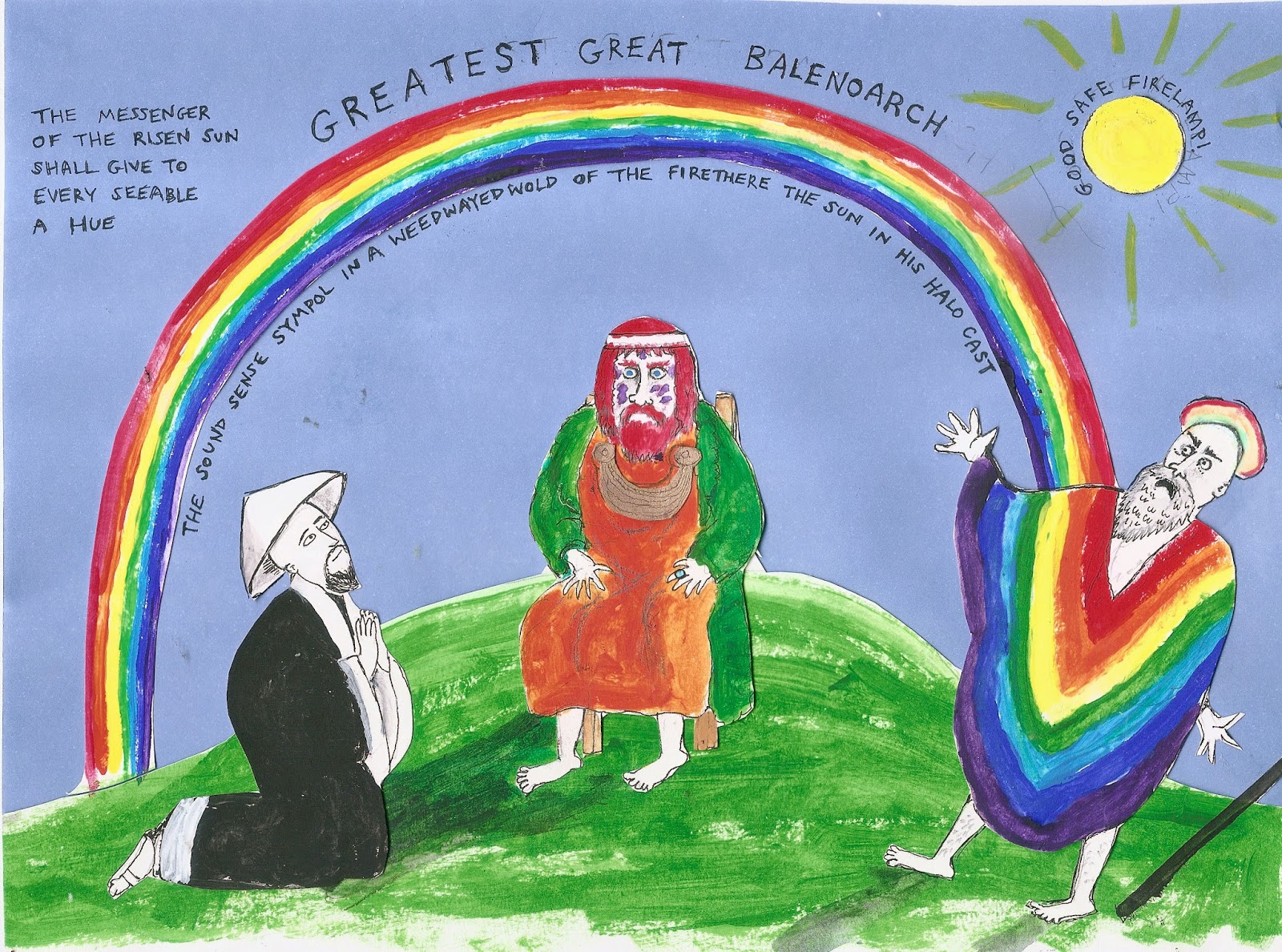
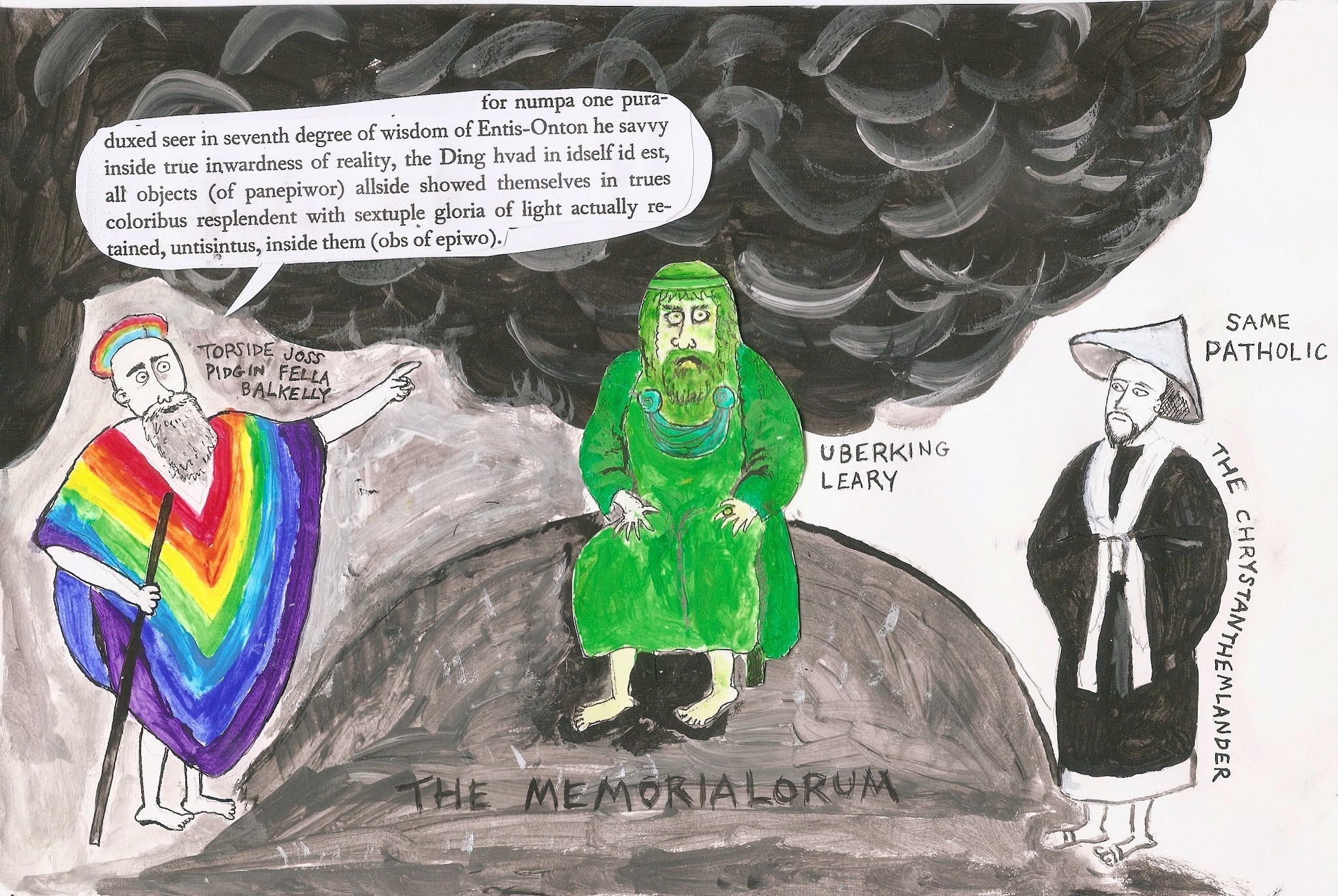
It struck me that this St Patrick and the Druid piece is so visual that it calls out to be illustrated. So, inspired by Clinton Cahill, Stephen Crowe and John Vernon Lord, I've made my first attempt to illustrate Finnegans Wake.

The first picture shows the night world of the book, defended by the Archdruid Balkelly, who is wearing a 'heptachromatic sevenhued septicoloured roranyellgreenlindigan mantle'.  

Saint Patrick, on the right, is dressed as a Japanese Buddhist bonze (monk). He is the messenger of the dawn, and Japan is the land of the Rising Sun ('the messanger of the risen sun...shall give to every seeable a hue and to every hearable a cry)'. At his first appearance, Patrick is called 'the Chrystanthemlander with his porters of bonzos' (609.32): 'Chrystanthemlander' combines the Japanese chrysanthemum with Christ, anthem and lander. Joyce has him talking Japanese.

In the middle is High King Leary, who is also HCE and Finn, buried in the book's opening chapter, but who now 'rearrexes from undernearth the memorialorum.' (610.03)


The sky is covered with a thick black cloud because, in their encounter with St Patrick, 'the druids by their incantations overspread the hill and surrounding plain with a cloud of worse than Egyptian darkness.' (The Catholic Encyclopedia). This was miraculously dispelled by the saint.

The druid is claiming, in pidgin English, that the daytime visible world of colour is an illusion. When we see a coloured object, we are seeing the one colour it has reflected, rather than the six colours of the spectrum it has absorbed. But a true seer, like the druid, can see the 'sextuple glory of the light actually retained...inside them.'

Pointing at High King Leary, he explains that his red hair, orange kilt, yellow breasttorc, green mantle, blue eyes, indigo gem on his ring and violet warwon bruises on his face are all really various shades of green! 

A green-coloured resurrected king reminds me of Osiris - 'Pu Nuseht [the sun up] lord of risings in the yonderworld' 593.23

Patrick is not impressed at all by the druid's argument, and accuses him of being colour-blind: 'you pore shiroskuro blackinwhitepaddynger'. You poor chiaroscuro black and white Irishman. 'Shiro' is Japanese for white and 'kuro' for black. 

The sun rises, dispelling the black clouds of the Book of the Night, and Patrick kneels in worship before the rainbow. Daytime colours are visible, and the furious druid is defeated.


Patrick and the Druid are opposites in every way. The druid is dressed in rainbow colours but only sees green. Patrick is dressed in black and white ('niggerblonker'), but can see the rainbow.  But each will have their turn as day and night alternate.

'Yet is no body present here which was not there before. Only is order othered. Nought is nulled. Fuit fiat!' 613.13


Tuesday, 17 March 2015

St Patrick and the Druid


'He is the only saint a man can get drunk in honour of,' Joyce said, in praise of Patrick....The only saint (Joyce) would praise was Saint Patrick, him he vaunted above all other saints in the calendar.' Padraic Colum

Happy St Patrick's Day!

It's a good day to look at Joyce's own treatment of St Patrick in this sketch, which he wrote in the summer of 1923 while on holiday in Bognor Regis. This was the fourth Wake sketch Joyce wrote, following Roderick O'Conor, Tristan and Isolde and St Kevin.

'St Patrick and the Druid' eventually found its way into Finnegans Wake, at the very end, on pages 611-2.


Joyce sent this to his patroness, Harriet Shaw Weaver on 2 August 1923, with a letter saying 'I send you this as promised – a piece describing the conversion of St Patrick by Ireland.' (Letters III: 79)

Harriet Shaw Waver was baffled by it, not least because much of it is written in pidgin English! 

But she made the above typescript for him, which he corrected, and which she then mislaid. So these corrections never found their way into the published text.  This was not among the manuscripts she gave to the British Museum and was published for the first time, in June 1989, by the James Joyce Broadsheet.

The piece is based on the story of Patrick's arrival in Ireland, and his magical duel with the Arch Druids of High King Leary. On the eve of Easter, the saint lit a paschal fire on the Hill of Slane. 

'avoice from afire bellowsed mishe mishe to tauftauf thuartpeatrick' 03.09

'The kindler of the paschal fire.' 128.33


At this time of year, it was the law that no fire could be lit before a new one was kindled at Tara. When the druids at Tara saw the light from Slane, they warned King Leary that he must put it out or it would burn forever. The Tripartite Life of St Patrick gives different versions of the duel that followed. 


Here, the chief druid is called Lochru, a name Joyce added to the typescript above, though the addition was lost.

In the story, the saint wins the magical duel. But in his sketch, Joyce only gives us the druid's side, and so he described the piece as 'the conversion of St Patrick by Ireland.'

Patrick's enemy is the 'archdruid of Irish chinchinjoss' - 'chin-chin' is pidgin for talking and 'joss' means god. So he's the top man in Irish God-talking - or theology!


Our druid is called Berkeley, because he's also the Irish philosopher and bishop, George Berkeley (above), author of An Essay Towards a New Theory of Vision (1709), in which he argued that the objects of sight are not material, but ideas in the mind.

Joyce's archdruid has his own theory of vision, which he explains at length to an uncomprehending St Patrick. This is how Joyce wrote it in his very first draft, when it was in clear English, from www.ricorso.net:

'The archdruid then explained the illusion of the colourful world, its furniture, animal, vegetable and mineral, appearing to fallen men under but one reflection of the several iridal gradations of solar light, that one which it had been unable to absorb while for the seer beholding reality, the thing as in itself it is, all objects showed themselves in their true colours, resplendent with the sextuple glory of the light actually contained within them.'

So the druid is claiming that the visible world of colour is an illusion. When we see a coloured object, we are seeing the one colour it has reflected, rather than the six colours of the spectrum it has absorbed. But a true seer, like the druid, can see the 'sextuple glory of the light actually contained within.'

He then points to High King Leary, witnessing the duel, and uses him as an example of what a true seer can see:

'
To eyes so unsealed King Leary’s fiery locks appeared of the colour of sorrel green, His Majesty’s saffron kilt of the hue of brewed spinach, the royal golden breasttorc of the tint of curly cabbage, the verdant mantle of the monarch as of the green of laurel boughs, the commanding azure eyes of a thyme and parsley aspect, the enamelled gem of the ruler’s ring as a rich lentil, the violet contusions of the prince’s feature tinged uniformly as with an infusion of sennacassia.'

The druid claims that King Leary's red hair, orange kilt, yellow breasttorc, green mantle, blue eyes, indigo gem and violet bruises are all really green!
 
Joyce then expanded this, adding pidgin English and Latinate terminology - so 'absorb' became 'absorbere'. He also included a description of the druid's rainbow coloured outfit:

'
Topside joss pidgin fella Berkeley, archdruid of the Irish josspidgin, in his heptachromatic sevenhued roranyellgreeblindigan mantle then explained to Patrick the albed, the illusiones of hueful world of joss its furniture mineral through vegetable to animal appearing to fallen men under but one reflectione of the several iridal gradationes of solar light that one which that part of it had shown itself unable to absorbere whereas for the seer beholding interiorly the true inwardness of reality, the thing as in itself it is, all objects showed themselves in their true coloribus resplendent with the sextuple gloria of light actually retained within them. In other words, to vision so unsealed King Leary’s fiery locks appeared of the colour of sorrel green while, to pass on to his sixcoloured costume His Majesty’s saffron kilt seemed of the hue of boiled spinach the royal golden breast torc of the tint of curly cabbage the verdant cloak of the mouth as of the viridity of laurel leaves, the commanding azure eyes of a thyme upon parsley look, the enamelled Indian gem of the ruler’s maledictive ring as an olive lentil, the violaceous warwon contusions of the prince’s features tinged uniformly as with a brew of sennacassia.' 


I love the change of 'the violet contusions of the prince's features' to 'the violaceous warwon contusions of the prince’s features'. They're King Leary's battle bruises!


Joyce then dramatically developed the transition between the two parts of the druid's speech, changing 'In other words' to this:

'Patfella no catch all that preachybook belong Luchru Berkeley bymby topside joss pidgin fella Luchru Berkeley say him two time with other words' (August typescript)

Patrick didn't understand Berkeley's message, so Berkeley told him a second time in a different way.

You can follow the development of this to the published text, which has more pidgin, at the www.ricorso.net website and the James Joyce Digital Archive.

PATRICK'S ANSWER


When Joyce added the piece to his book in 1938, he included Saint Patrick's answer, making him Japanese, because Japan is the land of the Rising Sun.  Joyce could also have been thinking of the Japanese invasion of China in 1937.

'the messanger of the risen sun...shall give to every seeable a hue' 609.19

At his first appearance, Patrick is called 'the Chrystanthemlander with his porters of bonzos' (609.32): 'Chrystanthemlander' combines the Japanese chrysanthemum with Christ, anthem and lander.  Christ is the 'risen sun' (Son). Bonzes are Japanese Buddhist priests or monks.

St Patrick's Japanese answer to the druid's argument is to accuse him of being colour blind:

'you pore shiroskuro blackinwhitepaddynger' 612.18

You poor chiaroscuro black and white Irishman. 'Shiro' is Japanese for white and 'kuro' for black. 

Patrick follows this with an obscure reference to the shamrock, which the saint famously used to demonstrate the Trinity (left).

In Joyce's version, it becomes a handkerchief:

'My tappropinquish to Me wipenmeselps gnosegates ahandcaughtscheaf of synthetic shammyrag to hims hers' (612.24)

There's a scatological level running through the whole piece, echoing the earlier Wake story, of 'How Buckley Shot the Russian General'. That story was reintroduced on page 610, when Juva says that King Leary has bet on both the druid and the saint: 'He has help his crewn on the burkeley buy but he has holf his crown on the Eurasian Generalissimo' 610.11-12

Patrick, the invader from the East, is the Eurasian Generalissmo.  

In the earlier story, the Irish Buckley shoots a Russian general after seeing him relieving himself and wiping himself with a green sod. Our 'shammyrag' plays the role of the sod in the earlier story, and it's not clear if Patrick's wiping his arse ('hims hers') or his nose ('gnosegates') with it! But the story of Buckley and the General is reversed – the Eurasian, wiping his arse with a shamrock, is now victorious over the Irishman.

The Saint then kneels down in prayer to the Rainbow - to the world of visible daytime colours:

'to Balenoarch (he kneeleths), to Great Balenoarch (he kneeleths down) to Greatest Great Balenoarch (he kneeleths down quite-somely), the sound salse sympol in a weedwayedwold of the firethere the sun in his halo cast. Onmen.' 612.27

'Arcobaleno' is Italian for rainbow. Balenoarch is also God, the whale (Balena, Baleine) ruler (arch).

'the firethere the sun in his halo cast. Onmen'  is a play on 'The Father the Son and the Holy Ghost, Amen' - the Trinity again.

The appearance of the sun - 'the firethere the sun' - spells defeat for the druid. In the original story, St Patrick caused the sun, blotted out by the druids, to reappear:

'The druids by their incantations overspread the hill and surrounding plain with a cloud of worse than Egyptian darkness. Patrick defied them to remove that cloud, and when all their efforts were made in vain, at his prayer the sun sent forth its rays and the brightest sunshine lit up the scene.'  

The Catholic Encyclopedia 

'That was thing, bygotter, the thing, bogcotton, the very thing, begad! Even to uptoputty Bilkilly–Belkelly-Balkally. Who was for shouting down the shatton on the lamp of Jeeshees. Sweating on to stonker and throw his seven. As he shuck his thumping fore features apt the hoyhop of His Ards.

Thud.' 612.31-6

The Archdruid, furious at his defeat, tries to shout down the sun. He shakes his thumb and forefingers in defiance at St Patrick's arse, or at the High King (Ard Ri). Then he falls to the ground with a thud. On the scatological level ('shatton' is 'shat on') this may be the sound of the Saint's turd hitting the ground.

The Irish hail the new dawn and the sunrise:

'Good safe firelamp! hailed the heliots. Goldselforelump! Halled they. Awed. Where thereon the skyfold high, trampa-trampatramp. Adie. Per ye comdoom doominoom noonstroom. Yeasome priestomes. Fullyhum toowhoom.'    613.01-4        
                          
The 'firelamp! is the sun and Ireland (''God save Ireland!' said the heroes'). 'Heliots' are helot and worshippers of Helios, the sun. Elsewhere Joyce calls Ireland 'Healiopolis' (24.180 and 'Healiotropolis' (598.08), after Tim Healy, governor general of the Irish Free State from 1922-8. McHugh says Dubliners called the Viceregal Lodge in Phoenix Park 'Healiopolis'.


'THE DEFENCE AND INDICTMENT OF THE BOOK'


Describing this piece to Frank Budgen, Joyce wrote:

'Much more is intended in the colloquy between Berkeley the arch druid and his pidgin speech and Patrick the [?] and his Nippon English. It is also the defence and indictment of the book itself, B's theory of colours and Patrick's practical solution of the problem. hence the phrase in the preceding Mutt and Jeff banter 'Dies is Dorminus master' = Deus est Dominus noster plus the day is Lord over sleep, i.e. when it days.'  

20 August 1939, Letters I p 406

So Joyce's druid represents the night world of Finnegans Wake - a world when we don't see daytime colours, but do apprehend the sextuple glory of inner reality (even if it looks green because it's Irish!). Then St Patrick comes and brings the sunrise and daytime colours. The druid defends and St Patrick indicts Finnegans Wake.

Patrick and the Druid are opposites in every way. The druid is dressed in rainbow colours but only sees green. Patrick is dressed in black and white ('niggerblonker'), but can see the rainbow. But each will have their turn as day and night alternate.

'Yet is no body present here which was not there before. Only is order othered. Nought is nulled. Fuit fiat!'
613.13

What I wonder is how much of this did Joyce foresee when he originally wrote the sketch in Bognor Regis that summer in 1923? Did he even know he was going to write a night book?

Patrick drives out the snakes from Ireland

'MY IRISH SAINT'


A rare example of a red wine praised by Joyce
'Joyce, who loved wine, had the waiter bring us a special kind which he recommended to us very earnestly. It was Clos de Saint Patrice (otherwise known as Chateauneuf du Pape) from the part of France where Saint Patrick sojourned after he made his escape from captivity in Ireland....'He is the only saint a man can get drunk in honour of,' Joyce said, in praise of Patrick as well as the wine. The talk turned on other saints, but Joyce would have none of them.  He dismissed Saint Francis. He declared he took little interest in Augustine. Aquinas then...? Joyce would have none of the good Doctor either, or of Saint Ignatius, despite his Jesuit training.  The only saint he would praise was Saint Patrick, him he vaunted above all other saints in the calendar. 'He was modest and he was sincere,' he said, and this was praise indeed from Joyce. And then he added: 'He waited too long to write his Portrait of the Artist' – Joyce meant Saint Patrick's Confession.'

Padraic Colum, Our Friend James Joyce p182

The saint was with Joyce at the beginning, in Bognor Regis, and at the end of the writing process. Here's a lovely recollection from the Swiss writer, Jacques Mercanton:

'On the Quay de Lutry...he installed himself on the little wall at the harbor's edge, stretched out his legs, pulled his straw hat down over his forehead, closed his eyes like the lion of Asia and basked in the last sunlight....So he sat there, pondered over 'Work in Progress', spoke of St Patrick, whose intercession was indispensable if he was to complete the book, wherein he has the saint carry on a dialogue in Chinese and Japanese with a druid....He made no move to leave until the cold evening air began to chill him: 'I follow St Patrick,' he said, pointing to Mrs Joyce, who was motioning to us from the platform of a streetcar. 'It is the title of an erudite book by my friend Gogarty, the Buck Mulligan of Ulysses. It would interest you.'
  Then with a sigh, 'Without the help of my Irish saint, I think I could never have got to the end of it.'

'The Hours of James Joyce', Portraits of the Artist in Exile, ed Potts, p.219 

A footnote to this tells us that Gogarty's book was found on Joyce's desk after his death.