
He suggested replacing ‘Guinness is Good for You’ with ‘Guinness –The Free, The Flow, the Frothy Freshener!’
That's a claim made on a wonderful advert for Guinness printed in the Irish Times on Bloomsday in 1982, Joyce's centenary. I was one of hundreds of Joyceans in Dublin for the celebration, and I bought a copy of the paper.
1982 was the year that Dublin, at long last, embraced James Joyce. The Irish Times Bloomsday editorial said:
'When Joyce came to publish his books, the censorious Ireland of the 1920s and 30s looked away disappprovingly, insofar as it paid any attention at all. However amends are now being made, as is right. Joyce by his writings paid great honour to the city of his birth, and the compliment should be returned.'
One of the Dublin institutions making amends was the Guinness brewery. They put on a big Joyce exhibition, 'Wine of the Country', which took a 'James's gape at Guinness and Dublin'. The exhibition was named after a nickname for stout in the Cyclops episode of Ulysses. We're in Barney Kiernan's pub, where Joe Hynes is buying a round:

-- Wine of the country, says he.
– What's yours? says Joe.
-- Ditto MacAnaspey, says I...
-- Three pints, Terry, says Joe
Here's the narrator's first taste of the lovely pint:
-- Health, Joe, says I. And all down the form.
Ah! Owl! Don't be talking! I was blue mouldy for the want of that pint. Declare to God I could hear it hit the pit of my stomach with a click.
The Guinness advert has another quotation from the same episode. Terry the barman is bringing a 'pony' (a half pint) to Little Alf Bergan.
-- Hurry up, Terry boy, says Alf.
Terence O'Ryan heard him and straightway brought him a crystal cup full of the foaming ebon ale which the noble twin brothers Bungiveagh and Bungardilaun brew ever in their divine alevats, cunning as the sons of deathless Leda. For they garner the succulent berries of the hop and mass and sift and bruise and brew them and they mix therewith sour juices and bring the must to the sacred fire and cease not night or day from their toil, those cunning brothers, lords of the vat.
The exhibition, which I visited on Bloomsday, recreated a Dublin pub bar of Joyce's day (using bits of counters rescued from defunct pubs, like Barney Kiernan's) and an iron fireplace where the canvassers in 'Ivy Day in the Committee Room' set their bottles of stout, waiting for them to open with a 'Pok!' (Has anyone ever managed that trick?). There was also a fine performance of Joyce readings by the Dublin actor Dermot Lynskey.


JOYCE'S GUINNESS SLOGAN
'After examining materials in the Guinness archive and talking with the archivist, I have concluded that there is no basis for Guinness's claim that Joyce wrote his own advertising slogan about Guinness stout....In a year of stagnant sales and bad public relations, Guinness took advantage of the publicity generated by Joyce's centenary to advertise its product to foreign customers and to repair its relationship with the public.'
Catherine Gubernatis Danne, 'The Facts and Fiction Behind "the Free, the Flow, the Frothy Freshener": The Guinness Company and the Story of Joyce's Lost Ad', JJQ, Vol. 48, No. 4, Joyce's Lives (Summer 2011), pp. 712
In fact, the proof that Joyce wrote this slogan is in Finnegans Wake. The 'frothy freshener' appears in the 'Haveth Childers Everwhere' episode, published as a book by Babou and Kahane in 1930 - just a year after the first 'Guinness is Good For You' ad came out.

In this speech of self-justification, HCE lists his great achievements as a city builder, all done out of love for his river-wife Anna Livia Plurabelle. One achievement is brewing Dublin stout:
'I brewed for my alpine plurabelle, wigwarming wench, (speakeasy!) my granvilled brandold Dublin lindub, the free, the froh, the frothy freshener, puss, puss, pussyfoot, to split the spleen of her maw' 553.25
Joyce wrote 'froh', which is German for merry, rather than the 'flow' in the Guinness version. HCE says 'free, froh...frothy' because he has a guilty stammer.
Dublin is paired with lindub because the Irish for stout is 'leann dubh' meaning 'black ale' (spelled 'lionn dubh' in the 1920s). Here's the entry from Dineen's 1927 dictionary (thanks to Eric Rosenbloom):
LIONN [Lin]
{genitive} LEANNA, {plural} {idem} -NTA, LEANNTAÍ and LEANNANNA {masculine} and {feminine}, liquid, liquor, any lisueous substance;
drink, ale, strong beer, wine (Wind,);
a humour of the body, lymph, phlegm, bile, choler; LIONN DUBH, porter, stout, {also, alias} black humour, melancholy (LIONNDUBH, {genitive} -UIBH, {plural} {idem}, and LEANNTA DUBHA)
The name Dublin itself comes from dubh linn 'black pool'. This was where the Poddle stream met the River Liffey to form a pool. So Dublin and Guinness Porter are related linguistically as well as geographically!
Joyce liked his slogan so much he repeated it:
'his groundould diablen lionndub, the flay the flegm, the floedy fleshener (purse, purse, pursyfurse, I'll splish the splume of them all!)' 72.34
When Joyce was getting 'Haveth Childers Everywhere' ready for publication, he was helped by his old University College friend Padraic Colum, who remembers the time in Our Friend James Joyce:
 'What did my contribution to this production amount to? I typed pages.
From time to time I was asked to suggest a word that would be more
obscure than the word already there. Joyce would consider my offer, his
eyes, their pupils enlarged behind glasses, expectant,
his face intent, his figure upstanding. ' I can't use it,' was what he
would say five times out of six...'
'What did my contribution to this production amount to? I typed pages.
From time to time I was asked to suggest a word that would be more
obscure than the word already there. Joyce would consider my offer, his
eyes, their pupils enlarged behind glasses, expectant,
his face intent, his figure upstanding. ' I can't use it,' was what he
would say five times out of six...'

Mary and Padraic Colum, Our Friend James Joyce, 1958 p.158
Joyce thanked Colum by putting him in the episode:
— The S. S. Paudraic's in the harbour. (550.07)
'He actually believed that, on one level anyway, his later work had a public appeal. ''My brandold Dublin lindub, the free, the froh, the frothy freshener' - that really is a good slogan for the Dublin brew, Guinness', and Joyce was actually disappointed that Guinness did not use it instead of the commonplace 'Guinness is good for you.' But maybe they will appropriate it some time – 'the free, the froh, the frothy freshener.' 'Lindub', Dublin scrambled, is the Irish for black ale.'
Mary and Padraic Colum, Our Friend James Joyce, 1958, p.156
'Maybe they will appropriate it sometime'
They did, Padraic, they did!
Joyce's disappointment that Guinness didn't use his slogan can only mean that he suggested it to them, or that he expected them to discover it for themselves when Haveth Childers Everywhere was published. Either way, Guinness didn't invent the story as a publicity stunt.
JOYCE AND ADVERTISING
It's easy to see why Joyce would have wanted to write an advert for Guinness. He was always fascinated by advertising, and he saw how it was shaping modern life. Joyce made his hero Leopold Bloom an advertising canvasser, a man who contemplates 'the infinite possibilities hitherto unexploited of the modern art of advertisement' with its 'magnetising efficacy to arrest involuntary attention, to interest, to convince, to decide.' (Ithaca)
Here's the most famous ad in Ulysses, from a recreation of the Evening Telegraph published by Split Pea Press in 1990. The slogan was invented by Joyce.

While writing the Wake, Joyce read the Irish and British papers daily, taking notes for his book. He was often more interested in the ads than the news stories. The very first notebook for the Wake includes newspaper ads for Bird’s Egg Substitute cake-meal (‘a tin with a purpose’), for Hustler soap and for the Colgate Shaving Stick (See Robbert-Jan Henkes great article on the Wake's origins here).
So Joyce would have been interested when Guinness launched their first ever advertising campaign in 1929, with the slogan 'Guinness is Good for You'. He might even have taken it as a challenge.

Soon after, John Gilroy's colour posters appeared.

This Guinness slogan makes three appearances in Finnegans Wake:
'Ghinees hies good fir yew.' 16.31
('for you' in the published text is a misprint)
'Guinness’s, may I remind, were just agulp for you' 190.07
'We have highest gratifications in announcing to pewtewr publikumst of pratician pratyusers, genghis is ghoon for you.' 593.17
In 1936, John Gilroy launched a new campaign, inspired by watching a sea lion performing balancing tricks at a circus. The new slogan, created by Dorothy L Sayers, was 'My goodness, MY GUINNESS'
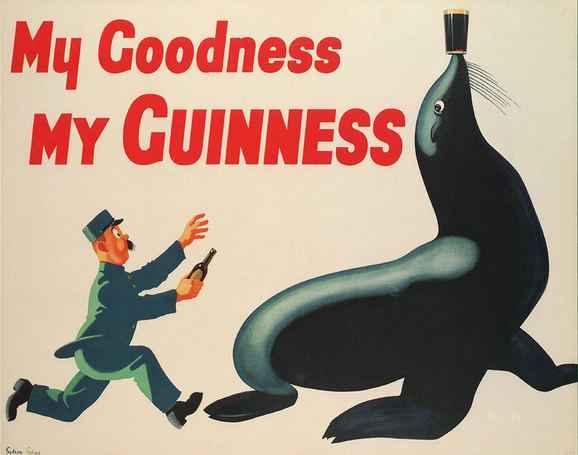
Joyce put that into the Wake too.
'O my goodmiss! O my greatmess!' 237.07
'another guidness, my good, to see' 345.22
WHEN GUINNESS WAS FROTHY
Here's a perfect pint of Guinness, from John Kavanagh's ('the Gravediggers') by Glasnevin cemetery. It has a creamy rather than a frothy head.

This thick creamy head was created in 1959, when Guinness brewer Michael Ash had the revolutionary idea of adding nitrogen to the draught beer. Nitrogen's tiny bubbles create a head so dense that bartenders can now draw a shamrock on top. After 1959, Guinness ads described the keg version as 'creamy'.
 |
 |
'Danu U’Dunnell’s foamous olde Dobbelin ayle.' 7.12
'Ser Artur Ghinis. Foamous homely brew, bebattled by bottle, gageure de guegerre.' 272.26
I learn from the James Joyce Digital Archive of Wake drafts that Joyce originally wrote 'the foamy freshener' before choosing the livelier 'frothy'. Maybe he should have thought of 'the foamous freshener'?
Anyway, Joyce was right to call Guinness 'frothy', and as for 'freshener', here's a 1937 Guinness poster.

Did someone remember Joyce's suggestion?
I think that Joyce's 'frothy freshener' was a very effective slogan. Since I started looking into this subject a couple of weeks ago, I've drunk nothing but Guinness; and every time I've ordered a pint, I've remembered the words 'the free, the froh, the frothy freshener'.
Slainte!
 |
| A pint in Davy Byrne's 13 June 2015 |


