Showing posts with label Guinness. Show all posts

Thursday, 24 January 2019

The Frothy Freshener: James Joyce's Guinness Slogan

'When it came to writing slogans James Joyce proved himself no slouch.
He suggested replacing ‘Guinness is Good for You’ with ‘Guinness –The Free, The Flow, the Frothy Freshener!’


That's a claim made on a wonderful advert for Guinness printed in the Irish Times on Bloomsday in 1982,  Joyce's centenary.  I was one of hundreds of Joyceans in Dublin for the celebration, and I bought a copy of the paper.

1982 was the year that Dublin, at long last, embraced James Joyce. The Irish Times Bloomsday editorial said:

'When Joyce came to publish his books, the censorious Ireland of the 1920s and 30s looked away disappprovingly, insofar as it paid any attention at all. However amends are now being made, as is right. Joyce by his writings paid great honour to the city of his birth, and the compliment should be returned.'

One of the Dublin institutions making amends was the Guinness brewery. They put on a big Joyce exhibition, 'Wine of the Country', which took a 'James's gape at Guinness and Dublin'. The exhibition was named after a nickname for stout in the Cyclops episode of Ulysses. We're in Barney Kiernan's pub, where Joe Hynes is buying a round:

-- Give it a name, citizen, says Joe. 
-- Wine of the country, says he. 
– What's yours? says Joe.
-- Ditto MacAnaspey, says I...
-- Three pints, Terry, says Joe


Here's the narrator's first taste of the lovely pint:

-- Health, Joe, says I. And all down the form.
Ah! Owl! Don't be talking! I was blue mouldy for the want of that pint. Declare to God I could hear it hit the pit of my stomach with a click.

The Guinness advert has another quotation from the same episode. Terry the barman is bringing a 'pony' (a half pint) to Little Alf Bergan.

-- Hurry up, Terry boy, says Alf. 
Terence O'Ryan heard him and straightway brought him a crystal cup full of the foaming ebon ale which the noble twin brothers Bungiveagh and Bungardilaun brew ever in their divine alevats, cunning as the sons of deathless Leda. For they garner the succulent berries of the hop and mass and sift and bruise and brew them and they mix therewith sour juices and bring the must to the sacred fire and cease not night or day from their toil, those cunning brothers, lords of the vat.

Bungiveagh and Bungardilaun are Edward Guinness, Lord Iveagh, who ran the brewery, and his older brother Arthur Guinness, Lord Ardilaun.
 
The exhibition, which I visited on Bloomsday, recreated a Dublin pub bar of Joyce's day (using bits of counters rescued from defunct pubs, like Barney Kiernan's) and an iron fireplace where the canvassers in 'Ivy Day in the Committee Room' set their bottles of stout, waiting for them to open with a 'Pok!' (Has anyone ever managed that trick?). There was also a fine performance of Joyce readings by the Dublin actor Dermot Lynskey.


JOYCE'S GUINNESS SLOGAN 


In 2011, Catherine Gubernatis Dannen investigated the background to Joyce's Guinness slogan in the brewery's archives. Here's her conclusion:

'After examining materials in the Guinness archive and talking with the archivist, I have concluded that there is no basis for Guinness's claim that Joyce wrote his own advertising slogan about Guinness stout....In a year of stagnant sales and bad public relations, Guinness took advantage of the publicity generated by Joyce's centenary to advertise its product to foreign customers and to repair its relationship with the public.'
 
Catherine Gubernatis Danne, 'The Facts and Fiction Behind "the Free, the Flow, the Frothy Freshener": The Guinness Company and the Story of Joyce's Lost Ad', JJQ, Vol. 48, No. 4, Joyce's Lives (Summer 2011), pp. 712


In fact, the proof that Joyce wrote this slogan is in Finnegans Wake. The 'frothy freshener' appears in the 'Haveth Childers Everwhere' episode, published as a book by Babou and Kahane in 1930 - just a year after the first 'Guinness is Good For You' ad came out.


In this speech of self-justification, HCE lists his great achievements as a city builder, all done out of love for his river-wife Anna Livia Plurabelle. One achievement is brewing Dublin stout:

'I brewed for my alpine plurabelle, wigwarming wench, (speakeasy!) my granvilled brandold Dublin lindub, the free, the froh, the frothy freshener, puss, puss, pussyfoot, to split the spleen of her maw'  553.25

Joyce wrote 'froh', which is German for merry, rather than the 'flow' in the Guinness version. HCE says 'free, froh...frothy' because he has a guilty stammer.

Dublin is paired with lindub because the Irish for stout is 'leann dubh' meaning 'black ale' (spelled 'lionn dubh' in the 1920s). Here's the entry from Dineen's 1927 dictionary (thanks to Eric Rosenbloom):

LIONN [Lin]
{genitive} LEANNA, {plural} {idem} -NTA, LEANNTAƍ and LEANNANNA {masculine} and {feminine}, liquid, liquor, any lisueous substance;
drink, ale, strong beer, wine (Wind,);
a humour of the body, lymph, phlegm, bile, choler;
LIONN DUBH, porter, stout, {also, alias} black humour, melancholy (LIONNDUBH, {genitive} -UIBH, {plural} {idem}, and LEANNTA DUBHA)

The name Dublin itself comes from dubh linn 'black pool'. This was where the Poddle stream met the River Liffey to form a pool. So Dublin and Guinness Porter are related linguistically as well as geographically! 

Joyce liked his slogan so much he repeated it:

'his groundould diablen lionndub, the flay the flegm, the floedy fleshener (purse, purse, pursyfurse, I'll splish the splume of them all!)' 72.34

When Joyce was getting 'Haveth Childers Everywhere' ready for publication, he was helped by his old University College friend Padraic Colum, who remembers the time in Our Friend James Joyce:

 'What did my contribution to this production amount to? I typed pages. From time to time I was asked to suggest a word that would be more obscure than the word already there. Joyce would consider my offer, his eyes, their pupils enlarged behind glasses, expectant, his face intent, his figure upstanding. ' I can't use it,' was what he would say five times out of six...' 

Mary and Padraic Colum, Our Friend James Joyce, 1958 p.158

Joyce thanked Colum by putting him in the episode:

   — The S. S. Paudraic's in the harbour.  (550.07)

Colum's book was probably the source for the 1982 Guinnesss ad slogan story:

'He actually believed that, on one level anyway, his later work had a public appeal. ''My brandold Dublin lindub, the free, the froh, the frothy freshener' - that really is a good slogan for the Dublin brew, Guinness', and Joyce was actually disappointed that Guinness did not use it instead of the commonplace 'Guinness is good for you.' But maybe they will appropriate it some time – 'the free, the froh, the frothy freshener.'  'Lindub', Dublin scrambled, is the Irish for black ale.' 

Mary and Padraic Colum, Our Friend James Joyce, 1958, p.156

'Maybe they will appropriate it sometime' 

They did, Padraic, they did!
  
Joyce's disappointment that Guinness didn't use his slogan can only mean that he suggested it to them, or that he expected them to discover it for themselves when Haveth Childers Everywhere was published. Either way, Guinness didn't invent the story as a publicity stunt.
  

JOYCE AND ADVERTISING


It's easy to see why Joyce would have wanted to write an advert for Guinness. He was always fascinated by advertising, and he saw how it was shaping modern life. Joyce made his hero Leopold Bloom an advertising canvasser, a man who contemplates 'the infinite possibilities hitherto unexploited of the modern art of advertisement' with its 'magnetising efficacy to arrest involuntary attention, to interest, to convince, to decide.' (Ithaca)

Here's the most famous ad in Ulysses, from a recreation of the Evening Telegraph published by Split Pea Press in 1990. The slogan was invented by Joyce.


While writing the Wake, Joyce read the Irish and British papers daily, taking notes for his book. He was often more interested in the ads than the news stories. The very first notebook for the Wake includes newspaper ads for Bird’s Egg Substitute cake-meal (‘a tin with a purpose’), for Hustler soap and for the Colgate Shaving Stick (See Robbert-Jan Henkes great article on the Wake's origins here).

So Joyce would have been interested when Guinness launched their first ever advertising campaign in 1929, with the slogan 'Guinness is Good for You'. He might even have taken it as a challenge.


Soon after, John Gilroy's colour posters appeared.


This Guinness slogan makes three appearances in Finnegans Wake:

'Ghinees hies good fir yew.' 16.31 
('for you' in the published text is a misprint)
'Guinness’s, may I remind, were just agulp for you' 190.07
'We have highest gratifications in announcing to pewtewr publikumst of pratician pratyusers, genghis is ghoon for you.'  593.17

In 1936, John Gilroy launched a new campaign, inspired by watching a sea lion performing balancing tricks at a circus. The new slogan, created by Dorothy L Sayers, was 'My goodness, MY GUINNESS'
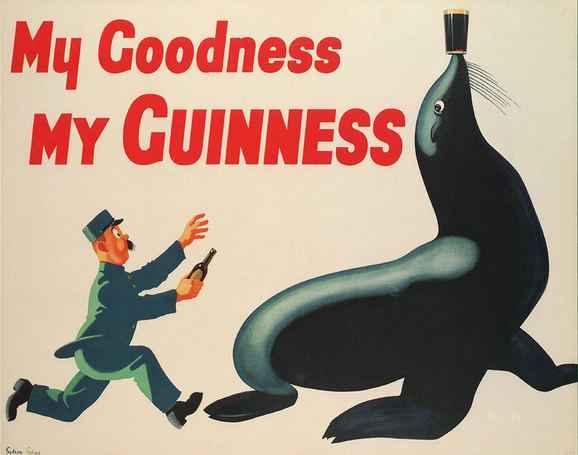

Joyce put that into the Wake too.

'O my goodmiss! O my greatmess!' 237.07
'another guidness, my good, to see' 345.22


WHEN GUINNESS WAS FROTHY


Here's a perfect pint of Guinness, from John Kavanagh's ('the Gravediggers') by Glasnevin cemetery. It has a creamy rather than a frothy head.


This thick creamy head was created in 1959, when Guinness brewer Michael Ash had the revolutionary idea of adding nitrogen to the draught beer. Nitrogen's tiny bubbles create a head so dense that bartenders can now draw a shamrock on top. After 1959, Guinness ads described the keg version as 'creamy'.

When Joyce wrote his slogan, Guinness had to be poured from two barrels, a method still used in the 1970s to pour plain porter, a weaker version of the stout (celebrated by Flann O'Brien's 'a pint of plain is your only man'). Here's a film showing the last pints of plain poured in Befast, in 1973. These have frothier heads, with bigger bubbles, than modern pints.


This froth could also be called foam, as in 'a crystal cup full of the foaming ebon ale' quoted above. Twice in the Wake, Joyce calls Dublin beer  'foamous'.

'Danu U’Dunnell’s foamous olde Dobbelin ayle.' 7.12
'Ser Artur Ghinis. Foamous homely brew, bebattled by bottle, gageure de guegerre.' 272.26

I learn from the James Joyce Digital Archive of Wake drafts that Joyce originally wrote 'the foamy freshener' before choosing the livelier 'frothy'. Maybe he should have thought of 'the foamous freshener'?

Anyway, Joyce was right to call Guinness 'frothy', and as for 'freshener', here's a 1937 Guinness poster.


Did someone remember Joyce's suggestion?

I think that Joyce's 'frothy freshener' was a very effective slogan. Since I started looking into this subject a couple of weeks ago, I've drunk nothing but Guinness; and every time I've ordered a pint, I've remembered the words 'the free, the froh, the frothy freshener'.

Slainte!

A pint in Davy Byrne's 13 June 2015


Wednesday, 29 October 2014

A Pint in the James Joyce Pub, Istanbul

I've just got back from a ten day holiday in Istanbul, where I visited some amazing places, including Hagia Sophia, the Basilica Cistern, the Church of St Saviour in Chora, and the JAMES JOYCE IRISH PUB! 


It gets terrible reviews on trip adviser, but I think the only reason people go on trip adviser is to write bad reviews. Somebody even complained that the pub was 'dingy inside', as if that was a bad thing for a pub!


When we went, the service was friendly, the toilets were clean and the Guinness was delicious.  They've also thought about the Joyce theme, and there's a biography of the great man on the drinks menu and website. The bar staff have Joyce on their t-shirts.


My only criticism of the Guinness is the large size of the head, but it was a creamy pint, and better than many you get in Ireland or Britain, where Guinness is now served much colder than it should be.


It struck me that they could have included some Joycean quotations related to Turkey on the walls. For example, in 1937, following a Thanksgiving dinner in Paris, Joyce wrote a poem in which he imagined the Turkish turkey describing the feast (In fact, the turkey bird has nothing to do with Turkey - it's a misunderstanding). Here are two verses (quoted by Ellmann):

At last I reached the banquet hall – and what a sight to see!
I felt myself transported back among the Osmanli
I poured myself a bubbly flask and raised the golden horn
With three cheers for good old Turkey and the roost where I was born.

I shook claws with all the hammers and bowed to blonde and brune
The mistress made a signal and the mujik called the tune.
Madamina read a message from the Big Noise of her State   
After which we crowed in unison: That Turco's talking straight! 

'The Big Noise' was Roosevelt's thanksgiving message. 


I took to pub stage, where they have live music many evenings.


Although Joyce never went to Turkey, he came across Turks in Trieste, and according to Ellmann, he 'was curious about the eastern influence that showed in the Greek, Turkish and Albanian costumes in the streets'. 


In his books, Joyce often uses the Orient as a location for escapist fantasy. Dubliners has a story 'Araby', set against the 1894 bazaar held in Dublin:

'The syllables of the word Araby were called to me through the silence in which my soul luxuriated and cast an Eastern enchantment over me.'

Then there's the appalling Mrs Kearney, in 'A Mother', 'trying to console her romantic desires by eating a great deal of Turkish Delight in secret.'


GAIETY PANTOMIMES 


Dublin's Gaiety Theatre pantomines, such as Sinbad the Sailor, The Forty Thieves, Aladdin and Turko the Terrible, often had an Oriental setting. Here's Stephen Dedalus in Ulysses thinking of his mother's favourite pantomime:

'She heard old Royce sing in the pantomime of Turko the Terrible and laughed with others when he sang:

I am the boy
That can enjoy
Invisibility.'  


Turko the Terrible was a hugely popular pantomime, starring the great comic character actor, Edward William Royce.  Here he is (below) in another Orientalist Gaiety pantomime, The Forty Thieves, in a picture from the V&A. I found another picture of him here.


'It was at Christmas 1873 that the first pantomime was tried at the
E.W.Royce as Hassarac, with Kate Vaughan as Morgiana
Gaiety and the famous Turko the Terrible—a pantomime never excelled in Dublin—was the work selected. Mr. Edwin Hamilton was accountable for the words of the songs and the one sung by King Turko in the throne room while anticipating the delights to be derived from his magic rose, where he thinks, ‘Invisibility is just the thing for me,/I am the boy that can enjoy/Invisibility’ was the most successful in the whole book. Mr. E. W. Royce enacted the title role as only his lively self at that time could.'  The Irish Playgoer, 1899


Turko the Terrible is also in Finnegans Wake: 'a tarrable Turk' 520.02 'turgos the turrible' (205.29) and 'Thorker the Tourable' (132.18).

ORIENTAL FANTASIES


Both Bloom and Stephen have oriental fantasies. Here's Bloom, who has also seen Turko the Terrible, daydreaming as he sets out to buy his breakfast kidney:

'Somewhere in the east: early morning....Wander through awned streets. Turbaned faces going by. Dark caves of carpet shops, big man, Turko the terrible, seated crosslegged smoking a coiled pipe. Cries of sellers in the streets. Drink water scented with fennel, sherbet. Wander along all day. Might meet a robber or two. Well, meet him. Getting on to sundown. The shadows of the mosques along the pillars: priest with a scroll rolled up. A shiver of the trees, signal, the evening wind. I pass on. Fading gold sky. A mother watches from her doorway. She calls her children home in their dark language. High wall: beyond strings twanged. Night sky moon, violet, colour of Molly's new garters. Strings. Listen. A girl playing one of these instruments what do you call them: dulcimers. I pass.' 
 
The night before the book opens, Stephen has had a dream of a 'Street of Harlots. Remember. Haroun al Raschid...Red carpet spread'.   Bloom has also had an oriental dream, of Molly with 'red slippers on. Turkish. Wore the breeches.'

She appears in a Turkish costume in one of the hallucinations in 'Circe':

'Beside her mirage of datepalms a handsome woman in Turkish costume stands before him. Opulent curves fill out her scarlet trousers and jacket slashed with gold. A wide yellow cummerbund girdles her. A white yashmak, violet in the night, covers her face, leaving free only her large dark eyes and raven hair...A coin gleams on her forehead. On her feet are jewelled toerings. Her ankles are linked by a slender fetterchain....Beside her a camel, hooded with a turreting turban, waits. A silk ladder of innumerable rungs climbs to his bobbing howdah.' 

In her final monologue, Molly thinks of getting 'a nice pair of red slippers like those Turks with the fez used to sell.'

European Turkish women's dress from Auguste Racinet's Le Costume Historique, 1888


TURKEY IN FINNEGANS WAKE


Finnegans Wake is packed with Turkish words and references, many of them documented by Kevin M. McCarthy in the James Joyce Quarterly Vol. 9, No. 2,, which you can read online if you register with JSTOR. You can also find the Turkish words listed in fweet.  I only have space to look at a couple of examples here - there are many more in McCarthy's article.

'He had fled again (open shun-shema!) this country of exile, sloughed off, sidleshomed via the subterranean shored with bedboards, stowed away and ankered in a dutch bottom tank, the Arsa, hod S.S. Finlandia, and was even now occupying, under an islamitic newhame in his seventh generation, a physical body Cornelius Magrath’s (badoldkarakter, commonorrong canbung) in Asia Major, where as Turk of the theater (first house all flatty: the king, eleven sharps) he had bepiastered the buikdanseuses from the opulence of his omnibox while as arab at the streetdoor he bepestered the bumbashaws for the alms of a para’s pence.'  98.4-14

These are some of the rumours surrounding the disappearance of HCE in Bk1 Chapter 4. He is said to have stowed away and escaped abroad to Asia Minor, where, as 'Turk of the theater' he threw coins (Turkish piastres) at the belly dancers (Dutch 'buikdanseuse') from the opulence of his box while, as a street Arab, he pestered 'bumbashaws' for alms. 'Turk of the theater' and 'open sun-shema!' ('Open Sesame', from Aladdin, mixed with Shaun and Shem) recalls the Gaiety pantomimes. 'Karakter' is Turkish for character and  'Para', in 'para's pence', is Turkish for money.


ARMENIAN ATROCITIES


Here's Shaun describing the foul stench of his brother Shem the Penman:

'no-one, hound or scrublady, not even the Turk, ungreekable in pursuit of armenable, dared whiff the polecat at close range' 181.22-4

That combines Wilde's joke that 'Fox hunters are the unspeakable in pursuit of the uneatable', with the Turkish-Greek conflict and the Armenian atrocities - the Turkish massacre of Armenian Christians in the early 1900s. This is also referred to in 'Armenian Atrocity' (72.11) and 'tuckish armenities' (530.36)
 

DUBLIN'S TURKISH BATHS


'He walked cheerfully towards the mosque of the baths. Remind you of a mosque, redbaked bricks.'

In Ulysses, Bloom has a bath at the Turkish and Warm Baths, 11 Leinster Street. This was one of several Turkish baths in Dublin, including the Hammam in Sackville Street and the Lincoln Place Turkish Bath Company, whose building resembled the Royal Pavilion in my home town, Brighton. The phrase 'mosque of the baths' and later description of its 'oriental edifice' suggests that Joyce may have confused the Leinster Street baths with this one, which closed down in 1902.

Malcolm Shifrin, who's writing a book about Victorian Turkish baths, has a good piece on Bloom's bath on his website. Joyce talked about Bloom's bath with Frank Budgen, saying, 'Does your reader realize what a unique event this was in the Dublin I knew up to 1904.' (James Joyce and the Making of Ulysses xvii)

Lincoln Place Turkish Bath Company, Dublin
The first Dublin Turkish bathhouse was opened in the late 18th century by an extraordinary character called Dr Achmed Borumborad. His story is told by Jonah Barrington, in his entertaining memoir, Personal Sketches of His Own Times, 1827, which you can read online here. Here's how Barrington describes Borumborad:

'He spoke English very intelligibly;  his person was extremely remarkable; and the more so, as he was the first Turk who had ever walked the streets of Dublin in his native costume. He was in height considerably above six  feet, rather pompous in his gait, and apparently powerful; an immense black beard covering his chin and upper lip. There  was, at the same time, something cheerful and cordial in the  man's address; and, altogether, he cut a very imposing figure. Everybody liked Doctor Achmet Borumborad: his Turkish dress,  being extremely handsome without any approach to the tawdry,  and crowned with an immense turban, drew the eyes of every passer by ; and I must say that I have never myself seen a more  stately-looking Turk since that period.   The eccentricity of the Doctor's appearance was, indeed, as  will readily be imagined, the occasion of much idle observation  and conjecture. At first, whenever he went abroad, a crowd of people, chiefly boys, was sure to attend him — but at a respectful distance; and if he turned to look behind him, the gaping boobies  fled, as if they conceived even his looks to be mortal.'  

Borumborad persuaded the corporation to fund the building of his bathhouse. He then fell in love with a Miss Hartigan, the daughter of a surgeon.


'Miss H. liked the Doctor vastly! and  praised the Turks in general, both for their dashing spirit and  their beautiful whiskers. It was not, however, consistent either  with her own or her brother's Christianity, to submit to the Doctor's tremendous beard, or think of matrimony, till  he had shaved the chin at least, and got a parson to turn him into a Christian, or something of that kind.' 

He agreed to her terms, and appeared before her cleanshaven and in European dress.

'In walked a Christian gallant, in a suit of full-dress black, and a very tall fine-looking Christian he was. Miss H. was surprised;  she did not recognise her lover, particularly as she thought it impossible he could have been made a Christian before the ensuing Sunday. He immediately, however, fell on his knees, seized  and kissed her lily hand, and, on her beginning to expostulate,  cried out at once, — " Don't be angry, my dear creature. To tell  the honest truth, I am as good a Christian as the archbishop !  I'm your own countryman, sure enough — Mr. Patrick Joyce  from Kilkenny county. The devil a Turk any more than yourself, my sweet angel! "   
   The ladies were astonished; but astonishment did not prevent Miss Hartigan from keeping her word, and Mr. and Mrs. Joyce became a very loving and happy couple.  The doctor's great skill, however, was supposed to lie in his  beard and faith, consequently, on this denouement, the baths declined.'  


Isn't that a great story? I've told it here because Patrick Joyce/Dr Borumborad is in Finnegans Wake!

'our aural surgeon, Afamado Hairductor Achmed Borumborad, M.A.C.A, Sahib, of a 1001 Ombrilla Street, Syringa padham, Alleypulley' 492.22