Showing posts with label Buffalo Notebooks. Show all posts

Friday, 19 September 2014

Meet the Genetic Wakeans


Genetic criticism is the study, through manuscripts and proofs etc, of the processes of literary creation. This might sound like a dry technical academic discipline, but there's nothing dry or dull about the Genetic Wakeans. Over at the online Genetic Joyce Studies, you'll find the most entertaining and passionate people writing about Finnegans Wake. Many of them have also contributed to this wonderful collection of essays, How Joyce wrote Finnegans Wake: A Chapter-by-Chapter Genetic Guide.

THE MANUSCRIPTS


Finnegans Wake is the ideal text for genetic criticism. The creation of the book is itself a subject of the Wake, which performs genetic criticism on itself!:

'look at this prepronominal funferal, engraved and retouched and edgewiped and pudden-padded very like a whale’s egg farced with pemmican as were it sentenced to be nuzzled over a full trillion times for ever and a night till his noddle sink or swim by that ideal reader suffering from an ideal insomnia...' 120.09-14

Joyce preserved almost every scrap of paper involved in the Wake's creation, and you can find them in four major archives. He sent most of his manuscripts and proofs to his patron, Harriet Shaw Weaver, who later donated them to the British Library.

Joyce's working notebooks and remaining manuscripts and proofs, abandoned in Paris at the outbreak of the war, were rescued by his heroic assistant, Paul Léon. In 1950, the notebooks were acquired by the State University of New York at Buffalo, and so they're known as the 'Buffalo Notebooks.'  
Here's a typical page from a Buffalo notebook, from Hypermedia Joyce Studies.

At the top right, you can see Joyce inventing his first hundred-letter thunderword, which appears on the book's opening page. He's crossed the entry out, which he would do whenever he used a notebook entry in a manuscript.

The Buffalo and British Museum materials were first made widely available with the 1978 publication of The James Joyce Archive, which gave a big boost to genetic studies.


A third set of manuscripts was acquired by the National Library of Ireland in Dublin, which has been making them available online. The fourth big archive is in the University of Tulsa, which has the final proofs for the book. These were only recently discovered there. Robert-Jan Henkes and Erik Bindervoet, the Dutch translators of Finnegans Wake, have written a lovely piece describing their excitement at the discovery of the Tulsa proofs (by Luca Crispi, who they describe as 'the Columbus of Joyce studies'):


'- Hey, the 'lost last proofs' have been found! There are 1500 pages of unexplored Finnegans Wake-materials in Tulsa!....the Tulsey Town Treasure Trove has yielded the very very last page proofs of Finnegans Wake, from late 1938 and early 1939, mere months before the novel hit the bookshops with a thunderclap (4 May 1939).
- All right! Right on!
- This makes Tulsa the fourth biggest Joyce-repository in the world and in the universe.
- What's in it then? Should we go there to see for ourselves? 
- Of course!'

'The Tulsey Town Treasure Trove: Preliminary Report on the Rediscovered Finnegans Wake Proofs', Genetic Joyce Studies, Spring 2003


Bindervoet (left) and Henkes, the best double-act in Wakean genetics
Henkes and Bindervoet went on to visit the Tulsa archive, where they were thrilled to mix their 'fingerprints with those of James Joyce, thereby absorbing some molecules from his genepool.'


CORRECTING THE TEXT 

'Has anybody had the courage to ask J.how many misprints are in it?' 

Joyce passes on the pained reaction of friends and editors to his new work to Harriet Shaw Weaver, 11 November 1925

A central genetic activity is fixing the book's thousands of misprints, and restoring text lost during the complex transmission process.  At Genetic Joyce Studies, Dirk van Hulle has listed many of the textual disappearances in the Wake's progress. A telling example is the word 'lost' in the book's last line, which originally read 'A way a lone a lost a last a loved a long the'

Here are the excitable Henkes and Bindervoet again, describing how it feels to a Genetic Wakean to see such mistakes creeping into Joyce's text:

' Through Joyce's accretive way of writing we could see the book take shape under his very pen....We saw words busy being born and busy dying. We saw sentences grow from mere words to more pages. We saw syntaxes swell until, by an unsolicited intervention from outside, they burst. We saw the precise intention of Joyce go to waste because of accidental sabotage by typists and printers. Many times we wanted to cry out: Take care, Joyce! Watch out! Something's going wrong there! Keep your hands on the wheel, for chrissake! Look in your rear mirror! Over there! You're losing something! O my God, this can't be really happening! An entire sentence off the road! An entire paragraph into the gulley! But the car scribbledehobbled rambling on, through puddles and potholes, rainshowers and hailstorms of criticism and ignorance, and one after the other essential car parts fell off to remain behind on the rocky rough country road from Dublin. We saw cristalclear phrases being ruined and disjointed by an accidental loss of punctuation marks, letters, words and sometimes whole lines. We saw Joyce make the most of typographical errors by concocting something new out of the muddle. We saw how he desperately tried to correct accidental mistakes, but more often than not we saw how he had to admit defeat and lay down his arms in the face of the inevitable inky, murky sea of mistakes his typists and printers made, and by neglecting them, continue them. In short, we were biting our nails in sorrow and impotent rage, howling at the moon of the inevitable course of history.'

'Finnegans Wake: The Corrected Text' Genetic Joyce Studies, 2004

Before translating the book into Dutch, Henkes and Bindervoet created their own corrected text.
  You can read their list of corrections as an appendix to their 2012 Oxford World's Classics edition of Finnegans Wake. Their changes are often different to Danis Rose and John O'Hanlon's Corrected Text. You can now make up your own mind how to correct the Wake, thanks to Rose and O'Hanlon's James Joyce Digital Archive, which includes every draft level.

SEARCHING FOR SOURCES

'I am quite content to go down to posterity as a scissors and paste man' 
 Joyce to George Antheil, 3 January 1931, Letters 1, 297

Finnegans Wake is a patchwork of quotations from books and newspapers, which Joyce recorded in the Buffalo notebooks. Genetic Wakeans like to track these down, an activity which can become addictive. 

'I locked myself up, I neglected my family, shirked my duties and generally wasn’t able to think about anything else but finding new sources. This lasted a full month, before I could tear myself away, little by little, from the World of Wakecraft, but after two months I still have to have my daily dose of source hunting. So beware. You may try this at home, but at your own peril.'


'I spent far too much time ploughing through several months' worth of Irish Times newspapers, reading every single line of every single newspaper. The waste of more than several hundred hours was made up by finding out exactly who Frisky Shorty was (FW. 039.18 et passim; he was a good friend of Boston Slim)'

Geert Lernout, 'The Finnegans Wake Notebooks and Radical Philology', Genetic Studies in Joyce, 1995

(Frisky Shorty is one of the gossip-mongers who spreads rumours about HCE. Joyce discovered the name in an article about 'Literary Vagabonds' ' He [the author W.H. Davies] varied the monopoly of tramping by stealing free rides on freight trains with kindred knights of the road known as "Boston Slim" and "Frisky Shorty."") 

The Dubliner Vincent Deane is one of the best genetic detectives. I first came across him in 1985, when he began to bring out the Finnegans Wake Circular - the first journal devoted to notebook studies.

It was Deane who tracked down Joyce's extensive use of the Thompson and Bywaters murder case and the source of the Festy King trial in 1923 court reports in the Connacht Tribune.
 

ROBBERT-JAN HENKES


Robbert-Jan Henkes is another great source hunter, and he's written a series of witty and playful articles, reconstructing Joyce's reading from his notebooks. He often uses fictional techniques to bring to life Joyce's reading ('With his less bad right eye close to the book, Joyce starts reading about marriage customs in the region around Tréguier...').


One of Henkes' best is his 2008 'James Joyce in Africa. An Expedition to the Sources of the Wake'which describes a 'word safari' the writer took in 1924:

'In March and May 1924, while drafting the first version of Shaun...Joyce took two short word-hunting trips to Africa. Until recently, little was known about these missions, although there were some telltale hints in Joyce’s travel notebooks. But now the sources of these travel notes have been discovered. Both African expeditions were tracing the footprints of the Scottish-born missionary Dan Crawford (1870-1926).'

Henkes presents this 'word safari', taken by Joyce in Paris, as if it was a real trip to Africa, and even includes this picture, captioned 'Joyce (left) meets Crawford in the long grass (photograph by P.B. Last).'

Henkes also gives us this map, captioned 'James Joyce’s itineraries in the basin of the Upper Congo, March (blue, from Elisabethville to Lake Mweru and then to, but not reaching Ilala) and May (red, from Chisamba to Lake Mweru) 1924'


PQ has written about this article in his excellent blog.


CREATING A DEMENTED STYLE


Henkes' latest piece includes a brilliant investigation into the sources of Joyce's treatment of old age, the Mamalujo episode, where he shows how Joyce created the rambling senile style of that chapter:

'As soon as Joyce had invented his Old Men...he quickly decided he needed to make them as demented as possible, and he started studying old age and its effects in some depth by delving into serious medical literature. This literature, in turn, supplied him with ideas of what the Old Men should actually be doing in their state of dementia.'

Henkes has identified Dr Costanza Pascal's La Démence Précoce (left) as a major source. She was a doctor in a clinic who recorded many of the symptoms of patients suffering from dementia. For example, she writes:

'They don’t get into their beds anymore, sleep on the blanket, under their bed, or under those of other people.’

This inspired the anarchically demented behaviour, and the shared bed, of the four old men in Joyce's episode:

'when they were in dreams of yore, standing behind the door, or leaning out of the chair, or kneeling under the sofacover and setting on the souptureen, getting into their way something barbarous, changing the one wet underdown convibrational bed or they used to slumper under...'

393.36-394.04. 

Another symptom of dementia described is the breakdown of language, as 'syntactical links (‘but’, ‘by’, ‘if’, etc.) are randomly placed and unite disparate sentences. [...] Nouns, adjectives, verbs are often the casualties of the language of these patients; conjunctions, prepositions grow less numerous. [...] Finally, nouns, adjectives, etc., eventually fade and disappear. Neologisms of dementia, which represent the last stage of erasing images, are constructed with the remains of all these elements.'

Henkes shows how Joyce used these ideas in creating the senile style of Mamalujo, deliberately mislaying prepositions and conjunctions. To create 'neologisms of dementia', he went through the text erasing letters, so that, for example, 'beautiful' at top left, became 'beaufu'.


In the same text, Henkes found Dr Costanza criticising another psychologist for presupposing 'an ideal human being with an ideal disease.'

Joyce recorded this in his notebook as  ‘ideal man suffering from an ideal disease’, which Henkes describes as  'an early version of his famous vision of the only possible public of Finnegans Wake, ‘that ideal reader suffering from an ideal insomnia,’ (FW 120.13-14) – a motto that can be engraved on the tombstone of many a genetic Wakean, dead or alive.'


WHY AREN'T THEY CELEBRITIES? 


These genetic Wakeans deserve to be more widely known and read!  To conclude, here's a quotation from another top geneticist, Jed Deppman:

'In a recurring dream, I wake up and genetic studies are no longer the sole province of academics. The whole world has embraced them: there are bestsellers, websites, talk shows, even professional teams...with mascots, fans, competitions, cheerleaders, and action figures....But then I wake up, and as Emily Dickinson (the last person I see in my dream) puts it: "The nearest dream recedes unrealized." Nobody in my family or college community has ever heard of genetic criticism or shows the slightest interest, and everyone encourages me politely but curtly to do something else.'

Jed Deppman, 'Joyce and the Case for Genetic Criticism,' Genetic Joyce Studies, 2006


Monday, 4 November 2013

An English Murder in Finnegans Wake


Frederick Bywaters (left) with the Thompsons
Here's an extraordinary photograph of a love triangle, taken in July 1921. It shows Edith Thompson sitting between her lover, Frederick Bywaters, and her husband Percy. They seem unaware of the camera. Yet it looks as posed as a painting by Jack Vettriano,

On 3 October 1922, the Thompsons were returning to their Ilford home after a night watching a Ben Travers farce at London's Criterion theatre, when Bywaters leaped out of the bushes and fatally stabbed Percy. 


Bywaters, who was quickly arrested, freely admitted his guilt. He told the police, 'The reason I fought with Thompson was because he never acted like a man to his wife. He always seemed several degrees lower than a snake.'  


Edith soon found herself accused alongside her lover. The police found more than sixty love letters she had sent him, in which she fantasised about Percy's death, and talked about giving him ground-up light bulbs to drink. When the couple were tried together, public sympathy was on the side of Bywaters, who was seen as having been manipulated by an older femme fatale.


They were found guilty, and hanged at exactly the same time, on 9 January 1923, in Holloway and Pentonville prisons. Edith fainted, and had to be held upright on the gallows by four warders. Her hangman, John Ellis, was traumatised by the execution and later killed himself. Bywaters' last words on the scaffold were, 'They are hanging an innocent woman'.      

'The mystery man is the husband.' James Joyce

James Joyce was fascinated by the case, which he followed in the English newspapers. He discussed it with his young Irish friend, Arthur Power:

'–The mystery man in the case is the husband, remarked Joyce, the immovable mass before the irresistible force so deeply bedded in his habits that anything outside seemed to him unreal: and of him we have no clear picture. But one thing I am certain of is that if all this had happened in France they would not have been executed, and I think that English justice was at fault in trying them side by side....I think it was gruesome and inhuman for the judge to try them the way he did....There was no real evidence against her,  in spite of all her letters saying she had given her husband this, and there was not a trace of any poison, glass etc., found in his body, and it took Bywaters' six-shilling knife to finish him off. Also at the trial she swore she had given her husband nothing, and it was all fantasy...for her mind was evidently full of the stuff she had been reading, while she wrote those letters to make her seem romantic in his eyes because in turn he used to taunt her with descriptions of his life while on his voyages.  

   As a picture I can see it all clearly, Ilford – the dark streets with dim lights showing behind the yellow window-blinds, and from a distance a soft wind coming up with a raw smell of fish and chips on it, the Thompsons walking arm in arm under the trees when this young man suddenly dashes out and stabs him, her crying and wailing, and her search, or pretended search, for help. I can smell the English effluvia here – and it reminds me...yes...of the Strand, say, on a Saturday night, the huddles of people in the passage outside the pubs; the sudden fights; the traffic-weary streets; the arc-lights shining down on the muddy tramped pavements. I remember how I disliked it all and I decided that I could never have become part of English life...'

                                                Arthur Power, Conversations with James Joyce, 1974 

From René Weis' Criminal Justice which is online here


Joyce uses the case repeatedly in Finnegans Wake. So Bywaters's description of Percy as 'several degrees lower than a snake' can be found on page 36: 'a creature in youman form who was quite beneath parr and several degrees lower than yore triplehydrad snake.'

FREDERICK BYWATERS AND ST KEVIN


In the spring and summer of 1923, only a few months after the lovers were hanged, Joyce wrote the earliest sketches for Finnegans Wake.  They included this comic hagiography on the childhood of St Kevin of Glendalough:

'Shortly after having swum into this vale of tears the little stranger Kevineen delighted himself by sporting with the sponge on tubbing night. As a growing boy under the influence of holy religion which had been instilled into him across his grandmother old Mrs Jones's knee he grew more and more pious and abstracted like the time God knows when, ejaculating for forty days indulgence and ten quarantines, he sat down on the plate of mutton broth.

He simply had no time for girls and things and often used to say to his dearest mother and dear sisters as how his dearest mother and dear sisters were good enough for him.  Of him we are further told that at the age of six he wrote a school prize essay on kindness to freshwater fish.'

In a brilliant piece of literary detection, Vincent Deane discovered that the source for this was an interview with Bywaters' mother, published in December 1922:

'It was only last year that we knew of his friendship with Mrs. Thompson, and, as far as I know, she was the first woman outside his family circle he ever cared for. In his young days he simply had no time for girls. He used to say that his sisters were good enough for him, and that there was no girl in Manor Park to equal them....His school reports always bore high marks, and he won quite a number of prizes and certificates, especially for essay-writing. One essay I shall always remember. The subject was “Kindness to Dumb Animals,” and it gained for him the first prize in his class.'

'My Boy's Life: By His Mother', The Daily Sketch, 15 December 1922

THE PLEBISCITE


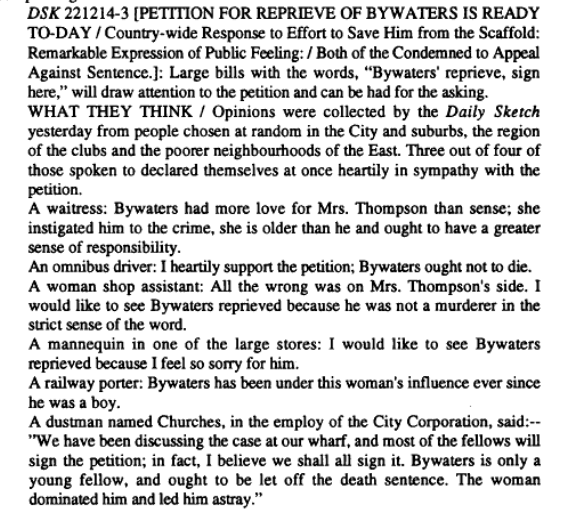
Vincent Deane discovered another article in The Daily Sketch of the 14 December 1922, also used by Joyce. The newspaper placed the blame for the crime on Edith and organised a petition for the reprieve of Bywaters.  Over a million people signed the petition.

In the article, 'Petition for the Reprieve of Bywaters is Ready Today', members of the public were asked for their opinion about Bywaters' guilt. Joyce used this as the basis for his 'Plebiscite' section (pages 58 on), where members of the public give their verdict on the guilt of HCE.

Here's a quote from the newspaper, followed by Joyce's comic and surreal transformation of it in the Wake: 

'Three soldiers were walking together in Fleet-street; one gave an opinion in which all concurred. It was the woman who was to blame. Bywaters played a bad part in the crime, but he was coerced. He proved himself a man afterwards.' Daily Sketch
 
'Tap and pat and tapatagain, (fire firstshot, Missiers the Refuseleers! Peingpeong! For saxonlootie!) three tommix, soldiers free, cockaleak and cappapee, of the Coldstream. Guards were walking, in (pardonnez-leur, je vous en prie, eh?) Montgomery Street. One voiced an opinion in which on either wide (pardonnez!), nodding, all the Finner Camps concurred (je vous en prie, eh?). It was the first woman, they said, souped him, that fatal wellesday, Lili Coninghams, by suggesting him they go in a field.'  58.23
 
Here's the Daily Sketch again:

'A dustman named Churches, in the employ of the City Corporation, said:— "We have been discussing the case at our wharf, and most of the fellows will sign the petition; in fact, I believe we shall all sign it. Bywaters is only a young fellow, and ought to be let off the death sentence. The woman dominated him and led him astray.'  

In the Wake, this became:

'A dustman nocknamed Sevenchurches in the employ of Messrs Achburn, Soulpetre and Ashreborn, prairmakers, Glintalook, was asked by the sisterhood the vexed question during his midday collation of leaver and buckrom alternatively with stenk and kitteney phie in a hash-housh and, thankeaven, responsed impulsively: We have just been propogandering his nullity suit and what they took out of his ear among my own crush. All our fellows at O’Dea’s sages with Aratar Calaman he is a cemented brick, buck it all!' 59.16

'Miss Sheila Courtenay, who is appearing in “The Cat and the Canary” at the Shaftesbury Theatre, put the same view: “I do sincerely hope,” she said, “that Bywaters will not be hanged. He is very young, and was egged on by a woman older than himself to do what he did. And then he has been so wonderful in his behaviour at the Old Bailey.”'  Daily Sketch

This inspired the Wake's actress ('One of our coming Vauxhall ontheboards who is resting for the moment' 58.33) who says 'it has been such a wanderful noyth untirely' 59.13

'A taxicab driver: Bywaters is a silly young fellow, but he ought not to pay the full penalty.'  
Daily Sketch

'A more nor usually sober cardriver, who was jauntingly hosing his runabout, Ginger Jane, took a strong view.' 59.24

'A sailor, on the Embankment, was encouraged to speak by his fiancée, and said: I think the woman was more to blame than Bywaters, but I think there was someone else in it.' Daily Sketch

'Meagher, a naval rating, seated on one of the granite cromlech setts of our new fishshambles for the usual aireating after the ever popular act, with whom were Questa and Puella, piquante and quoite, (this had a cold in her brain while that felt a sink in her summock, wit’s wat, wot’s wet) was encouraged, although nearvanashed himself, by one of his co-affianced to get your breath, Walt, and gobbit and when ther chidden by her fastra sastra to saddle up your pance, Naville, thus cor replied to her other’s thankskissing: I lay my two fingerbuttons, fiancee Meagher, (he speaks!) he was to blame about your two velvetthighs up Horniman’s Hill — as hook and eye blame him or any other piscman? — but I also think, Puellywally, by the siege of his trousers there was someone else behind it — you bet your boughtem blarneys — about their three drummers down Keysars Lane. (Trite!).'  61.13

In the first draft, from the Digital Archive, Joyce's text was very close to the source: 

'Three soldiers of the Coldstream Guards were walking in Montgomery street. One gave an opinion in which all concurred. It was the women, they said, he showed himself a man afterwards. A coming actress who has been called by 1 critic ‘a vestpocket Siddons’ was interviewed in a beauty parlour and while righting her cartwheel hat, said she hoped he would get an Xmas pardon as the world had been unkind to him. Then he has been so truly wonderful, she added. A dustman named Churches in the employ of Bullwinkle and McTigue was asked the question in a hashhouse and replied: We have just been discussing the case. All the fellows say he is a gameya one. A taxidriver took a strong view and said: Earywigger is a damned scoundrel in private life but folks say he has parliamentary privilege. A barmaid: it would be a shame to jail him on account of his health. Brian Linskey the boy curser, was questioned & gave a snappy comebackI'm for caveman sex life, curse it! Them two whores ought to get strangled or axed. Mrs Ida Wombwell, the 1old daring revivalist said of the fusiliers incident with the rosiest of cheeks: That man is a brute — but he is a magnificent brute. Sylvia Silence, the girl detective, said when told of all the facts:  Have you thought Greatness was his tragedy but he should pay the full penalty. The ends of justice must not be earwigged. A sailor seated on the granite setts of the fish market, was encouraged to speak by his fiancée & said I think he was to blame about the two slaveys |bas he had a perfect right, but I think there was someone else behind it about the 3 drummers.'


EDITH AND THE VOICE OF ISSY


In 1931, Joyce read Filson Young's 1923 book of the Trial, which presents the execution of Edith as a miscarriage of justice:

'Bywaters was not the innocent young lad that his defenders presented to the jury; Edith Thompson was not the corrupt, malignant sorceress portrayed by the prosecution.... Bywaters, as I read his character, was totally devoid of imagination; actions were his only realities. Edith Thompson had an excess of imagination. To her actions were unimportant. Her chief consciousness was hardly ever in what she was doing at. the time, but inhabited a world of dreams and make-believe.'

The book includes transcripts of Edith's letters, where she often addresses Bywaters as 'darlint'.  Just as Joyce used Bywaters as a model for Shaun (Kevin), he used Edith's letters in creating the voice of Issy.

Here's a key letter quoted on p.78 of the book, used in the cross-examination of Edith:


In Finnegans Wake, Joyce used this in a description of Issy, stuck with Chuff (Shaun) while pining for Glugg (Shem):

'If he's at anywhere she's therfor to join him. If it's to nowhere she's going to too.'  226.08

A few lines later, we have the chilling phrase, 'Glugg's got to swing' (226.20).

There's another echo, of 'like things are', in a few pages:

'Stop up, mavrone, and sit in my lap, Pepette, though I'd much rather not. Like things are m.ds. is all in vincibles' 232.25-6

'm.ds' is probably an abbreviation of 'my darlingest'.  The echoes of this letter were spotted by Adaline Glasheen in  her Third Census of Finnegans Wake, 1977.

Here's Issy speaking:

'My latest lad’s loveliletter I am sore I done something with. I like him lots coss he never cusses. Pity bon- hom. Pip pet. I shouldn’t say he’s pretty but I’m cocksure he’s shy. Why I love taking him out when I unletched his cordon gate. Ope, Jack, and atem! Obealbe myodorers and he dote so. He fell for my lips, for my lisp, for my lewd speaker. I felt for his strength, his manhood, his do you mind? There can be no candle to hold to it, can there?' 459.33

This echoes another letter on p187 of the trial book.


Here's Issy again:

'As for she could shake him. An oaf, no more. Still he’d be good tutor two in his big armschair lerningstoel and she be waxen in his hands. Turning up and fingering over the most dantellising peaches in the lingerous longerous book of the dark. Look at this passage about Galilleotto! I know it is difficult but when your goche I go dead. Turn now to this patch upon Smacchiavelluti!' 251.21

This is taken from three of Edith's letters. Here she's describing a character in Robert Hichen's novel, The Slave:

'Aubrey — I could shake him — no go — no initiative of his own... oh an ass — nothing more'

The 'good tutor' comes from another letter:

 'I was told I was the vilest tempered girl living & "you used not to be, but you're under a very good tutor"'

The rest comes from this letter:

'Darlingest lover of mine, thank you, thank you, oh thank you a thousand times for Friday – it was lovely – its always lovely to go out with you. And then Saturday – yes I did feel happy – I didn’t think a teeny bit about anything in this world, except being with you – and all Saturday evening I was thinking about you – I was just with you in a big arm chair in front of a great big fire feeling all the time how much I had won – cos I have darlint, won such a lot – it feels such a great big thing to me sometimes – that I can’t breathe....It seems like a great welling up of love – of feeling – of inertia, just as if I am wax in your hands – to do with as you will and I feel that if you do as you wish I shall be happy, its physical purely and I can’t really describe it – but you will understand darlint won’t you? You said you knew it would be like this one day – if it hadn’t would you have been disappointed. Darlingest when you are rough, I go dead – try not to be please.'

Raphael Slepon's wonderful Finnegans Wake Extensible Elucidation Treasury website lists almost fifty uses of the case, including all the letter quotations. These were all identified by Vincent Deane in his article 'Bywaters and the Original Crime', which is online here.

Deane was able to identify Joyce's sources thanks to his working notebooks, now in the University of Buffalo. These Buffalo notebooks are full of lists of foreign words, overheard conversations, and phrases lifted from hundreds of books and newspapers, which Joyce used as the basic building blocks of his book. His notes on the newspaper reports of murder case are all in VI.B.10, dated to October 1922-January 1923. His notes from Edith's letters are in VI.B.33, from February-April 1931.

'I am quite content to go down to posterity as a scissors and paste man for that seems to me a harsh but not unjust description.'

Joyce to George Antheil, 3 January 1931.

'Every dimmed letter in it is a copy and not a few of the silbils and wholly words I can show you in my Kingdom of Heaven....The last word in stolentelling!' 424.32

The names Bywaters and Thompson never appear in Finnegans Wake. Without Joyce's notebooks, and the detective work of Vincent Deane and Adaline Glasheen, it's unlikely that anyone would have spotted the book's references to the famous murder case.  

So what was Joyce up to in writing a book in this extraordinary way? I think that J.S.Atherton provides the answer in The Books at the Wake:

'Joyce believed that his words were 'Words of silent power' (345.19)....The book was indeed his life and he believed that he was entrapping some part of the essence of life within its pages....Joyce was not in his own opinion simply writing a book, he was also performing a work of magic.'


In Joyce's mind, phrases taken from other sources carried over the power of those sources, which then charged Finnegans Wake with significance. Joyce told a party of friends, 'Really it is not I who am writing this crazy book. It is you, and you, and you, and that man over there, and that girl at the next table.'  

...and Edith Thompson and Frederick Bywaters.


Here's the whole Daily Sketch article, from Vincent Deane's article