Showing posts with label Bywaters. Show all posts

Tuesday, 27 July 2021

Sylvia Silence, the girl detective


Thanks to Roy Bayfield 

Shortly after Ida Wombwell, the 17 year old  revivalist, describes HCE as 'a brut! But a magnificent brut!', Sylvia Silence, the girl detective, is asked her opinion. 

'Sylvia Silence, the girl detective (Meminerva, but by now one hears turtlings all over Doveland!) when supplied with informations as to the several facets of the case in her cozydozy bachelure’s flat, quite overlooking John a’Dream’s mews, leaned back in her really truly easy chair to query restfully through her vowelthreaded syllabelles: Have you evew thought, wepowtew, that sheew gweatness was his twadgedy? Nevewtheless accowding to my considewed attitudes fow this act he should pay the full penalty, pending puwsuance, as pew Subsec. 32, section 11, of the C. L. A. act 1885, anything in this act to the contwawy notwithstanding.' 61.01-11


Vincent Deane identified Joyce's source for Sylvia as an advertisment for The Schoolgirls' Weekly in the Sunday Express, 29 October 1922. Roy Bayfield has found the same advert in the same day's Sunday Mirror (right) and he went on to track down copies of the stories (above). Roy says, ‘She certainly gets into some scrapes! Love that she has animal helpers, a dog (Wolf) and a monkey (Jacko).’

It's a shame Eldorado Nell and Vi the Ventriloquist didn't also get into Finnegans Wake.

Since Joyce only saw this advert, he had to imagine what such a girl detective might be like. He compares her to Minerva, goddess of wisdom, and gives her a comic rhotacism (inability to pronounce the letter 'r') which he even applies to r's which aren't pronounced (the 'r' in 'considered' 'per' etc). Sylvia is a consulting detective, like Sherlock Holmes or Nero Wolfe, looking at the 'several facets of the case' in her 'cozodozy bachelure's flat'. Unlike the other members of the public questioned, who give short direct answers, Sylvia seems to see this as a personal interview with her celebrity self.

In the first draft, Joyce gave her an additional moralistic line, which was then cut or lost:

'The ends of justice must not be earwigged.'

Stephen Crowe has made a beautiful illustration of Sylvia Silence sitting in her flat, which you can see here.

Her voice and name reappear later in the Stories chapter:

Imagine twee cweamy wosen. Suppwose you get a beautiful thought and cull them sylvias sub silence.  337.16

We also hear her voice in the séance, still talking with the reporter, channeled by the sleeping Yawn:

—Have you ever weflected, wepowtew, that the evil what though it was willed might nevewtheless lead somehow on to good towawd the genewality? 523.02

The real Sylvia was far from languid. She was more like a female James Bond action heroine. Thanks again to Roy Bayfield.


THE FIRST SCHOOLGIRL SLEUTH

The Schoolgirls' Weekly was a brand new paper in 1922, with new kinds of stories, mostly written by men, using female pen names. Sylvia Silence was created by John William Bobin, writing as Katherine Greenhalgh. He's described here by Lucy Parker in 100 British Crime Writers (edited by Esme MisKimmon, Springer Press, 2020):

I've also found an entry for Sylvia Silence in Russell James's Great British Fictional Detectives, which includes a supposed picture of her.

By an extraordinary coincidence I bought this greeting card last week for a friend's birthday.  I only looked at it properly after posting this blog.  It's the cover of an Angela Brazil novel published in 1920, so the right period but wrong girl. This is Ingerd Saxon not Sylvia Silence.


Bobin had created a successful formula, which you can see throughout the run of The Schoolgirls' Weekly. This is from the entry on the paper on the wonderful Friardale website.

' In January 1933 came "That Amazing Room Of Clocks" written by J.W. Bobin as Adelie Ascott, the first tale of Valerie Drew the 18 year old intrepid girl detective, doting daughter of an ex-Scotland Yard Chief Commissioner. "The Secret Of The Old Clock" written by Mildred Wirt as Carolyn Keene was published in America in 1930 and concerned Nancy Drew the 16 year old intrepid girl detective, whose doting father Carson Drew was a famous criminal lawyer cum detective. In Valerie's adventures over the next 7 years she was ably assisted by Flash, an alsation dog who acted almost human at times, and was more useful than Ned Nickerson was to Nancy. Both Nancy and Valerie were also well seasoned teenage motorists (at 18 Nancy was even a qualified pilot), their common sense and innate decency went almost unbelievably deep. The stories were always concise, entertaining, never heavy or heavy-going, and a charming if often melodramatic window on the world of the 1930's from an allegedly young female point of view. Unlike the Noel Raymond detective series running in the Girls' Crystal it was nearly always obvious who the guilty party was.'


You can read a complete 1933 Valerie Drew story here.


Nancy Drew, the American schoolgirl sleuth, is still solving cases today. 


SCISSORS AND PASTE MAN

'I am quite content to go down to posterity as a scissors and paste man'

Joyce to George Antheil, 3 January 1931, Letters, 297

Going back to the Wake passage, it's fascinating to see how it was assembled from diverse sources, which had nothing to do with schoolgirl magazines. Following the blue hyperlinks in the brilliant Digital Archive, we can read Joyce's notes, taken from newspapers and books:

'Sylvia Silence, the girl  detective', 'supplied with this information', 'really truly easychair', 'restfully', 'vowelthreaded', 'J Caesar, greatness his tragedy', 'considered judgement' 'full penalty',   'Sect XI Crim. Law. Amend.  Act 1885', 'anything in his act to the contrary notwithstanding'

Most of the sources have not been identified, though one note ('J Caesar, greatness his tragedy') shows Joyce had been reading about Julius Caesar. It would be very hard to track down the source of 'restfully'.

'Full penalty' is one of the many phrases, identified by Vincent Deane, taken from the 1922 Daily Sketch article on Bywaters:

'Petition for Reprieve of Bywaters is Ready To-Day': 'A taxicab driver: Bywaters is a silly young fellow, but he ought not to pay the full penalty'

Viviana-Mirela Braslasu discovered that the word 'vowelthreaded' was taken from the opening page of Marjory Kennedy-Fraser and Kenneth Macleod's Songs of the Hebrides, 1917.


'Subsec. 32, section 11, of the C. L. A. act 1885'

Oscar Wilde was tried for 'gross indecency' under section 11 of the Criminal Law Amendment Act 1885. There is no subsection 32. Joyce has added that number to create the magical 1132 - the big number/date in Finnegans Wake, which relates to the law of falling bodies ('32 feet per second per second').  Oscar Wilde and HCE are both falling bodies.

Sam Slote found Joyce's specific source in Frank Harris's book Oscar Wilde His Life and Confessions, 1918.

 Here is the very section of the act.

Oscar Wilde was sentenced to two years with hard labour.

For more on Wilde in the Wake, see my post Oscar Wilde: The Great White Caterpillar.

Often there's a dark undercurrent to the comedy in Finnegans Wake. I think we get that here with the seemingly sweet Sylvia Silence, relaxing in her cozydozy bachelure's flat, demanding the harshest punishment for HCE.

Discussing the Thompson and Bywaters case with Arthur Power, Joyce talked about the censoriousness of the English: 

'Though there is plenty of legal liberty in England...there is not much individual liberty, for in England every man acts as a censor to his neighbour, while here in Paris you have the only real freedom in Europe, where no one gives a damn about what his neighbour thinks or does...But in England everybody is busy about everybody else.'

Conversations with James Joyce, p.76


Monday, 4 November 2013

An English Murder in Finnegans Wake


Frederick Bywaters (left) with the Thompsons
Here's an extraordinary photograph of a love triangle, taken in July 1921. It shows Edith Thompson sitting between her lover, Frederick Bywaters, and her husband Percy. They seem unaware of the camera. Yet it looks as posed as a painting by Jack Vettriano,

On 3 October 1922, the Thompsons were returning to their Ilford home after a night watching a Ben Travers farce at London's Criterion theatre, when Bywaters leaped out of the bushes and fatally stabbed Percy. 


Bywaters, who was quickly arrested, freely admitted his guilt. He told the police, 'The reason I fought with Thompson was because he never acted like a man to his wife. He always seemed several degrees lower than a snake.'  


Edith soon found herself accused alongside her lover. The police found more than sixty love letters she had sent him, in which she fantasised about Percy's death, and talked about giving him ground-up light bulbs to drink. When the couple were tried together, public sympathy was on the side of Bywaters, who was seen as having been manipulated by an older femme fatale.


They were found guilty, and hanged at exactly the same time, on 9 January 1923, in Holloway and Pentonville prisons. Edith fainted, and had to be held upright on the gallows by four warders. Her hangman, John Ellis, was traumatised by the execution and later killed himself. Bywaters' last words on the scaffold were, 'They are hanging an innocent woman'.      

'The mystery man is the husband.' James Joyce

James Joyce was fascinated by the case, which he followed in the English newspapers. He discussed it with his young Irish friend, Arthur Power:

'–The mystery man in the case is the husband, remarked Joyce, the immovable mass before the irresistible force so deeply bedded in his habits that anything outside seemed to him unreal: and of him we have no clear picture. But one thing I am certain of is that if all this had happened in France they would not have been executed, and I think that English justice was at fault in trying them side by side....I think it was gruesome and inhuman for the judge to try them the way he did....There was no real evidence against her,  in spite of all her letters saying she had given her husband this, and there was not a trace of any poison, glass etc., found in his body, and it took Bywaters' six-shilling knife to finish him off. Also at the trial she swore she had given her husband nothing, and it was all fantasy...for her mind was evidently full of the stuff she had been reading, while she wrote those letters to make her seem romantic in his eyes because in turn he used to taunt her with descriptions of his life while on his voyages.  

   As a picture I can see it all clearly, Ilford – the dark streets with dim lights showing behind the yellow window-blinds, and from a distance a soft wind coming up with a raw smell of fish and chips on it, the Thompsons walking arm in arm under the trees when this young man suddenly dashes out and stabs him, her crying and wailing, and her search, or pretended search, for help. I can smell the English effluvia here – and it reminds me...yes...of the Strand, say, on a Saturday night, the huddles of people in the passage outside the pubs; the sudden fights; the traffic-weary streets; the arc-lights shining down on the muddy tramped pavements. I remember how I disliked it all and I decided that I could never have become part of English life...'

                                                Arthur Power, Conversations with James Joyce, 1974 

From René Weis' Criminal Justice which is online here


Joyce uses the case repeatedly in Finnegans Wake. So Bywaters's description of Percy as 'several degrees lower than a snake' can be found on page 36: 'a creature in youman form who was quite beneath parr and several degrees lower than yore triplehydrad snake.'

FREDERICK BYWATERS AND ST KEVIN


In the spring and summer of 1923, only a few months after the lovers were hanged, Joyce wrote the earliest sketches for Finnegans Wake.  They included this comic hagiography on the childhood of St Kevin of Glendalough:

'Shortly after having swum into this vale of tears the little stranger Kevineen delighted himself by sporting with the sponge on tubbing night. As a growing boy under the influence of holy religion which had been instilled into him across his grandmother old Mrs Jones's knee he grew more and more pious and abstracted like the time God knows when, ejaculating for forty days indulgence and ten quarantines, he sat down on the plate of mutton broth.

He simply had no time for girls and things and often used to say to his dearest mother and dear sisters as how his dearest mother and dear sisters were good enough for him.  Of him we are further told that at the age of six he wrote a school prize essay on kindness to freshwater fish.'

In a brilliant piece of literary detection, Vincent Deane discovered that the source for this was an interview with Bywaters' mother, published in December 1922:

'It was only last year that we knew of his friendship with Mrs. Thompson, and, as far as I know, she was the first woman outside his family circle he ever cared for. In his young days he simply had no time for girls. He used to say that his sisters were good enough for him, and that there was no girl in Manor Park to equal them....His school reports always bore high marks, and he won quite a number of prizes and certificates, especially for essay-writing. One essay I shall always remember. The subject was “Kindness to Dumb Animals,” and it gained for him the first prize in his class.'

'My Boy's Life: By His Mother', The Daily Sketch, 15 December 1922

THE PLEBISCITE


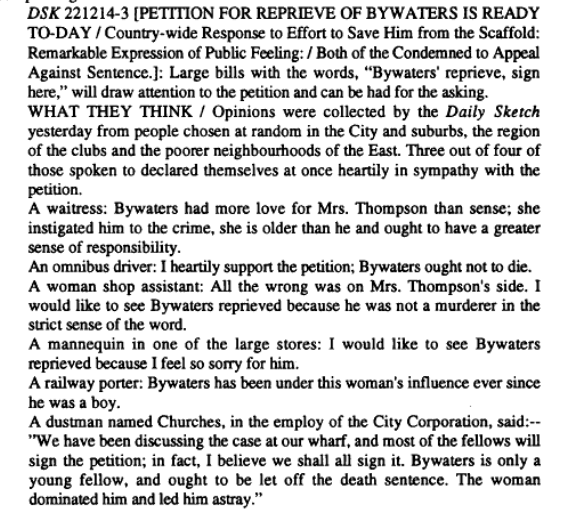
Vincent Deane discovered another article in The Daily Sketch of the 14 December 1922, also used by Joyce. The newspaper placed the blame for the crime on Edith and organised a petition for the reprieve of Bywaters.  Over a million people signed the petition.

In the article, 'Petition for the Reprieve of Bywaters is Ready Today', members of the public were asked for their opinion about Bywaters' guilt. Joyce used this as the basis for his 'Plebiscite' section (pages 58 on), where members of the public give their verdict on the guilt of HCE.

Here's a quote from the newspaper, followed by Joyce's comic and surreal transformation of it in the Wake: 

'Three soldiers were walking together in Fleet-street; one gave an opinion in which all concurred. It was the woman who was to blame. Bywaters played a bad part in the crime, but he was coerced. He proved himself a man afterwards.' Daily Sketch
 
'Tap and pat and tapatagain, (fire firstshot, Missiers the Refuseleers! Peingpeong! For saxonlootie!) three tommix, soldiers free, cockaleak and cappapee, of the Coldstream. Guards were walking, in (pardonnez-leur, je vous en prie, eh?) Montgomery Street. One voiced an opinion in which on either wide (pardonnez!), nodding, all the Finner Camps concurred (je vous en prie, eh?). It was the first woman, they said, souped him, that fatal wellesday, Lili Coninghams, by suggesting him they go in a field.'  58.23
 
Here's the Daily Sketch again:

'A dustman named Churches, in the employ of the City Corporation, said:— "We have been discussing the case at our wharf, and most of the fellows will sign the petition; in fact, I believe we shall all sign it. Bywaters is only a young fellow, and ought to be let off the death sentence. The woman dominated him and led him astray.'  

In the Wake, this became:

'A dustman nocknamed Sevenchurches in the employ of Messrs Achburn, Soulpetre and Ashreborn, prairmakers, Glintalook, was asked by the sisterhood the vexed question during his midday collation of leaver and buckrom alternatively with stenk and kitteney phie in a hash-housh and, thankeaven, responsed impulsively: We have just been propogandering his nullity suit and what they took out of his ear among my own crush. All our fellows at O’Dea’s sages with Aratar Calaman he is a cemented brick, buck it all!' 59.16

'Miss Sheila Courtenay, who is appearing in “The Cat and the Canary” at the Shaftesbury Theatre, put the same view: “I do sincerely hope,” she said, “that Bywaters will not be hanged. He is very young, and was egged on by a woman older than himself to do what he did. And then he has been so wonderful in his behaviour at the Old Bailey.”'  Daily Sketch

This inspired the Wake's actress ('One of our coming Vauxhall ontheboards who is resting for the moment' 58.33) who says 'it has been such a wanderful noyth untirely' 59.13

'A taxicab driver: Bywaters is a silly young fellow, but he ought not to pay the full penalty.'  
Daily Sketch

'A more nor usually sober cardriver, who was jauntingly hosing his runabout, Ginger Jane, took a strong view.' 59.24

'A sailor, on the Embankment, was encouraged to speak by his fiancée, and said: I think the woman was more to blame than Bywaters, but I think there was someone else in it.' Daily Sketch

'Meagher, a naval rating, seated on one of the granite cromlech setts of our new fishshambles for the usual aireating after the ever popular act, with whom were Questa and Puella, piquante and quoite, (this had a cold in her brain while that felt a sink in her summock, wit’s wat, wot’s wet) was encouraged, although nearvanashed himself, by one of his co-affianced to get your breath, Walt, and gobbit and when ther chidden by her fastra sastra to saddle up your pance, Naville, thus cor replied to her other’s thankskissing: I lay my two fingerbuttons, fiancee Meagher, (he speaks!) he was to blame about your two velvetthighs up Horniman’s Hill — as hook and eye blame him or any other piscman? — but I also think, Puellywally, by the siege of his trousers there was someone else behind it — you bet your boughtem blarneys — about their three drummers down Keysars Lane. (Trite!).'  61.13

In the first draft, from the Digital Archive, Joyce's text was very close to the source: 

'Three soldiers of the Coldstream Guards were walking in Montgomery street. One gave an opinion in which all concurred. It was the women, they said, he showed himself a man afterwards. A coming actress who has been called by 1 critic ‘a vestpocket Siddons’ was interviewed in a beauty parlour and while righting her cartwheel hat, said she hoped he would get an Xmas pardon as the world had been unkind to him. Then he has been so truly wonderful, she added. A dustman named Churches in the employ of Bullwinkle and McTigue was asked the question in a hashhouse and replied: We have just been discussing the case. All the fellows say he is a gameya one. A taxidriver took a strong view and said: Earywigger is a damned scoundrel in private life but folks say he has parliamentary privilege. A barmaid: it would be a shame to jail him on account of his health. Brian Linskey the boy curser, was questioned & gave a snappy comebackI'm for caveman sex life, curse it! Them two whores ought to get strangled or axed. Mrs Ida Wombwell, the 1old daring revivalist said of the fusiliers incident with the rosiest of cheeks: That man is a brute — but he is a magnificent brute. Sylvia Silence, the girl detective, said when told of all the facts:  Have you thought Greatness was his tragedy but he should pay the full penalty. The ends of justice must not be earwigged. A sailor seated on the granite setts of the fish market, was encouraged to speak by his fiancée & said I think he was to blame about the two slaveys |bas he had a perfect right, but I think there was someone else behind it about the 3 drummers.'


EDITH AND THE VOICE OF ISSY


In 1931, Joyce read Filson Young's 1923 book of the Trial, which presents the execution of Edith as a miscarriage of justice:

'Bywaters was not the innocent young lad that his defenders presented to the jury; Edith Thompson was not the corrupt, malignant sorceress portrayed by the prosecution.... Bywaters, as I read his character, was totally devoid of imagination; actions were his only realities. Edith Thompson had an excess of imagination. To her actions were unimportant. Her chief consciousness was hardly ever in what she was doing at. the time, but inhabited a world of dreams and make-believe.'

The book includes transcripts of Edith's letters, where she often addresses Bywaters as 'darlint'.  Just as Joyce used Bywaters as a model for Shaun (Kevin), he used Edith's letters in creating the voice of Issy.

Here's a key letter quoted on p.78 of the book, used in the cross-examination of Edith:


In Finnegans Wake, Joyce used this in a description of Issy, stuck with Chuff (Shaun) while pining for Glugg (Shem):

'If he's at anywhere she's therfor to join him. If it's to nowhere she's going to too.'  226.08

A few lines later, we have the chilling phrase, 'Glugg's got to swing' (226.20).

There's another echo, of 'like things are', in a few pages:

'Stop up, mavrone, and sit in my lap, Pepette, though I'd much rather not. Like things are m.ds. is all in vincibles' 232.25-6

'm.ds' is probably an abbreviation of 'my darlingest'.  The echoes of this letter were spotted by Adaline Glasheen in  her Third Census of Finnegans Wake, 1977.

Here's Issy speaking:

'My latest lad’s loveliletter I am sore I done something with. I like him lots coss he never cusses. Pity bon- hom. Pip pet. I shouldn’t say he’s pretty but I’m cocksure he’s shy. Why I love taking him out when I unletched his cordon gate. Ope, Jack, and atem! Obealbe myodorers and he dote so. He fell for my lips, for my lisp, for my lewd speaker. I felt for his strength, his manhood, his do you mind? There can be no candle to hold to it, can there?' 459.33

This echoes another letter on p187 of the trial book.


Here's Issy again:

'As for she could shake him. An oaf, no more. Still he’d be good tutor two in his big armschair lerningstoel and she be waxen in his hands. Turning up and fingering over the most dantellising peaches in the lingerous longerous book of the dark. Look at this passage about Galilleotto! I know it is difficult but when your goche I go dead. Turn now to this patch upon Smacchiavelluti!' 251.21

This is taken from three of Edith's letters. Here she's describing a character in Robert Hichen's novel, The Slave:

'Aubrey — I could shake him — no go — no initiative of his own... oh an ass — nothing more'

The 'good tutor' comes from another letter:

 'I was told I was the vilest tempered girl living & "you used not to be, but you're under a very good tutor"'

The rest comes from this letter:

'Darlingest lover of mine, thank you, thank you, oh thank you a thousand times for Friday – it was lovely – its always lovely to go out with you. And then Saturday – yes I did feel happy – I didn’t think a teeny bit about anything in this world, except being with you – and all Saturday evening I was thinking about you – I was just with you in a big arm chair in front of a great big fire feeling all the time how much I had won – cos I have darlint, won such a lot – it feels such a great big thing to me sometimes – that I can’t breathe....It seems like a great welling up of love – of feeling – of inertia, just as if I am wax in your hands – to do with as you will and I feel that if you do as you wish I shall be happy, its physical purely and I can’t really describe it – but you will understand darlint won’t you? You said you knew it would be like this one day – if it hadn’t would you have been disappointed. Darlingest when you are rough, I go dead – try not to be please.'

Raphael Slepon's wonderful Finnegans Wake Extensible Elucidation Treasury website lists almost fifty uses of the case, including all the letter quotations. These were all identified by Vincent Deane in his article 'Bywaters and the Original Crime', which is online here.

Deane was able to identify Joyce's sources thanks to his working notebooks, now in the University of Buffalo. These Buffalo notebooks are full of lists of foreign words, overheard conversations, and phrases lifted from hundreds of books and newspapers, which Joyce used as the basic building blocks of his book. His notes on the newspaper reports of murder case are all in VI.B.10, dated to October 1922-January 1923. His notes from Edith's letters are in VI.B.33, from February-April 1931.

'I am quite content to go down to posterity as a scissors and paste man for that seems to me a harsh but not unjust description.'

Joyce to George Antheil, 3 January 1931.

'Every dimmed letter in it is a copy and not a few of the silbils and wholly words I can show you in my Kingdom of Heaven....The last word in stolentelling!' 424.32

The names Bywaters and Thompson never appear in Finnegans Wake. Without Joyce's notebooks, and the detective work of Vincent Deane and Adaline Glasheen, it's unlikely that anyone would have spotted the book's references to the famous murder case.  

So what was Joyce up to in writing a book in this extraordinary way? I think that J.S.Atherton provides the answer in The Books at the Wake:

'Joyce believed that his words were 'Words of silent power' (345.19)....The book was indeed his life and he believed that he was entrapping some part of the essence of life within its pages....Joyce was not in his own opinion simply writing a book, he was also performing a work of magic.'


In Joyce's mind, phrases taken from other sources carried over the power of those sources, which then charged Finnegans Wake with significance. Joyce told a party of friends, 'Really it is not I who am writing this crazy book. It is you, and you, and you, and that man over there, and that girl at the next table.'  

...and Edith Thompson and Frederick Bywaters.


Here's the whole Daily Sketch article, from Vincent Deane's article