
Here's a cartoon strip by Tom Gauld, published in the Guardian Review last September.
Every Wake reader will get a jolt of recognition on seeing these twelve critics, passing judgement, all using words ending in 'ation'. For these are characters in Finnegans Wake.
They are the twelve customers in H.C.Earwicker's pub, where there is 'sawdust strown in expectoration and for ratification by specification of your information.' 245.31.
You can always spot the twelve by these pompous 'ation' words. They are 'the porters of the passions in virtue of retroratiocination, and, contributting their conflingent controversies of differentiation, unify their voxes in a vote of vaticination, who crunch the crusts of comfort due to depredation, drain the mead for misery to incur intoxication, condone every evil by practical justification and condam any good to its own gratification.' 142.21
We first meet them in the opening pages where they are the mourners at Tim Finnegan's wake:
'all the hoolivans of the nation, prostrated in their consternation and their duodisimally profusive plethora of ululation....To the continuation of that celebration until Hanandhunigan’s extermination!' 6.14
The twelve, 'a bundle of a dozen of representative locomotive civics' (221.04) represent public opinion in Finnegans Wake. Joyce told Padraic Colum,'Twelve is the public number. Twelve hours of the day, twelve men on a jury.'
In 1930, Joyce talked about number with Adolf Hoffmeister:
'Number is an enigma that God deciphers. Along with Beckett, a small red-haired Irishman and my great friend, I have discovered the importance of numbers in life and history. Dante was obsessed by the number three. He divided his poem into three parts, each with thirty-three cantos, written in terza rima. And why always the arrangement of four – four legs of a table, four legs of a horse, four seasons of the year, four provinces of Ireland? Why are there twelve tables of the law, twelve apostles, twelve months, and twelve Napoeon's marshals?'
Adolf Hoffmeister, 'Portrait of Joyce', in Portraits of the Artist in Exile (ed Potts) p129
Joyce mentions Beckett, who had written something similar in his 1929 essay, ‘Dante…Bruno. Vico..Joyce’, in a passage comparing Joyce with Dante:

The reason why there are twelve months is because there really are twelve lunar months in the solar year. Perhaps all the other twelves followed from that observation.
This is a medieval way of looking at numbers, and Joyce told Arthur Power, 'I feel that if I had lived in the fourteenth or fifteenth century I should have been much more appreciated.'
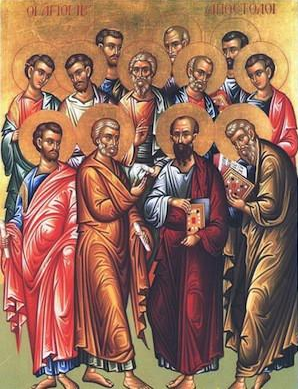 |
| Twelve apostles, one for each tribe of Israel |
Here are the twelve named as apostles:
'Matey, Teddy, Simon, Jorn, Pedher, Andy, Barty, Philly, Jamesy Mor and Tom, Matt and Jakes Mac Carty' 142.27
That's Matthias, Thaddaeus, Simon the Canaanite, John, Simon Peter, Andrew, Bartholomew, Philip, James the son of Zebedee, Thomas, Matthew, James the son of Alphaeus. Their names have been given an Irish twist, and include the Dublin sports journalist Jakes McCarthy ('Father, Son and Holy Ghost and Jakes M'Carthy.' Ulysses).
'Matey, Teddy, Simon, Jorn, Pedher, Andy, Barty, Philly, Jamesy Mor and Tom, Matt and Jakes Mac Carty' 142.27
That's Matthias, Thaddaeus, Simon the Canaanite, John, Simon Peter, Andrew, Bartholomew, Philip, James the son of Zebedee, Thomas, Matthew, James the son of Alphaeus. Their names have been given an Irish twist, and include the Dublin sports journalist Jakes McCarthy ('Father, Son and Holy Ghost and Jakes M'Carthy.' Ulysses).
One long passage has the twelve as jurymen, trying HCE and finding him guilty every night of his sin in the park:
'each and every juridical sessions night, whenas goodmen twelve and true at fox and geese in their numbered habitations tried old wireless over boord in their juremembers, whereas by reverendum they found him guilty of their and those imputations of fornicolopulation with two of his albowcrural correlations...' 557.13
They are also the months of the year:
'those component partners of our societate, the doorboy, the cleaner, the sojer, the crook, the squeezer, the lounger, the curman, the tourabout, the mussroomsniffer, the bleakabluetramp, the funpowtherplother, the christymansboxer' 142.08
Joyce originally listed the months as 'doorman, boiler, warrior, priser, courter, lounger, kenneler, tourist, harvester, blackablue tramp, funpowther plotter, chrystyman's box'. See if you can work out why he chose these names, and then find the explanations in fweet here.
The Ku Klux Klan had their own calendar, whose months are listed here:
'no more the tolvmaans, bloody gloomy hideous fearful furious alarming terrible horrible mournful sorrowful frightful appalling' 549.10
('horrible', not in the published text, was restored in the Corrected Text)
Here are the twelve signs of the Zodiac:
'Butting, charging, bracing, backing, springing, shrinking, swaying, darting, shooting, bucking and sprinkling their dossies sodouscheock with the twinx of their taylz.' 524.22
(butting ram, charging bull, brace of twins, backing crab, springing lion, shrinking virgin, swaying scales, darting scorpion, shooting archer, bucking goat, sprinkling water-carrier, fishes' tails)
In The Sigla of Finnegans Wake, Roland McHugh quotes this passage from Alwyn and Brinley Rees' Celtic Heritage: Ancient Tradition in Ireland and Wales.


TWELVE CRITICS
As in Tom Gauld's strip, the twelve are also critics. When Joyce set about creating a readership for his book, he picked twelve critics to do it for him – Samuel Beckett, Marcel Brion, Frank Budgen, Stuart Gilbert, Eugene Jolas, Victor Llona, Robert McAlmon, Thomas McGreevy, Elliot Paul, John Rodker, Robert Sage and William Carlos Williams. Their essays were collected in a 1929 book he called Our Exagmination Round His Factification for Incamination of Work in Progress.
Joyce called the twelve critics his marshals (he wrote to Valery Larbaud that he had stood behind 'those twelve marshals more or less directing them') imagining himelf as a Napoleon (though the emperor always had more then twelve marshals).

The cover has Joyce's sigla for the twelve, a clock face or a wheel with twelve spokes.
Having made the twelve real people, Joyce put them back into Finnegans Wake as characters:
'Imagine the twelve deaferended dumbbawls of the whowl abovebeugled to be the contonuation through regeneration of the urutteration of the word in pregross.' 284.18
'His producers are they not his consumers? Your exagmination round his factification for incamination of a warping process.' 497.02
I briefly became one of the twelve myself in 2013, when I went to a Wake reading session at Sweny the Chemist's, the great Joycean shrine in Dublin. I was delighted to discover that there were twelve of us, and we read the book sitting in a circle.
 |
| The twelve reading Shem the Penman in Sweny's |
DOYLES AND SULLIVANS
The twelve are sometimes called Doyles and sometimes Sullivans. They are 'doyles when they deliberate but sullivans when they are swordsed.' 142.26
The two names show the good and bad sides of public opinion. When the twelve are a deliberating jury, they are Doyles – probably from the Irish parliament, the Dail.
‘The jury (a sour dozen of stout fellows
all of whom were curiously named after doyles)' 574.30
'sour dozen of stout' suggests Saorstát Éireann - the Irish Free State.
They are also Doyles when they are in
harmony, as a choir:
‘a choir of the O’Daley O’Doyles
doublesixing the chorus’ 48.13

Nuad's irresistible Claideam Soluis (Sword of Light) was one of four magical objects of the Tuatha de Danaan. Joyce lists them at 211.11, where he calls the sword 'Clive Sollis'. An Claideam Soluis was also the title of the Gaelic League's newspaper, edited by Patrick Pearse.

Their leader is 'Sully the Thug' (212.03), and as a mob they sully the reputation of HCE.
'Sulla, an orthodox savage (and leader of a band of twelve mercenaries, the Sullivani).’ 573.06
'Sully, a barracker associated with tinkers, the blackhand, Shovellyvans, wreuter of annoyimgmost letters and skirriless ballets...'495.01
That's why they're called 'hoolivans of the nation' at the wake – hooligans mixed with Sullivans.
As an unthinking mob, Joyce's twelve are like cattle, 'ruled, roped, duped and driven' (142.23) by more powerful forces they do not understand.

THE FALL OF PARNELL
'Affected Mob Follows in Religious Sullivence' 602.25
There really was a Sullivan gang. This was the group of Catholic Irish politicians from Bantry in West Cork who, in alliance with the priests, destroyed Charles Stewart Parnell after the O'Shea divorce scandal.
There's a plaque to them in Bantry.

Their supporters called them the Bantry band, but Parnellites, like Joyce's father and W.B.Yeats, knew them as 'the Bantry gang' or 'the Sullivan gang'.
'If all other reasons were absent, it would seem plain that a combination of priests with 'the Sullivan gang' is not likely to have on its side in political matters divine justice.'
Yeats to John O'Leary January 1891
The Sullivan name came from the brother MPs, Timothy Daniel Sullivan (above right), composer of 'God Save Ireland', and Alexander Martin Sullivan, proprieter of The Nation (hence 'hoolivans of the nation' perhaps). Their leader was Tim Healy (above left), T.D.Sullivan's nephew and son-in-law. It was Healy who denounced Parnell in the dramatic split in Committee Room 16 on 6 December 1890, when he said that the alliance with the Liberals had ended 'in the stench of the divorce court.'
 |
| From the Durrus History website |
The Sullivan name came from the brother MPs, Timothy Daniel Sullivan (above right), composer of 'God Save Ireland', and Alexander Martin Sullivan, proprieter of The Nation (hence 'hoolivans of the nation' perhaps). Their leader was Tim Healy (above left), T.D.Sullivan's nephew and son-in-law. It was Healy who denounced Parnell in the dramatic split in Committee Room 16 on 6 December 1890, when he said that the alliance with the Liberals had ended 'in the stench of the divorce court.'
Tim Healy's twin brother Maurice, another MP in the group, also married a daughter of T.D.Sullivan.
Another key figure in the gang was William Martin Murphy, the Irish press baron. In Ulysses, the Citizen calls him 'Martin Murphy that Bantry jobber.' During the divorce scandal, Murphy founded the National Press, edited by Healy, as a means of destroying Parnell.
 |
| Martin Murphy that Bantry jobber |
'After
the Parnell divorce case, 'the Sullivan gang', led by Healy and backed
by Murphy's money, emerged as the spearhead of the clerical attack on
Parnell... To the young Yeats, whose dislike of 'the Sullivan gang'
antedated these proceedings – the spectacle of the plebeian Healy
taunting the fallen aristocrat was a powerful symbol.'
Healy's vicious attacks on Parnell inspired the nine-year old Joyce to write a poem, 'Et tu Healy', which John Stanislaus Joyce had printed - even sending a copy to the Pope!
'It... was a diatribe against the supposed traitor, Tim Healy, who had ratted at the bidding of the Catholic bishops and become a virulent enemy of Parnell, and so the piece was an echo of those political rancours that formed the theme of my father's nightly half-drunken rantings to the accompaniment of vigorous table-thumping. I think it was in verse because of the rhythm of bits of it that I remember. One line is a pentameter. At the end of the piece the dead Chief is likened to an eagle, looking down on the grovelling mass of Irish politicians from
His quaint-perched aerie on the crags of Time
Where the rude din of this . . . century
Can trouble him no more.'
Stanislaus Joyce, My Brother's Keeper
In A Portrait, the Parnellites Mr Casey and Simon Dedalus get into a ferocious argument with the devout Dante Riordan about the 'the priests' pawns':
'—Let him remember...the language with which the priests and the priests’ pawns broke Parnell’s heart and hounded him into his grave. Let him remember that too when he grows up.
—Sons of bitches! cried Mr Dedalus. When he was down they turned on him to betray him and rend him like rats in a sewer. Lowlived dogs! And they look it! By Christ, they look it!
—They behaved rightly, cried Dante. They obeyed their bishops and their priests. Honour to them!'
Later in the book, Stephen remembers the argument: 'His father’s gibes at the Bantry gang leaped out of his memory.'
Joyce, who hero-worshipped Parnell, wrote of his fall:
'Of the eighty three deputies, only eight remained faithful to him. The high and low clergy entered the lists to finish him off. The Irish press emptied on him and the woman he loved the vials of their envy. The citizens of Castlecomer threw quicklime in his eyes. He went from county to county, from city to city, 'like a hunted deer', a spectral figure with the signs of death on his forehead. Within a year he died of a broken heart at the age of 45.... In his final desperate appeal to his countrymen, he begged them not to throw him as a sop to the English wolves howling around them. It redounds to their honour that they did not fail this appeal. They did not throw him to the English wolves; they tore him to pieces themselves.'
'The Shade of Parnell', 1912
During the Wake's seance chapter, we hear that desperate cry of Parnell:
'Do not flingamejig to the twolves!' 479.14
By adding a 't' to wolves, Joyce has made Parnell beg them not to throw him to the twelve.
One of the messages of Finnegans Wake is that history repeats itself. I keep seeing parallels between Parnell's story and today's Brexit crisis. Bitterly divided, the Parnellites and Anti-Parnellites used their newspapers to accuse each other, in increasingly vitriolic terms, of treason. The public, 'ruled, roped, duped and driven' by the press and the priests, turned to violence. In Castlecomer, Parnell had quicklime flung in his eye. Tim Healy had the windows of his Dublin house smashed and was attacked twice, in Dublin and in Cork. Like Parnell, he suffered an eye injury.
'A Parnellite came up to (Healy) in his hotel in Cork, accused him of betraying his country, and punched him repeatedly in the face, smashing his glasses, splinters from which went into his eye.' Robert Kee, The Laurel and the Ivy
British MPs are now being advised to travel in groups to avoid being attacked.
It feels like the swordsed Sullivans are once more on the march.
'It... was a diatribe against the supposed traitor, Tim Healy, who had ratted at the bidding of the Catholic bishops and become a virulent enemy of Parnell, and so the piece was an echo of those political rancours that formed the theme of my father's nightly half-drunken rantings to the accompaniment of vigorous table-thumping. I think it was in verse because of the rhythm of bits of it that I remember. One line is a pentameter. At the end of the piece the dead Chief is likened to an eagle, looking down on the grovelling mass of Irish politicians from
His quaint-perched aerie on the crags of Time
Where the rude din of this . . . century
Can trouble him no more.'
Stanislaus Joyce, My Brother's Keeper
In A Portrait, the Parnellites Mr Casey and Simon Dedalus get into a ferocious argument with the devout Dante Riordan about the 'the priests' pawns':
'—Let him remember...the language with which the priests and the priests’ pawns broke Parnell’s heart and hounded him into his grave. Let him remember that too when he grows up.
—Sons of bitches! cried Mr Dedalus. When he was down they turned on him to betray him and rend him like rats in a sewer. Lowlived dogs! And they look it! By Christ, they look it!
—They behaved rightly, cried Dante. They obeyed their bishops and their priests. Honour to them!'
Later in the book, Stephen remembers the argument: 'His father’s gibes at the Bantry gang leaped out of his memory.'
Joyce, who hero-worshipped Parnell, wrote of his fall:
'Of the eighty three deputies, only eight remained faithful to him. The high and low clergy entered the lists to finish him off. The Irish press emptied on him and the woman he loved the vials of their envy. The citizens of Castlecomer threw quicklime in his eyes. He went from county to county, from city to city, 'like a hunted deer', a spectral figure with the signs of death on his forehead. Within a year he died of a broken heart at the age of 45.... In his final desperate appeal to his countrymen, he begged them not to throw him as a sop to the English wolves howling around them. It redounds to their honour that they did not fail this appeal. They did not throw him to the English wolves; they tore him to pieces themselves.'
'The Shade of Parnell', 1912
During the Wake's seance chapter, we hear that desperate cry of Parnell:
'Do not flingamejig to the twolves!' 479.14
By adding a 't' to wolves, Joyce has made Parnell beg them not to throw him to the twelve.
 |
| Parnell, eye bandaged after the lime attack, faces down the baying mob |
One of the messages of Finnegans Wake is that history repeats itself. I keep seeing parallels between Parnell's story and today's Brexit crisis. Bitterly divided, the Parnellites and Anti-Parnellites used their newspapers to accuse each other, in increasingly vitriolic terms, of treason. The public, 'ruled, roped, duped and driven' by the press and the priests, turned to violence. In Castlecomer, Parnell had quicklime flung in his eye. Tim Healy had the windows of his Dublin house smashed and was attacked twice, in Dublin and in Cork. Like Parnell, he suffered an eye injury.
'A Parnellite came up to (Healy) in his hotel in Cork, accused him of betraying his country, and punched him repeatedly in the face, smashing his glasses, splinters from which went into his eye.' Robert Kee, The Laurel and the Ivy
British MPs are now being advised to travel in groups to avoid being attacked.
It feels like the swordsed Sullivans are once more on the march.
FOX AND STAG
During the O'Shea divorce proceedings, it was revealed that Parnell used the name Fox when carrying on his affair. This led the Anti-Parnellite Charles Tanner to suggest in a Kilkenny speech that it was 'the duty of every Irishman to hunt Mr Fox with a cry of Tally-ho!'.
So, in the Wake, HCE becomes a fox hunted by a pack of dogs:
'Gundogs of all breeds were beagling with renounced urbiandorbic bugles, hot to run him, given law, on a scent breasthigh, keen for the worry. View!' 96.36
Parnell's supporters, like W.B.Yeats, preferred to see him as a hunted stag, which is more noble than its pursuers.
'During the quarrel over Parnell's grave, a quotation from Goethe ran through the papers, describing our Irish jealousy. 'The Irish seem to me like a pack of hounds, always dragging down some noble stag.''
W.B.Yeats, Autobiography, 1958, p211
Yeats used the image in two poems: 'But popular rage, Hysterica passio dragged this quarry down' ('Parnell's Funeral'), 'Your enemy, an old foul mouth, had set The pack upon him' ('To a Shade'). The 'foul mouth' was Tim Healy.
 |
| 'Stag Hunt' by Pauwel de Vos and Jan Wildens, 1633 |
The same image is in the poem Joyce gave to his Parnellite journalist, Joe Hynes:
'He is dead. Our Uncrowned King is dead.
O, Erin, mourn with grief and woe
For he lies dead whom the fell gang
Of modern hypocrites laid low.
He lies slain by the coward hounds
He raised to glory from the mire...'
'Ivy Day in the Committee Room.'
There's a stag hunt in Finnegans Wake, based on Ireland's famous Ward Union Stag hunt, between Naul and Ratoath in County Meath:
'the Wald Unicorns Master, Bugley Captain, from the Naul, drawls up by the door with the Honourable Whilp and the Reverend Poynter and the two Lady Pagets of Tallyhaugh, Ballyhuntus, in their riddletight raiding hats for to lift a hereshealth to their robost, the Stag, evers the Carlton hart.' 622.25
The initials in the last four words tell us that the stag is HCE.
On page 97, when HCE is being hunted as a fox, the place names are all in the area hunted by the Ward Union.
'From his holt outratted across the Juletide's genial corsslands of Humfries Chase from Mullinahob and Peacockstown, then bearing right upon Tankardstown...then through Raystown and Horlockstown and, louping the loup, to Tankardstown again. Ear canny hare for doubling through Cheeverstown they raced him, through Loughlinstown and Nutstown to wind him by the Boolies.'
Joyce, who strongly identified with Parnell, imagined himself as a defiant stag:
‘I stand the self-doomed, unafraid,
Unfellowed, friendless and alone,
Indifferent as the herring-bone,
Firm as the mountain ridges where
I flash my antlers on the air.’
'The Holy Office'
On his birthday, Joyce liked to wear a hunting waistcoat decorated with stags
and hounds –a family heirloom, given to him by his father in 1912. You can see it today in the
James Joyce Tower museum in Dublin.

I wonder if Tom Gauld has read Finnegans Wake. Joyce has made another appearance in his cartoon strip. But it would be nice if the appearance of the twelve in his cartoon is another of those many coincidences that cluster around the Wake.


