'How many! All these here once walked round Dublin. Faithful departed. As you are now so once were we.'
Bloom's thoughts in Glasnevin, 'Hades'
In Dublin last week, Lisa and I visited Glasnevin, the biggest and most famous cemetery in Ireland. It's home to 1.5 million departed Dubliners, 150 of them characters or people named in Ulysses. Former enemies lie here close together. Parnell is united in death with Tim Healy and Michael Collins with Eamon De Valera. Thomas Henry Burke, victim of the Phoenix Park murders is here, and so is a memorial to the Irish National Invincibles who killed him.
In Ulysses, Leopold Bloom travels to the cemetery for Paddy Dignam's funeral. Several of the characters who attend Dignam's funeral have now joined him in Glasnevin, including Simon Dedalus (John Joyce), Martin Cunningham (Matthew Kane), John Henry Menton, Father Coffey and the caretaker, John O'Connell.
I think the 'Hades' chapter, based on Odysseus's journey to the underworld, has more Homeric parallels than any other episode of Ulysses. Paddy Dignam, for example, is Elpenor, Odysseus's youngest companion, killed by accidentally falling from a roof. When Odysseus meets him in the underworld, he says, 'You have come here faster on foot than I could in my black ship.'
Dignam's funeral crosses four streams, the Dodder, Liffey and the Grand and Royal Canals - the four rivers of the underworld (Styx, Acheron, Cocytus and Phlegethon).
The statues Bloom passes on the way to the cemetery are Homer's heroic dead, who greet Odysseus in the underworld. Daniel O'Connell the Liberator, who founded Glasnevin, is Hercules.
'They passed under the hugecloaked Liberator's form.'

'Foundation stone for Parnell. Breakdown. Heart.'
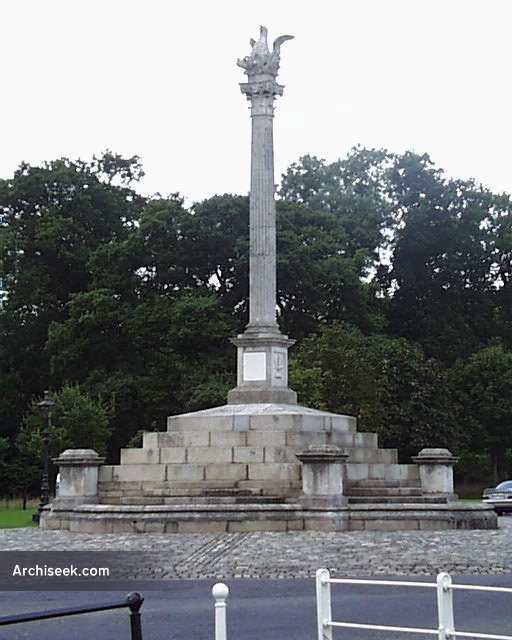
Parnell, Ireland's dead king, is Agamemmnon, both brought down through women. There was only a foundation stone for the monument in 1904.
 |
| The statue was unveiled in 1911 |
 |
| There was no English version on sale |
'Got his rag out that evening on the bowling green because I sailed inside him. Pure fluke of mine: the bias. Why he took such a rooted dislike to me. Hate at first sight...'
We couldn't find Menton among the densely packed graves - the map only gives general locations. But it was good to find this grave.

Francis Sheehy Skeffington (1878-1916) was at University College with Joyce. He was a socialist, republican, pacifist and feminist. After marrying Hanna Sheehy, a childhood friend of Joyce's, in 1903, he added her surname to his own. He tried to stop looting during the Easter Rising and was shot on the orders of a deranged British officer.
He appears as McCann in A Portrait of the Artist, where he tells Stephen Dedalus:
'Dedalus, you're an anti-social being, wrapped up in yourself. I'm not. I'm a democrat: and I'll work and act for social liberty and equality among all classes and sexes in the United States of the Europe of the future....I believe you're a good fellow but you have yet to learn the dignity of altruism and the responsibility of the human individual'.
In Glasnevin, generations of the same family are often buried in a single plot. Francis is here with Hanna, his mother, son and daughter-in-law, who followed the same radical tradition. The epitaph says they 'sought truth, taught reason and knew compassion.'
Nearby, we found Brendan Behan, who now has a little bronze statue inside the hole on his gravestone, where visitors used to leave pints of Guinness.


People still leave pints for Brendan, but at the foot of the stone.


I spotted another familiar name nearby.

I was excited to see a monument to Mulcahy with a statue of Jesus on top.

'- They tell the story, he said, that two drunks came out here one foggy evening to look for the grave of a friend of theirs. They asked for Mulcahy from the Coombe and were told where he was buried. After traipsing about in the fog they found the grave, sure enough. One of the drunks spelt out the name: Terence Mulcahy. The other drunk was blinking up at a statue of our Saviour the widow had got put up.
The caretaker blinked up at one of the sepulchres they passed. He resumed:
-- And, after blinking up at the sacred figure, Not a bloody bit like the man, says he. That's not Mulcahy, says he, whoever done it.'
Sadly it's the wrong Mulcahy. This monument is to Ellen Mulcahy who died in 1942. Had her family read Ulysses?
I wanted to find Parnell's enemy, Tim Healy, leader of the Bantry Gang, who I wrote about last month. He inspired Joyce's first ever published poem 'Et tu Healy'. While looking for him, we had the great luck to meet a Dubliner who asked us which grave we wanted to see. He took us straight to Healy.

The Dubliner's name is Martin Mooney, and he loves Glasnevin cemetery. He knows where all the characters in Ulysses are buried thanks to Vivien Igoe's book, The Real People of Joyce's Ulysses, where she lists them and gives locations using the cemetery grid system. Healy for example, is listed as at CE4. The letters, which are marked on the boundary walls, locate the rows of graves running east to west, while the numbers show the north-south position.
Martin knows Glasnevin better than anyone, but he hasn't read Ulysses and doesn't know the story. He's got Vivien Igoe's book because it is the best single source for biographies on the dead of Glasnevin. So we were able to give each other a guided tour. He showed us the graves, and I read out passages from Ulysses from my kindle.
I asked Martin if he could show us Joyce's parents and he took us there next.

'– Her grave is over there, Jack, Mr Dedalus said. I'Il soon be stretched beside her. Let Him take me whenever He likes.
Breaking down, he began to weep to himself quietly, stumbling a little in his walk. Mr Power took his arm.
–She's better where she is, he said kindly.
–I suppose so, Mr Dedalus said with a weak gasp. I suppose she is in heaven if there is a heaven.'
'In accordance with the instructions from his father’s ghost (so the son suggested), the gravestone for Glasnevin was soon commissioned (via Alfie Bergan) from Harrison’s, who had done the arms of Dublin for the North City Markets in 1892. Bergan had heard directly from John Stanislaus that the inscription was to mention only John himself and his wife May. There would be nothing about the other Joyces in the same plot, not even poor Georgie or Baby. Ignoring them John Stanislaus's own role as a father was ignored. To put up the gravestone as requested left Joyce (or his patron) in the end about £12 out of pocket. Alf Bergan sent him photographs of it.'
John Wyse Jackson and Peter Costello. John Stanislaus Joyce. p425

Martin then took us to the grave of Joseph Hutchinson (1852-1928), the fifth down above. He was Lord Mayor of Dublin in 1904. I found him on my kindle in the 'Wandering Rocks' episode, where we learn that he's away from the city on Bloomsday, visiting Llandudno. He's not in the City Council meeting on the Irish language, where Lorcan Sherlock deputises:
'Hell open to christians they were having, Jimmy Henry said pettishly, about their damned Irish language. Where was the marshal, he wanted to know, to keep order in the council chamber. And old Barlow the macebearer laid up with asthma, no mace on the table, nothing in order, no quorum even and Hutchinson, the lord mayor, in Llandudno and little Lorcan Sherlock doing locum tenens for him. Damned Irish language, of our forefathers'

Nearby we found Timothy Harrington, who was Lord Mayor of Dublin from 1901-3. He's in the Wake in the cluster of Lord Mayors given by their initials at 131.03. In Ulysses, he's remembered as the former Lord Mayor in the hallucinatory 'Circe' episode:
'(Several wellknown burgesses, city magnates and freemen of the city shake hands with Bloom and congratulate him. Timothy Harrington, late thrice Lord Mayor of Dublin, imposing in mayoral scarlet, gold chain and white silk tie, confers with councillor Lorcan Sherlock, locum tenens. They nod vigorously in agreement.)
LATE LORD MAYOR HARRINGTON (In scarlet robe with mace, gold mayoral chain and lace white silk scarf) That alderman sir Leo Bloom's speech be printed at the expense of the ratepayers. That the house in which he was born be ornamented with a commemorative tablet and that the thoroughfare hitherto known as Cow Parlour off Cork street be henceforth designated Boulevard Bloom.'
Bloom's birthplace, in Clanbrassil Street, is now 'ornamented with a commemorative plaque'!

I asked Martin to show us James 'Skin-the-Goat' Fitzharris's grave, where he posed for this picture.

James 'Skin-the-Goat' Fitzharris (1833-1010) was a Dublin cab-driver. Vivien Igoe says he got his nickname 'from a goat he found plucking at the straw that filled a horse's collar. He killed the goat, skinned it and used its hide to cover his knees when driving.'
On 6 May 1882, Fitzharris drove the Invincibles to the Phoenix Park, where they assassinated Lord Frederick Cavendish and Thomas Henry Burke. He refused to testify against them, despite offers of a huge bribe, and served time in prison. His grave is also a memorial to the five Invincibles who were hanged for the killing, and to Joseph Poole, a Fenian, hanged the same year for another killing.
Fitzharris is in Ulysses in the chapter in the cabman's shelter:
'Mr Bloom and Stephen entered the cabman's shelter, an unpretentious wooden structure, where, prior to then, he had rarely, if ever, been before; the former having previously whispered to the latter a few hints anent the keeper of it, said to be the once famous Skin-the-Goat, Fitzharris, the invincible, though he wouldn't vouch for the actual facts, which quite possibly there was not one vestige of truth in.'
By this Invincibles memorial, I read Martin the startling passage about the hanging of Joe Brady.
'I heard that from the head warder that was in Kilmainham when they hanged Joe Brady, the invincible. He told me when they cut him down after the drop it was standing up in their faces like a poker.' 'Cyclops'

'Never know who you're talking to...Like that Peter or Denis or James Carey that blew the gaff on the invincibles' 'Hades'
This led us into an Invincibles detour. Martin took us to the monument, paid for by Irish Americans, to Patrick O'Donnell, who shot the informer James Carey when they were both on a ship bound for South Africa. O'Donnell was brought back to London and hanged.
Next to the O'Donnell memorial, Martin pointed out the grave of Thomas Brady, father of Joe 'Bulldog' Brady. Thomas had asked to be buried here, as O’Donnell had avenged his son’s death by killing Carey. It's a new stone, put up in 2018 by the 'Invincibles Reinterment Campaign.'

The other grave I'd always wanted to visit was this, which is the only one in Glasnevin to mention Joyce's writing.

'Of what did bellchime and handtouch and footstep and lonechill remind him?
Of companions now in various manners in different places defunct: Percy Apjohn (killed in action, Modder River), Philip Gilligan (phthisis, Jervis Street hospital), Matthew F. Kane (accidental drowning, Dublin Bay), Philip Moisel (pyemia, Heytesbury street), Michael Hart (phthisis, Mater Misericordia hospital), Patrick Dignam (apoplexy, Sandymount).'
Cunningham's drowning is 'remembored' by the senile Old Men in 'Mamalujo', the first part of the Wake to be published:
'and then there was the drowning of Pharoah and all his pedestrians and they were all completely drowned into the sea, the red sea, and then poor Martin Cunningham out of the castle on pension when he was completely drowned off Dunleary at that time in the red sea and a lovely mourning paper and thank God there were no more of him.'
In the final published version, Joyce changed this to 'poor Merkin Cornyngwham, the official out of the castle on pension, when he was completely drowned off Erin Isles...'. 387.28
So it's a shame the gravestone doesn't mention his appearance in Finnegans Wake.
'Shakespeare' is also named on the gravestone, because of this description of Cunningham in 'Hades':
'Martin Cunningham's large eyes. Looking away now. Sympathetic human man he is. Intelligent. Like Shakespeare's face. Always a good word to say.... And that awful drunkard of a wife of his. Setting up house for her time after time and then pawning the furniture on him every Saturday almost. Leading him the life of the damned. Wear the heart out of a stone, that. Monday morning start afresh.'
In the Homeric parallel, Cunningham is Sisyphus, who has to roll a rock up a hill every day, only for it to roll down when it nears the top.

After Kane we found Dennis J Maginni, the dancing master, whose academy at 35 North Great George Street is now the Joyce Centre. There's a sign with a picture of him on the grave.
'Mr Denis J. Maginni, professor of dancing, &c., in silk hat, slate frockcoat with silk facings, white kerchief tie, tight lavender trousers, canary gloves and pointed patent boots, walking with grave deportment most respectfully took the curbstone as he passed lady Maxwell at the corner of Dignam's court.' 'Wandering Rocks'
We had only half an hour before the gates closed, but Martin took us at a brisk march round several more Ulysses graves. This is Paddy Hooper (1873-1931) , a well-known journalist working for the Freeman's Journal. From the 1890s to 1916, he was the paper's London correspondent. In Ulysses, he's made one of his occasional visits home to Dublin, and is found drinking in the Oval.

– What's that? Myles Crawford said with a start. Where are the other two gone?
– Who? the professor said, turning. They're gone round to the Oval for a drink. Paddy Hooper is there with Jack Hall. Came over last night.
– Come on then, Myles Crawford said. Where's my hat?
Jack Hall was another famous Dublin journalist, also buried in Glasnevin. Vivien Igoe says he broke the news of the Phoenix Park murders, getting the story into the midnight edition of the Evening Telegraph.
The next grave we saw belonged to Paddy Hooper's father, Alderman John Hooper (1845-97), who gave the Blooms a stuffed owl as a wedding present.

'What homothetic objects, other than the candlestick, stood on the mantelpiece?
A timepiece of striated Connemara marble, stopped at the hour of 4.46 a.m. on the 21 March 1896, matrimonial gift of Matthew Dillon: a dwarf tree of glacial arborescence under a transparent bellshade, matrimonial gift of Luke and Caroline Doyle: an embalmed owl, matrimonial gift of Alderman John Hooper.'
The next three graves were monuments to famous Dubliners from an earlier age, who are mentioned just in passing by Joyce.

This is the grave of Timothy O'Brien (1787-1862) a merchant, banker and Lord Mayor of Dublin. Vivien Igoe says that, as an innkeeper, O'Brien was known for his short measures. He
used a battered naggin for this and was nicknamed 'The Knight of the
Battered Naggin' . Perhaps that's how he could afford this grand
monument.
He's named in the drunken cacophony at the end of 'Oxen of the Sun':
'All off for a buster, armstrong, hollering down the street. Bonafides. Where you slep las nigh? Timothy of the battered naggin.'

He's mentioned by Miles Crawford, editor of the Evening Telegraph:
'–Grattan and Flood wrote for this very paper, the editor cried in his
face. Irish volunteers. Where are you now?...Who have you now like John
Philpot Curran? Psha!' 'Aeolus'
Next we saw a monument, in Gaelic, to James Fintan Lalor (1807-49), the orator and revolutionary. He response to the famine was to call for the nationalisation of the land:
'Ireland her own, and all therein, from the sod to the sky. The soil of Ireland for the people of Ireland.'

'In 1885 (Bloom) had publicly expressed his adherence to the collective and national economic programme advocated by James Fintan Lalor.' 'Ithaca'.

'Hereupon Punch Costello dinged with his fist upon the board and would sing a bawdy catch Staboo Stabella about a wench that was put in pod...' 'Oxen of the Sun'

It was close to cemetery closing time, and we left by the Prospect Gate, which stands next to our favourite pub in Dublin, John Kavanagh's, nicknamed the Gravediggers. We'd arranged to meet Dublin friends, Olga, Kevin, Alfreda and Ciaran here. Ciaran, the pub's tapas chef, is famous for his coddle. We spent the evening with them in the pub drinking the best Guinness in the world.
A visit to Glasnevin is a great way to find out more about the people of Ulysses, and to learn about Irish history along the way. I recommend the official cemetery guides, but if you want to make your own Joyce tour, look out for Martin Mooney!

If you can't get to Glasnevin, watch the beautiful film, 'One Million Dubliners', which features the erudite, witty and charismatic Glasnevin historian and guide Shane MacThomais. I went on one of his tours years ago, and was shocked to hear that he took his life in the cemetery in 2014. At his funeral, which frames the film, his friend and fellow guide Lorcan Collins likened his death to 'a library burning down.'