Showing posts with label hen. Show all posts

Friday, 4 November 2022

James Joyce's Ashpit


How many great writers have had archaeological digs in their back gardens?  

I learned that a Joyce excavation in Fairview, Dublin, was taking place in 2013, from PQ's blog, A Building Roam. He shared a story from the Irish Times, which declared 'While it is unlikely that the excavation will yield any lost manuscripts, it is still the first such exploration of a Joyce location that has been undertaken.'


The 2014 spring edition of Archaeology Ireland (top) has Andy Halpin and Mary Cahill's report on the secrets they uncovered in the ashpit of the Joyce family house at 8 Royal Terrace (now Inverness Rd) Fairview.  

Ashpits were rectangular sunken brick or concrete lined structures, for dumping the ashes from fires and other domestic rubbish. In the 19th century, the ashes were taken away to be used as fertiliser or material for brickmaking.  In Ireland and Britain, we still call rubbish collectors 'dustmen'. 

Here's a dustman from Mayhew's London Labour and the London Poor.  


We meet a dustman in Finnegans Wake'A dustman nocknamed Sevenchurches in the employ of Messrs Achburn, Soulpetre and Ashreborn, prairmakers, Glintalook...' 59.16

I like 'Ashreborn' - the ashes from ashpits are reborn as bricks and new life from fertiliser.

'This ourth of years is not save brickdust and being humus the same roturns.' 18.04

The Joyces lived in 8 Royal Terrace from 1900-1901, and it's the setting for the chapter of A Portrait where Stephen walks to the University.  Joyce describes the wet rubbish in the lane behind the house, where the dustmen would have made their collections;

'The lane behind the terrace was waterlogged and as he went down it slowly, choosing his steps amid heaps of wet rubbish, he heard a mad nun screeching in the nuns’ madhouse beyond the wall.

—Jesus! O Jesus! Jesus!

He shook the sound out of his ears by an angry toss of his head and hurried on, stumbling through the mouldering offal, his heart already bitten by an ache of loathing and bitterness.'

The nun's screeching may explain why, in Finnegans Wake, Joyce renames the street 'Royal Terrors' (420.28).

By the late Victorian period, metal dustbins (ashcans in the USA) had largely replaced sunken ashpits, and so the one in Fairview wouldn't have been regularly cleared out. The ashpit in 'An Encounter' is a place 'where nobody ever came':

'I hid my books in the long grass near the ashpit at the end of the garden where nobody ever came and hurried along the canal bank.' 


A London dustman in 1910

In 'Araby', Joyce describes the smell of the ashpits in North Richmond Street, where the family lived in 1894-7:

'The career of our play brought us through the dark muddy lanes behind the houses where we ran the gauntlet of the rough tribes from the cottages, to the back doors of the dark dripping gardens where odours arose from the ashpits, to the dark odorous stables where a coachman smoothed and combed the horse or shook music from the buckled harness.'

(Thanks to Hen Hanna for sharing these Dubliners quotes, when we were discussing the ashpit excavation)

Joyce talks about the same smells in a letter to his publisher:

'It is not my fault that the odour of ashpits and old weeds and offal hangs round my stories.'

Joyce to Grant Richards, 24 September 1905, Letters II

ASHPIT ARCHAEOLOGY


The story of the dig began in 2012, when the house owner, Stephen D'Arcy, discovered the ashpit. From the archaeologist's report: 

'Stephen, a professional gardener, was preparing this part of the garden for planting when he discovered the walls of the ash pit. At first he thought that they were the footing for a barbecue stand, but he quickly realised that he had discovered something quite different when fragments of glass with images began to emerge from the pit. At this stage, having removed some of the glass fragments (he) recognised them as magic lantern slides....'

From the Irish Times report on the dig

Stephen contacted the National Museum of Ireland, who sent in the archaeologists:

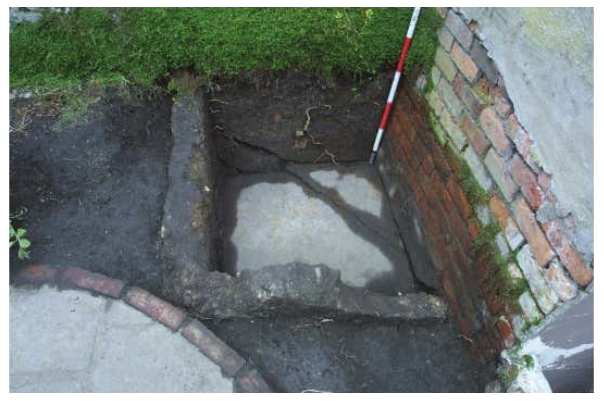
'Magic lantern slides in a suburban garden ash pit seem a long way from the usual investigations of cist burials and bog butter, but the archaeological nature of the discovery and the possible connection to important historical persons and events fit perfectly with the discipline of archaeological inquiry....The excavation of the ash pit took place over a week in February 2013, directed by Andy Halpin. Excavating an ash pit is not unlike excavating a Bronze Age cist burial, as the area to be excavated, confined by its concrete walls, is similar and the ashy deposit is also reminiscent of cremated deposits.'

Here's their photo of the excavated ashpit, which does look like a cist burial.


'charnelcysts of a weedwastewoldwevild' 613.21

'the hollow chyst excitement' 596.28

Cist burial, from Davis and Thurman's Crania Britannica, 1865

The dig revealed more than 250 complete and fragmented slides, mostly showing religious subjects. Some of them were painted, others posed photographs. Labels on the slides show they were bought from John Lizar's of Glasgow (which also had offices in Edinburgh, Liverpool and Belfast).

One of the ashpit slides, showing a scene from the Pilgrim's Progress


A John Lizar's magic lantern


In a great piece of detective work, the archaeologists suggest that the slides belonged to Thomas McBratney, a Presbyterian lay preacher who lived in the house from 1918 until his death in 1921. The slides must have been thrown away after his death, perhaps while Joyce was beginning Finnegans Wake.

THE ASHPIT BOOKS


Finding religious magic lantern slides in this ashpit is an astounding synchronicity. For this was the very ashpit, where in 1901, the Joyce family found two books.

'Somebody found at the end of the garden two books which the children nicknamed 'the ashpit books'. One was a song-book, the first pages of which were missing. It contained a large and miscellaneous collection of classical and traditional songs, popular ballads and many so-called comic songs, the humour of which always remained a mystery to me. The other was a closely and badly printed collated edition of the four gospels in a red cloth cover. The former tenants of the house were Protestants...As the little volume was still quite presentable, though the cloth of one cover was detached from the cardboard owing to exposure to weather, I put it on my shelf.'

Stanislaus Joyce, My Brother's Keeper, p113-114

'The splendour of the trove may have been the origin of another of John Stanislaus Joyce's sardonic catchphrases when anything was in short supply: 'Have you tried the ash-pit?'

John Wyse Jackson and Peter Costello, John Stanislaus Joyce, Fourth Estate, 1997, p227

Catholic families did not have Bibles, so the book was a revelation for Stanislaus, then aged 16. After reading it from cover to cover, 'the immediate result was the uneasy prompting of doubt.'  The ashpit book discovery led Stanislaus to lose his faith. 

'My mother blamed Jim for my blunt refusal to go to confession or Communion, but she was wrong, for in point of time, at least, I refused first.'

Stanislaus Joyce, My Brother's Keeper, p118

THE MIDDEN


The ashpit books recall the discovery in Finnegans Wake of a letter in a 'fatal midden' by Biddy the hen.  'Midden' is an archaeological term for a mound of domestic refuse, often food remains (kitchen middens). 

'This midden is a symbol, elaborated later, for the inhabited world in which men have left so many traces. The letter stands as a symbol for all attempts at written communication including all other letters, all the world's literature, the Book of Kells, all manuscripts, all the sacred books of the world, and also Finnegans Wake itself. One reason why The Book of Kells is included here is that it was once 'stolen by night...and found after a lapse of some months, concealed under sods' (Sullivan)'

J.S.Atherton, The Books at the Wake p62-3


Joyce may also have known that, since 1897, archaeologists were discovering vast amounts of Ancient Greek literature on papyrus scrolls from the dusty rubbish dumps of Oxyrhynchus in Egypt. 


Grenfel and Hunt's photo of their dig in Oxyrhynchus

The very first document discovered here was part of a previously unknown Gospel of Thomas, a Gnostic collection of the 'hidden sayings' of Jesus.  Read a transcript here.

Oxyrhynchus 1, The Gospel of Thomas

The hen, scratching at the heap, is like one of these archaeologists. The letter she finds seems to be from an Irish American woman in Boston to her sister Maggy:

'The bird in the case was Belinda of the Dorans...and what she was scratching at the hour of klokking twelve looked for all this zogzag world like a goodish-sized sheet of letterpaper originating by transhipt from Boston (Mass.) of the last of the first to Dear whom it proceded to mention Maggy well & allathome’s health...'111.05-11

Later in the Wake, this letter is explicitly linked with the ashpit

'a letter to last a lifetime for Maggi beyond by the ashpit' 211.22

In the heat of the midden, this Boston letter has been transformed, like a melting photographic negative of a horse:

'If a negative of a horse happens to melt enough while drying, well, what you do get is, well, a positively grotesquely distorted macromass of all sorts of horsehappy values and masses of meltwhile horse....this freely is what must have occurred to our missive.... Heated residence in the heart of the orangeflavoured mudmound had partly obliterated the negative to start with, causing some features palpably nearer your pecker to be swollen up most grossly...' 111.26-36


Horse negative, from pixabey.com

This makes it astounding that archaeologists should have found magic lantern slides in the ashpit. 

A photographic slide from the ashpit

Thanks to PQ for making the connection between the slides and the melting negative in his blog, where he relates this to Robert Anton Wilson, the biggest Wake synchronicity hunter.

To sum up this web of psychogeographic synchronicities:

1897 Archaeologists in Egypt discover a Gospel of Thomas in the rubbish dumps of Oxyrhynchus.
1901 At 8 Royal Terrace, Fairview, the Joyces find an edition of the four gospels in the ashpit.
1905 Joyce writes 'An Encounter,' in which the boy narrator hides his books 'in the long grass near the ashpit at the end of the garden where nobody ever came.'
Joyce writes to Grant Richards, 'It is not my fault that the odour of ashpits and old weeds and offal hangs round my stories.'
1921 Lay preacher Thomas McBratney's religious magic lantern slides find their way into the ashpit.
1923 Joyce writes the Hen chapter of Finnegans Wake, in which a letter dug out of a midden is compared with a melting photographic negative and a New Testament, the Book of Kells. This document has 'acquired accretions of terricious matter while loitering in the past' (114.28)
2013 The ashpit is excavated and the magic lantern slides discovered.

There might be even more synchronicities if we knew about the book of comic songs.

WALKING TO FAIRVIEW


Lisa and I made a pilgrimage to Fairview in June, during the Ulysses centenary celebrations, retracing the route Stephen takes from his home to the University, in reverse.  Father Conmee, who also walks part of the same route in Ulysses, is commemorated on Newcomen Bridge.


'His morning walk across the city had begun, and he foreknew that as he passed the sloblands of Fairview he would think of the cloistral silverveined prose of Newman; that as he walked along the North Strand Road, glancing idly at the windows of the provision shops, he would recall the dark humour of Guido Cavalcanti and smile'


Standing in front of the house,  I felt I was close to one of the key locations of Finnegans Wake.


Monday, 4 July 2016

Sex and Cricket in Finnegans Wake

As promised in my last post, here's James Joyce's steamy cricketing scene, from Finnegans Wake, pages 583.26–584.26. In their bedroom above the pub, HCE and ALP are having sex.
 
'Kickakick. She had to kick a laugh. At her old stick-in-the-block. The way he was slogging his paunch about, elbiduubled, meet oft mate on, like hale King Willow, the robberer. Cainmaker’s mace and waxened capapee. But the tarrant’s brand on his hottoweyt brow. At half past quick in the morning. And her lamp was all askew and a trumbly wick-in-her, ringeysingey. She had to spofforth, she had to kicker, too thick of the wick of her pixy’s loomph, wide lickering jessup the smooky shiminey. And her duffed coverpoint of a wickedy batter, whenever she druv behind her stumps for a tyddlesly wink through his tunnilclefft bagslops after the rising bounder’s yorkers, as he studd and stoddard and trutted and trumpered, to see had lordherry’s blackham’s red bobby abbels, it tickled her innings to consort pitch at kicksolock in the morm. Tipatonguing him on in her pigeony linguish, with a flick at the bails for lubrication, to scorch her faster, faster. Ye hek, ye hok, ye hucky hiremonger! Magrath he’s my pegger, he is, for bricking up all my old kent road. He’ll win your toss, flog your old tom’s bowling and I darr ye, barrackybuller, to break his duck! He’s posh. I lob him. We’re parring all Oogster till the empsyseas run googlie. Declare to ashes and teste his metch! Three for two will do for me and he for thee and she for you. Goeasyosey, for the grace of the fields, or hooley pooley, cuppy, we’ll both be bye and by caught in the slips for fear he’d tyre and burst his dunlops and waken her bornybarnies making his boobybabies. The game old merrimynn, square to leg, with his lolleywide towelhat and his hobbsy socks and his wisden’s bosse and his norsery pinafore and his gentleman’s grip and his playaboy’s plunge and his flannelly feelyfooling, treading her hump and hambledown like a maiden wellheld, ovalled over, with her crease where the pads of her punishments ought to be by womanish rights when, keek, the hen in the doran’s shantyqueer began in a kikkery key to laugh it off, yeigh, yeigh, neigh, neigh, the way she was wuck to doodledoo by her gallows bird (how’s that? Noball, he carries his bat!) nine hundred and dirty too not out, at all times long past conquering cock of the morgans.
  How blame us?
  Cocorico!'

Sex in Finnegans Wake is usually comic and grotesque. This is the case even with attractive young lovers, like Tristan and Isolde on their ship (where Tristan's sticking his tongue into Iseult's mouth is described as a football goal). In this passage we're dealing with HCE and ALP as the middle-aged Mr and Mrs Porter

A clear case of LBW
'She had to kick a laugh. At her old stick-in-the-block. The way he was slogging his paunch about'

The passage begins with ALP laughing at the sight of HCE, her old stick in the mud, slogging his paunch about on top of her. A slog is a powerful shot in which the batsman hits the ball as high and far as possible, aiming to reach the boundary.

 'elbiduubled' 583.27 Leg Before Wicket (L.B.W.)
 
'meet oft mate on...and her duff coverpoint...caught in the slips... square to leg' 583.28 etc

Mid Off, Mid On, Cover, Point, the Slips and Square Leg are all fielding positions in cricket, as shown in the plan below from Cricket for Dummies, which assumes a right handed batsman.

'like hale King Willow' 583.28

King Willow is an old name for cricket, whose bat is made of willow, a tough, light and resilient wood. Here's a 1946 British Pathe film about the making of bats, called 'King Willow'.


'Cainmaker’s mace and waxened capapee' 583.28

A mace to make a Cain would be the penis of Adam, our first father (we get Abel later in the passage). Cap-à-pie is armour (head to foot) – 'waxened' suggests a raincoat or condom. HCE's mace (penis) is covered with a condom (which threatens to burst later in the passage). 

Charles Stewart Caine (1861-1934) edited Wisden's Cricketers' Almanac, the Bible of the game, from 1926-33. Joyce wrote this passage in 1925–6.
'tarrant’s brand' 583.29

There were a few cricketing Tarrants, but the most famous was Frank Tarrant (1880-1951), an Australian all-rounder who settled in England and played for Middlesex. He was a right handed batsman and a left arm spin bowler. In 1909, playing for Middlesex against Gloucestershire, Tarrant became the only cricketer ever to both take a 'hat trick' (bowling out three batsmen with three consecutive deliveries) and 'carry his bat' (survive the whole innings as opening batsman) in the same match.

'on his hottoweyt brow' 583.30

Ottawey
Cuthbert Ottawey (1850-78), was a cricketer as well as being first captain of the England football team in an international match (It's amazing how many of these sportsmen played football as awell as cricket). As cricketer, he played for the Gentlemen against Players and for Oxford against Cambridge in the 1870s – which is a bit earlier than most of the cricketers Joyce names. He died at just 28 after catching a chill after a night of dancing.

Overall sense:  the brand on his hot white brow refers to HCE's flushed face, described earlier 'Redspot his browbrand' (582.31).

'trumbly wick-in-her' 583.31

Hugh Trumble (1867-1938) an Australian who was one of the greatest bowlers in history. He also captained Australia in two victorious test matches. His brother John was also a leading cricketer, playing in seven tests in 1885-6.

Hugh Trumble was the first great off-spin bowler – twisting his fingers to spin the ball from a right handed batsman's off side to leg side (see plan of fielding positions above). Here's a picture of him bowling, an action described by his team mate, Monty Noble, as 'sidelong and insinuating, with his neck craned like a gigantic bird'.


'ringeysingey.' 583.31

K.S. Ranjitsinhji (1872-1933)
The ruler of the princely state of Nawaganar, with the title of Maharajah Jam Saheb, Ranji, as he was nicknamed, played for England and Sussex. He was an astonishingly gifted batsman, inventing a new way of playing. Rather than push forwards, as batsmen had previously done, he played on the back foot. He invented the leg glance; instead of hitting the ball with a long swing of the bat, Ranji would flick it to the side, using the ball's own momentum. Here he is playing the leg glance in 1897.

His biographer Alan Ross quotes the cricketing correspondent of 'The World': 'The Indian has the eye of the hawk and wrists like Toledo steel and the finest of the batsman's art is his, the art of timing the ball....The ball leaves his blade with the swiftness of thought....He has a late cut which the envious gods are still practising in the Elysian fields.'

Neville Cardus, the Manchester Guardian's cricket correspondent, wrote of him, 'It is not in nature that there should be another Ranji. He was the Midsummer Night's Dream of cricket.'
 
'She had to spofforth' 583.32

The Australian Fred 'the Demon' Spofforth (1853-1926),  another of Joyce's childhood heroes, was the first aggressive fast bowler.  He won his nickname at Lords in May 1878, when he took ten wickets (including W.G.Grace for a duck, at which Spofforth leaped in the air shouting 'Bowled! Bowled!') Afterwards he wheeled round the dressing room, chanting, 'Ain't I a demon? Ain't I a demon?'


His biographer, Richard Cashman. quotes a clergyman who said that he had ' the type of countenance which one associates with the Spirit of Evil in Faust: A long face, piercing eyes, a hooked nose, and his hair parted in the middle giving the impression of horns.'

There's a great article about him by Simon Burnton in the Guardian. He quotes Billy Barnes, of Notts and England, who describes facing the Demon: 'I were in right form and not afeard of him when I goes in to bat. I walks into th' middle jaunty-like, flickin' my bat. As I got near Mr Spofforth he sort of fixed me. His look went through me like a red-hot poker. I walks on past him along th' wicket to th' batting end, and halfway down somethin' made me turn round and look at him over my shoulder. And there he was, still fixin' me with his eye. Spofforth was no bowler; he were a hypnotist, and ought in all fair sport to have been made to bowl in smoked specs.'

Spofforth was a terrifying lanky-looking galoot of a bowler
After fixing the batsman with his aggressive stare, Spofforth would then make his run like a 'human octopus' (Sir Home Gordon) or 'Catherine Wheel' (Arunabha Sengupta), before unleashing a variety of balls.

Spofforth's teamate John Trumble recalled, 'He had a different grip of the ball for each of the three paces he bowled and it must have necessitated for him very strenuous practice to secure accuracy with the grip he had for his very slow ball. But he could do many remarkable things with his hands, even throwing a new-laid egg a distance of 50 yards or so on turf and causing it to fall without breaking.'

Spofforth was largely responsible for the defeat of England in the 1882 match at the Oval that led to the Ashes.  When England's innings opened, with only 85 runs needed to win, it looked as if Australia had lost. Yet Spofforth declared, 'This thing can be done!'

He then led the team to an astonishing, close-run, victory, bowling out batsman after batsman.

Tom Horan, the Australian batsman and cricket writer, later recalled, 'The strain, even for the spectators, was so severe that one onlooker dropped down dead, and another with his teeth gnawed pieces out of the top of his umbrella. For the final half-hour you could have heard a pin drop. That was the match in which the last English batsmen had to screw his courage to the sticking place by the aid of champagne, when one man's lips were ashen grey, and his throat so parched that he could hardly speak as he strode by me to the crease; when the scorer's hand shook so that he wrote Peate's name like "geese', and when in the wild tumult at the fall of the last wicket, the crowd in one tremendous roar cried `bravo Australia'.' '

After the victory, Punch published the following verse:

Not even GRACE, of matchless skill 
(No worthier in the land),  
The ‘Demon’s’ onslaughts could resist, 
His awful speed withstand;  
By lightning smit, as falls the oak,  
The wickets fell beneath the stroke!

Following this first English defeat on home soil, the Sporting Times published a mock obituary: 'In affectionate remembrance of English Cricket which died at the Oval on 29 August 1882. Deeply lamented by a large circle of sorrowing friends and acquaintances. RIP. NB. The body will be cremated and the ashes taken to Australia.'  

'wide lickering jessup' 583.33

Gilbert Jessup (1874-1955), an English all-rounder, nicknamed 'the Croucher' because of his hunched stance at the crease. Jack Hobbs said of him, in Wisden, 'He was undoubtedly the most consistently fast scorer I have seen. He was a big hitter, too, and it was difficult to bowl a ball from which he could not score. He made me glad that I was not a bowler. Gilbert Jessop certainly drew the crowds, too, even more than Bradman, I should say.'


 'her duffed coverpoint of a wickedy batter' 583.34

Reggie Duff (1878-1911) Australian cricketer who often partnered Victor Trumper at the bat (He would joke, 'Victor is taking me out for a run again'). C.B.Fry said, 'Reggie Duff had a face like a good-looking brown trout, and was full of Australian sunshine.'  He was also an alcoholic, and died young from drink.


'a tyddlesly wink' 583.35

The Victorian parlour game of tiddlywinks, and the two unrelated Tyldesley families of Lancashire cricketers: the Worsley Tyldesleys, brothers Johnny and Ernest Tyldesley; and the Westhoughton Tyldesleys, brothers James, William, Harry and Dick Tyldesley. All of them played for their county, but the most famous was Ernest Tyldesley (1889-1962) Lancashire's most prolific run getter ever. Between 1919 and 1926,  he amassed 38,874 runs.

'his tunnilclefft bagslops' 583.35

John Tunnicliffe (1866-1948), Yorkshire cricketer. He was a forceful batsman, and a great slip fielder. Tunnicliffe was nicknamed 'Long John of Pudsey', and he used his long arms to make catches which others wouldn't have attempted, says wikipedia.  Here he is fielding a ball.


'the rising bounder's yorkers' 583.36

HCE is the rising bounder, bowling yorkers at ALP. A 'yorker' is a ball bowled at the ground beneath the batsman's feet.  Liam Herringshaw describes it as 'the quintessential death ball, and the most devastating weapon in a fast bowler's armoury.'

'as he studd and stoddard and trutted and trumpered' 583.36

Cricketers' names transformed into verbs indicating HCE's strenuous physical activity.

One of the batsmen bowled out by Spofforth at the Oval in 1882 was Charles Thomas Studd (1860-1931), the youngest and most famous of three cricketing brothers, who all played for Eton, Cambridge and Middlesex. He's the one in the middle here.


I learned on the 'Expired They All but Lives in Our Hearts' blog that he was a 'great batsman, a fine field and a high-class bowler.'

After the defeat, Studd was part of the team which then successfully toured Australia, in 1882-3, pledged to 'bring back the Ashes of English cricket.'

Studd, misnamed Studds, is in the verses written on the Ashes urn.

When Ivo goes back with the urn, the urn;
Studds, Steel, Read and Tycote return, return;
The welkin will ring loud,
The great crowd will feel proud,
Seeing Barlow and Bates with the urn, the urn;
And the rest coming home with the urn.

I found a fabulous picture of him playing the banjo, as an African missionary,  on the website of the WEC (Worldwide Evangelisation for Christ), which he founded.


'and stoddard' 584.01


Andrew Ernest Stoddart (1863–1916) was both a famous English cricketer and an international rugby player.  On 4 August 1886, he  took the record for the highest ever score in cricket at the time with an innings of 485 for Hampstead against Stoics. This was despite having spent the previous night dancing and then playing cards until dawn. He revived himself with a visit to the swimming baths and a hearty meal before playing the game. I learn from The Inexhaustible A.E.Stoddart that someone said to him that he must have been very anxious to get some sleep after that. Stoddart replied, 'Well, perhaps I was, but we had a lawn tennis match, a four, on that evening, so I had to play that. Then I had another tub, and had to hurry too, because we had a box at the theatre and a supper party afterwards. But after that I got to bed all right, and it wasn't nearly three!"

'and trutted' 584.01

Albert Trott (1873-1914), a Test cricketer for both Australia and England (His older brother Harry also played Test cricket for Australia).  He was the only cricketer to hit the ball right over the top of the pavilion at Lords Cricket Ground.  From Cricinfo'In 1899, the year he hit M. A. Noble over the Lord's pavilion, he passed 1000 runs and took 239 wickets. In 1900 he did much the same, and was acknowledged as just about the finest allround cricketer on earth. His batting was powerful, boisterous, and never quite as dependable after the monstrous blow off Noble. His massive hands held practically everything within reach. And his bowling, slung with a round-arm delivery, contained most of the arts. Warning against his fast ball was seldom sufficient insurance, and his slower ball had batsmen fanning at air.’  David Frith, The Cricketer, 1973

Ron Malings suggests also Henry Strutt (1840-1914), Lord Belper, who played for Harrow and Cambridge and was President of the MCC in 1882, but he wasn't nearly as well-known as the other cricketers Joyce includes.

'and trumpered' 584.01

Victor Trumper (1877-1915), another of Joyce's childhood heroes, was the greatest Australian batsman of the Golden Age of Cricket. Here's an assessment of him from Wisden: 'Of all the great Australian batsmen Victor Trumper was by general consent the best and most brilliant....Trumper at the zenith of his fame challenged comparison with Ranjitsinhji. He was great under all conditions of weather and ground. He could play quite an orthodox game when he wished to, but it was his ability to make big scores when orthodox methods were unavailing that lifted him above his fellows. For this reason Trumper was, in proportion, more to be feared on treacherous wickets than on fast, true ones. No matter how bad the pitch might be from the combined effects of rain and sunshine, he was quite likely to get 50 runs, his skill in pulling good-length balls amounting to genius....Under all conditions Trumper was a fascinating batsman to watch. His extreme suppleness lent a peculiar grace to everything he did. When he was hitting up a big score batting seemed quite an easy matter.'

Victor Trumper

'lordherry's' 584.01

Lord George Harris (1851-1932), captain of Kent and England and, as head of the MCC, the most powerful administrator in cricket.  As governor of Bombay, he oversaw the expansion of the game in India.


'blackham's' 584.02

Jack Blackham (1854-1932) was an Australian, also in the 1882 team at the Oval, nicknamed 'the prince of wicketkeepers'. He was one of the first wicketkeepers to stand up close to the stumps, facing even the fastest balls, wearing what were little more than gardening gloves.  Acording to Wisden, he 'stood exceptionally close to the wicket, was marvellously quick and in what was practically one action gathered the ball and whipped off the bails. Blackham came over here with every one of the first eight teams from Australia and was captain of that of 1893. Outside his superb wicket-keeping he was a very useful bat. Like most of the early Australian batsmen he had no pretentions to style but was strong in unorthodox hitting and a very difficult man to bowl out.'  

Here's a great photograph of him in action, waiting to pounce. Imagine the terror of an Engish batsman, facing the Demon Spofforth with Blackham standing behind him!

'bobby abels' 584.02

Bobby Abel (1857-1936), nicknamed 'The Guv'nor' was a famous Surrey batsman. I learn from cricinfo that he was a great crowd favourite for many years at the Oval, where he was the one reliable bat in a strong Surrey side. Of small stature (5'4"), and serious demeanour, he had an unconventional technique, with a bent for cross batted shots. 'He gathers runs like blackberries everywhere he goes' said CB Fry.The name is perhaps plural because his sons, Tom and Billy were also Surrey cricketers. Like Joyce, he had bad eye problems, eventually going blind. Despite this, he still managed to bat successfully.


Abel was the humble son of a lamplighter, which made him a 'Player' rather than a 'Gentleman'.  While Players were were paid wages by their clubs or fees by match organisers, Gentlemen claimed expenses. The system was abused by W.G.Grace, a Gentleman whose 'expenses' made him earn much more than the Players. In 1896, Abel threatened to boycot the Test Match if he didn't get a pay rise. He had to back down - the system wasn't reformed untl1962.

'Ye hek, ye hok, ye hucky hiremonger! !' 584.05 

In Ulysses, Bloom seated in the stocks, is mocked by the Artane Orphans, singing a street rhyme:


 You hig, you hog, you dirty dog! You think the ladies love you!


Jimmy Iremonger (1876-1956), a strong batsman for Nottinghamshire, voted Wisden Cricketer of the Year in 1903, though he never played in a Test match. He also played football for Nottingham Forest.

Jimmy Iremonger
'Magrath he’s my pegger, he is, for bricking up all my old kent road.' 584.05

Magrath is not a known cricketer, but a recurring character in Finnegans Wake – an enemy of HCE, abused by ALP in her letter. He's called Master McGrath at 212.03, after a famous Irish grey hound, celebrated in song. Here's Dominic Behan's version. The Old Kent Road is a quotation from a musicalhall song, but what it all means I have no idea!

'He’ll win your toss, flog your old tom’s bowling and I darr ye, barrackybuller, to break his duck! He’s posh. I lob him.'  584.07-8

In cricket, a coin is tossed to decide which team bats first. McHugh says that 'flog the bowling' means to hit hard and often, but I can't find any confirmation online.

'barrackybuller'
In 'Cricketers at the Wake', Ron Malings suggests C.F.Buller (1846–1906), a celebrated batsman for Middlesex in the 1860s and 70s who played in the side which defeated the Aborigines at Lords in 1868. Malings also wonders if he's the same Captain Buller who 'broke a window in the Kildare Street Club with a slong to square leg' in Ulysses.  From James Joyce Online Notes:

'As a cricketer he was known principally as ‘C. F. Buller’ (rather than ‘Captain Buller’), and, although he was not gazetted above the rank of Lieutenant in the Household Cavalry (2nd Regiment of the Life Guards), he was known as ‘Captain Buller’ at the time of the high-profile society divorce scandal of 1880 in England in which he was cited as co-respondent. Prior to this he had been discharged from the Army in 1871 as a result of his bankruptcy.'

Read his Wisden profile here.

Here's Ron Malings' reading of this section


'We're parring all Oogster till the empsyseas run googlie' 584.08


George Parr (1826-91), yet another early cricketer, known as 'the Lion of the North'. According to R.J.Brown, 'Parr was a great scientific batsman with a splendid defence, being extremely strong on the leg-side. He was an excellent runner between the wickets and a good judge of a short single, rarely running himself or his partner out. He was also a very fine fielder with a long throw, and once in a contest with a soldier at Lord's sent the ball about 109 yards.'

I have no idea where 'Oogster' comes from.

'till the empsyseas'

The M.C.C. (Marylebone Cricket Club), the ruling body in cricket, which owns Lords Cricket Ground.

'run googlie'

A googly is a deceptive delivery, bowled by a right arm leg spin bowler, invented by Bernard Bosanquet. From wikipedia: 'While a normal leg break spins from the leg to the off side, away from a right-handed batsman, a googly spins the other way, from off to leg, into a right-handed batsman. The bowler achieves this change of spin by bending the wrist sharply from the normal leg break delivery position.'  Here's a youtube showing you how to do it.

'Declare to ashes and teste his metch!' 584.10

Declare: 'The captain of the side batting may declare an innings closed, when the ball is dead, at any time during the innings.' Rule 14 of the Laws of Cricket.

The Ashes contested between England and Australia at Test Matches.

'Three for two will do for me and he for thee and she for you.' 584.10


Three runs for two wickets. Song 'Tea for Two'

'Goeasyosey, for the grace of the fields' 584.11


Go easy, says ALP. See my previous post on cricket for W.G.Grace.

'or hooley pooley' 584.12

Ted Pooley (1842–1907), an England wicket keeper from an earlier age, notorious for his involvement in the First Test Gambling Scandal.

'for fear he'd tyre and burst his dunlops' 584.13


Joyce is thinking of Dunlop rubber tyres here (i.e. a condom), but there was also a Charles Dunlop (1870-1911) who played cricket for Somerest in the 1890s. He wasn't famous like the other cricketers in Joyce's list.

ALP's worried that HCE will tire himself out or burst his condom.

'and waken her bornybarnies making his boobybabies' 584.14

She's also worried that his noisy baby-making (sex) will wake the children (born bairns) sleeping in the upper rooms. The chapter began with one of the chidlren (Shem/Jerry) waking and crying.

'The game old merrimynn' 584.14


The Grand Old Man (Grace) again. Ron Malings suggests two cricketers called Merriman, but they weren't well known. There was  William Merriman, who was mainly a football player and W.R. Merriman, who played for Winchester school.

Mynn demonstrates roundarm bowling
Alfred Mynn (1807-1861) is a more likely candidate. He was a powerful bowler of the roundarm era, nicknamed
'the Lion of Kent'.  Fred Gale, in 'Echoes from Old Cricket Fields' (1871), wrote, 'I must see another man who stands six-foot two, of gigantic but symmetrical figure, standing up his full height, taking six stately steps to the wicket, and bringing his arm round well below the shoulder, and sending the ball down like a flash of lightning dead on the wicket, before I can ever believe there is or has been a greater cricketer than Alfred Mynn.'

(All cricket writing seems to be driven by nostalgia for a vanished golden age). 

'with his lolleywide towelhat and his hobbsy socks and his wisden’s bosse and his norsery pinafore and his gentleman’s grip and his playaboy’s plunge and his flannelly feelyfoolin' 584.15

In Finnegans Wake, lists of clothing always come in sevens. 

'with his lolleywide towelhat' 584.15


The Lillywhite cricketing dynasty, which also ran a famous sports outfitters shop. That would explain the 'towelhat' in the quotation.  Lillywhite is a great name for a business outfitting a sport in which players wear white. Here's an article about the family in the Guardian.

William Lillywhite (1792-1854), a famous early Sussex bowler, nicknamed 'The Nonpareil'. He pioneered roundarm bowling, which replaced the earlier underarm style.
John and Fred Lillywhite, sons of the above. 
James Lillywhite (1842-1929), nephew of William. He was the first England Test Captain. 
There's a Lillywhite Family Museum, in Florida. 

'and his hobbsy socks' 584.15

Jack Hobbs (1882-1963), known as 'The Master', and viewed as one of the greatest batsmen ever. He was Joyce's exact contemporary, and the most famous cricketer while he was writing Finnegans Wake. Hobbs played for England in 61 test matches between 1908 and 1930. According to Wisden, in first class matches he scored 61,237 runs and 197 centuries – an unbeaten record.

'He was not an artist, like some of his predecessors, nor yet a scientist, like some of the moderns; he was perhaps the supreme craftsman....More than anyone else, he lifted the status and dignity of the English professional cricketer. If some of that has vanished in an age of chancers and graspers and slackers and hustlers, the enduring glow of Hobbs's life gives us hope that the golden flame could yet be rekindled.' Wisden 

More nostalgic longing!

Hobbs is buried in Hove, where I found his grave. His epitaph makes no mention of his cricket. His family were more proud of his knighthood.


'and his wisden's bosse' 585.16

John Wisden (1826-1884), English cricketer and founder of the famous Almanac. He was from Brighton, and played for Sussex. He was a short man, nicknamed 'The Little Wonder'.

'and his norsery pinafore' 585.16

The Nursery Ground at Lord's, bought in 1887 and used for practice. It's named after Henderson's Nursery which had been on the site.

'and his gentleman’s grip and his playaboy’s plunge' 584.17

Cricketers were divided into Gentlemen and Players (see Bobby Abel above) 

'and his flannelly feelyfoolin' 584.17 

Kipling's scathing reference to cricketers as 'the flanneled fools at the wicket' in 'The Islanders':

'And ye vaunted your fathomless power, and ye flaunted your iron pride,
Ere—ye fawned on the Younger Nations for the men who could shoot and ride!
Then ye returned to your trinkets; then ye contented your souls
With the flannelled fools at the wicket or the muddied oafs at the goals.'

'treading her hump and hambledown like a maiden wellheld' 584.18

'Treading' is a male bird copulating, which introduces a bird theme. HCE is the 'conquering cock' treading ALP up and down, and we hear him crow a the very end ('Cocorico!'). Elsewhere in the Wake, ALP appears as a hen called Biddy Doran.  

Hambledon Cricket Club, founded in 1750,  was once the most powerful club in the country and was known as the “cradle of cricket”.

'like a maiden wellheld' 584.18 

A 'maiden' is an over in which no runs are scored.  

'Well held Sir!' is said to a fielder who holds on to a difficult catch. 
 
'Ovalled over' 584.19
The Oval is the famous London cricket ground. Over and over. Fweet says that 'ovale' is French slang for female genitalia.

'when, keek, the hen in the doran’s shantyqueer began in a kikkery key to laugh it off, yeigh, yeigh, neigh, neigh, the way she was wuck to doodledoo by her gallows bird' (584.20)   

Chanticleer is the proud cock in the fables of Reynard the Fox

'keek...in a kikkery key' – Germans used the word 'Kickeriki' for a cock's crow, just as the French say 'Cocorico' and the English 'Cock-a-doodle-doo!' ('wuck to doodledoo')
This also explains the passage's opening phrase: 'Kickakick. She had to kick a laugh'
Malings points out that 'kickie-wickie' is also Elizabethan jocular slang for a wife ('He wears his honor in a boxe unseen/ that hugges his kickie-wickie heare at home.' All's Well that End's Well. 2.III.
'gallows bird' - Latin gallus: a cockerel. A 'gallows bird' is also old English slang for a thief.
cf 'the Dannamen gallous banged pan the bliddy duran' 14.20 

'how's that? Noball, he carries his bat!' 584.23
'How's that?' is an apeal from the bowling side, asking the umpire to give a verdict on whether the batsman has been dismissed. One bizarre rule of cricket is that an umpire can't rule a batsman out unless the fielding side appeals!
 
'No ball' is an umpire's verdict, disallowing an illegal delivery by a bowler.

It may also be Monty Noble (1873-1922) the Australian all-rounder, voted cricketer of the year by Wisden in 1900.
So HCE has been found NOT OUT by the umpire. He 'CARRIES HIS BAT', meaning that he has survived a whole innings as opening batsman. 


'nine hundred and dirty too not out'  584.24

HCE's final score is 932 not out. 


'conquering cock of the morgans.'  584.25

He's the conquering cock of the morning (German 'morgen')


'Cocorico!' 584.27

The triumphant crow of the cockerel, announcing the coming of dawn, which will arrive in the next chapter.