'riverrun, past Eve and Adams, from swerve of shore to bend of bay, brings us by a commodius vicus of recirculation back to Howth Castle and Environs.' Finnegans Wake
'They tell the story...how one happygogusty Ides-of-April morning...ages and ages after the alleged misdemeanour when the tried friend of all creation, tigerwood roadstaff to his stay, was billowing across the wide expanse of our greatest park in his caoutchouc kepi and great belt and hideinsacks and his blaufunx fustian and ironsides jackboots and Bhagafat gaiters and his rubberised inverness, he met a cad with a pipe.'35.01-11
This is Earwicker's encounter in the Phoenix Park with the cad with a pipe, a meeting that sets in motion the 'plot' of Finnegans Wake. The cad greets HCE, in Gaelic, and asks him the time. Earwicker takes the encounter as an attack, and fears 'being hurled into eternity right then, plugged by a softnosed bullet from the sap.' 'Quick on the draw' Earwicker pulls out his pocket watch and is about to give the time when the clock strikes midday. He then launches into a defence of his character, stammering that 'that there is not one tittle of truth, allow me to tell you, in that purest of fibfib fabrications.'
The cad goes home and tells his
wife 'as many of the bigtimer’s verbaten words which he could balbly call to memory'. She then tells an 'overspoiled priest', who is then overheard giving
'a slightly varied version' of it. And so it goes on until HCE's
reputation is destroyed by a deluge of gossip.
This is based on a real encounter that Joyce's father had in the Phoenix Park, which Joyce told Frank Budgen was 'the basis' of his book. Yet there is no definitive account of what happened.
PADRAIC COLUM'S VERSION
One version is given by Joyce's friend, Padraic Colum. In 1929, Colum helped Joyce prepare 'Haveth Childers Everywhere', for publication. This is another self-defence from HCE, where the cad reappears at the beginning: 'I protest there is luttrelly not one teaspoonspill of evidence at bottomlie to my babad....The caca cad!' 534.09,
'I see (Joyce) now standing in the middle of his apartment, laughing reminiscently because of a word that has come up. 'The caca cad!' H.C.E, cries, denouncing an accuser. 'A cad on a bicycle' had asked Joyce's father for a match in the Phoenix Park. Relating the incident when he got home, his father had used the word 'cad' abusively. But what did 'cad' mean? A cadet, a younger son. And why should the 'younger son' amount to a term of abuse? 'A cad on a bicycle' – Joyce was in a convulsion of laughter as he repeated it. Was the comedy in the fact that his father should be enraged because a young man on a bicyce addressed him? Or was it that the dark expanse of garden a man asking for a light, the ferocious reaction of the one accosted, suggested the comic side of a myth?' Mary and Padraic Colum, Our Friend James Joyce, 1958, p159
FRANK BUDGEN'S VERSION
Here's another version, from Frank Budgen:
'Commenting
on a precis of Le Fanu's book I made for him in 1937, Joyce wrote,
referring to the spot in Phoenix Park where the fierce Dangerfield
struck down Sturk: 'The encounter between my father and a tramp (the
basis of my book) actually took place in that part of the park.''
Joyce's 'Chapters of Going Forth by Day' in James Joyce and the Making of Ulysses, OUP, 1972, p330,
So Colum's young man on a bicycle has become a tramp - which is why I've put a picture of W.H.Davies, the Super-Tramp, at the top. But have you ever seen a tramp on a bicycle?
'Le Fanu's book' is Sheridan Le Fanu's House by the Churchyard, one of only four books, according to Gorman's biography, which made up Joyce's father's 'library'. In the book, Doctor Sturk is stunned and left for dead by Dangerfield,
the book's villain. Here's the moment when Dangerfield, after the
assault, finds a crowd gathered around Sturk's house:
'There was an indescribable something about the group which indicated
horror and excitement. Dangerfield quickened his pace, and arrived just
as the adjutant rode out. Saluting both as he advanced, Dangerfield asked— 'Nothing amiss, I hope, gentlemen?' 'The surgeon here's been found murdered in the park!' answered Lowe. 'Hey—Sturk?' said Dangerfield. 'Yes,' said the adjutant: 'this boy here says he's found him in the
Butcher's Wood.' 'The Butcher's Wood!—why, what the plague brought him there?'
exclaimed Dangerfield. ''Tis his straight road from Dublin across the park,' observed the
magistrate.'
Sherdian Le Fanu, TheHouse by the Churchyard, Chapter 53
In a later chapter, the congregation in Chapelizod church see Sturk's place empty:
'many, as from time to
time the dismal gap opened silent before their eyes,felt their thoughts
wander and lead them away in a strange and dismal dance, among the
nodding hawthorns in the Butcher's Wood, amidst the damps of night,
where Sturk lay in his leggings, and powder and blood, and the beetle
droned by unheeding, and no one saw him save the guilty eyes that
gleamed back as the shadowy shape stole swiftly away among the trees.'
Sherdian Le Fanu, The House by the Churchyard, Chapter 56 This assault is in the Wake: 'dangerfield
circling butcherswood where fireworker oh flaherty engaged a nutter of
castlemallards and ah for archer stunned’s turk.' 80.08
Thanks to this, we know that Joyce's father's encounter took place in the Butcher's Wood, a remote part of the park in the north west, by Castleknock. It's on the left here.
Brendan Nolan, in his Phoenix Park: A History and Guidebook (2005) says that the wood was a notorious hideout of robbers. It got its name because butchers from the City markets would gather here to settle quarrels, which were fought out in ritual ways using the tools of the trade.
RICHARD ELLMANN'S VERSION
There's yet another version of the encounter in Richard Ellmann's biography. Here it becomes an actual attempted robbery, which took place when John Joyce was working as a rates collector:
'The bravery he had once displayed in defending his collector's pouch against an assailant in the Phoenix Park was forgotten, to be remembered only in Finnegans Wake.'
Ellmann 1982, p35 Ellmann, as so often, gives no source for his story.
JOHN WYSE JACKSON AND PETER COSTELLO'S VERSION
In their biography John Stanislaus Joyce, John Wyse Jackson and Peter Costelloexpand on Ellmann's story. They give some alternative versions of 'whatever it was that happened to (John Joyce) if anything did at all':
It's shame that, like Ellmann, they don't give any sources. Peter Costello repeats the story in his book The Years of Growth, where he places the robbery outside the Viceregal Lodge near the site of the Phoenix Park murders, at the bottom right on this map – quite a distance from the Butchers Wood.
So we have many different stories proliferating, and no definitive account. The funny thing is that this is exactly what happens to the story of the encounter with the cad in Finnegans Wake. The big difference is that Joyce gives us the line of transmission, as the cad's story is passed on by various rumour mongers untilHostyturns it into the scurrillous Ballad of Persse O'Reilly. 'Therewith was released in that kingsrick of Humidia a poisoning volume of cloud barrage indeed. Yet all they who heard or redelivered are now with that family of bards and Vergobretas himself and the crowd of Caraculacticors as much no more as be they not yet now or had they then notever been.' 48.04
Thanks to Ian Garviefor sharing Charles Peake& Company's performance of Hosty's ballad.
'Not even
an escort of battleships and the loan of a bulletproof vest could induce me to set foot in your Free-fire [sic] State.'
James Joyce refuses an invitation to meet Eamon de Valera, the new Irish President, in 1932.
Eamon De Valera
Today is April Fool's Day, which gives me the excuse to share the greatest ever Joycean April Fool. It's an anonymous book review, written in 1985, from the Economist. I learned about the story at the time from an Irish friend, who sent me a report about the article from the Sunday Tribune, which you can read at the bottom. Searching online recently, I found that, in 2009, Hal O'Brien had posted the original book review on his blog. O'Brien was taken in by the article, only realising it was a hoax twenty years later.
The article appeared in The Economist, a weekly journal, on 30 March 1985: AFTER THE WAKE: A Selection from the Papers of James Joyce in the National Library of Ireland
Edited, and with a commentary by Dermot O’Grady.The University College Press, Cork. 185 pages. I£15
It has long been a source of annoyance to Joyce scholars that the
National Library of Ireland should have imposed a seal on those private
papers of James Joyce that came into its possession shortly after the
second world war. These papers, consisting of several thousand letters
to and from the harassed and impecunious author, a great many unpaid
bills and what appears to be the first draft of a long poem intended to
be the successor to Finnegans Wake, were retrieved from his apartment
in Paris a few weeks after Joyce’s death in January, 1941, by his
honorary secretary, Mr Paul Léon. Mr Léon handed the papers to the Irish
Free State’s ambassador to Vichy, with the instruction that they should
be deposited in the National Library under a 50-year seal if he should
fail to survive the war. Mr Léon perished at the hands of the Gestapo and the papers were duly
sent to Dublin, since when they have languished in 16 metal boxes in
Kildare Street, uncatalogued and unread until Professor O’Grady was
allowed access to them. The senior tutor in Celtic studies in
University College, Cork, he has hitherto enjoyed a career
undistinguished even by Irish academic standards and it is difficult to
imagine why he should have been chosen as the recipient of this honour.
The seal on the papers had been imposed by the library on the advice of Constantine Curran,
a schoolboy acquaintance of Joyce’s, whose adherence to the Roman
Catholic faith was steadfast, and was not due to expire until 1991.
This earlier examination of the papers was allowed apparently on the
personal intercession of Dr Garrett Fitzgerald, the taoiseach (prime minister). He has opened a hornet’s nest.
Professor O’Grady is exceedingly parsimonious in his quotation from
the correspondence. This is not surprising, given the incendiary
quality of many letters, particularly those written to Joyce by his
wife, Nora Barnacle, and by the sensitive nature of the private exchanges, previously unsuspected, which passed between him and Eamon De Valera.
Joyce was formally invited to meet de Valera, shortly after the
latter’s installation as president of the executive council of the Irish
Free State in 1932, and answered in most unrepublican terms. 'Not even
an escort of battleships and the loan of a bulletproof vest', he wrote, 'could induce me to set foot in your Free-fire [sic] State, nor would I
wish to put in jeopardy the pension which has been so generously been
bestowed upon me by the British at the behest of Sir Edmund Gosse.
I notice, incidentally, that you persist in the impudence of depicting
on your postage stamps a map of the whole island of Ireland although
your write [sic] runs in only three-quarters of it.'
The letters written to Joyce by his wife are, as previously
suspected, highly pornographic. Professor O’Grady does not sully his
pages with more than the barest allusion to their content. Joyce was
several times away from Nora Barnacle on what he alleged were business
trips and she was in the habit of sending him, at his own request, what
he called 'dirty letters'. Professor O’Grady makes it abundantly clear
that large stretches of the Penelope episode of Ulysses (commonly
known as Molly Bloom’s soliloquy) were the work not of James Joyce, but
of his wife. The passages quoted show convincingly why Constantine
Curran, after he had examined the papers for the library in 1951,
passionately pleaded for their destruction. In his introduction,
Professor O’Grady also calls for continued suppression of the papers for
a further period of 50 years beyond 1991.
His argument appears to rest on his contention that to allow the
publication of Joyce’s comments on his own work and on the work of other
modernist masters, particularly Eliot and Pound, would deal literary
scholarship a blow from which it would be a long time recovering. This
is a tendentious argument, and the standard of Professor O’Grady’s own
scholarship falls well below mediocrity. His text is by no means free
of error (Chapelizod, for example, is not in County Wicklow),
and the bibliography is grossly inadequate and there is no index. The
whole publication is shoddily printed and bound. The publication date —
the Monday after this issue of The Economist is published — seems
entirely appropriate.
According to the Sunday Tribune, the author was 'an Irish writer', 'a Joycean scholar' and 'a man of many parts'. Parts of his piece remind me of Myles na gCopaleen's 'Cruiskeen Lawn' column in the Irish Times ('a career
undistinguished even by Irish academic standards', 'Joyce was
several times away from Nora Barnacle on what he alleged were business
trips'). The article is close enough to the truth to be convincing. Paul Léon really did save Joyce's correspondence, which was kept by the Dublin Library under a 50 year seal. Here's Lucie Léon, his widow: 'He took all of his and Joyce's private correspondence over the years of their friendship and put it in a large envelope on which he wrote:
Private correspondence between James Joyce and Paul Léon. In the event of my death I bequeath these letters to the Dublin library. They are not to be opened before fifty years from now (1990). Only the immediate family of James Joyce and his literary executors may have access to these letters, when necessary.'
Lucie Léon,James Joyce and Paul L Léon: The Story of a Friendship, 1950 p36
Léon also risked his life to save many papers from Joyce's final address.
'Paul and a handyman we sometimes employed made two trips with a pushcart, and it was only later that I realised how distasteful entering someone else's home and rummaging through their private possessions had been to my husnband. He told me he hoped he had saved everything of importance, and I suggested that he go once more and make sure. Paul looked at me steadily and said very gently, 'Do you realise what you are saying?'
Lucie Léon, James Joyce and Paul L Léon: The Story of a Friendship, 1950 p39
Unike the correspondence, these papers, which included Joyce's working notebooks for the Wake, were not Léon's property. Giorgio Joyce later sold them to the Lockwood Memorial Library of the University of Buffalo. So the Economist author has combined two separate sets of documents here.
'At a special ceremony held at the National Library on 5 April 1992, and attended by inter alia the present author, Albert Reynolds (the Taoiseach), Stephen Joyce and Alexis Léon (Paul's son), these important papers were made available for inspection by the public for the first time. But not quite all. Some were resealed for another fifty-odd years, and others were handed over to Stephen Joyce. This occasioned much controversy. David Norris, a well-known Joycean raised the matter in the Irish Senate but failed to get any satisfaction.' The Textual Diaries of James Joyce, 1995, p9 According to the New York Times, Stephen Joyce's call for the continued suppression of the papers caused 'Senator David Norris, to stalk angrily out of a reception at the library'. So Professor O'Grady's call for 'continued suppression of the papers for
a further period of 50 years beyond 1991' was partly successful!
'Not even
an escort of battleships and the loan of a bulletproof vest', he wrote,
'could induce me to set foot in your Free-fire [sic] State'
This sounds like something Joyce could have written. He really did believe that if he visited the Irish Free State he risked being shot. In 1922, Nora, Giorgio and Lucia, visiting the Barnacle family in Galway, were on a train carrying Free State troops which was fired on by Irregulars: 'Joyce persuaded himself that the attack had an ulterior motive and, incredible as it sounds, that he was being aimed at through his family....Equally he is reported as believing some silly, quite groundless story that his books were burned at some date or another on the steps of the National University.'
Constantine Curran, James Joyce Remembered, p 81 'No doubt you will see Nora some other time when she goes to revisit her native dunghill, but it is doubtful that Giorgio and Lucia will go. The air in Galway is good but too dear at the present price.' Joyce to his aunt, Josephine Murray, October 1922.
'nor would I wish to put in jeopardy the pension which has been so generously been
bestowed upon me by the British at the behest of Sir Edmund Gosse.'
Joyce, a British citizen all his life, refused offers of an Irish passport, even during World War Two, when it would have helped him escape from occupied France.
At Yeats's request, in 1916 Edmund Gosse did help Joyce get £75 from the Royal Literary Fund, though not a pension. Gosse, who had not read Joyce's writing at the time, later regretted helping him:
'I have difficulty in describing to you in writing the character of Mr Joyce's notoriety. It is partly political, partly a perfectly cynical appeal to sheer indecency. He is not of course entirely without talent, but he is a literary charlatan of the extremest order. His principal book, Ulysses, has no parallel that I know of in French. It is an anarchical production, infamous in taste, in style, in everything. Mr Joyce is unable to publish or sell his books in England, on account of their obscenity. He therefore publishes a 'private' edition in Paris and charges a huge price for each copy. He is a sort of Marquis de Sade, but does not write so well. He is the perfect type of the Irish fumiste, a hater of England, more than suspected of partiality for Germany....There are no English critics of weight or judgment who consider Mr Joyce an author of any importance....He is not as I say without talent, but he has prostituted it to the most vulgar uses.' Edmund Gosse to Louis Gillet, 7 June 1924, quoted by Ellmann, James Joyce 1982, p528
A 'fumiste' is a chimney sweep, with the additionalslangmeaning of crackpot, jokeror fraud.
Joyce knew all about this letter, and responded to it in Gorman's official biography:
'Louis Gillet...luckily knew when to spice Anglo-Saxon advice with a large pinch of salt and the senseless and unforgiveable judgement of the author of 'Peach and apple and apricot' bore no weight with the French writer.'
Herbert Gorman, James Joyce, p338.
'I notice, incidentally, that you persist in the impudence of depicting
on your postage stamps a map of the whole island of Ireland although
your write [sic] runs in only three-quarters of it.'
Finn Fordham tells me that Joyce made a similar comment in a letter to Harriet Shaw Weaver:
'Shaun's map: for this see any postage stamp of the Irish Free State. It is a philatelic curiosity. A territorial stamp, it includes the territory of another state, Northern Ireland.'
24 March 1924, Letters p.213
Joyce was explainingAnna Livia's gift of'a sunless map of the world including the moon and stars for Shaun the Post' which later became 'a sunless map of the month, including the sword and stamps, for Shemus O'Shaun the Post' 211.31):
Some Free State stamps show a Sword of Light
Having created credibility, a good April Fool should suggest something startling. Here we have the suggestions that Nora Barnacle co-wrote 'Penelope' and that Eamon De Valera, an arch-conservative Catholic, wanted to meet James Joyce – known in Ireland as a writer of dirty books and an enemy of the Church.
De Valera appears in Finnegans Wake, where his name becomes 'the devil era' (473.07).
There's also the tantalisising mention of 'what appears to be the first draft of a long poem intended to
be the successor to Finnegans Wake'.
Every Wake reader will get a jolt of recognition on seeing these twelvecritics, passing judgement, all using words ending in 'ation'. For these are characters in Finnegans Wake. They are the twelve customers in H.C.Earwicker's pub, where there is 'sawdust strown in expectoration and for ratification by specification of your information.' 245.31. You can always spot the twelve by these pompous 'ation' words. They are 'the porters of the passions in virtue of retroratiocination, and, contributting their conflingent controversies of differentiation, unify their voxes in a vote of vaticination, who crunch the crusts of comfort due to depredation, drain the mead for misery to incur intoxication, condone every evil by practical justification and condam any good to its own gratification.' 142.21
We first meet them in the opening pages where they are the mourners at Tim Finnegan's wake:
'all the hoolivans of the nation, prostrated in their consternation and their duodisimally profusive plethora of ululation....To the continuation of that celebration until Hanandhunigan’s extermination!' 6.14 The twelve, 'a bundle of a dozen of representative locomotive civics' (221.04) represent public opinion in Finnegans Wake. Joyce told Padraic Colum,'Twelve is the public number. Twelve hours of the day, twelve men on a jury.' In 1930, Joyce talked about number with Adolf Hoffmeister: 'Number is an enigma that God deciphers. Along with Beckett, a small red-haired Irishman and my great friend, I have discovered the importance of numbers in life and history. Dante was obsessed by the number three. He divided his poem into three parts, each with thirty-three cantos, written in terza rima. And why always the arrangement of four – four legs of a table, four legs of a horse, four seasons of the year, four provinces of Ireland? Why are there twelve tables of the law, twelve apostles, twelve months, and twelve Napoeon's marshals?'
Joyce mentions Beckett, who had written something similar in his 1929 essay, ‘Dante…Bruno. Vico..Joyce’, in a passage comparing Joyce with Dante:
The reason why there are twelve months is because there really are twelve lunar months in the solar year. Perhaps all the other twelves followed from that observation.
This is a medieval way of looking at numbers, and Joyce told Arthur Power, 'I feel that if I had lived in the fourteenth or fifteenth century I should have been much more appreciated.'
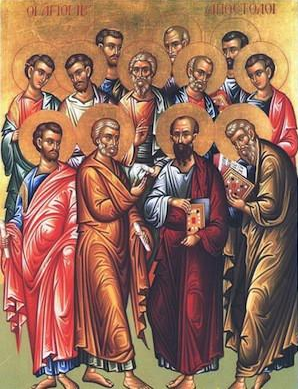
Twelve apostles, one for each tribe of Israel
Here are the twelve named as apostles: 'Matey, Teddy, Simon, Jorn, Pedher, Andy, Barty, Philly, Jamesy Mor and Tom, Matt and Jakes Mac Carty' 142.27
That's Matthias, Thaddaeus, Simon the Canaanite, John, Simon Peter, Andrew, Bartholomew, Philip, James the son of Zebedee, Thomas, Matthew, James the son of Alphaeus. Their names have been given an Irish twist, and include the Dublin sports journalist Jakes McCarthy ('Father, Son and Holy Ghost and Jakes M'Carthy.' Ulysses).
One long passage has the twelve as jurymen, trying HCE and finding him guilty every night of his sin in the park:
'each and every juridical sessions night, whenas goodmen twelve and true at fox and geese in their numbered habitations tried old wireless over boord in their juremembers, whereas by reverendum they found him guilty of their and those imputations of fornicolopulation with two of his albowcrural correlations...' 557.13
They are also the months of the year:
'those component partners of our societate, the doorboy, the cleaner, the sojer, the crook, the squeezer, the lounger, the curman, the tourabout, the mussroomsniffer, the bleakabluetramp, the funpowtherplother, the christymansboxer' 142.08
Joyce originally listed the months as 'doorman, boiler, warrior, priser, courter, lounger, kenneler, tourist, harvester, blackablue tramp, funpowther plotter, chrystyman's box'. See if you can work out why he chose these names, and then find the explanations in fweet here.
The Ku Klux Klan had their own calendar, whose months are listed here:
'no more the tolvmaans, bloody gloomy hideous fearful furious alarming terrible horrible mournful sorrowful frightful appalling' 549.10
('horrible', not in the published text, was restored in the Corrected Text)
Here are the twelve signs of the Zodiac:
'Butting, charging, bracing, backing, springing, shrinking, swaying, darting, shooting, bucking and sprinkling their dossies sodouscheock with the twinx of their taylz.' 524.22
In The Sigla of Finnegans Wake, Roland McHugh quotes this passage from Alwyn and Brinley Rees' Celtic Heritage: Ancient Tradition in Ireland and Wales.
TWELVE CRITICS
As in Tom Gauld's strip, the twelve are also critics. When Joyce set about creating a readership for his book, he picked twelve critics to do it for him – Samuel Beckett, Marcel Brion, Frank Budgen, Stuart Gilbert, Eugene Jolas, Victor Llona, Robert McAlmon, Thomas McGreevy, Elliot Paul, John Rodker, Robert Sage and William Carlos Williams. Their essays were collected in a 1929 book he called Our Exagmination Round His Factification for Incamination of Work in Progress.
Joyce called the twelve critics his marshals (he wrote to Valery Larbaud that he had stood behind 'those twelve marshals more or less directing them') imagining himelf as a Napoleon (though the emperor always had more then twelve marshals).
The cover has Joyce's sigla for the twelve, a clock face or a wheel with twelve spokes.
Having made the twelve real people, Joyce put them back into Finnegans Wake as characters:
'Imagine the twelve deaferended dumbbawls of the whowl abovebeugled to be the contonuation through regeneration of the urutteration of the word in pregross.' 284.18
'His producers are they not his consumers? Your exagmination round his factification for incamination of a warping process.' 497.02
Three other women did join us after the reading had started, but after five minutes listening to us reading Finnegans Wake, they realised they'd made a mistake and left. Yes, the Shade of Joyce compelled them to go, preserving the magic Twelve!
DOYLES AND SULLIVANS
The twelve are sometimes called Doyles and sometimes Sullivans. They are 'doyles when they deliberate but sullivans when they are swordsed.' 142.26
The two names show the good and bad sides of public opinion. When the twelve are a deliberating jury, they are Doyles – probably from the Irish parliament, the Dail.
‘The jury (a sour dozen of stout fellows
all of whom were curiously named after doyles)' 574.30
'sour dozen of stout' suggests Saorstát Éireann - the Irish Free State.
They are also Doyles when they are in
harmony, as a choir:
‘a choir of the O’Daley O’Doyles
doublesixing the chorus’ 48.13
When they turn into a hostile
baying armed (‘swordsed’) mob, they become Sullivans. The sword might be inspired by the Irish Free State stamp of 1922, which had a Sword of Light ('sword and stamps, for Shemus O'Shaun the Post' 211.31). 'Swordsed' also suggests swear words.
Nuad's irresistible Claideam Soluis (Sword of Light) was one of four magical objects of the Tuatha de Danaan. Joyce lists them at 211.11, where he calls the sword 'Clive Sollis'. An Claideam Soluis was also the title of the Gaelic League's newspaper, edited by Patrick Pearse.
Their leader is 'Sully the Thug' (212.03), and as a mob they sully the reputation of HCE.
'Sulla, an orthodox savage (and leader of a band of twelve mercenaries, the
Sullivani).’ 573.06
'Sully, a barracker associated with tinkers, the blackhand, Shovellyvans,
wreuter of annoyimgmost letters and skirriless ballets...'495.01
That's why they're called 'hoolivans of the nation' at the wake – hooligans mixed with Sullivans.
As an unthinking mob, Joyce's twelve are like cattle, 'ruled, roped, duped and driven' (142.23) by more powerful forces they do not understand.
THE FALL OF PARNELL
'Affected Mob Follows in Religious Sullivence' 602.25
There
really was a Sullivan gang. This was the group of Catholic Irish
politicians from Bantry in West Cork who, in alliance with the priests,
destroyed Charles Stewart Parnell after the O'Shea divorce scandal.
There's a plaque to them in Bantry.
Their supporters called them the Bantry band, but Parnellites, like Joyce's father and W.B.Yeats, knew them as 'the Bantry gang' or 'the Sullivan gang'.
'If all other reasons were absent, it would seem plain that a combination of priests with 'the Sullivan gang' is not likely to have on its side in political matters divine justice.'
TheSullivanname camefrom the brother MPs, Timothy Daniel Sullivan (above right), composer of 'God Save Ireland', and Alexander Martin Sullivan, proprieter of The Nation (hence 'hoolivans of the nation' perhaps). Their leader was Tim Healy (above left), T.D.Sullivan's nephew and son-in-law. It was Healy who denounced Parnell in the dramatic split in Committee
Room 16 on 6 December 1890, when he said that the alliance with the
Liberals had ended 'in the stench of the divorce court.'
Tim Healy's twin brother Maurice, another MP in the group, also married a daughter of T.D.Sullivan.
Another key figure in the gang was William Martin Murphy, the Irish press baron. In Ulysses, the Citizen calls him 'Martin Murphy that Bantry jobber.' During the divorce scandal, Murphy founded the National Press, edited by Healy, as a means of destroying Parnell.
Martin Murphy that Bantry jobber
'After
the Parnell divorce case, 'the Sullivan gang', led by Healy and backed
by Murphy's money, emerged as the spearhead of the clerical attack on
Parnell... To the young Yeats, whose dislike of 'the Sullivan gang'
antedated these proceedings – the spectacle of the plebeian Healy
taunting the fallen aristocrat was a powerful symbol.'
Conor Cruise O'Brien, 'Passion and Cunning: An Essay on the Politics of W.B.Yeats', 1965
'It... was a diatribe against the supposed traitor, Tim Healy, who had ratted at the bidding of the Catholic bishops and become a virulent enemy of Parnell, and so the piece was an echo of those political rancours that formed the theme of my father's nightly half-drunken rantings to the accompaniment of vigorous table-thumping. I think it was in verse because of the rhythm of bits of it that I remember. One line is a pentameter. At the end of the piece the dead Chief is likened to an eagle, looking down on the grovelling mass of Irish politicians from
His quaint-perched aerie on the crags of Time Where the rude din of this . . . century Can trouble him no more.'
Stanislaus Joyce, My Brother's Keeper
In A Portrait, the Parnellites Mr Casey and Simon Dedalus get into a ferocious argument with the devout Dante Riordan about the 'the priests' pawns': '—Let him remember...the language with which the priests and the priests’ pawns broke
Parnell’s heart and hounded him into his grave. Let him remember that
too when he grows up.
—Sons of bitches! cried Mr Dedalus. When he was down they turned on
him to betray him and rend him like rats in a sewer. Lowlived dogs!
And they look it! By Christ, they look it!
—They behaved rightly, cried Dante. They obeyed their bishops and
their priests. Honour to them!'
Later in the book, Stephen remembers the argument: 'His father’s gibes at the Bantry gang leaped out
of his memory.'
Joyce, who hero-worshipped Parnell, wrote of his fall:
'Of
the eighty three deputies, only eight remained faithful to him. The
high and low
clergy entered the lists to finish him off. The Irish press emptied on
him and the woman he loved the vials of their envy.
The citizens of Castlecomer threw quicklime in his eyes. He went from
county to county, from city to city, 'like a hunted deer', a
spectral figure with the signs of death on his forehead. Within a year
he died of a broken heart at the age of 45.... In his final desperate
appeal to his countrymen, he begged them
not to throw him as a sop to the English wolves howling around
them. It redounds to their honour that they did not fail this
appeal. They did not throw him to the English wolves; they tore
him to pieces themselves.'
'The Shade of Parnell', 1912
During the Wake's seance chapter, we hear that desperate cry of Parnell:
'Do not flingamejig to the twolves!' 479.14 By adding a 't' to wolves, Joyce has made Parnell beg them not to throw him to the twelve.
Parnell, eye bandaged after the lime attack, faces down the baying mob
One of the messages of Finnegans Wake is that history repeats itself. I keep seeing parallels between Parnell's story and today's Brexit crisis. Bitterly divided, the Parnellites and Anti-Parnellites used their newspapers to accuse each other, in increasingly vitriolic terms, of treason. The public, 'ruled, roped, duped and driven' by the press and the priests, turned to violence. In Castlecomer, Parnell had quicklime flung in his eye. Tim Healy had the windows of his Dublin house smashed and was attacked twice, in Dublin and in Cork. Like Parnell, he suffered an eye injury.
'A Parnellite came up to (Healy) in his hotel in Cork, accused him of betraying his country, and punched him repeatedly in the face, smashing his glasses, splinters from which went into his eye.' Robert Kee, The Laurel and the Ivy
It feels like the swordsed Sullivans are once more on the march.
FOX AND STAG
During the O'Shea divorce proceedings, it was revealed that Parnell used the name Fox when carrying on his affair. This led the Anti-Parnellite Charles Tanner to suggest in a Kilkenny speech that it was 'the duty of every Irishman to hunt Mr Fox with a cry of Tally-ho!'. So, in the Wake, HCE becomes a fox hunted by a pack of dogs: 'Gundogs of all breeds were beagling with renounced urbiandorbic bugles, hot to run him, given law, on a scent breasthigh, keen for the worry. View!' 96.36
Parnell's supporters, like W.B.Yeats, preferred to see him as a hunted stag, which is more noble than its pursuers.
'During the quarrel over Parnell's grave, a quotation from Goethe ran through the papers, describing our Irish jealousy. 'The Irish seem to me like a pack of hounds, always dragging down some noble stag.'' W.B.Yeats, Autobiography, 1958, p211
Yeats used the image in two poems: 'But popular rage, Hysterica passio dragged this quarry down' ('Parnell's Funeral'), 'Your enemy, an old foul mouth, had set The pack upon him' ('To a Shade'). The 'foul mouth' was Tim Healy.
'Stag Hunt' by Pauwel de Vos and Jan Wildens, 1633
The same image is in the poemJoyce gave to his Parnellite journalist, Joe Hynes:
'He is dead. Our Uncrowned King is dead.
O, Erin, mourn with grief and woe
For he lies dead whom the fell gang
Of modern hypocrites laid low.
He lies slain by the coward hounds
He raised to glory from the mire...' 'Ivy Day in the Committee Room.'
There's a stag hunt in Finnegans Wake, based on Ireland's famous Ward Union Stag hunt, between Naul and Ratoath in County Meath:
'the Wald Unicorns Master, Bugley Captain, from the Naul, drawls up by
the door with the Honourable Whilp and the Reverend Poynter and the two
Lady Pagets of Tallyhaugh, Ballyhuntus, in their riddletight raiding
hats for to lift a hereshealth to their robost, the Stag, evers the
Carlton hart.' 622.25
The initials in the last four words tell us that the stag is HCE. On page 97, when HCE is being hunted as a fox, the place names are all in the area hunted by the Ward Union. 'From his holt outratted across the
Juletide's genial corsslands of Humfries Chase from Mullinahob
and Peacockstown, then bearing right upon Tankardstown...then through Raystown and Horlockstown and,
louping the loup, to Tankardstown again. Ear canny hare for
doubling through Cheeverstown they raced him, through
Loughlinstown and Nutstown to wind him by the Boolies.'
Joyce, who strongly identified with Parnell,imagined himself as a defiant stag:
‘I stand the self-doomed, unafraid,
Unfellowed, friendless and alone,
Indifferent as the herring-bone,
Firm as the mountain ridges where
I flash my antlers on the air.’
'The Holy Office'
On his birthday, Joyce liked to wear a hunting waistcoat decorated with stags
and hounds –a family heirloom, given to him by his father in 1912. You can see it today in the
James Joyce Tower museum in Dublin.
I wonder if Tom Gauld has read Finnegans Wake. Joyce has made another appearance in his cartoon strip. But it would be nice if the appearance of the twelve in his cartoon is another of those many coincidences that cluster around the Wake.