Showing posts with label Chapelizod. Show all posts

Thursday, 28 April 2022

The Great Elm of Howth


Howth Castle and Environs c1735, with the elm by the two horses

In 1933, the Royal Dublin Society published The Trees of Ireland - Native and Introduced. This was a comprehensive list of every tree species in Ireland, compiled by a 31-year-old Dubliner called Maurice Fitzpatrick. His 1994 obituary from the Society of Irish Foresters (which he helped found in 1942) describes his great project:

'To complete Trees of Ireland, Native and Introduced, he visited 85 estates and arboreta, North and South, mostly on a pushbike, identifying and measuring each tree recorded – a phenomenal achievement of skill and physique.'

Fitzpatrick had to visit private estates because all of Ireland's ancient forests had been cut down by the late 19th century, as the drinkers discuss in Ulysses:

—As treeless as Portugal we’ll be soon, says John Wyse, or Heligoland with its one tree if something is not done to reafforest the land. Larches, firs, all the trees of the conifer family are going fast. I was reading a report of lord Castletown’s...

—Save them, says the citizen, the giant ash of Galway and the chieftain elm of Kildare with a fortyfoot bole and an acre of foliage. Save the trees of Ireland for the future men of Ireland on the fair hills of Eire, O.


One of the estates Fitzpatrick must have known well was Howth Castle, where he found a remarkable elm tree as well as the painting above, from the castle collection. This is from the opening page of his study:

'Little is known regarding the early introduction of exotic species. According to Loudon the oldest introduced tree in Ireland is an English Elm still standing at Howth Castle, which, he states, was planted about 1585. A painting of the castle and grounds, said by Mr Gaisford St. Lawrence to have been done in the reign of Queen Anne, certainly shows this elm as a large tree, with the formal beech hedges, which were so fashionable in gardens at the commencement of the eighteenth century, scarcely six feet high beside it.'

H.M.Fitzpatrick, 'The trees of Ireland – native and introduced', Scientific Proceedings of the Royal Dublin Society, 1933, 597

James Joyce knew The Trees of Ireland, and was so interested in the Howth elm that he wrote about it to his patroness Harriet Shaw Weaver:

'Léon began to read to me from a scientific publication about Irish trees. The first sentence was to the effect that the oldest tree in the island is an elm tree in the demesne of Howth Castle and Environs.'

Joyce to Harriet Shaw Weaver 10 July 1934 (Letters III 308)

In fact, the Howth elm was the oldest introduced tree in Ireland, but there were much older native trees. Yews can live for thousands of years. Like the hero of Finnegans Wake, the Howth elm was a foreign invader.

This 'scientific publication' was identified as Fitzpatrick's by Danis Rose. His The Textual Diaries of James Joyce (1995) has a brilliant chapter 'How Joyce planted The trees of Ireland in Finnegans Wake'.  Rose identified 67 uses of Fitzpatrick's trees, which you can see listed here in fweet.

I've found another picture of the Howth elm, from 1820, in Francis Erlington's A History of County Dublin (1903). You can see how much the tree had grown in 85 years. It now towers over the castle.


This tree was famous enough to appear in a 1911 book by the US folklorist, Charles M Fitzpatrick:

'There are not infrequent instances in folk tales of the dependence of human lives on those of plants and trees and one such instance has been noted in the superstition relative to the great elm of Castle Howth, near Dublin. For years this tree received care, its limbs being propped or tied when threatened with decay, in the belief that whenever a branch was broken the head of the Howths would die, and that when the tree itself should have lived out its life the family would become extinct.'

Myths and Legends of Flowers, Trees, Fruits and Plants, Washington Square Press, 1911

The great elm tree survived the earldom. The last earl of Howth died in a Bournemouth hotel in 1909.  The tree was still standing 24 years later when Fitzpatrick recorded it in his study. I can't find any later reference to it.

In Dublin in 2022 for Bloomsday I visited Howth Castle and found the place where the tree once stood.


Does anybody know when the great elm finally died?

Howth Castle passed into the female family line, the Gaisford-St Lawrences, who sold the estate in 2019 to Tetrarch Capital, who are now turning it into a 'retail food and tourist destination'. 

THE ELM OF CHAPELIZOD


Joyce had already given an elm tree a big role in his book, at the end of the 1924 Anna Livia episode, where one of the two washerwomen is transformed into one. In 1959, in The Books at the Wake, J.S.Atherton identified the source of this tree as Sheridan LeFanu's novel, The House by the Churchyard:

'One glance, however, before you go, you will vouchsafe at the village tree—that stalworth elm. It has not grown an inch these hundred years. It does not look a day older than it did fifty years ago, I can tell you. There he stands the same; and yet a stranger in the place of his birth, in a new order of things, joyless, busy, transformed Chapelizod, listening, as it seems to me, always to the unchanged song and prattle of the river, with his reveries and affections far away among bygone times and a buried race. Thou hast a story, too, to tell, thou slighted and solitary sage, if only the winds would steal it musically forth, like the secret of Midas from the moaning reeds.'

Sheridan LeFanu, prologue,  The House by the Churchyard, 1863

This is the Wake's 'loftleaved elm Lefanunian' (264.04) which is always paired with a stone, the tree standing for time and the stone for space. Like LeFanu's elm, Joyce's tree has a story to tell.

'The elm that whimpers at the top told the stone that moans when stricken' 94.04

'Tell me, tell me, tell me, elm! Night night! Telmetale of stem or stone.' 216.23

'Talkingtree and sinningstone stay on either hand.' 564.30

THE TREE OF MORPHEUS


Charles M Fitzpatrick's folklore study has another possible reason why the tree is so important in Joyce's night book.  The elm was the tree of Morpheus, god of sleep:

'In classic legend the elm was a creation of Orpheus, or a gift of the gods to him, for when he had returned from the vain attempt to release his wife from Hades and betaken himself to his harp for consolation, the listening earth took new life, and crowding over it came a grove of elms, marching to his song, and forming a green temple in whose shade he often pondered, and uttered melody while he remained on earth. Thus it should be the tree of Orpheus, but by some strange perversion it became the tree of Morpheus, god of sleep, and dreams hovered and roosted in its branches, ready, it would seem, to pounce on the unwary who stole a nap beneath it.'

Myths and Legends of Flowers, Trees, Fruits and Plants, Washington Square Press, 1911

Looking for the source of this idea, I've found it comes from Virgil's Aeneid, Bk 6, here in John Dryden's translation:

'Full in the midst of this infernal road,
An elm displays her dusky arms abroad:
The God of Sleep there hides his heavy head,
And empty dreams on ev'ry leaf are spread.'

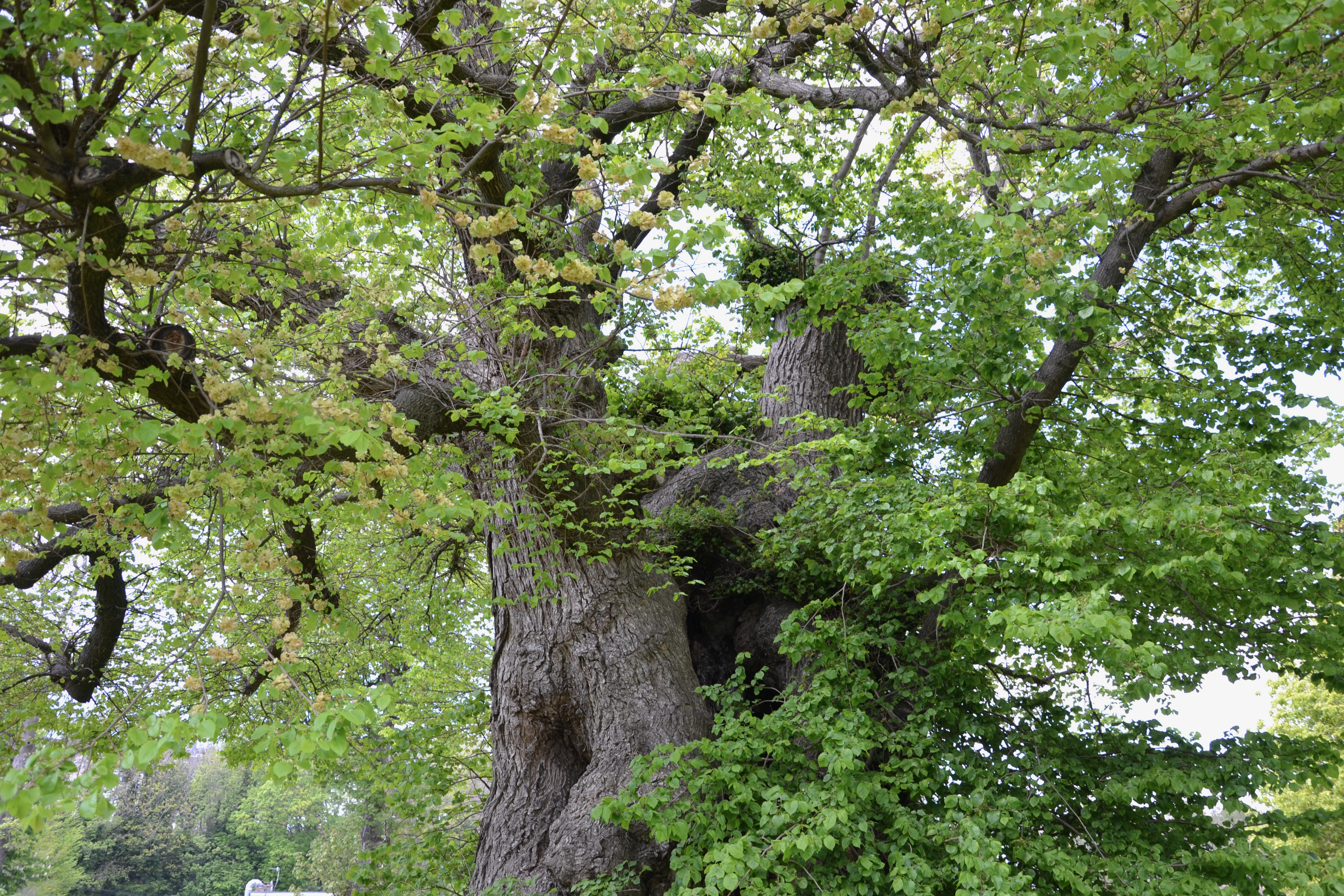
My home town, Brighton, has the greatest collection of elm trees in the world. I've been out photographing a few. This weeping wych elm in Queens Park reminds me of the washerwoman who turns into one in the Wake.

'I feel as old as yonder elm' 215.34


Here's an ancient elm, planted in 1776, in the grounds of the Royal Pavilion.  It's so old it's hollow, and people leave padlocks there as an offering.


Brighton has the oldest elm trees in Europe, including another hollow one in Preston Park, the only survivor of a 400-year-old pair called the twins.


Inside the elm...


Thursday, 14 January 2021

'Lets All Wake Brickfaced In Lucan'

Happy New Year Wake lovers! We may be locked down in our locations, but we can still travel in our imaginations. So let's go on a journey up the Liffey, six miles past Chapelizod to a leafy village on the south bank of the river. 

'Let's all wake brickfaced in Lucan'! 359.27


'Like we larnt from that Buke of Lukan in Dublin’s capital, Kongdam Coombe.' 255.

The name Lucan is either from the 'Leamhcán' (place of elms) or 'Leamhachán' (place of marsh-mallow plants). The marsh plants seem more likely, according to the Lucan Newsletter. Wouldn't elms have been a common sight all along the Liffey?

Lucan is famous for an earl, a Palladian mansion, a spa hotel, and a steam tram - all of them appearing in Finnegans Wake. More importantly, Lucan is mixed up with Chapelizod, creating a dream location which Joyce calls 'Lucalizod'.

In her Third Census, Adaline Glasheen suggested that the name 'links Issy and the two Isoldes to Lucia Joyce and Alice'. Perhaps Joyce chose it because it resembles 'localised'. 


'Gush Mac Gale and Roaring O’Crian, Jr., both changelings, unlucalised, of no address' 87.18

'When you’re coaching through Lucalised, on the sulphur spa to visit, it’s safer to hit than miss it, stop at his inn!' 565.33

Localised Lucalizod is the 'particular universal' (260.r3).

'THE LOCALISATION OF LEGEND' 263.r2

Joyce came up with 'Lucalizod' even before he had started writing his earliest sketches, for it appears in his 1922-3 Nice notebook (V1.B.10.33).

He first used the word in his second Wake sketch, on the big love scene between Tristan and Isolde. In the earliest fair copy, Isolde is 'the belle of Chapelizod'.


Here's the second draft, in which Isolde has become 'the dinkum belle of Lucalizod'.

Sadly, this phrase didn't make it into the published book (where Isolde is simply 'the dinkum belle' at 384.21). But the name Lucalizod stuck.  In the second chapter, the narrators discuss HCE's name:

'The great fact emerges that after that historic date all holographs so far exhumed initialled by Haromphrey bear the sigla H.C.E. and while he was only and long and always good Dook Umphrey for the hungerlean spalpeens of Lucalizod and Chimbers to his cronies it was equally certainly a pleasant turn of the populace which gave him as sense of those normative letters the nickname Here Comes Everybody.'  32.14

In his first draft, Joyce wrote 'the ragged tiny folk of Lucalizod'. Arthur Young gives a derivation of 'spalpeen' in his 18th century Tour of Ireland.


In the fourth chapter, the place became 'folkrich Lucalizod':

'Who, but who (for second time of asking) was then the scourge of the parts about folkrich Lucalizod it was wont to be asked, as, in ages behind of the Homo Capite Erectus...
' 101.10-13

The name made its fourth appearance in the earliest title of Anna Livia Plurabelle's letter defending HCE against the slander, spread 'all around Lucalizod':

First and Last Only True Account all about the Honorary Mirsu Earwicker, L.S.D., and the Snake (Nuggets!) by a Woman of the World who only can Tell Naked Truths about a Dear Man and all his Conspirators how they all Tried to Fall him Putting it all around Lucalizod about Privates Earwicker and a Pair of Sloppy Sluts plainly Showing all the Unmentionability falsely Accusing about the Raincoats 107.01-7

A few pages later, Chapelizod and Lucan are again combined as 'Isitachapel-Asitalukin' (Is it a chapel? Has it a look in?):

'That stern chuckler Mayhappy Mayhapnot, once said to repeation in that lutran conservatory way of his that Isitachapel-Asitalukin was the one place, ult aut nult, in this madh vaal of tares (whose verdhure’s yellowed therever Phaiton parks his car while its tamelised tay is the drame of Drainophilias) where the possible was the improbable and the improbable the inevitable.'  110.06-12

The place next became 'muchtried Lucalizod' in the description of Shem the Penman taking refuge in his 'inkbattle house' from the street fighting in Dublin:

After the thorough fright he got that bloody, Swithun’s day, though every doorpost in muchtried Lucalizod was smeared with generous erstborn gore and every free for all cobbleway slippery with the bloods of heroes.... 178.08

It was a placename Joyce could play with. In 'Haveth Childers Everywhere', HCE boasts of his achievements as a city builder:

'if I was magmonimoss as staidy lavgiver I revolucanized by my eructions' 545.32

'THE SULPHUR SPA TO VISIT'


Lucan was famous for its sulphur spring, discovered in 1758 by the wonderfully named Agmondisham Vesey, owner of the Lucan demesne.

The water was vividly described by John Rutty in his 1772 Essay Towards a Natural History of Dublin, Vol 2 :

'It may be smelt at a distance of many yards....It resembles the Aix-la-Chapelle water in smell and taste...having the flavour of a boiled egg and when strongest of a semitputrid egg.'


The spring's medicinal qualities are described by Mrs James J Daly, in 'Curative Wells in Old Dublin', a paper she read to the Old Dublin Society on 9 December 1957.

The original Spa House Hotel was rebuilt as the Hydropathic Spa Hotel in 1890-1


'Hydropathy' is what we now call 'Hydrotherapy'.

F.W.Crossley's Visit Ireland  guidebook (1892) carries a full page advert for the brand new hotel.


'Lucan is principally known as a health resort. Recently there has been a splendid hotel erected, called the New Spa Hotel, which is excellently appointed, and contains every convenience and comfort which the visitor can desire. It is situated on an eminence commanding a view of some of the finest scenery in the county Dublin, and within a few yards of a valuable sulphur spa, which is now attracting much attention and patronage....Persons suffering from gout, rheumatism, and hepatic disorders, could not do better than spend a week or two here, where they would not only find relief from their ailments, but may also have an enjoyable holiday.'

F.W.Crossley, Visit Dublin, Irish Tourism Development, 1892, p.15

In Finnegans Wake,  'hydropathic' becomes 'hydrocomic', and the hotel becomes another version of Earwicker's pub:

'They near the base of the chill stair, that large incorporate licensed vintner, such as he is, from former times, nine hosts in himself, in his hydrocomic establishment and his ambling limfy peepingpartner' 580.33

'When you’re coaching through Lucalised, on the sulphur spa to visit, it’s safer to hit than miss it, stop at his inn!'  565.33

The Lucan Spa Hotel is still going, but a busy motorway now separates it from the river.


THE LUCAN STEAM TRAM


From the collection of Joe Williams

'Visitors who are staying in Dublin for a few days are strongly recommended before leaving to pay a visit to the little village of Lucan. The steam tram is an excellent mode of conveyance, and accomplishes the journey in about three quarters of an hour.'

F.W.Crossley, Visit Dublin, Irish Tourism Development, 1892, p.15

The South Dublin Libraries Local Studies Blog has a fascinating piece on the Lucan steam tram, which you can read here. It started running on 20 February 1883, and was the only service to operate during the Easter Rising.

'The village and the Spa Hotel were crowded with visitors from all parts of Ireland ....‘peace and plenty’ reigned in Lucan, disturbed only by the boom of the distant guns in the city and the glare at night of the conflagrations.' 

Freeman’s Journal 9th May 1916.

In Finnegans Wake, we can hear the cry of the tram conductor, as the west-bound tram stops at Chapelizod

'Issy-la-Chapelle! Any lucans, please?' 80.36 

A LORD AT LUCAN 


'Before there was patch at all on Ireland there lived a lord at Lucan.'  452.28

'You make me think of a wonderdecker I once. Or somebalt thet sailder, the man megallant, with the bangled ears. Or an earl was he, at Lucan?' 620.08

In 1566, the Lucan demesne was acquired by Sir William Sarsfield, a wealthy merchant and Lord Mayor of Dublin.  The most famous member of his family was Patrick Sarsfield, who was born in Lucan. James II's leading general in the war against William of Orange, Sarsfield was made first Earl of Lucan in 1690.


As a Jacobite title, this earldom was never recognised in the United Kingdom.  Like Joyce, Sarsfield went on a 'wildgoup's chase across the kathartic ocean' (185.06) and spent his last years as an exile in France. There is now a campaign by the Wild Geese Festival to repatriate his remains, but to Limerick rather than Lucan.

Back in Ireland, the demesne passed into the hands of the Veseys, who married into the Sarsfield family. In 1772, Agmondisham Vesey, discoverer of the sulphur spa, built a magnificent Palladian mansion here, working with the architect William Chambers (designer of the Casino at Merino). According to the Irish Times, its oval dining room was the inspiration for the Oval Office in the White House.  

Vesey's wife Elizabeth was a founder of the Bluestockings Society, and friend of Samuel Johnson.

Here's a view of the house, now the official residence of the Italian ambassador,  from Itsmyireland.


The title was revived in 1795, when Sir Charles Bingham, who had married Anne Vesey, was made the first Earl of Lucan.  It was his grandson, George Charles Bingham, the Third Earl, who ordered the Charge of the Light Brigade, as shown on the television set in Earwicker's pub.

The Bingham estate was in Castlebar, Mayo rather than Lucan. Here the third earl earned a reputation as a monster.

'During the Great Famine he engaged in wholesale evictions and showed a complete disregard for public opinion. In the parish of Ballinrobe alone he demolished over 300 cabins and evicted 2,000 people (1846–9). He then consolidated the holdings and leased them to wealthy ranchers.' 

James Quinn, 'The Exterminator', History Ireland


'To the people of Mayo an Earl of Lucan, a Bingham, was an oppressor, responsible for the cruelties of the past and the misery of the present, automatically to be hated. .....He cherished an equally powerful contempt for them. From the bottom of his heart he despised them, swarming, half starving, ignorant, shiftless, and Roman Catholics into the bargain. It is doubtful if he considered the Irish as human beings at all.....Evictions became numerous, and it began to be said in Mayo that he possessed 'all the inherited ferocity of the Binghams.'
Fear of the third Earl bit deep into the consciousness of the people, and he still survives as a bogey in Castlebar. Tales are told of the fierce Earl galloping through the town, the hoofs of his great black horse striking sparks from the cobble-stones, bringing terror to his tenants' hearts. When least expected he suddenly appeared, for though he gained the credit of being a resident landlord, he seldom stayed in Castlebar more than a few days -- it was his custom to swoop down a dozen times a year. On one occasion, believing him to be safely in England, the inhabitants of Castlebar were burning him in effigy on the Mall when suddenly the sound of the great black horse was heard and the Earl galloped into the midst of the crowd, shouting as they scattered in terror, 'I'll evict the lot of you.''


Joyce refers to this story at the end of the games chapter, when HCE's sudden appearance ends the children's fun:

'One must recken with the sudden and gigantesquesque appearance unwithstandable as a general election in Barnado’s bearskin amongst the brawlmiddle of this village childergarten of the largely longsuffering laird of Lucanhof.'  253.25

Crimean War veterans in bearskins

If you mention Lord Lucan today, people think of Richard John Bingham, the notorious Seventh Earl, who vanished in mysterious circumstances in 1974.

To finish, here's 'Lord Lucan is Missing', a 1978 song from the Dodgems, a band I used to see regularly in Brighton back in the punk years. They ask, 'Is he in the Clerment Club or in the south of France? Playing on a roulette wheel In another game of chance? Is he dead upon the Downs rotting in the grass? Or is he hid behind the cloak of the British ruling class?'

Forty-two years after they asked the questions, we still don't know the answers.