Thursday, 28 April 2022

The Great Elm of Howth


Howth Castle and Environs c1735, with the elm by the two horses

In 1933, the Royal Dublin Society published The Trees of Ireland - Native and Introduced. This was a comprehensive list of every tree species in Ireland, compiled by a 31-year-old Dubliner called Maurice Fitzpatrick. His 1994 obituary from the Society of Irish Foresters (which he helped found in 1942) describes his great project:

'To complete Trees of Ireland, Native and Introduced, he visited 85 estates and arboreta, North and South, mostly on a pushbike, identifying and measuring each tree recorded – a phenomenal achievement of skill and physique.'

Fitzpatrick had to visit private estates because all of Ireland's ancient forests had been cut down by the late 19th century, as the drinkers discuss in Ulysses:

—As treeless as Portugal we’ll be soon, says John Wyse, or Heligoland with its one tree if something is not done to reafforest the land. Larches, firs, all the trees of the conifer family are going fast. I was reading a report of lord Castletown’s...

—Save them, says the citizen, the giant ash of Galway and the chieftain elm of Kildare with a fortyfoot bole and an acre of foliage. Save the trees of Ireland for the future men of Ireland on the fair hills of Eire, O.


One of the estates Fitzpatrick must have known well was Howth Castle, where he found a remarkable elm tree as well as the painting above, from the castle collection. This is from the opening page of his study:

'Little is known regarding the early introduction of exotic species. According to Loudon the oldest introduced tree in Ireland is an English Elm still standing at Howth Castle, which, he states, was planted about 1585. A painting of the castle and grounds, said by Mr Gaisford St. Lawrence to have been done in the reign of Queen Anne, certainly shows this elm as a large tree, with the formal beech hedges, which were so fashionable in gardens at the commencement of the eighteenth century, scarcely six feet high beside it.'

H.M.Fitzpatrick, 'The trees of Ireland – native and introduced', Scientific Proceedings of the Royal Dublin Society, 1933, 597

James Joyce knew The Trees of Ireland, and was so interested in the Howth elm that he wrote about it to his patroness Harriet Shaw Weaver:

'Léon began to read to me from a scientific publication about Irish trees. The first sentence was to the effect that the oldest tree in the island is an elm tree in the demesne of Howth Castle and Environs.'

Joyce to Harriet Shaw Weaver 10 July 1934 (Letters III 308)

In fact, the Howth elm was the oldest introduced tree in Ireland, but there were much older native trees. Yews can live for thousands of years. Like the hero of Finnegans Wake, the Howth elm was a foreign invader.

This 'scientific publication' was identified as Fitzpatrick's by Danis Rose. His The Textual Diaries of James Joyce (1995) has a brilliant chapter 'How Joyce planted The trees of Ireland in Finnegans Wake'.  Rose identified 67 uses of Fitzpatrick's trees, which you can see listed here in fweet.

I've found another picture of the Howth elm, from 1820, in Francis Erlington's A History of County Dublin (1903). You can see how much the tree had grown in 85 years. It now towers over the castle.


This tree was famous enough to appear in a 1911 book by the US folklorist, Charles M Fitzpatrick:

'There are not infrequent instances in folk tales of the dependence of human lives on those of plants and trees and one such instance has been noted in the superstition relative to the great elm of Castle Howth, near Dublin. For years this tree received care, its limbs being propped or tied when threatened with decay, in the belief that whenever a branch was broken the head of the Howths would die, and that when the tree itself should have lived out its life the family would become extinct.'

Myths and Legends of Flowers, Trees, Fruits and Plants, Washington Square Press, 1911

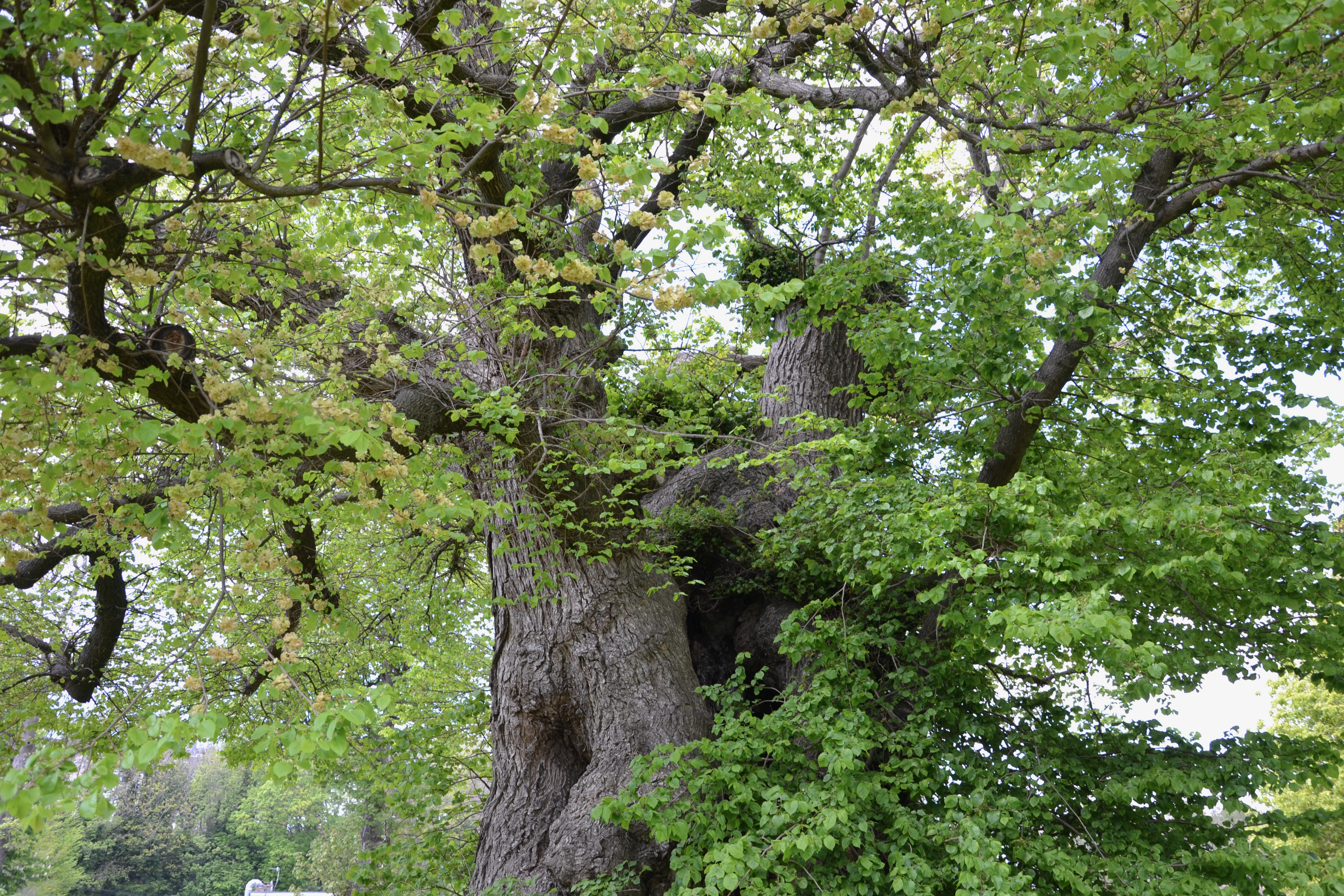
The great elm tree survived the earldom. The last earl of Howth died in a Bournemouth hotel in 1909.  The tree was still standing 24 years later when Fitzpatrick recorded it in his study. I can't find any later reference to it.

In Dublin in 2022 for Bloomsday I visited Howth Castle and found the place where the tree once stood.


Does anybody know when the great elm finally died?

Howth Castle passed into the female family line, the Gaisford-St Lawrences, who sold the estate in 2019 to Tetrarch Capital, who are now turning it into a 'retail food and tourist destination'. 

THE ELM OF CHAPELIZOD


Joyce had already given an elm tree a big role in his book, at the end of the 1924 Anna Livia episode, where one of the two washerwomen is transformed into one. In 1959, in The Books at the Wake, J.S.Atherton identified the source of this tree as Sheridan LeFanu's novel, The House by the Churchyard:

'One glance, however, before you go, you will vouchsafe at the village tree—that stalworth elm. It has not grown an inch these hundred years. It does not look a day older than it did fifty years ago, I can tell you. There he stands the same; and yet a stranger in the place of his birth, in a new order of things, joyless, busy, transformed Chapelizod, listening, as it seems to me, always to the unchanged song and prattle of the river, with his reveries and affections far away among bygone times and a buried race. Thou hast a story, too, to tell, thou slighted and solitary sage, if only the winds would steal it musically forth, like the secret of Midas from the moaning reeds.'

Sheridan LeFanu, prologue,  The House by the Churchyard, 1863

This is the Wake's 'loftleaved elm Lefanunian' (264.04) which is always paired with a stone, the tree standing for time and the stone for space. Like LeFanu's elm, Joyce's tree has a story to tell.

'The elm that whimpers at the top told the stone that moans when stricken' 94.04

'Tell me, tell me, tell me, elm! Night night! Telmetale of stem or stone.' 216.23

'Talkingtree and sinningstone stay on either hand.' 564.30

THE TREE OF MORPHEUS


Charles M Fitzpatrick's folklore study has another possible reason why the tree is so important in Joyce's night book.  The elm was the tree of Morpheus, god of sleep:

'In classic legend the elm was a creation of Orpheus, or a gift of the gods to him, for when he had returned from the vain attempt to release his wife from Hades and betaken himself to his harp for consolation, the listening earth took new life, and crowding over it came a grove of elms, marching to his song, and forming a green temple in whose shade he often pondered, and uttered melody while he remained on earth. Thus it should be the tree of Orpheus, but by some strange perversion it became the tree of Morpheus, god of sleep, and dreams hovered and roosted in its branches, ready, it would seem, to pounce on the unwary who stole a nap beneath it.'

Myths and Legends of Flowers, Trees, Fruits and Plants, Washington Square Press, 1911

Looking for the source of this idea, I've found it comes from Virgil's Aeneid, Bk 6, here in John Dryden's translation:

'Full in the midst of this infernal road,
An elm displays her dusky arms abroad:
The God of Sleep there hides his heavy head,
And empty dreams on ev'ry leaf are spread.'

My home town, Brighton, has the greatest collection of elm trees in the world. I've been out photographing a few. This weeping wych elm in Queens Park reminds me of the washerwoman who turns into one in the Wake.

'I feel as old as yonder elm' 215.34


Here's an ancient elm, planted in 1776, in the grounds of the Royal Pavilion.  It's so old it's hollow, and people leave padlocks there as an offering.


Brighton has the oldest elm trees in Europe, including another hollow one in Preston Park, the only survivor of a 400-year-old pair called the twins.


Inside the elm...


Wednesday, 2 February 2022

A Ulysses Centenary Saponiad


Ulysses is a hundred years old today!

We celebrated the centenary on Sunday night with David Collard's online Glue Factory event, where there were readings, films, songs and talks. 

Follow David on Twitter @DavidCollard1

Lisa and I contributed a short performance of the Saponiad (soap epic), a lovely word that Stuart Gilbert came up with in 1930:

'Through the greater Odyssey of Bloomsday there runs a ‘Little Odyssey’, a Saponiad, the wandering of the soap – a comic counterpart of the heroic tale.'


The Saponiad begins around 10.30 in Sweny the Chemist's and ends 13 hours later in the kitchen of 7 Eccles Street.


We began like this

Me:Tonight we are lucky to have the hero of that Saponiad – Let me introduce you to Soap
SOAP: Hello
You all look very clean....apart from you!
ME: What kind of soap are you?
SOAP: I’m lemon soap, made in Dublin by Sir John Barrington...


We only briefly covered the events of the soap's day, so here are its actual wanderings through Ulysses:

We first meet the soap on the counter of Sweny the chemist's:

'Nice smell these soaps have. Pure curd soap. Time to get a bath round the corner....
I’ll take one of these soaps. How much are they?
—Fourpence, sir.
Mr Bloom raised a cake to his nostrils. Sweet lemony wax.
—I’ll take this one, he said. That makes three and a penny.
—Yes, sir, the chemist said. You can pay all together, sir, when you come back.
—Good, Mr Bloom said.
He strolled out of the shop, the newspaper baton under his armpit, the coolwrappered soap in his left hand'


Mr Sweny in Sweny's

Fourpence was the price of two pints of stout.


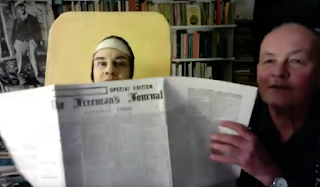
In the street Bloom meets Bantam Lyons, who borrows the Freeman's Journal to look at the racing page. When Bloom gets the newspaper back he wraps the soap up in it. At this point I wrapped Lisa up in my facsimile copy of the paper:


'Mr Bloom folded the sheets again to a neat square and lodged the soap in it, smiling.'


Although the scene for this chapter in the Gilbert-Gorman schema is 'the Bath', we don't actually visit the baths.

SOAP: But that's the most important bit!


The chapter ends with Bloom imagining the bath:

'Enjoy a bath now: clean trough of water, cool enamel, the gentle tepid stream. This is my body.

He foresaw his pale body reclined in it at full, naked, in a womb of warmth, oiled by scented melting soap, softly laved. He saw his trunk and limbs riprippled over and sustained, buoyed lightly upward, lemonyellow...'


We next meet the soap shortly after 11 am in the carriage, heading north to Glasnevin for Paddy Dignam's funeral.

'I am sitting on something hard. Ah, that soap: in my hip pocket. Better shift it out of that. Wait for an opportunity....'

Getting out of the carriage, he moves the soap to his inner handkerchief pocket.

'Change that soap now. Mr Bloom’s hand unbuttoned his hip pocket swiftly and transferred the paperstuck soap to his inner handkerchief pocket.'


I think it's now 'paperstuck' because it got wet in the bath.

In the newspaper chapter, after midday, 'Aeolus', the soap gets its own headline:

'ONLY ONCE MORE THAT SOAP

He took out his handkerchief to dab his nose. Citronlemon? Ah, the soap I put there. Lose it out of that pocket. Putting back his handkerchief he took out the soap and stowed it away, buttoned, into the hip pocket of his trousers'


It stays in his hip pocket for the rest of the day. Although the headline says 'only once more' there are seven more soap appearances.

At the end of the lunch chapter, around 2 pm, the soap helps Bloom out of a difficult situation, when he's trying to avoid a chance street encounter with Blazes Boylan:

'I am looking for that. Yes, that. Try all pockets. Handker. Freeman. Where did I ? Ah, yes. Trousers. Purse. Potato. Where did I ?

Hurry. Walk quietly. Moment more. My heart.

His hand looking for the where did I put found in his hip pocket soap lotion have to call tepid paper stuck, Ah, soap there! Yes. Gate.

Safe!'


The soap's tepid now, and by the time of the Sirens episode, around 4.40pm, it's sticky:

'Ow. Bloom stood up. Soap feeling rather sticky behind. Must have sweated: music. That lotion, remember.'


In the evening, around 9.30, on Sandymount Strand, Bloom smells the soap and again remembers he's forgotten to go back and pay Mr Sweny for the lotion.


'Mr Bloom inserted his nose. Hm. Into the. Hm. Opening of his waistcoat. Almonds or. No. Lemons it is. Ah no, that’s the soap.

O by the by that lotion. I knew there was something on my mind. Never went back and the soap not paid.'


In the late evening after 11.10pm, in Nighttown, Bloom worries that he's had his pockets picked:

BLOOM O!

(Shocked, on weak hams, he halts. Tommy and Jacky vanish there, there. Bloom pats with parcelled hands watch, fobpocket, bookpocket, pursepocket, sweets of sin, potato soap.)

BLOOM Beware of pickpockets. Old thieves' dodge. Collide. Then snatch your purse.


But the climax of the epic is the apotheosis of the soap, when it's transformed into a sunrise and gains the power of speech:

'BLOOM: I was just going back for that lotion whitewax, orangeflower water. Shop closes early on Thursday. But the first thing in the morning. (He pats divers pockets.) This moving kidney. Ah!

(He points to the south, then to the east. A cake of new clean lemon soap arises, diffusing light and perfume.)

THE SOAP:

We’re a capital couple are Bloom and I.
He brightens the earth. I polish the sky.

(The freckled face of Sweny, the druggist, appears in the disc of the soapsun.)


SWENY: Three and a penny, please.

BLOOM: Yes. For my wife. Mrs Marion. Special recipe.'


At this point Lisa as the soap rose up from beneath the table with a sun on her head, and Sweny's face on the sun.


I based Sweny's face on the photo of him in the chemist's today, with added freckles.


I wonder if the sunrise was inspired by the Freeman's Journal, which wrapped the soap earlier in the day. The editorial page had an image of the sun rising above the Bank of Ireland, formerly Parliament House. In Calypso, Bloom remembers Arthur Griffith's witty description of this as 'a homerule sun rising up in the northwest from the laneway behind the bank of Ireland.'

Finnegans Wake also has a soap sunrise.


The soap then features in the Litany of the Daughters of Erin


'THE DAUGHTERS OF ERIN:

Kidney of Bloom, pray for us
Flower of the Bath, pray for us
Mentor of Menton, pray for us
Canvasser for the Freeman, pray for us
Charitable Mason, pray for us
Wandering Soap, pray for us...'


The Saponiad ends after two in the morning in the kitchen of 7 Eccles Street:

'Having set the halffilled kettle on the now burning coals, why did he return to the stillflowing tap?

To wash his soiled hands with a partially consumed tablet of Barrington’s lemonflavoured soap, to which paper still adhered, (bought thirteen hours previously for fourpence and still unpaid for), in fresh cold neverchanging everchanging water and dry them, face and hands, in a long redbordered holland cloth passed over a wooden revolving roller.'


ME: And that's when the Saponiad ends.
SOAP: And that's when the book should have ended! 

You can still buy lemon soap from Sweny's Pharmacy and, at 5 euros, it's better value than it was when Mr Bloom bought his bar.

'Let me know exactly what you are doing and how you are getting on, if you have sold anything or are travelling for soap. Oh my prophetic soul when I put soap in Ulysses' pocket.'


Joyce to Frank Budgen, 28 February 1921


Friday, 31 December 2021

The Coach With the Six Insides


Here's Jean Erdman, the choreographer and dancer, dancing the role of Biddy the Hen in The Coach With the Six Insides, her 1962 musical comic stage adaptation of Finnegans Wake.

Erdman, who died in May 2020, at the age of 104, was the wife of the mythologist Joseph Campbell, co-author of The Skeleton Key to Finnegans Wake.  A great dancer and choreographer, she began in 1938 as the soloist of the Martha Graham company. After forming her own company in 1944, she collaborated with John Cage, Merce Cunningham and Maya Deren. As a choreographer, she created total theatre, mixing spoken words, music, dance and visual art.  The Jean Erdman company continues today, and its website has filmed recreations of her dances.

Here she is as Medusa, from an unfinished film by Maya Deren. This reminds me of James Joyce dancing 'like a satyr on a Greek vase'.


An extract from The Coach With the Six Insides was filmed for television in 1964, and here it is, from YouTube, posted by Repetition compulsion. It begins with an interview, in which Erdman explains why dance and Finnegans Wake were made for each other.

'All the language is rhythmic and poetic, it has many layers of meaning....The language of movement, which can carry images quickly...doesn't bind you down to defining things.'

I love the dances, by Jean Erdman, in which she performs all the various aspects of Anna Livia Plurabelle. Her guiding belief was that 'a choreographer should create for each new dance a style of movement intrinsic to its subject'. You can see this in the different ways she dances the lively bouncing hen and Kate the weighed-down crone. The four actors speak the text extracted from various parts of the book, and also use mime. I like the way they arrive on stage, driving their coach.  
 
Joyce, who was himself a celebrated dancer, would have approved (See my post James Joyce: The Dancing Years).
 
There are similarities with Mary Manning's play and Mary Ellen Bute's film, also based on The Skeleton Key, and also creating a new plot by selecting passages from across the Wake. The main difference is that Earwicker doesn't appear in The Coach With the Six Insides – perhaps because it's all taking place inside his dreaming mind.

This is where the title comes from:
 
'You have jest (a ham) beamed listening through (a ham pig) his haulted excerpt from John Whiston’s fiveaxled production, The Coach With The Six Insides, from the Tales of Yore of the times gone by before there was a hofdking or a hoovthing or a pinginapoke in Oreland, all sould'  359.22

There's a record of the show, with Teiji Ito's wonderful music, which you can listen to on Jean Erdman's bandcamp page. Ito is better known for his scores for Maya Deren. See 'Teiji Ito on Maya Deren' on YouTube.

Campbell wrote an explanation of the story for a 1964 theatre programme (which you can download from the University of Hawaii here). Here he goes even further than The Skeleton Key in finding a daytime existence for the dreamer. So he says that The Coach With the Six Insides was 'the title of a television drama seen on the tavern bar a few hours before the dream.'


See my post The Dream of H.C. Earwicker? for the background to this dreamer theory, which dominated early readings of Finnegans Wake.
 
I've also found a New York Times interview with Campbell and Erdman, by David Sears, from 1982, when the piece was being revived for Joyce's centenary.
 
Campbell: 'I was working on the 'Skeleton Key to Finnegans Wake' years before. And I suppose that's what got into her system. But it was her idea to make it a dance, really. It was originally going to be a solo, you know. Then she seemed to get so excited about the language and the fun of what Joyce was doing with language that she couldn't think of just having a dance. So the next step was to bring in actors.'

'But the dance was never dropped,' Miss Erdman adds. 'Originally it was the dance of Anna Livia Plurabelle. She's Finnegan's wife, but she really embodies all women of every kind. And it was going to be an evening of those images: the young girl, the daughter, the old crone, the seductive Maggies, the wife, the river and the rain, Belinda the hen. Those were the main ideas, anyway - all Anna Livia. And in each one I was searching for movement themes that would shape the body. These were abstract themes all coming together in one feminine principle, but they were also independent characters. Then I showed them to Teiji Ito, our composer, and he decided on what wonderful sounds to use -such instruments as Japanese flutes, bells, shells, marimbala, accordion and violin.'

From adding music and dialogue, characters and mime passages, the 'Coach' turned into a series of vignettes through which the dance sequences were strung like Joyce's 'perils before swain.'
 
'Anna Livia is the River Liffey,' explains Mr. Campbell. 'When you're south of Dublin, it starts out like a little dancing girl. Then it flows north a little bit and starts turning eastwards, running through the suburbs of the city. She's now a mother of a family near Phoenix Park. When it turns and goes through the city, it sweeps off all of the filth like a scrubwoman taking it out to the sea. The River Liffey is all of those stages at once, all of the time, so that when she's a little girl she's also the old woman. And when she's the old woman the dancing girl is still there.'

'And that's why I wanted to dance her,' adds Miss Erdman. 'Joyce makes that river his female principle. She activates the book, urges her hero-husband on to greater deeds, tempts him to do too much and then fall. She puts him together again, like Humpty Dumpty, and starts him out. And when she dies, she just flows out into the ocean and up into the rainfall.'

Rising and falling, crucifixion and ascension, motifs occuring throughout the mythologies of the world, have here been translated in dance terms through Mr. Campbell's guidance.

'All dance is based on the truths of gravity, so we have to recognize a world dance from that point of view,' his wife continues. 'In East Indian dance, the body stands on the ground, articulating with the arms around a center. But it's not asking to conquer gravity at all. This is in direct opposition to European dance, which has an entirely different mythology. There you find the impulse to jump, the rebound, the constant yearning toward an infinite point. It is a relationship to an outside deity, not from within.'

'That's where Joyce comes in,' says Mr. Campbell, developing her theme. 'He accepts man in all his nastiness, brutality and everything. He takes you into the abyssal nightmare of time in the 'Wake,' only to show you mercy afterwards. And that saves mankind. It's the resurrection, or if you wish, reincarnation. Romans, Chapter 11, Verse 32, you know, and that's a number occurring throughout the book over and over again - 1132.
 
'And at the end the river meets the ocean to come back as the rain,' his wife exclaims. 'The old crone is so wonderful to dance, because she's so full of her weight. But then she becomes possessed with the spirit of this whole thing, that crazy 'I'm out on the town now' kind of thing! And she's suddenly doing wild jigs. She becomes a totally different person.

''You know I have to laugh when I think it's really the people who don't know the book at all, or the language or anything like that, who usually end up having the most fun with this show.' Miss Erdman says. 'They don't feel responsibility for understanding it, so they are then free to totally understand.'
 
'I think you're right there, Jean,' Mr. Campbell admits. 'But we're all like that, really, because you can't get to the bottom of Joyce after all. You just have to have fun with him and float along with that wonderful river.'

'In that wonderful 'Coach,' ' she adds, with a wink and a knowing smile.


Happy New Year Wakeans!


Tuesday, 28 December 2021

Your Questions for James Joyce

Joyce ponders his answers

In my last post, I asked for your questions about Finnegans Wake to take back, via Time Machine, to James Joyce in Paris.

There are some great questions here, and they're all so varied. No question was repeated. 

I was reminded of Joyce's comment that his book could 'satisfy more readers than any other book because it gives them the opportunity to use their own ideas in the reading.'


The Time Machine (Alfred Jarry model) is cranked up and running, and I'm about to set off, aiming for 34 Rue de Vignes, Paris, on 4 May 1939, publication day.

Here are the questions for Mr Joyce.

Steve Carey:

Are we to assume the prior administration of some kind of truth serum? JJ seems to have been particularly averse to being 'worked out.' If so, I’d ask: what would you wish your reader to know from reading your book?


HenHanna:

I could ask... but Joyce rarely gave simple , straight Answers,
-- Or did he sometimes ?Did he ever give Super-helpful , simple , straight Answers
to Carola G-W,
to Mercanton , ....... ?

In fact, he did give straight answers to questions about Finnegans Wake.

Calum Gibson: 

Did he know he was writing a book that most people would find extremely difficult to read?

(This is one Joyce answered. He told Adolf Hoffmeister, 'I don't think that the difficulties in reading it are so insurmountable. Certainly any intelligent reader can read and understand it, if he returns to the text again and again.')

Neil Burns:

Would you, do you think, knowing that this soundscape novel, being not accepted, generally by those not willing to engage with the text, in a meaningful way, forget the whole project or did you need to get it out of your literary system?

Rob Hardy from fwread (the page a week group) asked:

There are just too many questions about this enormous enigmatical work - I'd be embarrassed to ask for any sort of explanation.

But wouldn't it be fun to let him know that all these years later there were still scads of people puzzling through? And that some of them are using a thing called e-mail ("Speak to us of Emailia," saith the big book) internationally to read together one page a week?

Some asked philosophical questions.


Gavan Kennedy:


Is there a reality beyond 'the reality of experience'?  


Bruce Stewart:

'My question would be simple. “Do you believe in the individual human soul, Mr Joyce?” He would probably answer, I do not think I have the right or the means to express my philosophical opinions except through (“sauf que”) the elaborate means of my experimental art.” Ou seja.'

Others had specific questions about the structure of the book.

Alex Gregoire:


With III.1, I’d want to get him more solidly on the record about the backwards stations. How much time do we have with him? I’ll bring a few bottles of Swiss Piss & we’ll make a Saturday of it.

Tim Finnegan:

How are Books One and Three symmetrical?

Lars Johansson:

Is your book supposed to take place on a single night, or series of nights, and if so, on what specific date or dates?

Can you tell me more about the character of Sigurdsen (or whatever his name is). Is he both servant and police man or two different persons? What was the inspiration to him?
And also more about Magrath and father Michael

Walt Heenan asked about HCE's 'crime':

Did he actually do it? And if I could get him to elaborate a bit, then what in the hell, exactly, was it that he done?....Should we acquit him or convict him? 

Graziano Galati:

I guess I would ask:Are HCE and family a red Herring of sorts? Are you not just really completing the portrait? 

Bernadette Gorman, author of Sounds of Manymirth on the Night's Ear Ringing, a new book about Percy French and Finnegans Wake, asked:

What was his problem and obsession with Percy French and why did he so carefully fillet his library of all the Percy French material he manifestly consulted? Also why did he spend months in the UK in 1923 the year after The Chronicles of PF were published? Another question, did he raid his father's files on the Chapelizod distillery, carried from rented house to rented house and did he discover that it was the Chapelizod Distillery that Percy French lost his considerable savings in? In a word, did John Joyce rob Percy French?

Bernadette also responded to the Magrath question above:

"Parsee French writer of annoyingmost letters and skirriles ballets who is Magrath's thug and smells cheaply of Power's spirits and he is not fit enough to throw guts down to a bear..." Some mouthful straight from the mouth of JSJ surely? So who is Magrath???

Dr Anne-Marie D'Arcy, Joycean Medievalist, asked: 

Well, I'm pretty sure of the significance of the date 1132, and attendant dates, so I would ask him about the influence of Edmund Hogan, Daniel Binchy, E.K. Rand, E.R. Curtius and M.L. Laistner on its evolution ...

Bozo Monkey Bear:

interesting game. i would ask if he intended to make the physical book a simulacrum of the globe and how he conceived of the idea and how he managed to get north and south pole exploration references around pages 314 and 628/3 (given printing technology back then it doesn't seem like that was an easy task)? i'd also be interested in how the procession of the equinoxes and other "deep time" elements figure into the work (ala pq's interest in these elements)?

Robert Reister:

I would ask him to elaborate on the “coach with six insides”, tesseract, associations please ?

('The Coach with the Six Insides' appears at 359.24. HCE's 'existence as a tesseract' is at 100.35)

Vincent Altman O'Connor:

"Mr Joyce, why did you visit the graveyard at Sidlesham Church? Were you looking for a particular grave? Who is buried in the environs of Bognor (of all places) that might be of interest to you?" ("Whisht owadat! I was looking for the grave of a famous Dubliner but, well..!")

(The first person to identify this Dubliner will be treated by me to Coddle & Pint in the Gravediggers next Bloomsday.)

Vincent later gave his answer to this one.    


Paul Devine quoted Samuel Beckett's essay in the Exagmination:

 
“You cannot complain that this stuff is not written in English. It is not written at all. It is not to be read. It is to be looked at and listened to. His writing is not about something. It is that something itself.”
Did Samuel Beckett discuss this with you, Mr Joyce?

Clint Carroll:

Peter, I'd love to ask Joyce how he muscled through his doubts or troubles while writing this special monster of a book. Mr. Joyce, how did you keep the engine running, the soul floating above water, and the intellect humming for almost two decades? Song? Drink? Prayer? Love? Stubbornness? Belief? Hope? Fun(n)?

What word, line, and/or passage delighted you the most as you wrote it or it occurred to you?


Tim Cotton:

If you had your time over again, what changes would you make in your literary trajectory?

Robert K Blechman:

Since you wrote Ulysses as the first meta novel, was Finnegans Wake intended to be the first post-meta novel?

Diego Pacheco:

Bac
k in the ear1y days, what was it like reading Finnegans Wake in a reading group setting? You (J.J.)seem to believe in the life of soul(s) substance and monad(s) coherence after death. How does Finnegans Wake describe Brunian monadic existence existencially and transpersonally? Did you pick universe building or did universe buildung pick you?


(J.J.) Is your last unwritten novel woven into Finnegans Wake yet to be extricated?


Mary Adams:

Not directly about FW, but could I ask if he remains persecuted by nightmares? I want to help free him. 

El Tel:

Were you on drugs when you wrote it?

Brian Hodge:

How did you get away with the the biggest literary con job for all these years?

Marcin Kedzior:

Could we go for a walk by the river, and maybe you could tell me about the sounds along the way.
 

Philip Franklin:


My question relates to JJ creating an act of magic, and assumes he keeps up with recent developments*:

What's your view, Mr Joyce, on the fact that a current well known Irish writer writes a fictional biography of a writer who was more or less a contemporary of yours, and then goes on and calls it The Magician?

I'm in the middle of the Colm Toibin book, and in fact Thomas Mann and JJ have always been paired in my head, from the following experience. When I went to college in the sixties we were asked to read in the summer beforehand the Magic Mountain, in German. Not an easy task. When we got there the professor who had set the reading suggested we should now try something else of the same vintage - Ulysses. Which took me 40 years to get through, with the centenary of Bloomsday providing the final push.

*I will have to take a copy of Colm Toibin's The Magician in the Time Machine back to 1939 to explain this question to Mr Joyce. 

JKB Pacer:

'Lots of possible questions about plot and structure, but one major one: Who dies?' 

Michael Quinn:

'What is wrong with you?' 

Wednesday, 22 December 2021

What would you ask James Joyce?


I have some questions for you Mr Joyce

Suppose you could time travel back to Paris in the 1930s, and ask James Joyce to explain Finnegans Wake. What questions would you ask him?

He loved talking about his Work in Progress, as it was called until publication, but the people who interviewed him hadn't read the published book, and they didn't ask the questions we would ask now.  I've collected his statements in an earlier post, James Joyce describes Finnegans Wake.

Here are a few I would start with.

Is there a dreamer? Who is it?

What did you mean when you told Frank Budgen that your father's encounter with a tramp in the Phoenix Park was the 'whole basis' of your book?  What actually happened with your father and the tramp?

You also told Frank Budgen, in 1939, that the St Patrick and the Druid sketch was 'the indictment and defense of the book.' Did you have any idea that of that when you wrote it in 1923?

You started the project in Nice in October 1922, taking notes from newspaper ads e.g. Bird's substitute cake meal ('a tin with a purpose'). What did you think you were doing?

Why is so much of the book, even everyday phrases, recycled from newspapers and books? Did you want us to find your notebooks and track down all those sources?

Did you believe that in writing the book you were performing a work of magic?

What is the significance of the date 1132?  

Joyce invents 1132, from the National Library of Ireland
 

How much of the book takes place in the Mullingar House in Chapelizod, where this plaque can be seen?


Who are the 'we' who narrate the opening chapters of Book One?

Who is the 'I' who narrates the opening of Book Three? Is it really the old men's donkey?

How did you learn to write pidgin English in a Bognor guest house?

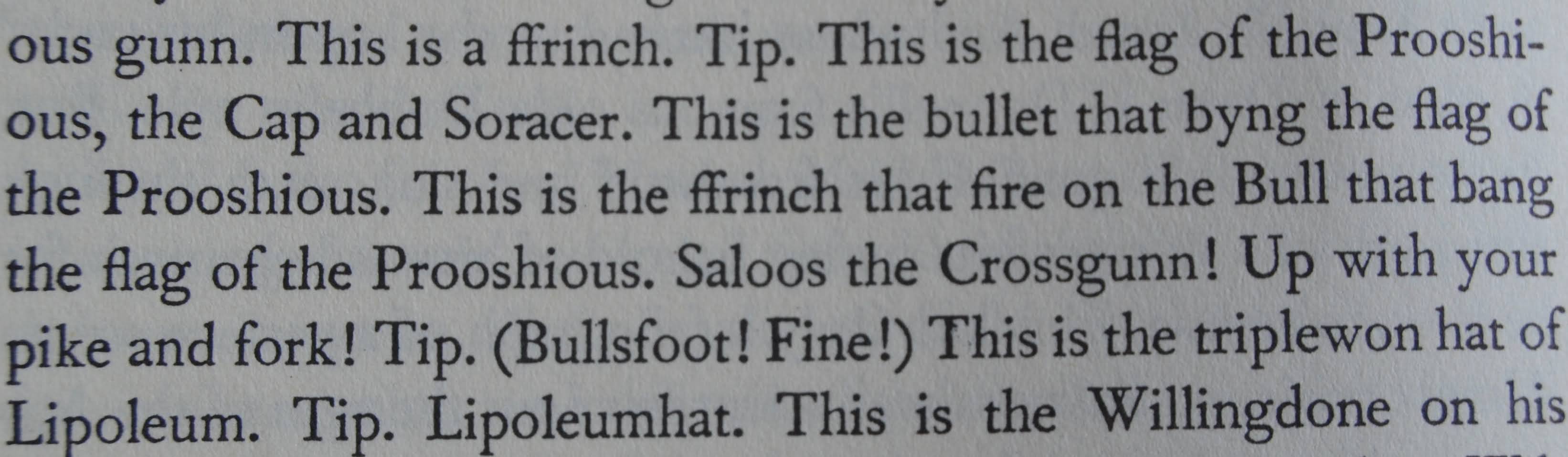
What's making all the 'tip' sounds in the Museyroom on pages 8-10?


What's making all these BENK! BINK! noises on page 379

Explaining the Phoenix Park Nocturne on p244, you told Jacques Mercanton that here ‘two little birds, male and female, release their little prayers, the two dots on the i's.'


Do you often use letters as pictures like this?

You also told Mercanton that you were following a 'method of working according to the precise laws of phonetics, the laws that rule over all languages'. What did you mean?

You told Max Eastman that in writing of the night, you couldn't use words in their ordinary connections: 'Used that way they do not express how things are in the night, in the different stages – the conscious, then semi-conscious, then unconscious.'  

Where do these different stages appear in the book? Is the Porter chapter, where there's more visual description, closer to waking?

Why and when did you abandon the title Finn's Hotel and rename it Finnegans Wake

Why did you drop your plan to make the fourth Shaun chapter 'all about roads, all about dawn and roads'?

Who is the late archdeacon J.F.X. Preserved Coppinger?

What did you mean when you told C.K.Odgen, explaining 'Hircus civis eblanensis', that 'the first man of Dublin was a he-goat'?

A Glass of Goat's Milk (1909)

When you got the chance to correct the text in 1939, why didn't you correct the real misprints instead of adding all those commas?

Richard Ellmann says that you 'spent a week in November (1929) explaining to James Stephens the whole plan of Finnegans Wake.'  What did you tell him?


What would you ask Mr Joyce?


Sunday, 31 October 2021

The Cult of Water

Here's a spooky film for Halloween, Wake Lovers.


This film, made by the Central Office of Information in 1973, traumatised a whole generation of British children who saw it on television. Writing in Fortean Times, Bob Fischer, who was one of them, calls them the 'haunted generation' 

'The bloody thing used to come lurching out of the ad breaks during Tiswas without any warning: one minute they'd be cheerily trying to sell you Connect 4 or this week's Look In, the next you'd be confronted by a cowled child-killer with Donald Pleasance's voice, gloomily intoning about how 'the show-offs are easy … but the unwary are easier still' and triumphantly warning, his voice laden with echo: 'I'll be BACK-ACK-ACK-ACK!'....I can remember the effect it had on me: it remains, unequivocally, the most scared I have ever been by anything. I was so scared that it continued to haunt me, years after they stopped showing it. Working on my university newspaper, I was granted an interview with Pulp. I wasted my allotted hour talking not about their music, but The Spirit of Dark and Lonely Water, which they'd recently mentioned in passing in the NME. In fairness, they seemed keen to talk about it as well. 'I know it sounds like acid bollocks,' their guitarist Russell Senior offered, 'but me and Jarvis once went down the River Don in Sheffield, throwing money in the water to appease The Spirit.''

Alexis Petridis, 'Danger! The World's Scariest Films!' The Guardian, 30 March 2012

OFFERINGS TO WATER GODDESSES

By throwing coins into the River Don, Jarvis Cocker and Russell Senior were continuing a custom which goes back to the Bronze Age.  The finest Celtic metalwork has been found in our rivers, especially the Thames, Trent and Welland. 

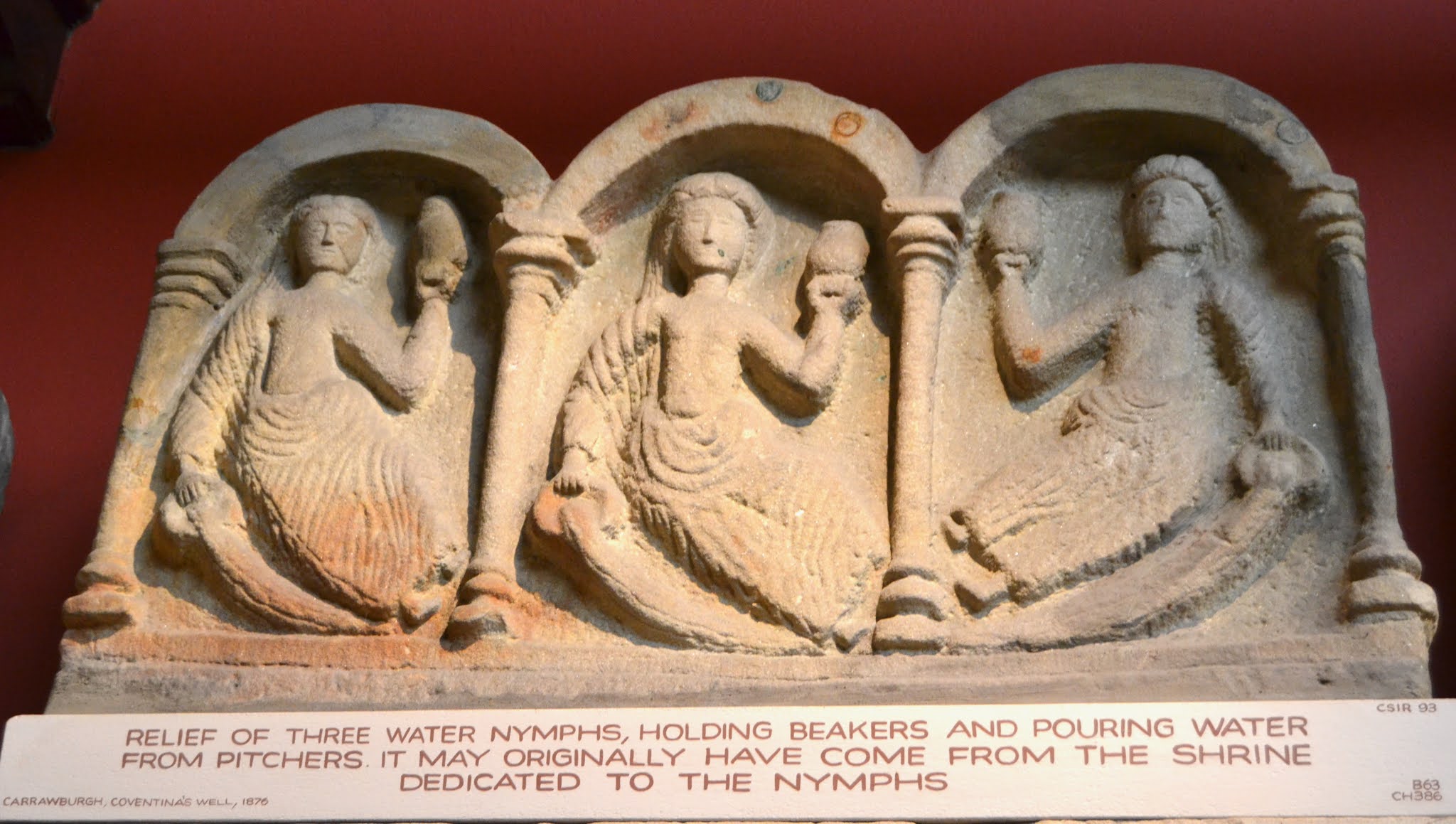
After the Roman conquest, watery offerings were restricted to shrines with sacred pools, like Bath, where the goddess Sulis Minerva was worshipped at a hot spring.  

Last week I visited Carrawburgh fort on Hadrian's Wall, where there was a shrine to another water goddess, Coventina.

There was a sacred spring and pool here, Coventina's Well, excavated by the landowner John Clayton in 1876. He found 13,487 Roman coins, though only six can now be seen in his museum. Astonishingly,  the antiquarian John Collingwood Bruce melted most of them down, and had them cast into an eagle weighing 6.5kg. A local told me that there was an old man living nearby who, as a boy, was given handfuls of Roman coins here. He used them as skimming stones in the lough (unconsciously returning them to the goddess).


My friend and neighbour, David Bramwell, who grew up beside the River Don in Doncaster, was another 1970s child traumatised by the Lonely Water film.  


'I’ve wrestled all my life with thalassophobia – the fear of large bodies of water – and wanted to confront this fear. In the last ten years I went down a rabbit hole researching water cults, sacred springs and wells. I wanted to pay my respect to water. I also became interested in the idea of following a river back to its source. I knew if I was going to make this journey as a pilgrimage it’d have to be along the river Don where I grew up, to search for its lost water goddess and to trace its biological and metaphorical death and resurrection over the millennia. When I discovered that Sheffield adopted Vulcan – the Roman god of fire and forge – as its mascot in the 1800s, the story began to catalyse as a mythic battle of the sexes: goddess of water vs god of fire. During the industrial revolution Danu was the equivalent of a princess locked in a tower and being force-fed MacDonalds for 200 years.'

From a 2019 interview with David in Folkhorrorrevival.

Vulcan on Sheffield Town Hall

In 2017, David made a radio programme, Danu – Dead flows the Don, for the Radio 3 series Between the Ears. It included his compositions and the sounds of the river recorded with hydrophones.  There were interviews with Alan Moore, discussing hydromancy; John Heaps, a Sheffield steelworker recalling throwing cyanide into the river in the 1970s; and the Sheffield folklorist David Clarke quoting a sinister rhyme about the River Don:

'The shelving, slimy river Dun
Each year a daughter or a son.'

I recommend David Clarke's article, 'Dead Flows the Don', which is online here.

The programe also featured a Sheffield witch, Anwen, who runs a shop called Airy Fairy.  She tells David to travel to the source of the Don, to make amends to the river goddess, Danu.

In 2018, David expanded the material from the radio programme to make a stage show, The Cult of Water, which he performed by candlelight for the Brighton Festival.  Using film and sound recordings, he took the audience on a psychogeographical journey, back in time, up the river to its source. 

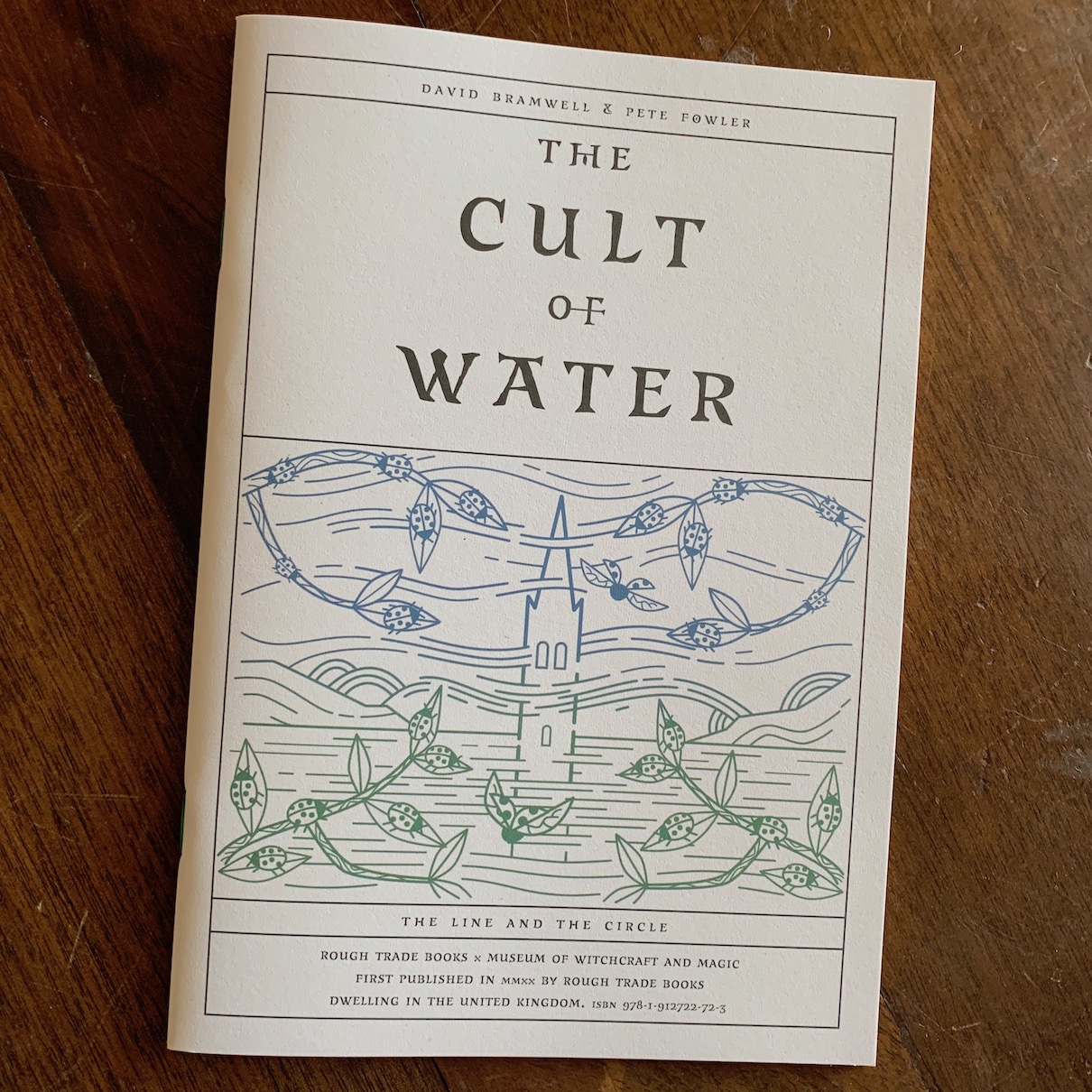
You can now get the text as a booklet, illlustrated by Pete Fowler, published by Rough Trade Books and the Museum of Witchcraft.


'Can Bramwell face his demons and unravel the symbolic mysteries of our ancient ancestors? Who is the mysterious Vulcan? And will there be a pie and a pint waiting for him at the end of it all?'

DUBLIN AND ANNA LIFFEY

Watching David's show in 2018, I was struck by the parallels between David's story and Finnegans Wake.  Joyce's main characters are a male city, Dublin, married to a female river, Anna Liffey.  The main difference is that in Finnegans Wake, the two elements are balanced.  The river and the city each have their say in the book.  Anna Livia speaks at the very end, from pages 615-628, and we move from the river at the end back to the city in the opening.

Anna Liffey on the Custom House

In one of the book's greatest sections, Haveth Childers Everywhere (532-554), HCE as Dublin describes how he 'waged love' on the river (547.07), leading her from Leixlip, and casting bridges over her to adorn her.

'I cast my tenspan joys on her, arsched overtupped, from bank of call to echobank' 547.29

There were ten bridges over the Liffey when Joyce was writing. There are now twenty-one I think.

'...and I gave until my lilienyounger turkeythighs soft goods and hardware (catalogue, passim) and fine ladderproof hosiery lines (see stockingers' raiment) and cocquette coiffs (see Agnes' hats) and pennigsworths of the best of taste of knaggy jets and silvered waterroses and geegaws of my pretty novelties and wispywaspy frocks, trancepearances of redferns and lauralworths' 548.18

Even the city's brewing of Guinness is an act of love for the river: 

'I brewed for my alpine plurabelle, wigwarming wench, (speakeasy!) my granvilled brandold Dublin lindub, the free, the froh, the frothy freshener, puss, puss, pussyfoot, to split the spleen of her maw' 553.25

Joyce could write this lovesong because Dublin, unlike Sheffield, never had heavy industry.  His favourite whiskey was Jameson's, which he believed tasted of the River Liffey. He told Gilbert Seldes, 'All Irish whiskeys use the water of the Liffey; all but one filter it, but John Jameson uses it mud and all. That gives it its special quality.' Joyce sent Seldes an Easter present of a bottle of Jamesons with a card inscribed, 'James Joyce presents Anna Livia's fireheaded son.' (Ellmann 592)

Imagine Haveth Childers Everywhere rewritten as the voice of industrial Sheffield/Vulcan describing his relationship with the Don!

'Choked by the coal industry at Mesborough, polluted from the heavy steelworks of Rotherham and Sheffield, the Don is diverted to soothe Vulcan's hellish heat.'  

The Cult of Water

After I told David about HCE and ALP, he wrote a new Wake section for the show, which follows his arrival at the river's source.


In 2019, David toured The Cult of Water, taking it to Doncaster, Sheffield, Liverpool, London and various festivals. Each performance ended with a Q&A focusing on the stories and history of the local river. So, in Brighton, he talked about our lost river, the Wellesbourne. In Liverpool, he was joined by the poet Eleanor Rees talking about the folklore surrounding the River Mersey. In London, the folklorist Chris Roberts talked about the capital's lost rivers.  

He should take the show to Dublin and have a Q&A on the Liffey!

David has a new Guardian article on walking the Don, which you can read here: 'The post-industrial river, called South Yorkshire’s answer to Apocalypse Now by Jarvis Cocker in the 1970s, today boasts great trails and clean waters.'

FROM SWERVE OF SHORE TO BEND OF BAY


The Cult of Water has now had yet another incarnation, as a 2021 album of David's music and songs based on the show. This also marks the twentieth anniversary of his band, Oddfellow's Casino.


Here's 'From Swerve of Shore to Bend of Bay', from The Cult of Water, opening with the voice of Alan Moore.