
Yes, in 1923 Joyce, suffering with eye troubles, was dictating passages from his new book to his wife, who had never shown any interest in his writing. What did she make of it?
The pages were also displayed in 2022 at the MoLI in Dublin. I was surprised by how big the paper was.
 |
| copyright National Library of Ireland |
 |
| copyright National Library of Ireland |

The piece dates from the very beginnings of Finnegans Wake and was probably composed between late March and June 1923, when he was unable to read or write due an attack of conjunctivitis followed by an eye operation. Despite this, he was still creating new material in his mind.
This is a first version of what would become the Mamalujo episode, the first part of the Wake to be published, in the transatlantic review in 1924. Unlike the later version, written in a rambling repetitive exhausted style, to express senility, this sketch is concise and lively. It also doesn't read like a first draft but a finished careful composition. In writing about senility, Joyce drew on his astonishing powers of memory.
 |
| Illustration by John Vernon Lord from the Folio edition |
To set the scene, this is a continuation of Tristan and Isolde sketch, the big love scene set on a ship (above), which ended with the mocking song of the seabirds circling above. In a cinematic shift of perspective, we move down into the sea where we find four ancient men, as blind as Joyce, listening in to the big kiss of the lovers. They are senile Irish historians and also waves of the sea, ancient voyeurs clinging to the Irish sea ferries and 'peering with glaucomatose eyes through the cataractic portholes of honeymoon cabins'.
Here is the text as dictated. In going through it beneath, I'll quote Joyce's revised version.
THE FOUR WAVES OF ERIN
They had seen their share: the capture of Sir Arthur Casement in the year 432, Coronation of Brian by the Danes at Clonmacnois, the drowning of poor Mat Keane of Dunlearery, the scattering of the flemish armada off the coasts of Galway and Longford, the landing of St Patrick at Tara in the year 1798, the dispersal of the French fleet under General Boche in the year 2002.
And such was their memory that they had been appointed extern professors to the four chief seats of learning in Erin, the Universities of killorcure, killthemall, killeachother, killkelly-on-the-Flure, whither they wirelessed four times weekly lectures in the four modes of history, past, present, absent and future
Saltsea widowers all four, they had been many ages before summarily divorced by their respective spouses (with whom they had parted on the best of terms) by a decree absolute issued by Mrs Justice Smashman in the married male offenders court at Bohernabreena, one for inefficiency in backscratching, two for having broken wind without having first made a request in writing on stamped foolscap paper, three for having attempted hunnish familiarities after a meal of decomposed crab, four on account of his general cast of countenance.
Though that was ever so long ago, they could still with an effort of memory and by counting carefully the four buttons of the fly of their trousers recall the name of the four beautiful sisters Brinabride who were at the moment touring the United States.
Yet were they fettlesome anon, lured by beauty often would they cling tentacularly to the sides of the Northwall and Holyhead boats and the Isle of Man tourist steamers, peering with glaucomatose eyes through the cataractic portholes of honeymoon cabins or saloon ladies' toilet apartments.
Yet were they fettlesome anon, lured by beauty often would they cling tentacularly to the sides of the Northwall and Holyhead boats and the Isle of Man tourist steamers, peering with glaucomatose eyes through the cataractic portholes of honeymoon cabins or saloon ladies' toilet apartments.
But when those jossers aforesaid, the Four Waves of Erin, heard the detonation of the osculation which with ostentation Tristan to Isolde gave, then lifted they up round Ireland's shores the wail of old men's glee.
Highchanted the elderly Waves of Erin in four-part Palestrian melody, four for all, all one in glee of grief of loneliness of age but with a bardic license, there being about of birds and stars quite a sufficient number.


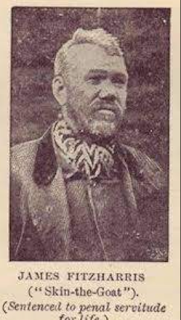
The old men may have muddled his horse-drawn cab with the pharaoh's chariot. I think the Red Sea is 'proleptic' (anticipatory) because its name anticipates bloodshed – the stabbing of Burke and Cavendish in the park.
Last year I found Fitzharris's grave, which is also a memorial to the Invincibles, in Glasnevin.
In Dubliners, we learn why, apart from drowning, he is called 'poor Mat Keane':
'His own domestic life was not very happy. People had great sympathy with him, for it was known that he had married an unpresentable woman who was an incurable drunkard. He had set up house for her six times; and each time she had pawned the furniture on him.
Everyone had respect for poor Martin Cunningham.'

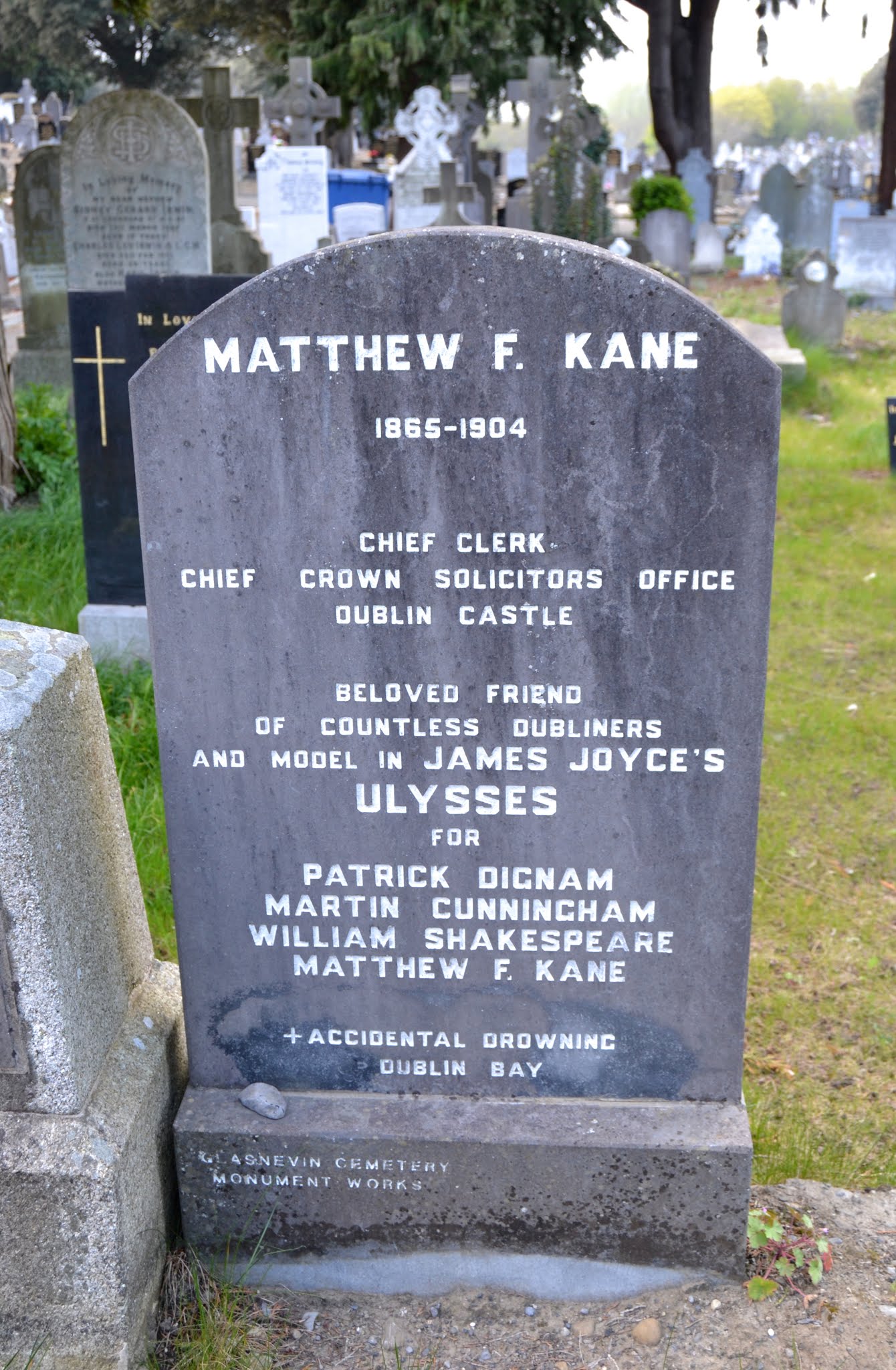
Here's his grave, which I photographed last year. It mentions his appearance in Uysses. It's a shame it doesn't include Finnegans Wake!


When Joyce rewrote the passage, he used the fictional name, and brought in the pharaoh's Red Sea:
'and then poor Martin Cunningham out of the castle on pension when he was completely drowned off Dunleary at that time in the red sea'
Here's the final transformation of the passage in Finnegans Wake, where he has become Merkin Cornyngwham - combining Martin Cunningham with Mark of Cornwall.

See also Casement's transformation into a Lady Jales Casemate and the reappearance of those Dublin auctioneers, now Queen Baltersby off the White Ship, wrecked in 1120.

'The fleet of the Flemings came from England in the army of Mac Murchadha to contest the kingdom of Leinster for him: they were seventy heroes, dressed in coats of mail.'


This passage reminds me of the 'several highly respectable Dublin ladies' accusing Leopold Bloom of sending them improper letters.
'MRS BELLINGHAM Tan his breech well, the upstart! Write the stars and stripes on it!
MRS YELVERTON BARRY Disgraceful! There's no excuse for him! A married man!'
'Bohernabreena in old times was Boher-na-Bruighne or 'the road of the court' or 'great mansion', one of the five great palaces or breens, houses of universal hospitality, for which Ireland was famed.'
William Domville Handock', History of Tallaght, 1899
The inspiration for this divorce section was probably Swift's Struldbrugs.
'If a Struldbrug happen to marry one of his own kind, the marriage is dissolved of course, by the courtesy of the kingdom, as soon as the younger of the two comes to be fourscore; for the law thinks it a reasonable indulgence, that those who are condemned, without any fault of their own, to a perpetual continuance in the world, should not have their misery doubled by the load of a wife.'
Highchanted the elderly Waves of Erin in four-part Palestrian melody, four for all, all one in glee of grief of loneliness of age but with a bardic license, there being about of birds and stars quite a sufficient number.
This was their way
A birdless heaven, seadusk and one star,
Low in the west
And thou, poor heart, loves image, faint and far,
Rememberest
Her clear cold eyes and her soft lifted brown
And fragrant hair,
Falling as through the silence falleth now
Dusk from the air.
A why wilt thou,
A why wilt thou remember these,
A why,
Poor heart, repine,
If the dear love she yielded with a sigh
Was never thine!'
‘The Three Tonns or Waves of Erin are much celebrated in Irish romantic literature. They were Tonn Cleena in Glandore harbour in Cork; Tonn Tuaithe outside the mouth of the Bann in Derry; and Tonn Rudraidhe in Dundrum Bay off the County Down. In stormy weather, when the wind blows in certain directions, the sea at these places, as it tumbles over the sandbanks, or among the caves and fissures of the rocks, utters an unusually loud and solemn roar, which excited the imagination of our ancestors. They believed that these sounds had a supernatural origin, that they gave warning of the deadly danger, or foreboded the approaching death, of kings or chieftains, or bewailed a king's or a great chief's death.’
Joyce later told Eugene Jolas that his aim was 'to build many planes of narrative with a single esthetic purpose'. This creation of old Irishmen who are also waves was the first piece he composed with multiple planes.
'TOG: a coat; to tog, is to dress or put on clothes; to tog a person, is
also to supply them with apparel, and they are said to be well or queerly
tog'd, according to their appearance.

It was cancelled in 2020-21, for the first time since 1940, due to Covid.


Another nice addition, made in 1938, fifteen years after the original sketch, is 'tailturn' making 'tailturn horseshow'. This combines the turning tails of the Dublin show horses with the Tailteann Games in County Meath. This was an ancient festival, which died out following the Anglo-Norman invasion – Joyce added 'angler nomads' at the same time. It was revived by the Irish Free State in 1924, when the new games were held in Croke Park Dublin. Like the horse show, it took place in August.


'The computer on which I was viewing the Wake manuscript also contained images of the Léon cache, titled 'Joyce Papers 2002'. Perhaps, you may say, Joyce was clairvoyant as well as mischievous, or possibly this is a matter of absolutely no import, or perhaps again there is a more peculiar game in play . . .'
It's possible Joyce was thinking of the law of falling bodies - 32 feet per second per second, which is on Bloom's mind in Ulysses. But his reason for making this change may have simply been to add an additional layer of confusion. In their senility they haven't even chosen an important date to remember. In the rewrite, Joyce made this the key date of the chapter, and later the whole book.
Low in the west
And thou, poor heart, loves image, faint and far,
Rememberest
Her clear cold eyes and her soft lifted brown
And fragrant hair,
Falling as through the silence falleth now
Dusk from the air.
A why wilt thou,
A why wilt thou remember these,
A why,
Poor heart, repine,
If the dear love she yielded with a sigh
Was never thine!'
THE FOUR WAVES OF ERIN
At this stage, Joyce has not yet named his four men, later called Matt Gregory, Marcus Lyons, Luke Tarpey and Johnny MacDougall, and collectively Mamalujo.
Nora first wrote 'The Four Waves of Ireland'. The change to the poetic 'Erin' is in Nora's handwriting, so Joyce may have decided on this while he was dictating.
As ‘waves of Erin’, the four are magical waves, drawn from Irish myth, which would roar a warning in times of danger. There were three of them but Joyce has made four:
‘The Three Tonns or Waves of Erin are much celebrated in Irish romantic literature. They were Tonn Cleena in Glandore harbour in Cork; Tonn Tuaithe outside the mouth of the Bann in Derry; and Tonn Rudraidhe in Dundrum Bay off the County Down. In stormy weather, when the wind blows in certain directions, the sea at these places, as it tumbles over the sandbanks, or among the caves and fissures of the rocks, utters an unusually loud and solemn roar, which excited the imagination of our ancestors. They believed that these sounds had a supernatural origin, that they gave warning of the deadly danger, or foreboded the approaching death, of kings or chieftains, or bewailed a king's or a great chief's death.’
P. W. Joyce’s A Social History of Ancient Ireland, Vol II p.525
Later in the piece they become radio waves, wirelessly broadcasting history lectures. The waves' cries also inspired their 'wail' at the end, 'lifted up round Ireland's shores'.
Joyce later told Eugene Jolas that his aim was 'to build many planes of narrative with a single esthetic purpose'. This creation of old Irishmen who are also waves was the first piece he composed with multiple planes.
'leaning upon the staves of memory'
The four who have endured through all of human history, live in their hopelessly muddled memories, the walking sticks that support them. They are like Swifts Struldbrugs in Gulliver's Travels.
'They have no remembrance of anything but what they learned and observed in their youth and middle-age, and even that is very imperfect; and for the truth or particulars of any fact, it is safer to depend on common tradition, than upon their best recollections. The least miserable among them appear to be those who turn to dotage, and entirely lose their memories...'
'Four eminently respectable old heladies'
Joyce dictated 'gentlemen', but then changed this to 'heladies'. One of the symptoms of senility running through Mamalujo is confusion about sexual identity. He also changed 'spouses' to 'she-husbands'. This shows the beginning of the new style, where the narrative voice is not just describing senility but also expressing it.
'got up in sleek holiday toggery for the occasion...'
TOG'D OUT TO THE NINES: a fanciful phrase, meaning simply, that a person
is well or gaily dressed.
TOGS, or TOGGERY: wearing-apparel in general.'
James Hardy Vaux, A New and Comprehensive Vocabulary of the Flash Language, 1819
This creates a conversational feel, as if we are being buttonholed for an anecdote. It's similar to the earlier Roderick O'Connor sketch which includes 'you say yourself', 'wait till I tell you' and 'what do you think he did sir'.
Apart from the salt water, they look like the Irish peer, Richard Wingfield, 4th Viscount Powerscourt (1762–1809). The family was well known in Dublin, with its townhouse, Powerscourt House on South William Street (now a shopping centre). Here he is - imagine him on his way to the Dublin horse show with salt water pouring off him!


It's now the Dublin Trading Company.


The Royal Dublin Society horseshow, one of the highlights of the Irish social and sporting calendar, dates from 1864. It was even held in August 1920, at the height of the war of Independence, when this cartoon appeared in the Sunday Independent.
'Togs' is 16th century vagabond's cant, and is short for 'togeman' meaning coat. The OED suggests that the 19th century spread of the word may be linked to its similarity with toga.
'grey half tall toque tailormade frock coat to match fathomglasses'
Joyce added 'tailormade' and changed 'hat' to 'toque', echoing 'toggery'. They are formally dressed in Victorian frock coats and grey toques, but 'sleek' and 'grey' also makes me think of seals.
He's invented the word 'fathomglasses' - perhaps opera glasses for looking through, or measuring, the fathoms of water. In the Wake, this became 'they had their fathomglasses to find out all the fathoms.' 386.16
'and soforth, you know'
'for all the world apart from the salt water like the fourth viscount Powerscourt...'

'...or North the auctioneer at the royal Dublin societies annual horseshow.'
North the auctioneer is one of Joyce's additions to the dictated text. This is James H North the auctioneer and estate agent, whose business was at 110 Grafton Street – not far from Powerscourt House. From Thom's 1904 directory.


I bought this on ebay.

I expect John Joyce, with his many changes of address, had personal dealings with the company.

Here's how the passage expanded (and made more confused) appeared in Finnegans Wake. Joyce has added more central Dublin locations and changed North's surname to Tickell, but added his real initials.
 |
| I drew the map was I was a student in 1983. |
He's also increased the gender confusion, making the statue of Daniel O'Connell 'Mrs Dana O'Connell' and 'Battersby Sisters' from another Dublin auctioneer and estate agent, Battersby Brothers of 39 Westmoreland Street. Here they are in Thom's 1904 Directory.

Here's a 1970 photo from the Dublin City Council Photographic Collection. The Atrium Lounge now stands here.

Leopold Bloom thinks of these auctioneers while walking down Eccles Street in the Calypso episode of Ulysses:
'Number eighty still unlet. Why is that? Valuation is only twentyeight. Towers, Battersby, North, MacArthur: parlour windows plastered with bills.'
 |

JOYCE CREATES 1132
'They had seen their share.. the capture of Sir Arthur Casement in the year 1132 Coronation of Brian by the Danes at Clonmacnois the drowning of Pharoah F Phitzharris in the (proleptically) red sea. The drowning of poor Mat Keane of Dunlearery the scattering of the flemish armada off the coasts of Galway and Longford, the landing of St Patrick at Tara in the year 1798, the dispersal of the French fleet under General Boche in the year 2002.'
Since they are waves of the sea, their muddled memories are mostly of maritime events, such as landings, invasions and drownings. When Joyce dictated this piece, the first date was 432 - the year of St Patrick's arrival in Ireland. So there were two famous dates - 432 and 1798, the year of the French, and one absurd date - 2002.
Yet how extraordinary that Joyce should have chosen 2002 - the year that the National Library announced it had bought the manuscript!

Joyce then made a momentous change, crossing out the 4 of 432 and writing 11. Yes, this is the moment he created 'the only real date in Finnegans Wake' (Anthony Burgess).
 |
| The darker pencil is James' Joyce's handwriting. National Library of Ireland |
'the capture of Sir Arthur Casement in the year 1132'
In April 1916, Sir Roger Casement, was captured after being set ashore from a German submarine in Banna Strand in Tralee Bay, County Kerry. The old men have probably confused him with Sir Arthur Guinness (or Sir Arthur Wellesley).

'Coronation of Brian by the Danes at Clonmacnois'
Here the old men have almost got some facts right. Brian Boru, who defeated the Danes at the Battle of Clontarf in 1014, was educated at the monastery of Clonmacnoise by the River Shannon in County Offaly. The monastery was associated with the kings of Connacht who were often buried here.

'the drowning of Pharoah F Phitzharris in the (proleptically) red sea'
This was added by Joyce to the dictated text, squeezed in, in a darker pencil, at the very bottom of the page (see above). The name suggests James Fitzharris, nicknamed Skin-the-Goat, the cabman who drove the Phoenix Park assassins, and who keeps the cabman's shelter in Ulysses. The 'Ph' spelling of his name goes with 'Pharaoh'.

The old men may have muddled his horse-drawn cab with the pharaoh's chariot. I think the Red Sea is 'proleptic' (anticipatory) because its name anticipates bloodshed – the stabbing of Burke and Cavendish in the park.
 |
F.A.Bridgman, Pharaoh's Army Engulfed in the Red Sea |
'The drowning of poor Mat Keane of Dunlearery'
This is Nora's misspelling of Matt Kane. He was a close friend of Joyce's father, and he really did drown in 1904 off Kingstown, which was called Dunleary before 1821, and given its old name, with the Irish spelling Dún Laoghaire in 1920. It's fitting that the old men only know the early name.
Kane was the original of Martin Cunningham in Dubliners and Ulysses. Joyce attended his funeral and used it as the basis for Paddy Dignam's – so Martin Cunningham in Ulysses is attending his own funeral.

I like 'Dunlearery' but it may be another of Nora's mistakes.
'His own domestic life was not very happy. People had great sympathy with him, for it was known that he had married an unpresentable woman who was an incurable drunkard. He had set up house for her six times; and each time she had pawned the furniture on him.
Everyone had respect for poor Martin Cunningham.'
Here's the Freeman's Journal report, which shows that it was a massive funeral.


When Joyce rewrote the passage, he used the fictional name, and brought in the pharaoh's Red Sea:
'and then poor Martin Cunningham out of the castle on pension when he was completely drowned off Dunleary at that time in the red sea'
Here's the final transformation of the passage in Finnegans Wake, where he has become Merkin Cornyngwham - combining Martin Cunningham with Mark of Cornwall.

See also Casement's transformation into a Lady Jales Casemate and the reappearance of those Dublin auctioneers, now Queen Baltersby off the White Ship, wrecked in 1120.

'the scattering of the flemish armada off the coasts of Galway and Longford'
In 1588, the Spanish Armada was scattered by storms off the west coast of Ireland. The joke here is that County Longford, in the middle of Ireland, is landlocked.
As for flemings, The Annals of the Four Masters has this entry for the Anglo-Norman invasion of Ireland in 1169.
The word 'flemish' suggests phlegm, which later inspired the old men's 'phlegmish hoopicough' at 397.24

Boche was a mocking nickname for the Germans used by the Allies during World War I. It is thought to be a shortened form of the French portmanteau 'alboche', derived from Allemand and caboche ("head" or "cabbage"). In his rewrite, Joyce changed the name to 'Madam-general Bonaboche', bringing in Bonaparte, and then 'Motham General Bonaparte' (388.21)
'the landing of St Patrick at Tara in the year 1798 the dispersal of the French fleet under General Boche in the year 2002'
St Patrick had his duel with the High Druid at Tara, the subject of another 1923 sketch.
There were two failed French invasions of Ireland, in 1796-7 and 1798. Here's a Gilray cartoon showing the first one.

UNIVERSITY PROFESSORS
'And such was their memory that they had been appointed extern professors to the four chief seats of learning in Erin, the Universities of killorcure, killthemall, killeachother, killkelly-on-the-Flure, whither they wirelessed four times weekly lectures in the four modes of history, past, present, absent and future'
Here's the first suggestion that the old men represent the four provinces of Ireland. Kill is Irish for church but the echoes of killing suggest the Irish Civil War, and Joyce's own fears that he risked being shot if he visited the Irish Free State.

The word before 'professors' is hard to read - it may say 'extern' (ie external) or 'exterm'. A professor living in the sea would have to be external!
The four province idea was more fully developed in the transatlantic review version, where we also get to hear their individual voices as wireless broadcasts cutting in. Here the four are radio waves as well as waves of the sea.

The old men's 'modes of history' are grammatical tenses, with the comical addition of 'absent' - suggested by the different meanings of the word 'present' (now and in this place). Originally, they included the future, hence the date 2002. Joyce cut this and the date in his rewrite – the old men live in the past.
GROUNDS FOR DIVORCE
'Saltsea widowers all four, they had been many ages before summarily divorced by their respective shehusbands (with whom they had parted on the best of terms) by a decree absolute issued by Mrs Justice Squelchman in the married male offenders court at Bohernabreena, one for inefficiency in backscratching, two for having broken rerewind without having first made a request in writing on stamped foolscap paper, three for having attempted hunnish familiarities after a meal of decomposed crab, four on account of his general cast of countenance.'
I love these grounds for divorce. Did they make Nora respond with a joke about her own possible grounds for divorce? She had more to complain about than 'inefficiency in backscratching'.
'by a decree absolute'
The final decree ending a marriage after a decree nisi showing legal requirements have been met.
cf Bloom in Eumaeus: ' Then the decree nisi and the King's Proctor to show cause why and, he failing to quash it, nisi was made absolute.'
The final decree ending a marriage after a decree nisi showing legal requirements have been met.
cf Bloom in Eumaeus: ' Then the decree nisi and the King's Proctor to show cause why and, he failing to quash it, nisi was made absolute.'
Here Joyce added 'rere' to 'wind', making 'rerewind'. 'Mrs Justice Squelchman' was originally 'Squashman' - but the meaning is the same, a fearsome female judge squashing men.

This passage reminds me of the 'several highly respectable Dublin ladies' accusing Leopold Bloom of sending them improper letters.
'MRS BELLINGHAM Tan his breech well, the upstart! Write the stars and stripes on it!
MRS YELVERTON BARRY Disgraceful! There's no excuse for him! A married man!'
Bohernabreena is a townland in County Dublin beside the River Dodder.
William Domville Handock', History of Tallaght, 1899
'If a Struldbrug happen to marry one of his own kind, the marriage is dissolved of course, by the courtesy of the kingdom, as soon as the younger of the two comes to be fourscore; for the law thinks it a reasonable indulgence, that those who are condemned, without any fault of their own, to a perpetual continuance in the world, should not have their misery doubled by the load of a wife.'
In the expanded version, the sense that we are reading grounds for divorce is harder to follow.


'hunnish familiarities after eating a bad crab in the red ocean'
Like Boche, 'hunnish' is WW1 slang for the beastly and underhand behaviour of the Germans.
On the day Joyce sent the sketch to Harriet Shaw Weaver, he learned of the death of his old Belvedere schoolfellow, Richard Sheehy. Joyce, who believed that his writing had prophetic power, wrote to Weaver:
'It is strange that on the day I sent off to you a picture of an epicene professor of history in an Irish university college seated in the hospice for the dying etc after 'eating a bad crab in the red sea' I received a paper from Dublin containing news of the death at the age of 41 of an old schoolfellow of mine in the hospice for the dying, Harold's Cross, Dublin, professor of law in the University of Galway....More strangely still his name (which he used to say was an Irish (Celtic) version of my own) is in English an epicene name being made up of the feminine and masculine personal pronouns – Sheehy. It is as usual rather uncanny.'
Letter to Harriet Shaw Weaver, 23 October 1923, Letters Vol I
Letter to Harriet Shaw Weaver, 23 October 1923, Letters Vol I
Did he also prophesy the 1991 discovery that eating a bad crab can cause brain damage and lasting memory loss?

FOUR BEAUTIFUL SISTERS
'Though that was ever so long ago, they could still with an effort of memory and by counting accurately the four periwinkle buttons of the fly of their knickybockies recall the name of the four beautiful sisters Brinabride who were at the moment touring the United States of Africa.'
Joyce dictated 'counting carefully the four buttons of their trousers' and later added 'accurately', 'periwinkle', the childish 'knickybockies' and 'of Africa'.
As waves of the sea, they have had briny brides, sister sea nymphs. But 'name' rather than 'names' suggests that all they can remember of their wives is their maiden surname. The idea that their wives are 'at the moment touring the United States of Africa' sounds like a senile delusion.
'in 1132 Brian or Bride street' 388.11
'O, come all ye sea nymphs of Dingle beach to cheer Brinabride queen from Sybil surfriding'. 399.03
'O, come all ye sea nymphs of Dingle beach to cheer Brinabride queen from Sybil surfriding'. 399.03
This then became a Wake motif:
'An auburn mayde, o’brine a’bride, to be desarted' 13.26
'An auburn mayde, o’brine a’bride, to be desarted' 13.26
'—Sold! I am sold! Brinabride! My ersther! My sidster!
Brinabride, goodbye! Brinabride! I sold!' 500.21
'the bride of the Bryne' 595.05
Brinabride, goodbye! Brinabride! I sold!' 500.21
'the bride of the Bryne' 595.05
In the senile rewrite, the sense of this passage was lost - as well as 'touring the United States of Africa'.
'not forgetting about shims and shawls week, in auld land syne (up) their four hosenbands, that were four (up) beautiful sister misters, now happily married, unto old Gallstonebelly, and there they were always counting and contradicting every night‚ tis early the lovely mother of periwinkle buttons, according to the lapper part of their anachronism (up one up two up one up four) and after that there now she was, in the end, the deary, soldpowder and all, the beautfour sisters...' 393.14
THE FOUR AS VOYEURS
'Yet were they fettlesome anon, lured by the immortal rose of Wombman's beauty. Often would they cling tentacularly about the ship's waists of the Northwall and Holyhead boats and the Isle of Man tourist steamers, peering with glaucomatose eyes through the cataractic portholes of honeymoon cabins or saloon ladies' toilet apartments.'
The four are voyeurs, trying to peer, despite glaucoma and cataracts, through the portholes of the ships crossing the Irish Sea – which explains why they are here beside the ship carrying Tristan and Isolde from Ireland to Cornwall.
Expanding the dictated text, Joyce changed 'lured by beauty to 'lured by the immortal rose of Wombman's beauty'. 'The immortal rose of woman's beauty' sounds like a phrase he's read in a magazine.
.jpeg) |
| copyright National Library of Ireland |
He also rewrote 'cling to the sides of', as the vivid 'cling tentacularly about the ship's waists of.' The low mid section of a ship is its 'waist'. We see the old men now as cephalopods.
 |
| 1920 illustration from St Nicholas's magazine |
'Fettlesome' is an invented word. 'Fettle' (state) is most commonly used in the phrase 'fine fettle'. Fettle is also an Old English word for a belt, which may link with their clinging to the ships.
Again, much of the original sense was lost in the rewrite:
'And after that so glad they had their night tentacles and there they used to be, flapping and cycling, and a dooing a doonloop, panementically, around the waists of the ship...'394.12
'like a foreretyred schoon-masters, and their pair of green eyes and peering in, so they say, like
the narcolepts on the lakes of Coma, through the steamy windows, into the honeymoon cabins, on board the big steamadories,
made by Fumadory, and the saloon ladies’ madorn toilet chambers
lined over prawn silk and rub off the salty catara off a windows
and, hee hee, listening, qua committe, the poor old quakers, oben
the dure, to see all the hunnishmooners and the firstclass ladies' 395.06
THE WAIL OF OLD MEN'S PLANXTY
The passage ends with their wailing musical lament as, hearing the big kiss of Tristan and Isolde, they are struck by 'grief of loneliness'.
'But when those jossers aforesaid, the Four Waves of Erin, heard the detonation of the osculation (cataclysmic cataglotism) which with ostentation (osculum cum basio suavioque) Tristan to Isolde gave, then lifted they up round Ireland's shores the wail of old men's planxty.
Highchanted the elderly Waves of Erin in four-part Palestrian melody, four for all, all one in glee of grief of loneliness of age but with a bardic license, there being about of birds and stars and noise quite a sufficient quantity.
Highchanted the elderly Waves of Erin in four-part Palestrian melody, four for all, all one in glee of grief of loneliness of age but with a bardic license, there being about of birds and stars and noise quite a sufficient quantity.
This plashed their wavechant'
Joyce has made several changes, including adding Latin terms for kisses and changing 'glee' to 'planxty'. A glee is a three or four-part acapella song, but it also suggests gleeful and this is a lament. One theory is that 'planxty' derives from the Latin 'plancus' (lament).
The pervert in 'An Encounter' is called a 'queer old josser' and he also has green eyes.
 |
| Palestrina |
Joyce loved the music of Giovanni da Palestrina (1525-1594), who wrote many motets, hymns and madrigals for four voices. He told Frank Budgen, 'In writing the mass for Pope Marcellus, Palestrina did more than surpass himself as a musician....He saved music for the Church.'
'This was their way' became 'This plashed their wavechant' - sadly lost in the final version.
The old men's final song is a version of 'Tutto e Sciolto' (All is Lost), a poem of nostalgic regret , inspired by a failed romance with a student, which Joyce wrote in Trieste in 1914, and which he published in 1927 in Pomes Pennyeach. Did Nora know anything about the background to this poem?
On rewriting 'Mamalujo', Joyce wisely decided to drop this personal poem and write a more suitable song - in which each of the old men in turn, and in a different Irish accent, fantasises about Isolde.
See my post Four Irish Accents.


