
Here's a scene from Mary Ellen Bute's wonderful film 'Passages from James Joyce's Finnegans Wake', which you can see on youtube and ubuweb. Bute needed to find ways of visualising Joyce's text, and one of them was to re-invent the Wake narrator as a television newsreader. It might seem that she's taking liberties here, but television is in Joyce's book.

 |
The extraordinary thing about the Wake pub is that it has a television set!
If you travelled back to the Mullingar House in 1937-8, when the chapter was written, and told Mr Keenan, the landlord, that one day his pub would have a television, he would surely have dismissed the idea as science fiction. But I can confirm that it really now does have television – three sets, showing sporting events. Finnegans Wake has the power to predict the future!
 |
| A Mullingar House television, photographed in April 2019 |
'There were no television sets in bars until eight years after FW was published, and no television sets in Irish bars for about twenty years later. And yet Joyce has a television set in the bar!'
Robert Anton Wilson from an interview transcribed by Scott McKinney and published in 2012 on the OnlyMaybe blog
The pub television is first introduced as a radio, a 'tolvtubular high fidelity daildialler, as modern as tomorrow afternoon and in appearance up to the minute....eclectrically filtered for allirish earths and ohmes.' (309.26). Later we receive its broadcasts, first a weather forecast (p324) and then a Horse Race report (341-2). The radio seems to be turning into a television, for the horse race is 'verbivocovisual':
 |
| Another Mullingar House television |
Soon after, there's we get the first explicit mention of television:
'The other foregotthened abbosed in the Mullingaria are during this swishingsight teilweisioned.' 345.34
Zwischenzeit is German for 'interval' and Teilweise' means 'partly'. Perhaps the radio is only partly a television here.
.jpg) To Joyce, with his Jesuit education, 'General' would also recall the Superior General of the Society of Jesus, nicknamed the 'Black Pope'. Between 1915 and 1942, this was Wlodimir Ledóchowski (right).
To Joyce, with his Jesuit education, 'General' would also recall the Superior General of the Society of Jesus, nicknamed the 'Black Pope'. Between 1915 and 1942, this was Wlodimir Ledóchowski (right).
So Joyce calls his General 'Popey O’Donoshough, the jesuneral of the russuates', and describes him wearing various religious seals.

This is how I picture Joyce's Russian General emerging, like a spectre, on the screen of the Mullingar House television.
Joyce, who opened Ireland's first cinema in 1909, followed the development of television almost from the beginning. The Wake has what may be the earliest use of 'television' in literature, published in transition in 1927. This appears in the published text at 150.32-5:
I think one reason that Joyce was interested in television was that it was a new technology which required new words. 'Television' itself combines the Greek 'tēle' (far) and the Latin 'visio' (seeing). It's almost a Wake word! According to the OED, the word goes back to 1900, when The Century Magazine, imagining the future, declared 'Through television and telephone we shall see and hear each other as though face to face.'

Horses and televisions again! This is what Jung would have called a synchronicity.
In the passage above, Joyce has come up with his own alternative, 'faroscope', meaning 'far seer' (Greek 'skopon' again). It also has the special Wake echo of the 'fire escape' in Medina Place, Hove, used by Charles Stewart Parnell to escape from being caught with Kitty O'Shea (cf 'a skyerscape' 4.36; 'fuyerescaper! 228.29; 'fairescapading in his natsirt' 388.03). There's also 'Pharos', the Greek lighthouse.
Imagine if the television pioneers had been Joyce fans. Along with the physicists' 'quark', adopted from Finnegans Wake by Murray Gell-Man, we might today talk about what we saw last night on our faroscopes rather than our televisions.
'Television kills telephony in brothers' broil. Our eyes demand their turn. Let them be seen!' 52.18
Television will replace the telephone, for our eyes demand their turn, after our ears.
THE ICONOSCOPE
The 1930s saw big leaps forward, with electronic television improving on Baird's mechanical system. This was the work of many inventors, but the most important was probably Vladimir Zworykin, who invented and named the iconoscope, the first practical television camera tube.

An iconoscope focussed an image through a camera lens on a 'mosaic screen', a mica plate, covered with vast numbers of tiny silver cells, made photo-sensitive by being coated with caesium (Joyce's 'caeseine coatings'). Each cell on the screen built up an electrical charge, whose strength depended on how much light it received. This complete image, or teleframe, was then scanned by a stream of electrons, which traversed the mosaic screen in a series of slightly sloped parallel lines. So Joyce gives us:
'Down the photoslope....the scanning firespot of the sgunners traverses the rutilanced illustred sunksundered lines'
Again, there's the Battle of Balaclava here, as the Russian gunners traverse the British lines. 'sunksundered' is an echo of 'rode the six hundred', from Tennyson's 'Charge of the Light Brigade'.
 The image captured on the mosaic screen, in the form of a stream of electical impulses, was then converted into a radio carrier wave for transmission - 'borne by their carnier walve'
These signals were then picked up by radio receivers - tv aerials -and converted back into an electrical current, which was then amplified and used to create the image on the television screen.
Synchronizing pulses added to the signal at the end of every scan line and teleframe ensured that the receiver remained locked in step with the transmitted signal ('Down the photoslope in syncopanc pulses').
 To convert the electrical current back into the original image ('its viseversion'), televisions used the Cathode Ray Tube, also named by Zworykin. This was a vacuum tube containing an electron or spray gun, which bombarded a flourescent screen with a narrow beam of electrons ('bombardment screen... Spraygun rakes and splits them'). This caused the screen to glow, recreating the original teleframe.


'There is no other television company or experimenter in the world, who has today anything equivalent in size of picture for the home and larger screens to those shown by Scophony. This is, therefore, an achievement of which Britain can be very proud.'


This 'simple explanation'(!) shows how the control worked.

I still don't fully understand this, but it looks mighty impressive!
'(his electroscophonious* photosensition under suprasonic light control may be logged for by our none too distant futures as soon as tone values can be turned out from Chromophilomos, Limited at a millicentime the microamp)' 123.12-15
'Hll, smthngs gnwrng wthth sprsnwtch!' 349.26
Hell, something's gone wrong with the supersonic switch! The missing letters represent missing parts of the television image.


Here are Joyce's notes, with page and line numbers added by Rose, showing where each item appears in the Wake. The letters 'G' and 'S' refer to the green and sienna coloured crayons which Joyce used to cross out each entry when he transferred it to his text. So 'shortwave' is not crossed out because Joyce didn't use it.

Rose writes, 'I have not been able to find a reference to the singular material, guranium satin, with whch Joyce, in II.3, constructs his bairdboard bombardment screen.'
 The source of Joyce's notes was finally tracked down, 42 years after Rose published them, in a brilliant piece of detective work by Ian MacArthur and Viviana-Mirela Braslasu's. You can read their discoveries in 'Television in Notebook VI.B.46', in Genetic Joyce Studies 2020:
This is the source of most of Joyce's notes, but not 'telavicious nieces' which is MacArthur and Braslau's transcription of Rose's 'telavicious mica'.
'It may be a pun on ‘television pieces’, which would tie the entry to the index Joyce was recording, or, to speculate even further, it may be a reference to some distant—hence the use of the prefix ‘tele-’ as ‘tella-’—relatives: the ‘vicious nieces’. But what Joyce really meant, we may never know.'
Most of Joyce's notes were taken from just two articles, 'Television Topics', on the Scophony mechanical system, and 'Light and Electrons', a technical description of the electron beam system. He then used the notes to create a strange hybrid of a mechanical and an electronic television. The Finnegans Wake device combines split focus and a supersonic light system from a mechanical television with the spray gun, caesium coating and iconoscope of an electronic one.
'I am really one of the great engineers, if not the greatest, in the world besides being a musicmaker, philosophist and heaps of other things.'
To Harriet Shaw Weaver, postcard of 16 April 1927, Letters Vol I, p250.
The next page of the article supplied Joyce's list with 'teleframes' and 'Baird board'


'Shortwave', the first item in Joyce's list, came from the heading of another article.

The whole magazine is fascinating to read now, looking back from the television future that the writers were imagining.

Now follows the key passage, which Joyce wrote in December 1937. The pub drinkers have been listening to a double act, Butt and Taff, who are trying to tell the Crimean War story of 'How Buckley Shot the Russian General.' On page 349, the characters appear on the pub television screen, with Taff fading (becoming Tuff) and Butt emerging (becoming Batt). They are then replaced on the screen by the figure of the Russian General, a version of HCE:
In the heliotropical noughttime following a fade of transformed Tuff and, pending its viseversion, a metenergic reglow of beaming Batt, the bairdboard bombardment screen, if tastefully taut guranium satin, tends to teleframe and step up to the charge of a light barricade. Down the photoslope in syncopanc pulses, with the bitts bugtwug their teffs, the missledhropes, glitteraglatteraglutt, borne by their carnier walve. Spraygun rakes and splits them from a double focus: grenadite, damnymite, alextronite, nichilite: and the scanning firespot of the sgunners traverses the rutilanced illustred sunksundered lines. Shlossh ! A gaspel truce leaks out over the caeseine coatings. Amid a fluorescence of spectracular mephiticism there caoculates through the inconoscope stealdily a still, the figure of a fellowchap in the wohly ghast, Popey O’Donoshough, the jesuneral of the russuates. The idolon exhibisces the seals of his orders: the starre of the Son of Heaven, the girtel of Izodella the
Calottica, the cross of Michelides Apaleogos, the latchet of Jan of Nepomuk, the puffpuff and pompom of Powther and Pall, the great belt, band and bucklings of the Martyrology of Gorman. It is for the castomercies mudwake surveice. The victar. Pleace to notnoys speach above your dreadths, please to doughboys. Hll, smthngs gnwrng wthth sprsnwtch! He blanks his oggles because
he confesses to all his tellavicious nieces. 349.06-29
 This is an astonishing account of the working of television, merged with the Crimean War.
'Charge of a light barricade' combines beams of light firing at the 'bombardment screen' with the Light Brigade charging the Russian guns at Balaclava. You can imagine how Joyce's imagination took off at the name 'Light Brigade'!
This is an astonishing account of the working of television, merged with the Crimean War.
'Charge of a light barricade' combines beams of light firing at the 'bombardment screen' with the Light Brigade charging the Russian guns at Balaclava. You can imagine how Joyce's imagination took off at the name 'Light Brigade'!
Here's Erroll Flynn in the 1936 film, 'Charge of the Light Brigade'. If you've ever seen this on a cathode ray set, you will have experienced both the beams of light and the charging cavalrymen simultaneously. I wonder if Joyce saw this film, released just two years before his own Crimean War treatment.
There's also a religious dimension to Joyce's text, suggested by the word 'iconoscope', a technical television term, from the Greek eikon (image) and skopon (to watch). The General's appearance on the screen is like that of a Saint from a Russian Icon, or a Spectre - 'idolon' is from the Greek eidolon - spectre - which also gives us 'idol' . This all suggests the miraculous impact of early television.
 |
| A 1938 Baird television |
Here's Erroll Flynn in the 1936 film, 'Charge of the Light Brigade'. If you've ever seen this on a cathode ray set, you will have experienced both the beams of light and the charging cavalrymen simultaneously. I wonder if Joyce saw this film, released just two years before his own Crimean War treatment.
There's also a religious dimension to Joyce's text, suggested by the word 'iconoscope', a technical television term, from the Greek eikon (image) and skopon (to watch). The General's appearance on the screen is like that of a Saint from a Russian Icon, or a Spectre - 'idolon' is from the Greek eidolon - spectre - which also gives us 'idol' . This all suggests the miraculous impact of early television.
 |
| icon of Alexander Nevsky, another Russian general |
So Joyce calls his General 'Popey O’Donoshough, the jesuneral of the russuates', and describes him wearing various religious seals.
JOHN LOGIE BAIRD
'Bairdboard' is named after John Logie Baird, who transmitted the first television images in 1925. This is the first known photograph of a moving image produced by Baird's 'televisor', in around 1926. It shows his business partner Oliver Hutchinson.
This is how I picture Joyce's Russian General emerging, like a spectre, on the screen of the Mullingar House television.
Joyce, who opened Ireland's first cinema in 1909, followed the development of television almost from the beginning. The Wake has what may be the earliest use of 'television' in literature, published in transition in 1927. This appears in the published text at 150.32-5:
 |
| transition, October 1927 |
I think one reason that Joyce was interested in television was that it was a new technology which required new words. 'Television' itself combines the Greek 'tēle' (far) and the Latin 'visio' (seeing). It's almost a Wake word! According to the OED, the word goes back to 1900, when The Century Magazine, imagining the future, declared 'Through television and telephone we shall see and hear each other as though face to face.'
Frank McNally of the Irish Times told me on twitter that his paper first used the word in 1906. He also discovered that there was a racehorse called Television in 1927, the same year that Joyce published his piece. Frank posted this picture from the 'Gossip from the Course' column of 9 June 1927.

In the passage above, Joyce has come up with his own alternative, 'faroscope', meaning 'far seer' (Greek 'skopon' again). It also has the special Wake echo of the 'fire escape' in Medina Place, Hove, used by Charles Stewart Parnell to escape from being caught with Kitty O'Shea (cf 'a skyerscape' 4.36; 'fuyerescaper! 228.29; 'fairescapading in his natsirt' 388.03). There's also 'Pharos', the Greek lighthouse.
Imagine if the television pioneers had been Joyce fans. Along with the physicists' 'quark', adopted from Finnegans Wake by Murray Gell-Man, we might today talk about what we saw last night on our faroscopes rather than our televisions.
Here's another early use of the term, added to the text in the early 1930s:
'Television kills telephony in brothers' broil. Our eyes demand their turn. Let them be seen!' 52.18
Television will replace the telephone, for our eyes demand their turn, after our ears.
THE ICONOSCOPE
 |
| Zworykin with his iconoscope |
An iconoscope focussed an image through a camera lens on a 'mosaic screen', a mica plate, covered with vast numbers of tiny silver cells, made photo-sensitive by being coated with caesium (Joyce's 'caeseine coatings'). Each cell on the screen built up an electrical charge, whose strength depended on how much light it received. This complete image, or teleframe, was then scanned by a stream of electrons, which traversed the mosaic screen in a series of slightly sloped parallel lines. So Joyce gives us:
'Down the photoslope....the scanning firespot of the sgunners traverses the rutilanced illustred sunksundered lines'
Again, there's the Battle of Balaclava here, as the Russian gunners traverse the British lines. 'sunksundered' is an echo of 'rode the six hundred', from Tennyson's 'Charge of the Light Brigade'.
These signals were then picked up by radio receivers - tv aerials -and converted back into an electrical current, which was then amplified and used to create the image on the television screen.
Synchronizing pulses added to the signal at the end of every scan line and teleframe ensured that the receiver remained locked in step with the transmitted signal ('Down the photoslope in syncopanc pulses').
THE CATHODE RAY TUBE
BRITISH TELEVISION IN 1937
1937, when Joyce was writing, was a big year for television in Britain. On 12 May, the BBC broadcast the coronation of George VI, which drew much a bigger and more widespread audience than expected. Here's a passage from May the Twelfth, the Mass Observation survey.
 |
| May the Twelfth, Faber and Faber, 1937 |
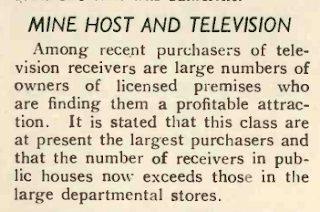
According to Television and Short Wave World, of April 1937, pubs in South East England were now buying tv sets (despite Robert Anton Wilson's comment at the beginning of this post).

Thanks to Finn Fordham, who quotes this in his article 'Early Television and Finnegans Wake'.
Most viewers would have been watching on cathode-ray sets like this Baird televisor, advertised in the same magazine.
 |
| 1937 advert for a Baird cathode-ray television. |
But a new type of mechanical television was coming....

'ELECTROSCOPHONIOUS' TELEVISION
In the same year, the British Scophony company demonstrated a new system, a mechanical rival to the cathode-ray. Scophony gave the the highest performance ever achieved with mechanical scanners. This was designed for the home and for theatres.

Television and Short Wave World April 1937

'Scophony have developed a special type of liquid cell....The introduction of this special light relay which permits of the modulation of an almost unlimited amount of light puts an entirely different complexion on the possibilities of optical mechanical systems.... The whole secret of the success of the Scophony system can be summed up in four words, 'plenty of modulated light.''

Television and Short Wave World, April 1937
The system was able to produce plenty of modulated light thanks to two Scophony inventions - Supersonic Light Control (the liquid cell above) and Split Focus. Here's how they are described in Scophony's 1938 manual, from Scotland's Early Technology library.


The Supersonic Light Control System was invented by John Henry Jeffree, Scophony's chief engineer, in 1934. You can read some articles about the system by Jeffree, posted by Chris Long on his optics website.
 |
| From the Perluma optics site |
This 'simple explanation'(!) shows how the control worked.

Here's another diagram from Scophony's brochure showing the light control's use in a television set. The light was scanned across the screen by two mirror drums, a small high speed one to produce the line scan, and a large slow speed unit to produce the frame scan.


Joyce knew about Scophony. 'Split Focus' is referred to in 'splits them from a double focus'. He mentions the light control in a passage added to the Letter chapter in May 1938 in which he imagines the future of television:
'(his electroscophonious* photosensition under suprasonic light control may be logged for by our none too distant futures as soon as tone values can be turned out from Chromophilomos, Limited at a millicentime the microamp)' 123.12-15
*The published text has 'dectroscophonious', a mistake by the typist who misread Joyce's 'el' as 'd'.
 |
| A Scophony home television at Radiolympia |
It looks as if the television in the pub episode is also a Scophony one. At the end the transmission seems to break down, as a voice exclaims:
'Hll, smthngs gnwrng wthth sprsnwtch!' 349.26
Hell, something's gone wrong with the supersonic switch! The missing letters represent missing parts of the television image.

In 1937, Scophony looked like the future, but that future never came. With the outbreak of war, the BBC stopped its transmissions. It was feared that German bombers would lock on to the signals, which would guide them straight to the Alexandra Palace. The radio engineers were needed for the war effort.
Yet Scophony lives on in the pages of Finnegans Wake.

And here come those racehorses again!
JOYCE'S NOTES ON TELEVISION
A lot of the information above comes from Danis Rose, who transcribed Joyce's notes on television in his Index Manuscript, published by the Wake Newslitter Press in 1978. The Index Manuscript is a transcription of one of Joyce's last working notebooks, known as VI.B.46. You can also read Rose's explanations of television in the James Joyce Digital Archive.
Here are Joyce's notes, with page and line numbers added by Rose, showing where each item appears in the Wake. The letters 'G' and 'S' refer to the green and sienna coloured crayons which Joyce used to cross out each entry when he transferred it to his text. So 'shortwave' is not crossed out because Joyce didn't use it.
Rose writes, 'I have not been able to find a reference to the singular material, guranium satin, with whch Joyce, in II.3, constructs his bairdboard bombardment screen.'
Another unusual entry for an account of television is the word 'ghastly' which inspired Joyce's description of the Russian General as 'the wholly ghast' 349.19
POSTCRIPT 2021: JOYCE'S SOURCE DISCOVERED!

'Having earlier given the hostelry a radio, Joyce then added a television. The source of
most of the notes that Joyce made in notebook VI.B.46 on page 095 come from the December 25th
1937 edition of Popular Wireless & Television Times3 with the magazine cover cameo’s boasting
“All the Latest Television News”.'
This is the source of most of Joyce's notes, but not 'telavicious nieces' which is MacArthur and Braslau's transcription of Rose's 'telavicious mica'.
MacArthur and Braslau couldn't find 'guranium satin' either, but they suggest another possible source for this:
‘‘Uranium Satin’ was a type of glass, popular in the 1930’s and used mainly for vases and
ornaments. Mildly radioactive from the compounds of the element added in the glass making,
today it is a collecters’ item..... Joyce may have included it in his notes because of its green fluorescent properties. He had read
the article “CONCERNING FLUORESCENCE” on page 394 of the magazine we identified.
Public demonstrations of television started in 1936. The pictures were small and described as
‘greenish-hued’. Perhaps we can see a greenish ghostly image of the slain Russian General
intruding onto the television screen of the pub...'
 |
| A uranium satin vase from ebay |
Another mystery is 'logged'. It's possible that Joyce was thinking of a radio log, which is referred to several times in the magazine's articles on radio.

Most of Joyce's notes were taken from just two articles, 'Television Topics', on the Scophony mechanical system, and 'Light and Electrons', a technical description of the electron beam system. He then used the notes to create a strange hybrid of a mechanical and an electronic television. The Finnegans Wake device combines split focus and a supersonic light system from a mechanical television with the spray gun, caesium coating and iconoscope of an electronic one.
To Harriet Shaw Weaver, postcard of 16 April 1927, Letters Vol I, p250.
'TELEVISION TOPICS'
The most interesting article, 'Television Topics', is Joyce's source for his information on the Scophony system. From this, he took 'electric', 'scophony', 'split focus', 'supersonic light control', 'scanners', 'viceversus', 'traverses the picture', and 'scanning spot'.
Imagine the reaction of James Joyce, who had never seen a television set, to this description:
'We have had the privilege of witnessing the first demonstration of television pictures received from Alexandra Palace on a large screen by mechanical means. And when we say large, we refer to a picture nearly six feet wide....Our biggest difficulty was in realising that we were actually looking at television and not watching an ordinary film being run through.'
 |

MacArthur and Breslasu cite this section from 'Television Topics' as the source of 'Baird Board'.

What struck me here was the mention of the possibility of colour television, which Joyce also refers to in Finnegans Wake.
'his electroscophonious photosensition under suprasonic light control may be logged for by our none too distant futures as soon astone values can be turned out from Chromophilomos, Limited at a millicentime the microamp' 123.12
Here Joyce, imagining the none too distant future of television, invents his own colour television company - Chromophilomos, Limited (Chrômophilos is artificial Greek, meaning colour-loving).
MacArthur and Breslasu tracked down Joyce's 'ghastly' to 'ghostly' which appears twice in a section on fluorescence in the 'Television Topics' article. This section also gave him 'fluorescence' (used in 'amid a fluorescence') and 'energy beam' (used in 'metenergic reglow of beaming Batt').

'LIGHT AND ELECTRONS'
The second article used by Joyce is a highly technical explanation of the electron multiplier. Here he found 'spray gun', 'photo-sensitive', 'bombarded', 'caesium coating', 'micro-amp', 'tone values'. 'stepped up' and 'iconoscope'

'Shortwave', the first item in Joyce's list, came from the heading of another article.

The whole magazine is fascinating to read now, looking back from the television future that the writers were imagining.
To finish, here's a lovely page showing what a family Christmas might be like around a television set.


