Thursday, 7 November 2019

The Battle of James Joyce's Bones 1


Over the past three weeks, we've seen an 'international battle of the bones' fought in the media over James Joyce. So much has been said about the case that it will take me two posts to cover the story so far. I can't remember him ever making so many appearances in headlines. Here are just a few from the Irish Times and the Guardian.


For the background, we have to go back to 1948, when Ireland gave W.B.Yeats, who had died in France, a state funeral.  His coffin was brought back to Galway on an Irish naval ship where it was greeted by a guard of honour. With Eamon de Valera and the bishops in attendance, he was buried in Sligo Churchyard. At the funeral, Louis MacNiece said the coffin was more likely to hold 'a Frenchman with a club foot' than Yeats – it turns out he was right.


In Zurich, Nora Joyce read all about Yeats' state funeral.

'Why not the same for Joyce? Nora, backed by Giorgio, felt that the Irish Government should do no less for its greatest writer of prose than for its greatest poet. Joyce's body, in any case, needed a more permanent resting place than the grave accorded him upon his unexpected death in Zurich. Swiss policy, unwelcoming to immigrants dead or alive, encouraged the repatriation of foreign visitors.'  

Brenda Maddox, Nora, p 477

'While his grave remained in Zurich, she felt she must remain there, though the climate was bad for her. But she was prepared to leave if her proposal were accepted....the proposal had come to nothing....Nora Joyce had been bitterly disppointed.' 

Jane Lidderdale and Mary Nicolson, Dear Miss Weaver, p412

Nora's worry about a more permanent resting place no longer applies. In 1966, both Joyces, originally buried separately, were reunited in the cemetery in an ehrengrab (honour grave), awarded to people for extraordinary services or achievements in their lifetimes. The city takes perpetual responsibility for the care of Joyce's grave
 

THE BATTLE BEGINS 


In 2017, the Dublin biographer Anthony Jordan called for the repatriation of Joyce to right 'the great wrong' done to Nora. This October, his plan was taken up by two Dublin city councillors, Dermot Lacey and Paddy McCartan, who suggested bringing back James and Nora for the centenary of Ulysses in 2022.  On 14 October, Lacey told The Journal : 'The benefit of this is that you’re honouring someone’s last wishes. I’m not going to be cynical about bones but I think it’s something Joycean lovers would appreciate.' 

In the same article, Senator David Norris said, 'I am on two minds about this. I tried to get it off the ground about 40 or 50 years ago but it didn’t get anywhere and it is only bones after all. And when we dug up Yeats’ they got the wrong person. I think they probably could get Joyce but I think he’s probably happy where he is....Nothing disinfects a reputation so thoroughly as the tinkle of cash and of course it’s about that. So I would say I wouldn’t oppose it but I wouldn’t be doing anything to encourage it.' 

JOYCE BELONGS IN ZURICH

Ezra Pound visits Joyce's grave shortly before his death, photo by Horst Tappe


As the headlines at the top show, the responses from Joyceans to the proposal were overwhelmingly negative. The first came from Professor Sam Slote of Trinity, in a letter on 16 October to the Irish Times

'Joyce never expressed any wish to be buried in Ireland.....Zurich has done very well for Joyce with a beautiful statue at his grave and it is an entirely fitting city for him to be buried: besides being the city where he died, it is where he wrote large chunks of Ulysses.

Furthermore, there is a line in Finnegans Wake that seems to anticipate Joyce’s burial in Fluntern cemetery: ‘As the lion in our teargarten rememberers the nenuphars of his Nile’: Fluntern is right next to the Zurich zoo; the German word for zoo is Tiergarten. Joyce himself remarked that in the cemetery you can hear lions roaring in the nearby zoo. So, ’teargarten’ is a lovely little compound word that combines zoo with cemetery (a tear garden) and one can indeed hear lions in the teargarten from by Joyce’s grave.'

I love that Wake reading! Here's another prophetic quotation from the book:

— One might hear in their beyond that lionroar in the air again, the zoohoohoom of Felin make Call.
488.13

Ellmann ends his Joyce biography with this quotation from Nora, who would take visitors to see the grave:

'He was awfully fond of the lions - I like to think of him lying there and hearing them roar.'


On 17 October, Fritz Senn from the Zurich James Joyce Foundation was interviewed in the Guardian.

'All I know is that there seems to be no evidence that Joyce wanted to return to Ireland or even be buried there, He never took Irish citizenship when he could have done it. Most Joyce experts would agree....The Zurich grave contains four bodies, of Joyce, Nora and Giorgio, the son. But there is also Asta Osterwalder Joyce, Giorgio’s second wife, who would have no relation to Ireland at all. There would also be some local resistance on this side....the city is quite proud of the grave. A natural reaction. And then Joyce’s last refuge was Zurich.'


There was also a letter on 22 October from Lady Antonia Fraser to the Guardian with a picture of her husband Harold Pinter, standing by the grave. She wrote, 'I understand completely why the city of Zurich does not want such a perfect place of pilgrimage disturbed.'


It's fitting that Joyce should be buried in Zurich, right in the middle of Europe. Although his subject was always Dublin, he saw himself as a European writer. His degree was in modern languages and, when his contemporaries were learning Irish, he was teaching himself Danish so that he could read Ibsen in the original.

'Joyce hated all manner of provincialism. It was the main reason for his continual residence on the mainland of Europe....'Ah,' exclaimed Joyce contemptuously to me once when we were discussing the Irish literary movement, 'the bloody nonsense that has been written about Ireland! – parish froth! I intend to lift it into the international sphere and get away from the parish pump, and from my dearly beloved brethren'.... To be plunged back into the comparatively primitive society...of Dublin would have horrified him....Immersed in Continental life he felt safe and happy, as an international genius, where the physical life pleased him at every turn.' 

Arthur Power, 'James Joyce - The Internationalist', Envoy, 1951 


Joyce in Zurich photographed by Carola Giedion-Welcker
 
Joyce loved Zurich, which he told Carola Giedion-Welcker 'always brought him luck.'  'What a city!', he would exclaim, 'A lake a mountain and two rivers are its treasures'. He often visited the city in the 1930s to see Alfred Vogt, the eye surgeon who saved him from total blindness. There are dozens of references to Zurich in Finnegans Wake.

The drawings on p308 were made by a real Zurich schoolgirl, Lucia von Curiel

'The connection between me and your hospitable city extends over a period of nearly forty years and in these painful times I feel highly honoured that I should owe my presence here in large part to the personal guarantee of Zurich's first citizen.' 

One of Joyce's last letters, written to the Mayor of Zurich on 20 December 1940

WHO OWNS JOYCE?


On 19 October, Patrick Callan had a witty letter in the Irish Times, under the heading 'Who Owns Joyce?'

'Dublin City Council’s recent motion in favour of 'repatriating' the remains of James Joyce and other individuals interred in Zurich treats these distant bodies as if they were somehow the property of an ideal Ireland, with the Government asked to take 'all appropriate steps' to bring them to Dublin....The motion is only the latest in a long series of Irish requests to move the Joyce remains. The persistent clamour has been such that in 1977, one of the Irish Times’s most distinguished satirists caustically noted the implications of the rolling calls for a Joyce reburial.

Donal Foley, in his Man Bites Dog column, declared that the 'Joyce funeral' would be an ideal way to introduce visitors to a newly established Irish 'Festival of Funerals'. Other repatriations might include Thomas Moore, John F Kennedy, Niall of the Nine Hostages, and Che Guevara. A spokesman for Bord Fáilte (Great Funerals Festival Department) said that when they ran out of 'Great Irish Bodies', they would dig up figures such as Brian Boru, and transfer them to their 'rightful place in the republican plot at Glasnevin'.'


Che Guevara did appear on an Irish stamp

We have one answer to the question 'Who owns Joyce?' from the man himself, in this dialogue between Bloom and Stephen in Ulysses:

Joyce doesn't belong to Ireland!

Foley's column reminded me of Joyce's magnificent list of the 'Irish heroes and heroines of antiquity' decorating the Citizen's kilt in 'Cyclops' (see comments section below). Ireland could also repatriate The Man that Broke the Bank at Monte Carlo, The Last of the Mohicans, Thomas Cook and Sons and the Buddha.

When I mentioned this on Facebook, Finn Fordham, author of the excellent Lots of Fun at Finnegans Wake, came up with a lovely suggestion:

'Since you mention Buddha, the solution surely, one I think I read about in one of Myles's Irish Times columns, is to divide the body up, Osiris-like, if you like, and distribute it around the seven cities that have a claim on him. A committay will have to be formed, but in anticipation I suggest the following: Dublin gets the heart, Cork the throat, Trieste the liver, London the right arm, Rome the left, Paris the brain and Zurich the eyes. Other bits unaccounted for - well how about the city parks mentioned in Haveth Childers Everywhere?'

Bognor Regis and Sidlesham Churchyard, where the Earwickers are buried, would also have a claim.

To finish for now, here's a song by a modern pilgrim, Andy White, who went on a journey from Dublin to Zurich, looking for James Joyce's grave.


Monday, 17 June 2019

'Pataphysical Bloomsday


'16 June according to the vulgar calendar, is in reality 2 Gidouille in the Pataphysical Calendar, which is dedicated not only to St. Lucullus, amateur, but also to:  

BLOOMSDAY

Please join us for readings by Marcia Farquhar OGG and Tony White at the annexe to the annexe of the Rogation, namely: Bookartbookshop.'

That's an email I had last week from Alastair Brotchie, biographer of Alfred Jarry, inviting me to The London Institute of 'Pataphysics' Bloomsday celebration in the wonderful Bookartbookshop in Pitfield Street. 

The 'Pataphysical calendar was created in France in 1949, by the founders of Le Collège de ’Pataphysique. They chose to celebrate Bloomsday because they saw Joyce as one of their 'patacessors'writers and artists who were consciously or unconsciously pataphysical, though not directly influenced by Jarry

Joyce did know about Jarry.  In Paris, he became friends with his former lover, Léon-Paul Fargue, and Jarry appears at least twice in the Wake (as a model for the bohemian artist Shem the Penman):

greeze a jarry grim felon! Good bloke him! 278.F01

He has novel ideas I know and he’s a jarry queer fish betimes, I grant you, and cantanberous, the poisoner of his word, but lice and all and semicoloured stainedglasses, I’m enormously full of that foreigner, I’ll say I am!
463,12


Bookartbookshop is one of the world's great bookshops. Run by Tanya Peixoto, it specialises in artists' books and small press publications. It's the best place to go to find the key texts of the European avant garde, many from Alastair's Atlas Press, 'Publishers of the Anti-Tradition Since 1983'.

Some of my Atlas Press books

Walking from Farringdon Station to the bookshop, Lisa and I visited Bunhill Fields where two of Joyce's literary heroes - Daniel Defoe and William Blake lie buried. In Trieste, Joyce lectured on both writers, who represented his dual sides, Blake the mystic and myth creator, and Defoe the realist, obsessively recording street and shop names. We failed to find Blake's new gravestone, unveiled last year by Bruce Dickinson of Iron Maiden.


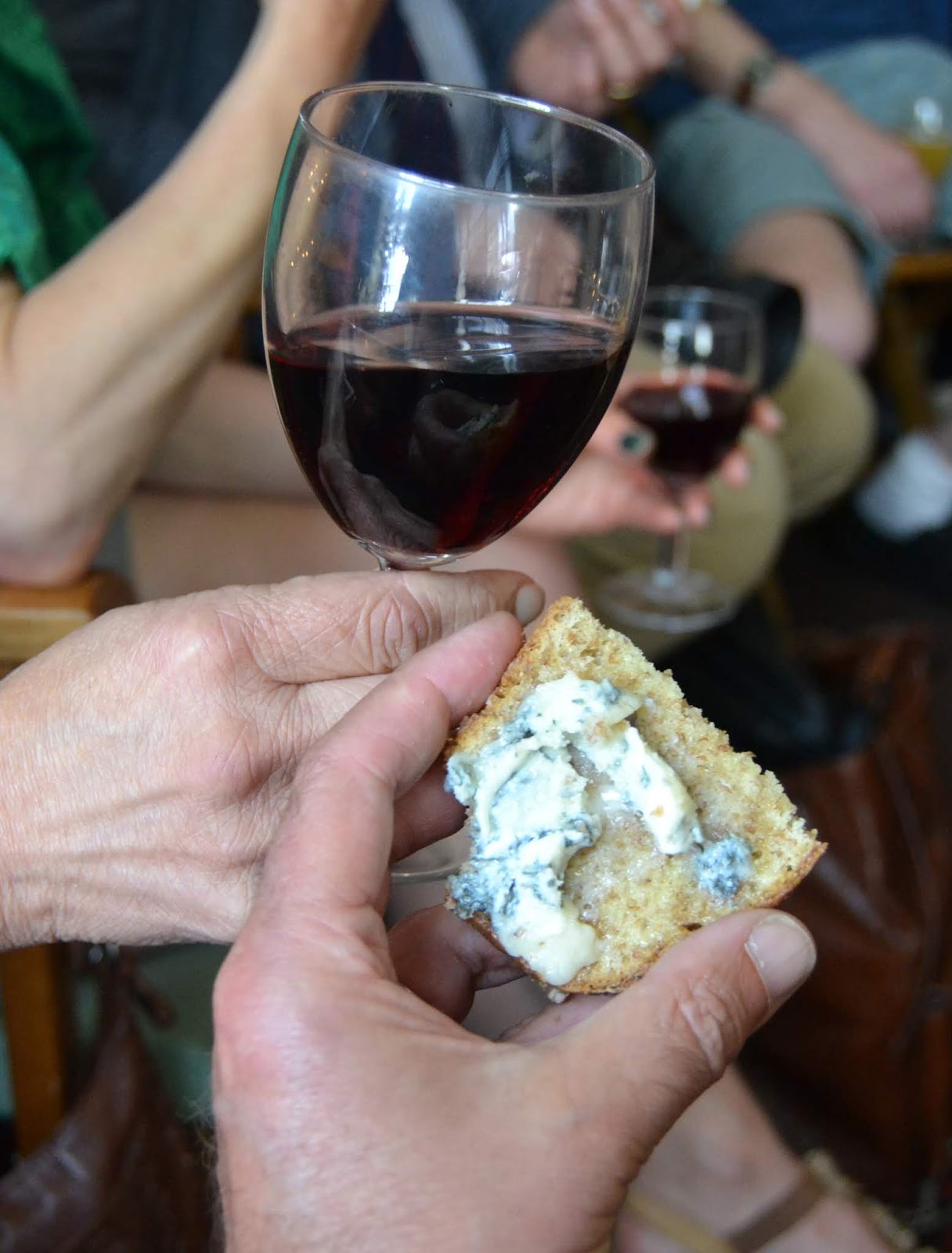
Arriving at the bookshop we were greeted by Tanya and Alastair, and given glasses of burgundy in honour of Bloom's lunch. About sixteen of us crowded into the tiny bookshop, where we listened to the writer Tony White's 'Portrait of the Author as a Young Postman: on reading Joyce in the Camden Town of the early 1990s.'

'Oyessoyess! I never dramped of prebeing a postman' FW 488.18

Tony wore his Royal Mail tie, in memory of his time as a Camden postman and in honour of Shaun the Post, one of the Wake's main characters. It was while he was working at the Post Office that Tony first read Finnegans Wake


One day on his rounds, an old lady saw what he was reading and said, 'If you're reading that (pointing to book) you shouldn't be wearing that (pointing to tie). You should be at University.' Tony told her that he'd already been to University, and got a first in Fine Art.

He later learned that she was the novelist Alice Thomas Ellis.


A fellow postman, also called Tony, had a very different reaction to the book.

'What's that you're reading Tone? Give us it here' 
'Ok Tony' (hands Finnegans Wake to fellow postman)
(Fellow postman looks at book, looks back at Tony, looks back at book and back at Tony): 'C•nt!'

Next Tony gave us his dynamic reading of the Museyroom, the Battle of Waterloo section from the Wake, which I've written about here.  I filmed the opening, in which he cast various audience members as museum exhibits.


Then we all went upstairs to Alastair's flat, where we had more burgundy and gorgonzola cheese.


'Mr Bloom ate his strips of sandwich, fresh clean bread, with relish of disgust, pungent mustard, the feety savour of green cheese. Sips of his wine soothed his palate. Not logwood that. Tastes fuller this weather with the chill off.'

Alastair toasted Leopold Bloom, rather than Joyce, because Bloom is imaginary, and 'Pataphysics is 'the science of imaginary solutions'.


Then Marcia Farquhar, our favourite performance artist, read the last section of Molly Bloom's soliloquy, from no ('no thats no way for him has he no manners nor no refinement nor no nothing in his nature') to the final yes ('first I put my arms around him yes and drew him down to me so he could feel my breasts all perfume yes and his heart was going like mad and yes I said yes I will Yes'). In previous years she's done the whole chapter.


Applause for Marcia

I loved the sleepy way she read the text. On his website, Tony describes her reading as 'generous, intimate and mesmerising...you could have heard a pin drop.'

Marcia and Alastair after the reading
It was extraordinary to hear Molly Bloom straight after the Museyroom. Joyce wrote the Wake piece in 1926, just five years after writing Molly Bloom, yet they are worlds apart.

Here's a film by Tracy Drew of Marcia doing an earlier reading of the piece in the bookshop.


JOYCE AND JARRY

There's no evidence that Joyce read Jarry's books, but their writing shares many characteristics.  Both were revolutionary writers, who reinvented literary forms and who loved to create new words (such as 'pataphysics' itself). Yet they were also rooted in Classical, Medieval and Renaissance literature.  Influenced by Francois Rabelais, both loved writing long lists. Here's part of a Jarry list from Exploits & Opinions of Dr Faustroll, Pataphysician.


 Here's part of a Joyce list, of the gifts of Anna Livia to her children, from the Wake:


Jarry shared Joyce's 'cloacal obsession', another feature of Rabelais, as well as an interest in alchemy. The Latin section of the Wake where Shem, using an alchemical process, makes ink out of his own excrement, would easily fit into Faustroll:

'First, the artist, the high first-sower, pulled himself towards the life-giving and all-powerful earth without any shame or pardon, and pulling up his raincoat and unbuttoning his trousers, his buttocks naked as they were born, crying and moaning, evacuated his bowels into his own hand, then, relieved of the black animal, he sounded the trumpet and placed his own dung, which he called "his dejections," into an urn once used as an honoured mark of sadness, and under the invocation of the twin brothers Medard and Godard pissed cheerfully and mellifluously therein, whilst singing with a great voice the psalm which begin, 'My tongue is the pen of a scribe writing swiftly.' Finally, from that foul dung mixed with the cheerfulness of the divine Orion, baked and then exposed to the cold, he made for himself an indelible ink.' 

FW 185 (translated from the Latin) 

Alchemists really did use dung in their experiments. See Agnieszka Rec's post 'Dung? Alchemy is full of it.'

'Alchemy is something of a hidden (or not so hidden) presence throughout pataphysics....providing an early example of a science of imaginary solutions.'

Andrew Hugill, 'Pataphysics: A Useless Guide, p204

Jarry and Joyce both use an obsessive scientific descriptive mode. Here's Bloom scratching a bee sting in 'Ithaca'.


And here's Faustroll getting dressed.
 

Jarry, like Joyce, accepted the simultaneous existence of opposite meanings.

'Jarry treated ambiguity as the stylistic manifestation of a universal principle of convertibility. Text means all things equivocally; anything may become its opposite; not literature but living is the supreme pun; writing is a slip of the tongue. Such total literary promiscuity is bound to yield the monstrous.'  

Roger Shattuck, The Banquet Years, 1968 p241

That could be a description of Finnegans Wake!  

There is also the Pataphysical principle of equivalence

'For the total Pataphysician, the most banal graffito equals in value the most consummate book, even Faustroll itself, and the humblest mass-produced saucepan equals the nativity of Altdorfer.

Doctor Sandomir, founder of the College, in his Testament

Joyce used this principle in gathering the material for Finnegans Wake, which he assembled out of every kind of literature, low and high.  Here's a description of items from newspaper stories he collected in his very first Wake notebook:

'Joyce took notes from the cooking sections for making apple pies and syllabubs, he made a list of London churches, took down quite a few golf terms scattered throughout the notebook, he noted words and phrases from ‘Our Ladies Letter’ section, facts about bats, expressions like ‘search me’, ‘pon my Sam’, ‘I bet you,’ and ‘holybones’, he took words from advertisements for per­sonnel (‘Youth wanted’), advertisements for Bird’s Egg Substitute cake-meal (‘a tin with a purpose’), for Hustler soap, for the Colgate Shaving Stick, for the Schoolgirl’s Weekly Magazine; one of his favourite pastimes is finding out of the way surnames from the births, marriages and deaths sections, possibly for his future characters.'  

Robbert-Jan Henkes 'Before King Roderick Became Publican in Chapelizod', Genetic Joyce Studies, Spring 2012


For more Jarry see my other blog The Jamboree Bag, where Lisa and I appear as Ma and Pa Ubu.