Tuesday, 27 July 2021

Sylvia Silence, the girl detective


Thanks to Roy Bayfield 

Shortly after Ida Wombwell, the 17 year old  revivalist, describes HCE as 'a brut! But a magnificent brut!', Sylvia Silence, the girl detective, is asked her opinion. 

'Sylvia Silence, the girl detective (Meminerva, but by now one hears turtlings all over Doveland!) when supplied with informations as to the several facets of the case in her cozydozy bachelure’s flat, quite overlooking John a’Dream’s mews, leaned back in her really truly easy chair to query restfully through her vowelthreaded syllabelles: Have you evew thought, wepowtew, that sheew gweatness was his twadgedy? Nevewtheless accowding to my considewed attitudes fow this act he should pay the full penalty, pending puwsuance, as pew Subsec. 32, section 11, of the C. L. A. act 1885, anything in this act to the contwawy notwithstanding.' 61.01-11


Vincent Deane identified Joyce's source for Sylvia as an advertisment for The Schoolgirls' Weekly in the Sunday Express, 29 October 1922. Roy Bayfield has found the same advert in the same day's Sunday Mirror (right) and he went on to track down copies of the stories (above). Roy says, ‘She certainly gets into some scrapes! Love that she has animal helpers, a dog (Wolf) and a monkey (Jacko).’

It's a shame Eldorado Nell and Vi the Ventriloquist didn't also get into Finnegans Wake.

Since Joyce only saw this advert, he had to imagine what such a girl detective might be like. He compares her to Minerva, goddess of wisdom, and gives her a comic rhotacism (inability to pronounce the letter 'r') which he even applies to r's which aren't pronounced (the 'r' in 'considered' 'per' etc). Sylvia is a consulting detective, like Sherlock Holmes or Nero Wolfe, looking at the 'several facets of the case' in her 'cozodozy bachelure's flat'. Unlike the other members of the public questioned, who give short direct answers, Sylvia seems to see this as a personal interview with her celebrity self.

In the first draft, Joyce gave her an additional moralistic line, which was then cut or lost:

'The ends of justice must not be earwigged.'

Stephen Crowe has made a beautiful illustration of Sylvia Silence sitting in her flat, which you can see here.

Her voice and name reappear later in the Stories chapter:

Imagine twee cweamy wosen. Suppwose you get a beautiful thought and cull them sylvias sub silence.  337.16

We also hear her voice in the séance, still talking with the reporter, channeled by the sleeping Yawn:

—Have you ever weflected, wepowtew, that the evil what though it was willed might nevewtheless lead somehow on to good towawd the genewality? 523.02

The real Sylvia was far from languid. She was more like a female James Bond action heroine. Thanks again to Roy Bayfield.


THE FIRST SCHOOLGIRL SLEUTH

The Schoolgirls' Weekly was a brand new paper in 1922, with new kinds of stories, mostly written by men, using female pen names. Sylvia Silence was created by John William Bobin, writing as Katherine Greenhalgh. He's described here by Lucy Parker in 100 British Crime Writers (edited by Esme MisKimmon, Springer Press, 2020):

I've also found an entry for Sylvia Silence in Russell James's Great British Fictional Detectives, which includes a supposed picture of her.

By an extraordinary coincidence I bought this greeting card last week for a friend's birthday.  I only looked at it properly after posting this blog.  It's the cover of an Angela Brazil novel published in 1920, so the right period but wrong girl. This is Ingerd Saxon not Sylvia Silence.


Bobin had created a successful formula, which you can see throughout the run of The Schoolgirls' Weekly. This is from the entry on the paper on the wonderful Friardale website.

' In January 1933 came "That Amazing Room Of Clocks" written by J.W. Bobin as Adelie Ascott, the first tale of Valerie Drew the 18 year old intrepid girl detective, doting daughter of an ex-Scotland Yard Chief Commissioner. "The Secret Of The Old Clock" written by Mildred Wirt as Carolyn Keene was published in America in 1930 and concerned Nancy Drew the 16 year old intrepid girl detective, whose doting father Carson Drew was a famous criminal lawyer cum detective. In Valerie's adventures over the next 7 years she was ably assisted by Flash, an alsation dog who acted almost human at times, and was more useful than Ned Nickerson was to Nancy. Both Nancy and Valerie were also well seasoned teenage motorists (at 18 Nancy was even a qualified pilot), their common sense and innate decency went almost unbelievably deep. The stories were always concise, entertaining, never heavy or heavy-going, and a charming if often melodramatic window on the world of the 1930's from an allegedly young female point of view. Unlike the Noel Raymond detective series running in the Girls' Crystal it was nearly always obvious who the guilty party was.'


You can read a complete 1933 Valerie Drew story here.


Nancy Drew, the American schoolgirl sleuth, is still solving cases today. 


SCISSORS AND PASTE MAN

'I am quite content to go down to posterity as a scissors and paste man'

Joyce to George Antheil, 3 January 1931, Letters, 297

Going back to the Wake passage, it's fascinating to see how it was assembled from diverse sources, which had nothing to do with schoolgirl magazines. Following the blue hyperlinks in the brilliant Digital Archive, we can read Joyce's notes, taken from newspapers and books:

'Sylvia Silence, the girl  detective', 'supplied with this information', 'really truly easychair', 'restfully', 'vowelthreaded', 'J Caesar, greatness his tragedy', 'considered judgement' 'full penalty',   'Sect XI Crim. Law. Amend.  Act 1885', 'anything in his act to the contrary notwithstanding'

Most of the sources have not been identified, though one note ('J Caesar, greatness his tragedy') shows Joyce had been reading about Julius Caesar. It would be very hard to track down the source of 'restfully'.

'Full penalty' is one of the many phrases, identified by Vincent Deane, taken from the 1922 Daily Sketch article on Bywaters:

'Petition for Reprieve of Bywaters is Ready To-Day': 'A taxicab driver: Bywaters is a silly young fellow, but he ought not to pay the full penalty'

Viviana-Mirela Braslasu discovered that the word 'vowelthreaded' was taken from the opening page of Marjory Kennedy-Fraser and Kenneth Macleod's Songs of the Hebrides, 1917.


'Subsec. 32, section 11, of the C. L. A. act 1885'

Oscar Wilde was tried for 'gross indecency' under section 11 of the Criminal Law Amendment Act 1885. There is no subsection 32. Joyce has added that number to create the magical 1132 - the big number/date in Finnegans Wake, which relates to the law of falling bodies ('32 feet per second per second').  Oscar Wilde and HCE are both falling bodies.

Sam Slote found Joyce's specific source in Frank Harris's book Oscar Wilde His Life and Confessions, 1918.

 Here is the very section of the act.

Oscar Wilde was sentenced to two years with hard labour.

For more on Wilde in the Wake, see my post Oscar Wilde: The Great White Caterpillar.

Often there's a dark undercurrent to the comedy in Finnegans Wake. I think we get that here with the seemingly sweet Sylvia Silence, relaxing in her cozydozy bachelure's flat, demanding the harshest punishment for HCE.

Discussing the Thompson and Bywaters case with Arthur Power, Joyce talked about the censoriousness of the English: 

'Though there is plenty of legal liberty in England...there is not much individual liberty, for in England every man acts as a censor to his neighbour, while here in Paris you have the only real freedom in Europe, where no one gives a damn about what his neighbour thinks or does...But in England everybody is busy about everybody else.'

Conversations with James Joyce, p.76


Saturday, 24 July 2021

Ida Wombwell, the seventeenyearold revivalist

'Missioner Ida Wombwell, the seventeenyearold revivalist, said concerning the coincident of interfizzing with grenadines and other respectable and disgusted peersons using the park: That perpendicular person is a brut! But a magnificent brut!' 60.22

This passage, written in November 1923, comes from the Plebiscite section, where members of the public are asked their opinion of the guilt or innocence of HCE. Most of the people questioned are taken from a real newspaper plebiscite, published in the Daily Sketch, on the guilt of Frederick Bywaters, condemned to hang for murder.  But Ida Wombwell isn't in that article.
 
The sentence is based on this note that Joyce wrote in September-November 1923. 

'Ida Wombwell / 17yr girl revivalist' VI.B.11.

I've just discovered that, in the early 1920s, there was a real Ida Wombwell - a teenage Methodist preacher from Nottingham. I've been on her trail through the pages of The Primitive Methodist Leader.  
 
 
This article is from 17 April 1924.


Here's another article from the same paper, dated 13 November 1924. She is called a 'girl preacher' and a 'missioner' (missionary).


A few years later, she was touring Australia, as reported in the Sydney Morning Herald of 24 May 1929.

 
There we leave Ida, on her missionary tour of every state in Australia. She would surely have been astonished to learn that she became a character in Finnegans Wake!
 
I looked her up on ancestry.co.uk and found this.
 
 
The articles in the Primitive Methodist Leader are too late to have been used by Joyce, who wrote about Ida in 1923. Now someone (with the patience of Vincent Deane) needs to track down the specific newspaper article where Joyce found her.  I suspect it was published in 1922, when she was 17 years old. 


Ida must be a relation of 'the market missioners Hayden Wombwell' 529.01

Joyce was amused by religious revivalists, like J Alexander Dowie who appears in Ulysses
 
'Come on, you winefizzling ginsizzling booseguzzling existences! Come on, you dog-gone, bullnecked, beetlebrowed, hogjowled, peanutbrained, weaseleyed four flushers, false alarms and excess baggage! Come on, you triple extract of infamy! Alexander J. Christ Dowie, that's yanked to glory most half this planet from 'Frisco Beach to Vladivostok. The Deity ain't no nickel dime bumshow. I put it to you that he's on the square and a corking fine business proposition. He's the grandest thing yet and don't you forget it. Shout salvation in King Jesus. You'll need to rise precious early, you sinner there, if you want to diddle the Almighty God.'
 
He had a record of Amy Semple Macpherson preaching which he played Morley Callaghan:

''Do you think Mr and Mrs Callaghan would like to hear the record?' he asked his wife. 'What record?' asked McAlmon, blinking suspiciously...Mrs Joyce was regarding my wife and me very gravely. 'Yes,' she said. 'I think it might interest them.'
'What record?' McAlmon repeated uneasily.
Mrs Joyce rose, got a record out of a cabinet and put it on the machine. After a moment my wife
and I looked at each other in astonishment. Aimee Semple McPherson was preaching a sermon! At that time, everyone in Europe and America had heard of Mrs McPherson, the attractive, seductive blonde evangelist from California. But why should Joyce be interested in the woman evangelist?
   The evangelist had an extraordinary voice, warm, low, throaty and imploring. But what was she asking for? As we listened, my wife and I exchanging glances, we became aware that the Joyces were watching us intently, while Mrs McPherson's voice rose and fell. The voice, in a tone of ecstatic abandonment, took on an ancient familiar rhythm. It became like a woman's urgent love moan as she begged. 'Come, come on to me, And I will give you rest...and I will give you rest...Come, come...' My wife, her eyebrows raised, caught my glance, then we averted our eyes, as if afraid that the Joyces would know what we were thinking. But Joyce, who had been watching us intently, had caught our glance. It was enough. He brightened and chuckled. Then Mrs Joyce, who had also kept her eyes on us, burst out laughing herself. Nothing had to be explained. Grinning mischievously, in enormous satisfaction with his small success, Joyce poured us another drink.'
 
That Summer in Paris 
 
Aimee, whose mother worked for the Salvation Army, is in Finnegans Wake:
 
'the aimees of servation' 351.33

This must be the record!

Saturday, 15 May 2021

Painted Saws in Ovingdean


Meet my friend Jo Goddard, abstract ceramic sculptor and tiki mug maker, in a report from Latest TV's William Ranieri. 

Last year, Jo inherited a collection of saws from her father. She had the inspired idea to get her friends to paint the saws, and then exhibit them in her garden. The exhibition is called Out of the Woods, and it's running until the end of this month.


Thirty artists took part, including sculptors and ceramicists.


Lisa painted her saw with day and night scenes inspired Ken Layne's Desert Oracle Radio, one of our favourite radio shows. 


We listen to Desert Oracle every Saturday evening, sipping a Dark and Stormy cocktail and watching the sun set. It transports us from Lockdown Britain to the spooky Mojave desert, where coyotes howl and strange lights are seen in the sky.

Gram Parsons, the fallen angel, is on Lisa's handle. Listen to episode 3 of Desert Oracle Radio to find out why Gram and Joshua Tree are forever connected.


La Llorona on the other side is the dark-haired weeping ghost woman, often seen on the Old Spanish Trail through the Mojave - the one we now call Route 66. 'Listen for her,' says Ken, 'at the lonesome edge of town. Watch for her.'


This is how the show always opens.


I painted my saw with the hundred letter thunderword from the first page of Finnegans Wake.  It's made up of words for thunder in Arabic (gargarahat), Hindi (karak), Japanese (kaminari), Finnish (ukkonen), Greek (brontê), French (tonnerre), Italian (tuono), Portuguese (trovão), Swedish (åska), Danish (torden) and Irish ( tórnach), joined together to make a mighty thunderclap.


Here's how the great Jim Norton (Bishop Len Brennan from Father Ted) reads the word, from the Naxos audiobook.


The handle has Joyce's sigla - the symbols he used to stand for the various characters in Finnegans Wake.


Joyce's one good eye is covered with a patch after yet another iridectomy. He wears a white jacket to reflect the available light, though he can barely see anything with his right eye. I took care with the tie because he told the portrait artist Patrick Tuohy, 'Never mind my soul, Tuohy. Just make sure you get my tie right.'

The other side is the River Liffey flowing into Dublin bay on the last page of Finnegans Wake, and the riverrun that continues on the first page.


The handle is the Irish Sea, and the god Oceanus-Neptune-Manaanan McLir.

And it's old and old it's sad and old it's sad and weary I go back to you, my cold father, my cold mad father, my cold mad feary father, till the near sight of the mere size of him, the moyles and moyles of it, moananoaning, makes me seasilt saltsick and I rush, my only, into your arms.


The river, which is carrying Autumn leaves, is the colour of the hair of Livia Svevo, a model for Anna Livia.  Here's a photo of her with hair hair down, from the Museo Sveviana in Trieste.

courtesy of Museo Sveviano, Trieste

Joyce said, 'I've...immortalized the tresses of Signora Svevo. These were long and reddish-blond. My sister who used to see them let down told me about them. The river at Dublin passes dye-houses and so has reddish water. So I have playfully compared these two things in the book I'm writing.'


I only realised after I'd delivered the saw that I'd made a mistake with the book's final sentence. This was spotted by Finn Fordham


The irony is that the Faber typesetters made a similar mistake, except they lost 'a lost'!

We went over to Ovingdean where I built a state-of-the-art display unit for the saws.  

Night side saws

Here I am at the opening, a rare chance to wear a suit. The great tiki mugs on the table were made by Jo.

Day side saws

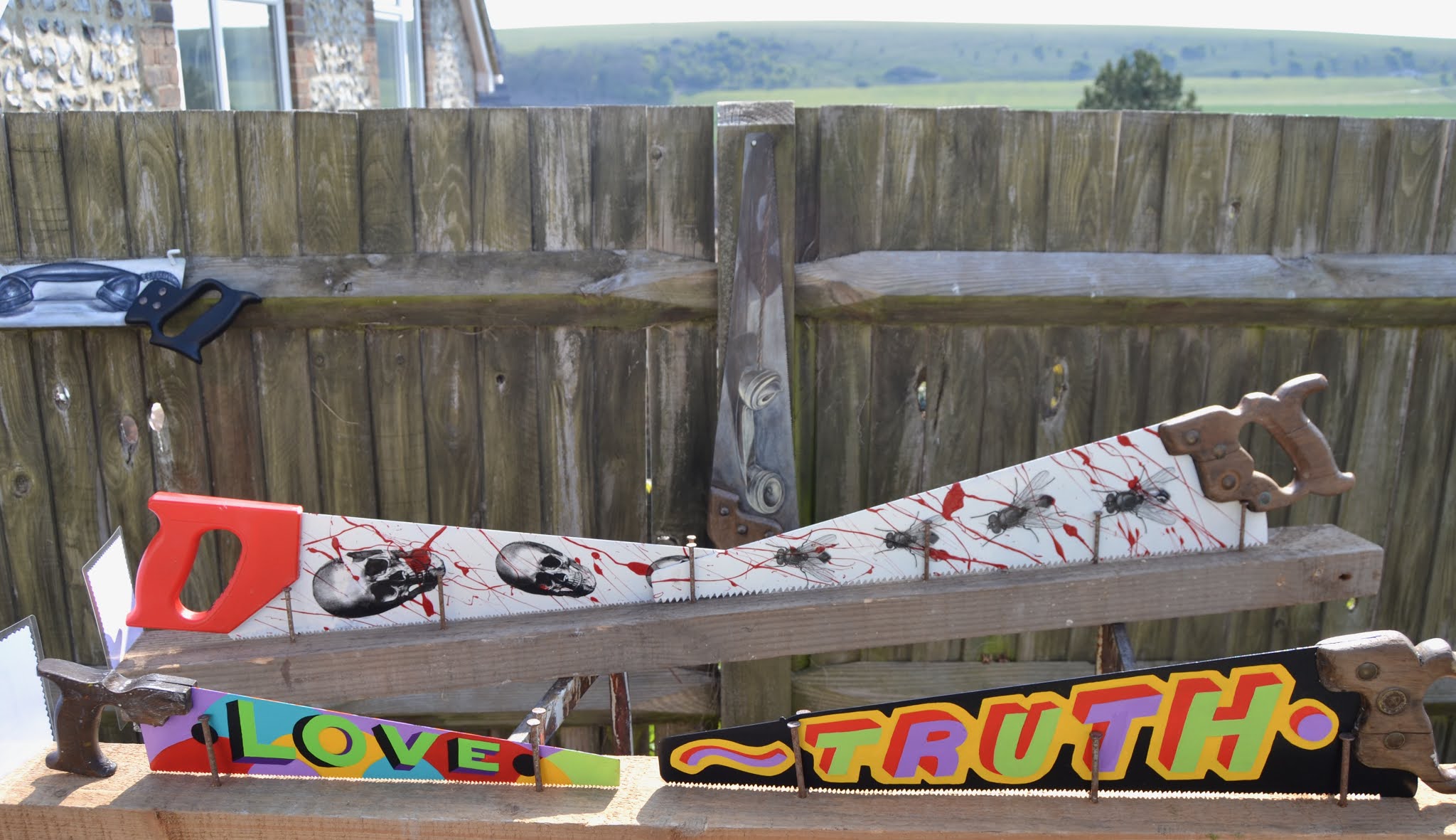
Here are some more saws I photographed at the exhibition opening. These are by the tattoo artists Alex and Zoe Binnie (front), Billy Chainsaw (middle) and Matt Noir (fence).


Here's Chris 'Sick' Moore with his saws. He's inspired by the great midcentury American illustrators Jim Flora, Cliff Roberts, Saul Bass and Ed 'Big Daddy' Roth. 


I love the devil he painted on the handle of his Robert Johnson Me and the Devil saw.


Mimi Butler decorated her saw with a long-necked bird.


Mimi also created the lovely blackbird signage for the exhibition.


Here are two saws from Wintz, who says that the second one is a 'very deliberate colour combo to really mess with your eyes!' See Wintz's 'drawings from alternate realms' on Instgram.


Jeremy Diaper, architect, decorated his saws with drawings of buildings near his home in Kemptown.


I like the rusty background.


Matt Noir is interested in 'the symbolic power of objects, how they are bestowed with meaning, evoke memories and develop narratives.' Here's one of his still life saws.


Here's a ghostly face from Jeffrey Disastronaut.


The flamboyant Dave Pop! took over Jo's garage with his 'bright, bold pop art, with a generous topping of seaside sauce!'


You can see Dave singing 'Am I in Love or Am I Insane?' on YouTube.


Jim Sanders made a sculpture out of his saw.  Read about Jim's amazing Brighton studio/home here.


Here's Jim with another sculpture he made for the show.


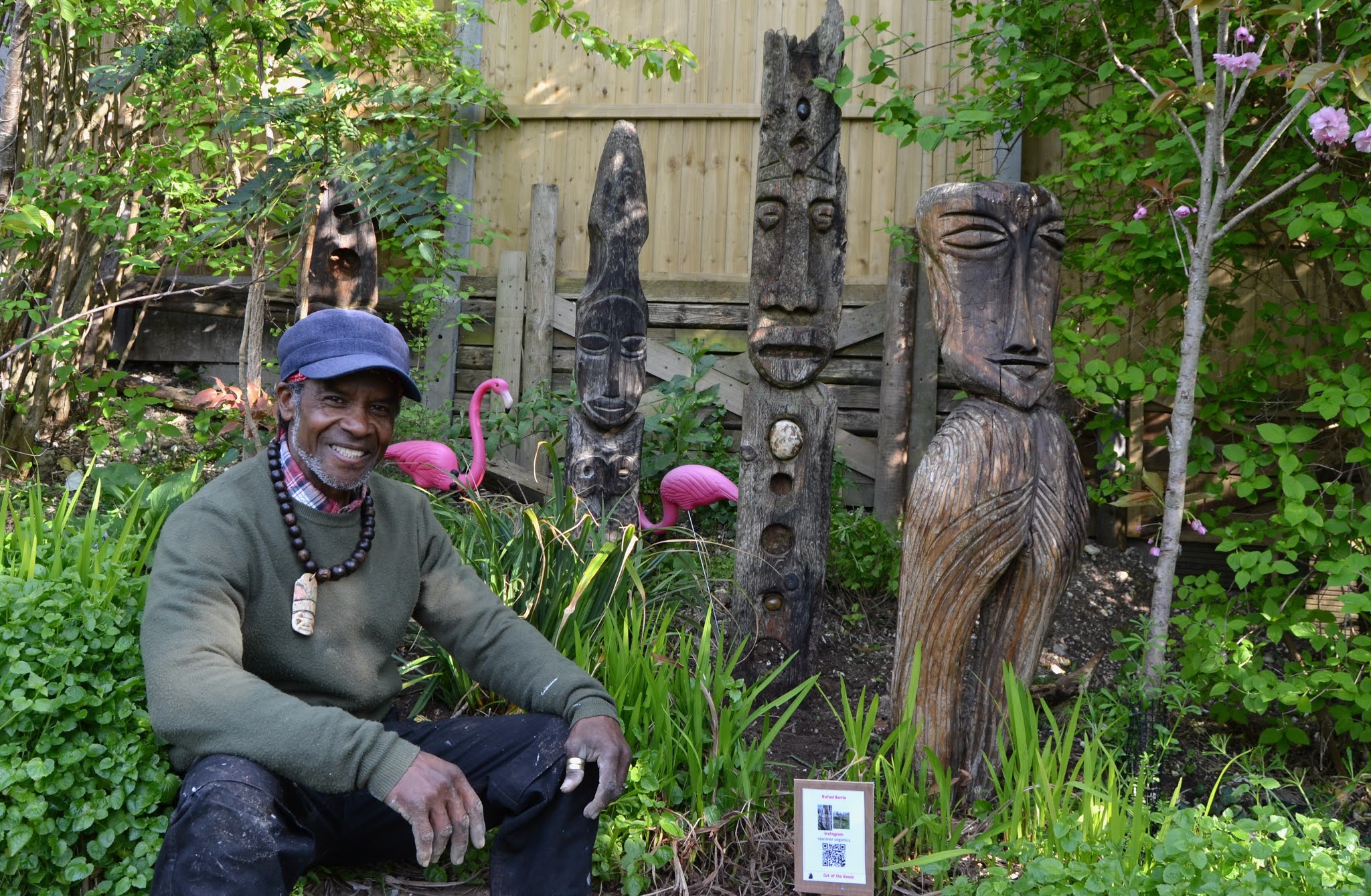
There are more sculptures at the bottom of the garden by Rafael Berrio


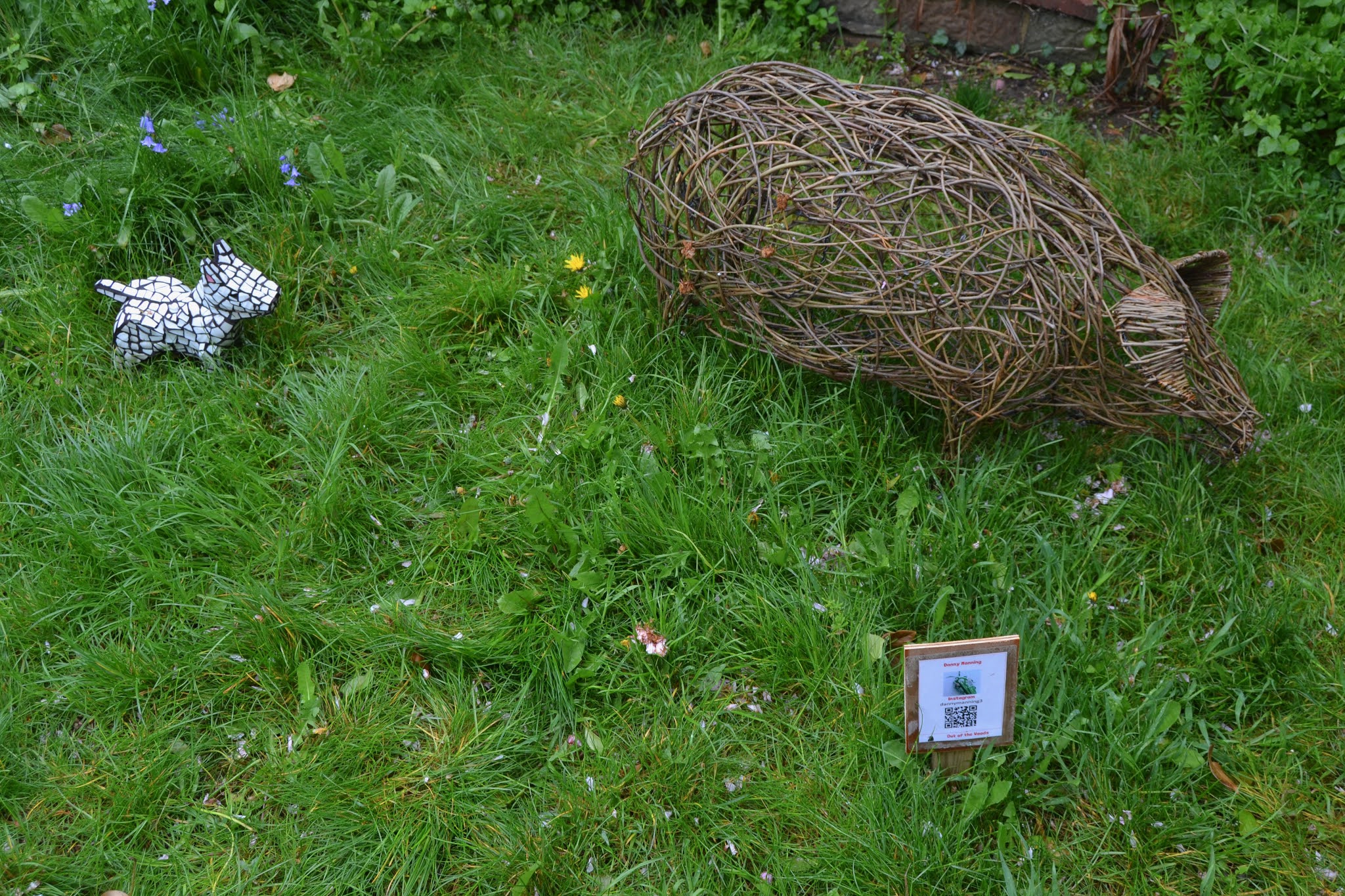
On the grass in front of Rafael's sculpture there's a pig made by Danny Manning, textile artist and willow weaver.

Continuing the animal theme, there's a vitrine with a ceramic Sumatran orangutan by Jack Durling. He says of this piece, 'Where there is weakness there is also strength'.


Climbing up a fence is a longhorn beetle made by another willow weaver, Dominic Parrette.


Christine Scawin has installed these sculptures made of recycled copper on the grass.


There are female figures by Claudia Castelton-Brown. I can imagine these on Lisa's Desert Oracle saw.


These stone sculptures are by Jacob Frerichs.


A fence has banners made by Julie-ann Smith.


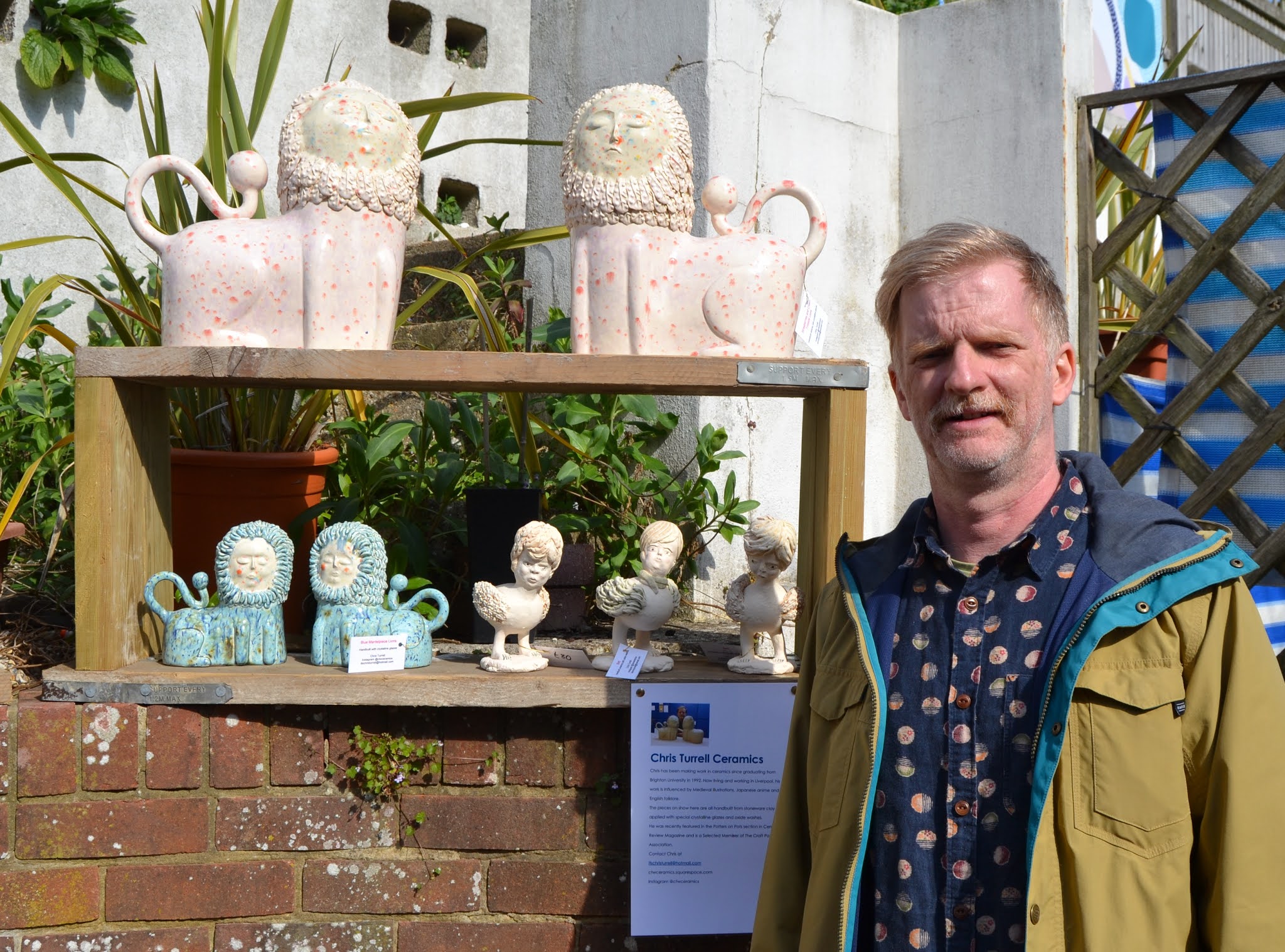
Apart from the saws and sculpture, there are ceramics from Chris Turrell and Simon Dredge.


Karen Hirst has decorated the mulberry tree.


Hélène McCarthy, 'mudlarker, scavenger, bricoleur' has work in the garden, in the 'art hutch', and a vitrine.


There's also an artshed with a display of cyanotypes by Tara Gould.


And there's a geodesic dome! Here are Jo and Jeremy performing the topping out ceremony.


Here's one of Jo's ceramic sculptures.


Her tiki mugs are unbelievably good value, and you can drink beer out of them as well as cocktails.


The exhibition's been getting lots of visitors. Here's Foz Foster who, apart from playing lead guitar in David Devant and His Spirit Wife, the best band in the multiverse, is musical director of a Sawchestra. Foz brought a musical saw along and played a recital in the garden.