Monday, 4 November 2013

An English Murder in Finnegans Wake


Frederick Bywaters (left) with the Thompsons
Here's an extraordinary photograph of a love triangle, taken in July 1921. It shows Edith Thompson sitting between her lover, Frederick Bywaters, and her husband Percy. They seem unaware of the camera. Yet it looks as posed as a painting by Jack Vettriano,

On 3 October 1922, the Thompsons were returning to their Ilford home after a night watching a Ben Travers farce at London's Criterion theatre, when Bywaters leaped out of the bushes and fatally stabbed Percy. 


Bywaters, who was quickly arrested, freely admitted his guilt. He told the police, 'The reason I fought with Thompson was because he never acted like a man to his wife. He always seemed several degrees lower than a snake.'  


Edith soon found herself accused alongside her lover. The police found more than sixty love letters she had sent him, in which she fantasised about Percy's death, and talked about giving him ground-up light bulbs to drink. When the couple were tried together, public sympathy was on the side of Bywaters, who was seen as having been manipulated by an older femme fatale.


They were found guilty, and hanged at exactly the same time, on 9 January 1923, in Holloway and Pentonville prisons. Edith fainted, and had to be held upright on the gallows by four warders. Her hangman, John Ellis, was traumatised by the execution and later killed himself. Bywaters' last words on the scaffold were, 'They are hanging an innocent woman'.      

'The mystery man is the husband.' James Joyce

James Joyce was fascinated by the case, which he followed in the English newspapers. He discussed it with his young Irish friend, Arthur Power:

'–The mystery man in the case is the husband, remarked Joyce, the immovable mass before the irresistible force so deeply bedded in his habits that anything outside seemed to him unreal: and of him we have no clear picture. But one thing I am certain of is that if all this had happened in France they would not have been executed, and I think that English justice was at fault in trying them side by side....I think it was gruesome and inhuman for the judge to try them the way he did....There was no real evidence against her,  in spite of all her letters saying she had given her husband this, and there was not a trace of any poison, glass etc., found in his body, and it took Bywaters' six-shilling knife to finish him off. Also at the trial she swore she had given her husband nothing, and it was all fantasy...for her mind was evidently full of the stuff she had been reading, while she wrote those letters to make her seem romantic in his eyes because in turn he used to taunt her with descriptions of his life while on his voyages.  

   As a picture I can see it all clearly, Ilford – the dark streets with dim lights showing behind the yellow window-blinds, and from a distance a soft wind coming up with a raw smell of fish and chips on it, the Thompsons walking arm in arm under the trees when this young man suddenly dashes out and stabs him, her crying and wailing, and her search, or pretended search, for help. I can smell the English effluvia here – and it reminds me...yes...of the Strand, say, on a Saturday night, the huddles of people in the passage outside the pubs; the sudden fights; the traffic-weary streets; the arc-lights shining down on the muddy tramped pavements. I remember how I disliked it all and I decided that I could never have become part of English life...'

                                                Arthur Power, Conversations with James Joyce, 1974 

From René Weis' Criminal Justice which is online here


Joyce uses the case repeatedly in Finnegans Wake. So Bywaters's description of Percy as 'several degrees lower than a snake' can be found on page 36: 'a creature in youman form who was quite beneath parr and several degrees lower than yore triplehydrad snake.'

FREDERICK BYWATERS AND ST KEVIN


In the spring and summer of 1923, only a few months after the lovers were hanged, Joyce wrote the earliest sketches for Finnegans Wake.  They included this comic hagiography on the childhood of St Kevin of Glendalough:

'Shortly after having swum into this vale of tears the little stranger Kevineen delighted himself by sporting with the sponge on tubbing night. As a growing boy under the influence of holy religion which had been instilled into him across his grandmother old Mrs Jones's knee he grew more and more pious and abstracted like the time God knows when, ejaculating for forty days indulgence and ten quarantines, he sat down on the plate of mutton broth.

He simply had no time for girls and things and often used to say to his dearest mother and dear sisters as how his dearest mother and dear sisters were good enough for him.  Of him we are further told that at the age of six he wrote a school prize essay on kindness to freshwater fish.'

In a brilliant piece of literary detection, Vincent Deane discovered that the source for this was an interview with Bywaters' mother, published in December 1922:

'It was only last year that we knew of his friendship with Mrs. Thompson, and, as far as I know, she was the first woman outside his family circle he ever cared for. In his young days he simply had no time for girls. He used to say that his sisters were good enough for him, and that there was no girl in Manor Park to equal them....His school reports always bore high marks, and he won quite a number of prizes and certificates, especially for essay-writing. One essay I shall always remember. The subject was “Kindness to Dumb Animals,” and it gained for him the first prize in his class.'

'My Boy's Life: By His Mother', The Daily Sketch, 15 December 1922

THE PLEBISCITE


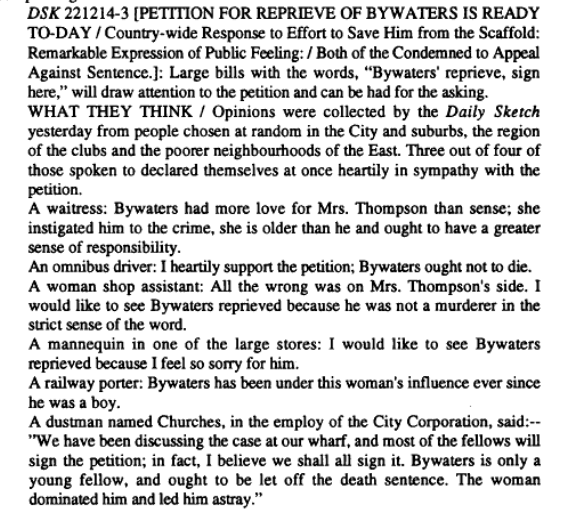
Vincent Deane discovered another article in The Daily Sketch of the 14 December 1922, also used by Joyce. The newspaper placed the blame for the crime on Edith and organised a petition for the reprieve of Bywaters.  Over a million people signed the petition.

In the article, 'Petition for the Reprieve of Bywaters is Ready Today', members of the public were asked for their opinion about Bywaters' guilt. Joyce used this as the basis for his 'Plebiscite' section (pages 58 on), where members of the public give their verdict on the guilt of HCE.

Here's a quote from the newspaper, followed by Joyce's comic and surreal transformation of it in the Wake: 

'Three soldiers were walking together in Fleet-street; one gave an opinion in which all concurred. It was the woman who was to blame. Bywaters played a bad part in the crime, but he was coerced. He proved himself a man afterwards.' Daily Sketch
 
'Tap and pat and tapatagain, (fire firstshot, Missiers the Refuseleers! Peingpeong! For saxonlootie!) three tommix, soldiers free, cockaleak and cappapee, of the Coldstream. Guards were walking, in (pardonnez-leur, je vous en prie, eh?) Montgomery Street. One voiced an opinion in which on either wide (pardonnez!), nodding, all the Finner Camps concurred (je vous en prie, eh?). It was the first woman, they said, souped him, that fatal wellesday, Lili Coninghams, by suggesting him they go in a field.'  58.23
 
Here's the Daily Sketch again:

'A dustman named Churches, in the employ of the City Corporation, said:— "We have been discussing the case at our wharf, and most of the fellows will sign the petition; in fact, I believe we shall all sign it. Bywaters is only a young fellow, and ought to be let off the death sentence. The woman dominated him and led him astray.'  

In the Wake, this became:

'A dustman nocknamed Sevenchurches in the employ of Messrs Achburn, Soulpetre and Ashreborn, prairmakers, Glintalook, was asked by the sisterhood the vexed question during his midday collation of leaver and buckrom alternatively with stenk and kitteney phie in a hash-housh and, thankeaven, responsed impulsively: We have just been propogandering his nullity suit and what they took out of his ear among my own crush. All our fellows at O’Dea’s sages with Aratar Calaman he is a cemented brick, buck it all!' 59.16

'Miss Sheila Courtenay, who is appearing in “The Cat and the Canary” at the Shaftesbury Theatre, put the same view: “I do sincerely hope,” she said, “that Bywaters will not be hanged. He is very young, and was egged on by a woman older than himself to do what he did. And then he has been so wonderful in his behaviour at the Old Bailey.”'  Daily Sketch

This inspired the Wake's actress ('One of our coming Vauxhall ontheboards who is resting for the moment' 58.33) who says 'it has been such a wanderful noyth untirely' 59.13

'A taxicab driver: Bywaters is a silly young fellow, but he ought not to pay the full penalty.'  
Daily Sketch

'A more nor usually sober cardriver, who was jauntingly hosing his runabout, Ginger Jane, took a strong view.' 59.24

'A sailor, on the Embankment, was encouraged to speak by his fiancée, and said: I think the woman was more to blame than Bywaters, but I think there was someone else in it.' Daily Sketch

'Meagher, a naval rating, seated on one of the granite cromlech setts of our new fishshambles for the usual aireating after the ever popular act, with whom were Questa and Puella, piquante and quoite, (this had a cold in her brain while that felt a sink in her summock, wit’s wat, wot’s wet) was encouraged, although nearvanashed himself, by one of his co-affianced to get your breath, Walt, and gobbit and when ther chidden by her fastra sastra to saddle up your pance, Naville, thus cor replied to her other’s thankskissing: I lay my two fingerbuttons, fiancee Meagher, (he speaks!) he was to blame about your two velvetthighs up Horniman’s Hill — as hook and eye blame him or any other piscman? — but I also think, Puellywally, by the siege of his trousers there was someone else behind it — you bet your boughtem blarneys — about their three drummers down Keysars Lane. (Trite!).'  61.13

In the first draft, from the Digital Archive, Joyce's text was very close to the source: 

'Three soldiers of the Coldstream Guards were walking in Montgomery street. One gave an opinion in which all concurred. It was the women, they said, he showed himself a man afterwards. A coming actress who has been called by 1 critic ‘a vestpocket Siddons’ was interviewed in a beauty parlour and while righting her cartwheel hat, said she hoped he would get an Xmas pardon as the world had been unkind to him. Then he has been so truly wonderful, she added. A dustman named Churches in the employ of Bullwinkle and McTigue was asked the question in a hashhouse and replied: We have just been discussing the case. All the fellows say he is a gameya one. A taxidriver took a strong view and said: Earywigger is a damned scoundrel in private life but folks say he has parliamentary privilege. A barmaid: it would be a shame to jail him on account of his health. Brian Linskey the boy curser, was questioned & gave a snappy comebackI'm for caveman sex life, curse it! Them two whores ought to get strangled or axed. Mrs Ida Wombwell, the 1old daring revivalist said of the fusiliers incident with the rosiest of cheeks: That man is a brute — but he is a magnificent brute. Sylvia Silence, the girl detective, said when told of all the facts:  Have you thought Greatness was his tragedy but he should pay the full penalty. The ends of justice must not be earwigged. A sailor seated on the granite setts of the fish market, was encouraged to speak by his fiancée & said I think he was to blame about the two slaveys |bas he had a perfect right, but I think there was someone else behind it about the 3 drummers.'


EDITH AND THE VOICE OF ISSY


In 1931, Joyce read Filson Young's 1923 book of the Trial, which presents the execution of Edith as a miscarriage of justice:

'Bywaters was not the innocent young lad that his defenders presented to the jury; Edith Thompson was not the corrupt, malignant sorceress portrayed by the prosecution.... Bywaters, as I read his character, was totally devoid of imagination; actions were his only realities. Edith Thompson had an excess of imagination. To her actions were unimportant. Her chief consciousness was hardly ever in what she was doing at. the time, but inhabited a world of dreams and make-believe.'

The book includes transcripts of Edith's letters, where she often addresses Bywaters as 'darlint'.  Just as Joyce used Bywaters as a model for Shaun (Kevin), he used Edith's letters in creating the voice of Issy.

Here's a key letter quoted on p.78 of the book, used in the cross-examination of Edith:


In Finnegans Wake, Joyce used this in a description of Issy, stuck with Chuff (Shaun) while pining for Glugg (Shem):

'If he's at anywhere she's therfor to join him. If it's to nowhere she's going to too.'  226.08

A few lines later, we have the chilling phrase, 'Glugg's got to swing' (226.20).

There's another echo, of 'like things are', in a few pages:

'Stop up, mavrone, and sit in my lap, Pepette, though I'd much rather not. Like things are m.ds. is all in vincibles' 232.25-6

'm.ds' is probably an abbreviation of 'my darlingest'.  The echoes of this letter were spotted by Adaline Glasheen in  her Third Census of Finnegans Wake, 1977.

Here's Issy speaking:

'My latest lad’s loveliletter I am sore I done something with. I like him lots coss he never cusses. Pity bon- hom. Pip pet. I shouldn’t say he’s pretty but I’m cocksure he’s shy. Why I love taking him out when I unletched his cordon gate. Ope, Jack, and atem! Obealbe myodorers and he dote so. He fell for my lips, for my lisp, for my lewd speaker. I felt for his strength, his manhood, his do you mind? There can be no candle to hold to it, can there?' 459.33

This echoes another letter on p187 of the trial book.


Here's Issy again:

'As for she could shake him. An oaf, no more. Still he’d be good tutor two in his big armschair lerningstoel and she be waxen in his hands. Turning up and fingering over the most dantellising peaches in the lingerous longerous book of the dark. Look at this passage about Galilleotto! I know it is difficult but when your goche I go dead. Turn now to this patch upon Smacchiavelluti!' 251.21

This is taken from three of Edith's letters. Here she's describing a character in Robert Hichen's novel, The Slave:

'Aubrey — I could shake him — no go — no initiative of his own... oh an ass — nothing more'

The 'good tutor' comes from another letter:

 'I was told I was the vilest tempered girl living & "you used not to be, but you're under a very good tutor"'

The rest comes from this letter:

'Darlingest lover of mine, thank you, thank you, oh thank you a thousand times for Friday – it was lovely – its always lovely to go out with you. And then Saturday – yes I did feel happy – I didn’t think a teeny bit about anything in this world, except being with you – and all Saturday evening I was thinking about you – I was just with you in a big arm chair in front of a great big fire feeling all the time how much I had won – cos I have darlint, won such a lot – it feels such a great big thing to me sometimes – that I can’t breathe....It seems like a great welling up of love – of feeling – of inertia, just as if I am wax in your hands – to do with as you will and I feel that if you do as you wish I shall be happy, its physical purely and I can’t really describe it – but you will understand darlint won’t you? You said you knew it would be like this one day – if it hadn’t would you have been disappointed. Darlingest when you are rough, I go dead – try not to be please.'

Raphael Slepon's wonderful Finnegans Wake Extensible Elucidation Treasury website lists almost fifty uses of the case, including all the letter quotations. These were all identified by Vincent Deane in his article 'Bywaters and the Original Crime', which is online here.

Deane was able to identify Joyce's sources thanks to his working notebooks, now in the University of Buffalo. These Buffalo notebooks are full of lists of foreign words, overheard conversations, and phrases lifted from hundreds of books and newspapers, which Joyce used as the basic building blocks of his book. His notes on the newspaper reports of murder case are all in VI.B.10, dated to October 1922-January 1923. His notes from Edith's letters are in VI.B.33, from February-April 1931.

'I am quite content to go down to posterity as a scissors and paste man for that seems to me a harsh but not unjust description.'

Joyce to George Antheil, 3 January 1931.

'Every dimmed letter in it is a copy and not a few of the silbils and wholly words I can show you in my Kingdom of Heaven....The last word in stolentelling!' 424.32

The names Bywaters and Thompson never appear in Finnegans Wake. Without Joyce's notebooks, and the detective work of Vincent Deane and Adaline Glasheen, it's unlikely that anyone would have spotted the book's references to the famous murder case.  

So what was Joyce up to in writing a book in this extraordinary way? I think that J.S.Atherton provides the answer in The Books at the Wake:

'Joyce believed that his words were 'Words of silent power' (345.19)....The book was indeed his life and he believed that he was entrapping some part of the essence of life within its pages....Joyce was not in his own opinion simply writing a book, he was also performing a work of magic.'


In Joyce's mind, phrases taken from other sources carried over the power of those sources, which then charged Finnegans Wake with significance. Joyce told a party of friends, 'Really it is not I who am writing this crazy book. It is you, and you, and you, and that man over there, and that girl at the next table.'  

...and Edith Thompson and Frederick Bywaters.


Here's the whole Daily Sketch article, from Vincent Deane's article


Thursday, 17 October 2013

Reading Shem in Sweny's


My weekend in Dublin ended with a return visit to Sweny's Pharmacy, to join in their regular Sunday night reading of Finnegans Wake. On arrival, I was welcomed by volunteer P.J.Murphy, in his white chemist's coat, who offered me a mug of tea and a paperback copy of the book. Twelve people arrived for the reading, and we all sat around the walls of the Pharmacy.

There were also free fairy cakes!


Fairy cakes!
I was nervous beforehand, because I've always believed that Finnegans Wake should be read in an Irish accent. While I'm happy to do that on my own, I'd be  embarrassed to put on an Irish accent in front of a room full of Irish people.

So it was a relief to find that there were other non-Irish folk there. I sat between David Cunningham, a Scottish lighting designer, who was working on a production at the Abbey, and Kirsten, a Danish journalist who'd just moved to Dublin and was discovering Joyce for the first time. She'd already been to the Ulysses reading at Sweny's. I think, after that, Finnegans Wake came as a bit of a shock! There was also a jolly American and another Englishman. The remaining seven were Irish.


Kirsten from Denmark

 
A jolly American

The reading was begun by the bearded Irishman (below) behind the counter, who explained that we were in the Shem the Penman chapter, starting from the middle of page 176. Shem the Penman is a comic and grotesque portrait of Joyce himself, and it's the funniest and easiest chapter in the book. Everyone would read a page in turn, in an anti-clockwise direction.

The reading begins
The fact that there were twelve of us was a wonderful Joycean coincidence. Joyce told his friend Padraic Colum, 'Twelve is the public number. Twelve hours of the day, twelve men on a jury.' In the book, there are twelve drinkers in HCE's pub, who are also members of a lynch mob, mourners at the wake, jurymen, months, hours, apostles, a football team, the twelve tables of Roman Law, Napoleon's marshals, tribes of Israel, and heaps of other things.  

You can spot the twelve in the book because they're always accompanied by pompous words ending in
'-ation'. They 'crunch the crusts of comfort due to depredation, drain the mead for misery to incur intoxication, condone every evil by practical justification and condam any good to its own gratification...' (142.19-21).

While he was writing the Wake, Joyce got twelve friends to write a book of essays explaining what he was up to. Published in 1929, it was called Our Exagmination Round His Factification for Incamination of Work in Progress. The cover has Joyce's sigla (symbol) for the twelve, a circle (based on a clock face). That's also picked up in the word 'Round' in the title.

So it was very appropriate that there were twelve of us and we were all sitting around the walls of Sweny's Pharmacy, reading the book in a circle!


Having said all that, three other women did join us after the reading had started, but after five minutes listening to us reading Finnegans Wake, they realised they'd made a mistake and left. Yes, the Shade of Joyce compelled them to go, preserving the magic Twelve!


As the reading passed around, I couldn't help flicking forward to see which page was likely to come my way. Some pages are much harder to read than others. I was lucky to get page 182, a relatively easy one describing Shem writing 'nameless shameless shamelessness about everybody he ever met.'


Kirsten, who followed me, was less lucky to have to read the long list of all the rubbish strewing Shem's house ('once current puns, quashed quotatoes, messes of mottage, unquestionable issue papers, seedy ejaculations...'). 

Kirsten reads p183

The Englishman who followed stood up to read his page, another difficult one describing Shem's preparation of an insane egg dish.

Englishman reading page 184
But I felt sorriest for the Irishman who got page 185. He had to read the filthiest passage in the whole book. It describes Shem making ink from his own excrement and, to preserve decorum, it's in Latin! There's a translation here. He did a heroic job getting through it.

We raced through the chapter at a good rate and seven of us had to read a second page. 

I was pleased to end up with the final page, which describes the coming of Anna Livia Plurabelle, 'as happy as the day is wet, babbling, bubbling, chattering to herself, deloothering the fields on their elbows leaning with the sloothering slide of her, giddygaddy, grannyma, gossipaceous Anna Livia.' When I was a teenager, my Father bought me a record of Cyril Cusack reading this so it's very familiar to me. I copied Cusack's phrasing and rhythms (but not his Irish accent). At the end, I got a round of applause!

After the reading, we all went over the road to have a drink in the Lincoln's Inn pub. Another Joyce coincidence! This pub is next door to Finn's Hotel, where Nora Barnacle was working as a maid in 1904 when she first went out with James Joyce. The Lincoln's Inn even has the original front door of the hotel. The words 'Finn's Hotel' are all over Joyce's early Wake notebooks, and it looks as if this was his first title for Finnegans Wake. He has hidden this original title in the Wake at 514.18:  '— .i..'. .o..l.' 

The perfect ending to a wonderful Wake weekend in Dublin.


Wednesday, 16 October 2013

At the Gaiety

On Sunday, our last day at Dublin Theatre Festival,  Lisa and I went to the Gaiety Theatre to see the matinee of Waiting for Godot. The Gaiety is one of the most beautiful theatres in the world, with a stunning interior by Frank Matcham. It was also James Joyce's favourite theatre, and it appears in almost all his books. Just as the Mullingar House is the principal pub in Finnegans Wake, the Gaiety is the book's main theatre.

We've been to the Gaiety once before, in 1987, to see Niall Toibin in Borstal Boy. Toibin, who has spent most of his life impersonating Brendan Behan, did a brilliant job, catching the North Dublin accent and the suggestion of a stammer. Have a listen to Toibin reading the end of Borstal Boy, from his album, 'Being Behan'. Back in 1987, we were annoyed by the audience, who burst into applause every time Toibin swore.

The Gaiety is a major Dublin institution, and the palm prints of the performers who've played there are cast in bronze on the street outside. Here's Milo O'Shea, who played Leopold Bloom in the film of Ulysses.


Here's the great Ronnie Drew of the Dubliners.


The Godot production was by Gare St Lazare, who specialise in Beckett. They usually stage one-man shows by the brilliant Conor Lovett, who speaks Beckett's prose in the most natural way. We went to a post-show talk by him in Brighton in May when he said that, if he could write, he would write just like Beckett.

Lovett's Vladimir formed a great comic double-act with Gary Lydon's Estragon. By the way,
A Gaiety pint to suspend my disbelief
Lydon is the spitting image of Brendan Behan! I also loved Gavan O'Herlihy's American accented Pozzo and Tadgh Murphy's astonishing Lucky, whose long speech got the Gaiety audience applauding again. But this is no place to be reviewing Samuel Beckett, except to say that his career was a reaction against James Joyce. He told his biographer, James Knowlson:


'I realized that Joyce had gone as far as one could in the direction of knowing more, [being] in control of one’s material. He was always adding to it; you only have to look at his proofs to see that. I realized that my own way was in impoverishment, in lack of knowledge and in taking away, in subtracting rather than in adding.'


In the theatre programme, the director, Judy Hegarty Lovett quoted the physicist Richard P. Feynman, to describe her feelings about the play:

'I can live with doubts and uncertainty and not knowing. I think it's more interesting to live not knowing than to have answers which might be wrong...I don't feel frightened by not knowing things, by being lost in a mysterious universe without having any purpose, which is the way it really is so far as I can tell. It doesn't frighten me.'

That strikes me as even more applicable to Finnegans Wake. When you read Joyce's book, you are certainly 'lost in a mysterious universe'.

The Gaiety was built in 1871 by the Gunn brothers, Michael and John. There's a bust of John Gunn on the stairs, but it's Michael who appears repeatedly in Ulysses and Finnegans Wake. He was a friend of Joyce's father, John Stanislaus, who often took his family to the Gaiety. In the Wake, Gunn is another identity for the hero, HCE, appearing as 'Mr Makeall Gone' (220.24) and 'Daddy Gunne' (104.08) among others.

The theatre is also named many times, and is described in detail on page 32: 'that king's treat house of satin alustrelike above floats and footlights...' (a play on the address, South King's Street).

The Gaiety has always been famous for its Christmas pantomimes, and in Ulysses there are memories of seeing Turko the Terrible and Sinbad the Sailor there. One of Stephen Dedalus's most touching memories of his recently dead mother is of her laughing at the Gaiety pantomime:

'She heard old Royce sing in the pantomime of Turko the Terrible and laughed with others when he sang:

I am the boy
That can enjoy
Invisibility.'

W.G.Wills' A Royal Divorce, about Napoleon and Josephine, was another play the young
Joyce saw at the Gaiety and never forgot. It starred the actor manager, W.W.Kelly as Napoleon, with his wife playing Josephine. J.S.Atherton, who tracked a manuscript copy of the play down, describes its astonishing final tableau:

'A backcloth showing the scene of Waterloo was pierced with holes which were

intermittently lit up to represent the firing of cannon. In front of this models of cavalrymen were wound forward on glass runners while 'Pepper ghosts' of cuirassiers produced by a sort of magic lantern, fell dramatically to their death in the clouds of white smoke that filled the stage. In the foreground on a big white horse, rode Napoleon, or sometimes - apparently when Mr Kelly wanted a rest - Wellington. It made no difference to the play who was on the horse as nothing was said.' The Books at the Wake.

This scene is re-enacted in Finnegans Wake ('This is the Willingdone on his same white harse....This is the Willingdone hanking the half of the hat of lipoleums up the tail on the buckside of his big white harse' pages 8-9) and referred to many times elsewhere in the book.


In his library, Joyce owned a copy of an 1896 booklet called the Souvenir of the Twenty-Fifth Anniversary of Gaiety Theatre. The cover shows the Gunn brothers at the top, with Michael on the right.

You can read the whole booklet here. I looked it up in Raphael Slepons' wonderful 'Finnegans Wake Estensible Elucidation Treasury' website, and found that Joyce quotes from the booklet in the Wake twelve times.

J.S.Atherton also talks about Joyce's use of the booklet and the many appearances in the Wake of the actors and actresses who once performed at the Gaiety:

'Nearly all of them are now dead and many of them were not very well known outside Ireland when they were alive. But they were part of the set-up that 'made the world and how they used to be at that time in the vulgar ear...in the good old bygone days of Dion Boucicault the Elder...in the otherworld' (384.36). And Joyce recreates his 'other world' of the 'vulgarera' without any thought of making things easy for his readers to understand. In fact he seems to have decided that readers who were not prepared to study the Dublin of his youth did not deserve to understand his book.'

The Books at the Wake p151


Monday, 14 October 2013

Lemon Soap from Sweny's


'Sweny's in Lincoln place. Chemists rarely move. Their green and gold beaconjars too heavy to stir.' Ulysses

After our trip to Chapelizod, we headed to Sweny's Pharmacy, a delightful Joycean shrine run by enthusiastic volunteers. They have regular readings from Joyce's works, including Finnegans Wake, and also sell Joyce's books, postcards and souvenirs. Don't go looking for medicine though. They proudly boast that this is the 'worst Pharmacy in the city'!

There's a lovely bit of film on vimeo, by Ailbhe O'Donnell, which beautifully captures the atmosphere of Sweny's.

The man in the white coat above is P.J.Murphy, one of the volunteers. You can see him here on youtube talking about his favourite bits of Ulysses.  We had a long chat, and he invited me to come back the following day for their weekly reading of Finnegans Wake. I bought a bar of lemon soap, as I always do when I visit Sweny's.


In Ulysses, Leopold Blooom goes to Sweny's to order some orangeflower and whitewax skin lotion for his wife. He also picks up a bar of lemon soap, on impulse, promising Mr Sweny to come back later to pay - a promise he forgets to keep.

Bloom's lemon soap has its own mini-Odyssey through the pages of the book, as he variously moves it from one suit pocket to another. Finally, in the hallucinatory Circe episode, the soap appears as a character in its own right!:

'BLOOM: I was just going back for that lotion, whitewax, orangeflower water. Shop closes early on Thursday. But first thing in the morning. (He pats divers pockets)....

(He points to the south, then to the east. A cake of new clean lemon soap arises, diffusing light and perfume.)

THE SOAP: 
We're a capital couple are Bloom and I;
He brightens the earth, I polish the sky.

(The freckled face of Sweny, the druggist, appears in the disc of the soapsun.)
SWENY: Three and a penny, please. 
BLOOM: Yes. For my wife, Mrs Marion. Special recipe.'

That's a picture of Mr Sweny himself, an astonishing find, on display in the Pharmacy.


When I first visited Dublin, in the 1980s, Sweny's was an ordinary modern chemist's, with no visible sign of a Joyce connection. I took this photo in 1987, when I bought a film and some toothpaste there. I'm pretty sure there was no lemon soap for sale then.

By the 90s, the Joyce tourism industry was in full swing. So, in 1993, I did buy a bar of lemon soap, but from the Joyce Tower at Sandycove rather than Sweny's. I still have the faded box it came in.
We were back in Dublin in 2004, celebrating the centenary of Bloomsday. The whole city had gone Joyce nuts and every butcher and cheesemonger had a quote from Ulysses in the window. Sweny's was still a pharmacy, but now had a window full of Joycean memorabilia and lemon-shaped lemon soaps.


The Pharmacy finally closed in 2009, and it looked for a while as if the beautiful interior might be lost, ending up as yet another bland coffee shop. But a group of volunteers got together to save it. They are unpaid, but costs are partly covered by the sale of Joyce's books, jewellery and the famous lemon soap.

Here's a photo I took of the window in the spring of 2013. Not only were they reading from Ulysses, Finnegans Wake, A Portrait and Dubliners, but also from Ulysses in French!


Here's a man we met in Sweny's in 2010. He was introduced to us as the great-grandson of Mr Sweny's second cousin.


The cabinet drawers are filled with old paper packages


This chap (below) used to stand outside the Pharmacy, but they had to get rid of him for health and safety reasons!


I like the sign saying 'Bring your lunch. Why not?'

I recommend Sweny's lemon soap, which you can now buy online from them for five euros. It's very lemony.


I went back the following day to join in their weekly Finnegans Wake reading...

Saturday, 12 October 2013

A Pint in Earwicker's Pub

Although I've been to Dublin many times, until last Saturday I'd never been to Chapelizod, the little suburb beside Phoenix Park, three miles west of the city centre. This is in spite of the fact that Joyce told Eugene Jolas that Finnegans Wake was the story of a 'Chapelizod family':

'I might easily have written this story in the traditional manner....But I, after all, am trying to tell the story of this Chapelizod family in a new way. Time and the river and the mountain are the real heroes of my book.' (quoted by Jolas in My Friend James Joyce).

After leaving the Phoenix Park, we walked west along the Chapelizod Road, until we came to the Mullingar House pub. This has an extraordinary plaque above the door, which was the main reason I wanted to visit Chapelizod. Dublin is full of pubs with Joycean plaques and signs. Usually they make limited rational claims, such as, 'This pub features in Ulysses.' But the Mullingar House makes the wonderful claim to be 'HOME OF ALL CHARACTERS AND ELEMENTS IN JAMES JOYCE'S NOVEL 'FINNEGANS WAKE''!


So we went to the Mullingar House, half expecting to find 'the whole stock company of the old house of the leaking barrel'(510.17).


I've been looking into where this claim comes from. Much of Book Two of the Wake takes place in and around a pub, run by Humphrey Chimpden Earwicker. It's first described in the Phoenix Park Nocturne:

'And if you wand to Livmouth, wenderer, while Jempson's weed decks Jacqueson's Island, here lurks, bar hellpellhullpullthebell, none iron welcome....here's dapplebellied mugs and troublebedded rooms and sawdust strown in expectoration. And, for ratification by specification of your information, Mr Knight, tuntapster, buttles; his alefru's up to his hip. And Watsy Lyke sees after all rinsings and don't omiss Kate, homeswab homely, put in with the bricks.' 245.23

There's a letter from Lucia Joyce to Frank Budgen (written in May 1933, when Joyce himself couldn't see to write), which says, 'The principal bistro he [Joyce] says is the Mullingar Inn, of which in W.i.P. [Work in Progress] the big man is assumed to be the landlord'.

Frank Budgen had been commissioned by Joyce to do a painting of Chapelizod. In his great book, James Joyce and the Making of Ulysses (1934), Budgen described his visit to the pub, quoting the Wake passage. This must be the source of the word 'elements' on the plaque:

'An atmosphere, sweet and glad, hangs over the river at Chapelizod...All Joyce's elemental shapes are there. I painted a picture on the south bank of the river in front of a row of cottages....Shem and Shaun and a murmuration of Maggies gathered round me to criticise and admire....When it began to ''darkle'' I adjourned to the Mullingar Inn. Sawdust was strewn in ''expectoration'' and a quorum of ''representative civics'' already assembled to ''drain the mead of misery to incur intoxication''. The subject of their ''conflingent controversies of differentiation'' was the Irish Grand National. Mr Keenan, blond, burly, affable, authoritative and bright-eyed, entertained us in his custom-house. He was called away, and in his absence an amiable lady served us with pints...Here in the space of a few hours, and in their own locality, I made acquaintance with many of the elements of Work in Progress - river, hill, forest, human habitation, laughing girls, brothers in conflict, citizens in council, a woman serving and a big man presiding.'

The Liffey at Chapelizod from the bridge, renamed the Anna Livia bridge for Joyce’s centenary

In a letter to Joyce, in the James Joyce Digital Archive, Budgen described writing this passage:

'I am adding a page or two on Chapelizod where I bring in Shem and Shaun and the Maggies and the twelve as well as the bigman landlord of the Mullingar Inn. Mr Kernan, by the way, is a Scowegian looking man. One never knows whether he is scowling or laughing. I have read Lefanu's “The House by the Churchyard”. I shall bring in somehow the ”Stalworth Elm”.'

19 July 1933 (National Library of Ireland, Paul Léon papers)

JOHN STANISLAUS JOYCE


Earwicker is largely based on Joyce's father, John Stanislaus Joyce. Joyce told Budgen that 'the whole basis' for Finnegans Wake was an encounter his father had with a tramp in the Phoenix Park. Like HCE, John Stanislaus was a disgraced patriarch, a man who was 'one time the king of our castle/ Now he's kicked about like a rotten old parsnip.' (45.07)

In 1873-6, John Joyce had a well-paid job as Secretary to the Chapelizod Distillery, and spent many happy times drinking in the Mullingar Hotel, as it was then called. In later years, after he had squandered his inheritance, John Joyce looked back to his times in the Mullingar, run by the Broadbent family, as a lost golden age:

'Broadbent and I were very great friends. He had the Mullingar Hotel there, and a fine decent fellow he was. We used to have great times there. There was a bowling green at the back of his hotel and I was considered a celebrated bowler...On one occasion Dollymount challenged us to a game. We won and we stood them food and drink after it. This was followed by a splendid musical evening as we had a lot of musical fellows down with us....We beat Dollymount and I made a big score; and by God I was carried around the place and such a time we had....I was made a lot of and was taken around by the boys on their shoulders; and my God the quantity of whisky that I drank that night! It must have been something terrible for I had to go to bed. I was not very long in bed when half a dozen of the fellows came up to me and said that they were having a singsong downstairs, adding: 'Come on Jack, don't have them beat us at the singing.'...Begor I could not walk so I told them to clear out to Blazes...'

Flann O'Brien spread a rumour that this interview, published in the James Joyce Yearbook in 1949, was a fake, yet it was found in Joyce's papers after his death and it is also quoted by Herbert Gorman in his authorised biography.


Here's a painting of John Joyce by Patrick Tuohy, commissioned by Joyce in 1923, the year he began writing Finnegans Wake.

'This old man, ruddy and hoary, dignified and truculent, stubborn as a mule and witty as the devil, would soon dominate his son's life again, this time from a portrait painted by an Irishman and hung on the drawing-room wall. Joyce attached at least as much importance to this painting as to the portrait of Mrs Svevo, named Anna Livia, who, as we know, was to lend her golden hair to Anna Livia, and to the waters of the Liffey.'

Nino Frank, 'The Shadow that had Lost its Man', in Portraits of the Artist in Exile (ed Potts) pp 86-7
John Joyce's drunken collapse into bed in the Mullingar House reminds me of the end of the pub sequence in Finnegans Wake, when we learn what befell 'to Mocked Majesty in the Malincurred Mansion' (380.04). Following scenes of riotous drinking and singing, HCE, now identified as 'His Most Exuberant Majesty King Roderick O'Conor', last High King of Ireland, drinks all the dregs and collapses unconscious in his pub. This is one of the many falls in the book.

There's another link between John Stanislaus Joyce and the Mullingar House - Sheridan Le Fanu's novel, The House by the Churchyard, set in 18th century Chapelizod. Joyce told his biographer, Gorman, that this was one of the four books which made up his father's 'library'. It's a major source in Finnegans Wake. A lot of scenes take place in the village inn, called the Phoenix, which Louis Mink claimed stood on the site of the Mullingar House. 
 
'MULLINGAR HOUSE...It occupies the site of the Phoenix, which appears in Le Fanu's House by the Churchyard as 'the jolly old inn just beyond the turnpike at the sweep of the road leading over the butressed bridge by the mill...first to welcome the excursionist from Dublin.'
 
 
However, as Tim Finnegan pointed out in the comments beneath this posting, in 1912 there was both a Phoenix Tavern and a Mullingar Hotel in Chapelizod. They are listed in Porter's Guide to North County Dublin under H and K:

Halpin, Thomas, Vintner, Phoenix Tavern
Keys, Mrs. Margaret, Wine and Spirit Merchant, The Mullingar Hotel
  
Here are a few more references to the Mullingar House in Finnegans Wake: 'the whole history of the Mullingcan Inn' (64.08); HCE  'owns the bulgiest bungbarrel that was ever tiptapped in the privace of the Mullingar Inn' (138.18); 'the boss's bess bass is the browd of Mullingar' (286 L06); 'that mulligar scrub' 321.33; 'The other foregotthened abbosed in the Mullingaria.' 345.34; 'those Mullinguard minstrelsers are marshalsing.'  371.3; and 'the bogchaps of the porlarbaar of the marringaar of the Lochlunn gonlannludder of the feof of the foef of forfummed Ship-le-Zoyd.' 370.27
Joyce's death mask above the bar

But is the Mullingar House really 'home of all characters and elements' in the book?
Lucia Joyce's letter uses the phrase 'the principal bistro'. Nothing in Finnegans Wake is fixed, and HCE's pub moves around Dublin and Ireland and even turns into a ship in the Roderick O'Connor scene. Elsewhere in the book, it's identified with the Royal Banqueting Hall at Tara ('House of cedarbalm of mead' 558.35); The Nancy Hands pub, east of Phoenix Park; The Hydropathic Hotel, Lucan ('his hydrocomic establishment' 580.25); and a pub called the Goat and Compasses. Chapelizod also gets muddled up with another suburb, Lucan, in a dream location Joyce calls 'Lucalizod'.
A picture of Joyce on the wall of the pub


In his
Finnegans Wake Gazeteer, Louis Mink writes, 'Earwicker's public house is no doubt everywhere, or everywhere that pints are drawn and songs are sung.'

The Mullingar House has a James Joyce Bistro at the back, and drawings of Joyce and his death mask on the walls. But it's very much a locals' pub, away from the tourist trail. The bowling green where John Joyce had his triumphant game in the 1870s is long gone, and the pub now stands on a busy road.

Even if it doesn't live up to the great claim made on the plaque, the pub is well worth a visit. Sitting in the bar, I imagined the landlord drinking the dregs and the whole place transforming into a ship. Looking at the curving wood of the bar, Lisa said, 'It does look a bit like a ship.'

A pint of Guinness from Earwicker's pub!