Thursday, 11 February 2021

James Joyce, the dancing years


Apart from being the greatest prose writer in world literature, a cinema pioneer, and a bronze medal winning tenor singer, James Joyce was also a dancer.

In this post, I've collected, and illustrated, descriptions of Joyce dancing over the last two decades of his life. He danced long before this, but I can only find tantalising clues about these earlier dances e.g.

'Joyce brought his Roman visit to an orgiastic close. One night he got drunk with two mailmen and went with them to dance on the Pincio'. Ellmann, p.241

'LIQUOR WENT TO HIS FEET'

Dance for Joyce was an accompaniment to drinking.   Helen Joyce, his daughter-in-law, said of him, 'Liquor went to his feet, not to his head.'

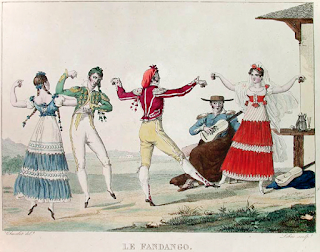
Finnegans Wake mentions Joyce's drunken dancing, in this lively description of Shem the Penman reeling home after a bender, a prancing prince of fandangos:

'reeling more to the right than he lurched to the left....like a prance of findingos, with a shillto shallto slipny stripny, in he skittled.' 186.25-187.01


THE SAILOR'S HORNPIPE

On the opening page of A Portrait of the Artist as a Young Man,  young Stephen dances a sailor's hornpipe while his mother plays the piano. Perhaps this was James Joyce's first dance.

'His mother had a nicer smell than his father. She played on the piano the sailor’s hornpipe for him to dance. He danced:

Tralala lala,
Tralala tralaladdy,
Tralala lala,
Tralala lala.'

Uncle Charles and Dante clapped.'

Two of the earliest photos of Joyce, aged six, show him wearing a sailor's suit.  The one with his mother is described in 'The Dead':

'Her photograph stood before the pierglass. She held an open book on her knees and was pointing out something in it to Constantine who, dressed in a man-o-war suit, lay at her feet.'

There's a memory of this early dance in Finnegans Wake, in the children's games chapter. Shem, now a boy called Glugg, makes a running entrance dressed as a sailor ('gotten orlop in a simplasailormade') and dances a hornpipe to the same rhythm. 

Try singing it:

He’s a pigtail tarr
and if he hadn’t got it toothick 
he’d a telltale tall of his pitcher on a wall 
with his photure in the papers for cutting moutonlegs and capers, 
letting on he’d jest be japers and his tail cooked up.  

232.36-233.04


A Sailor's Hornpipe from the 1915 Swedish film, Modern Dances,  posted on YouTube by Walter Nelson

'THE RITUAL ANTICS OF A COMIC RELIGION'

The first good description of Joyce dancing comes from Frank Budgen, his regular drinking partner in Zurich during World War One:

'On festive occasions and with a suitable stimulus, beribboned and wearing a straw picture hat (Autolycus turned pedant and keeping school, Malvolio snapping up unconsidered trifles) Joyce would execute a fantastic dance. It was not a terpsichorean effort of the statuesque Isadora Duncan variety, but a thing of whirling arms, high-kicking legs, grotesque capers and coy grimaces that suggested somehow the ritual antics of a comic religion.
   'You look like David,' I said, 'leaping and dancing before the ark'.....'

Frank Budgen, James Joyce and the Making of Ulysses, OUP, 1972, p194-5

What could Joyce's 'coy grimaces' have looked like?

'August Suter made six figures in stone for the Amsthauser in Zurich. I stood for one of them, and even in the frozen stone the likeness persists. It always amused Joyce vastly to see this over-lifesize stone effigy resembling me gazing sternly down upon the free burgesses of Switzerland's commercial capital; and whenever a few of us on the way to the Usteristasse passed under that gaze at a late hour, he would execute his comic ritual dance in honour of the stone guest, to whom would be poured out suitable libations.' 

Budgen, ibid

A dance beneath Budgen's statue

August Suter's brother Paul, interviewed by Ellmann, is another source for Joyce's Zurich dancing days:

'When the mood came over him, he might suddenly interrupt a Saturday afternoon walk in the fashionable Bahnhofstrasse by flinging his loose limbs about in a kind of spider dance, the effect accentuated by his tight trouser-legs and wide cloak, diminutive hat, and thin cane....
   (Joyce's) favourite statue in Zurich was one for which Budgen had served as a model.... and often late at night he would say to a group that included Budgen, 'Let's go and see Budgen,' and would conduct them to the statue....Sometimes he would honour this idol with his spider dance.
   An especially gay party took place within an office of the hated consulate. The restaurants having closed, Budgen invited Joyce and Suter to come to the rooms of the commercial department, where they sat round on the carpet....At the party's height Budgen stood on top of the money-safe and performed an Indian belly-dance, while Joyce performed his spider-dance on the carpet below. None of them remembered how or when they got home.'

August Suter wrote a memoir of Joyce, which includes a description of a drinking session at the consulate:

'We made our way to the British consulate and into Budge's office where we drank the wine we had brought with us. Paul Suter was not equal to the strain and was sick on the carpet.. Budgen enlisted all our help to clean the carpet by means of hot water.....Afterwards Budgen carried Joyce, a bit under the influence, home on his back, as he had done before.'

August Suter, 'Some Reminiscences of James Joyce,' Portraits of the Artist in Exile, p.63 

I wonder if this was the same party.


'IT'S THE SATYR ON A GREEK VASE!'


After the Joyces moved to Paris in 1920, Budgen was replaced as Joyce's main drinking and dancing partner by Robert McAlmon.  In her diary, Helen Nutting described them both dancing at Joyce's birthday party at 2 Square Robiac in 1928:

'Antheil was asked to play old English music, and Joyce and McAlmon danced quietly in the back parlor, improvising rhythmic movements, McAlmon on negro themes and Joyce Greek so that Adrienne exclaimed, 'Mais regardez done ce Joyce; il est tout a fait Grecque. C'est le satyre sur un vase Grecque!' ('But look at Joyce; he's totally Greek.  It's a satyr on a Greek vase!') and it was so, skipping, delicate, with a clean line.'

Quoted by Ellmann, James Joyce, p599


As with his writing, Joyce liked to include comic parody in his dances. In dancing like a Greek satyr, Joyce was parodying the style of Raymond Duncan, who was Lucia Joyce's dance teacher. 

'This tendency to invent dance figures he must have passed on to his daughter Lucia, who made the most promising beginnings in the art of dancing.'

Frank Budgen, ibid.


Joyce and Lucia must have talked about dancing a lot, judging by this letter he wrote to her in 1931

'I send you the programme of the Indian dancer Uday Shankar. If he ever performs at Geneva don't miss going there. He leaves the best of the Russians far behind. I have never seen anything like it. He moves on the stage floor like a semi-divine being. Altogether, believe me, there are still some beautiful things in this poor old world.'

Joyce to Lucia, 15 June 1931, Letters I, 341

You can see Uday Shankar (Ravi's older brother)  dancing on YouTube.

Joyce's young friend Arthur Power has more information about Joyce's low opinion of the Russian ballet. They went to see a 1920 performance of Massine's revival of Stravinsky's The Rite of Spring:

'The Russian ballet was all the rage, and I remember one of the early performances of 'Sacre du Printemps' during which an uproar broke out in the audience....When I asked Joyce how he liked the ballet he shrugged his shoulders and told me he did not much care for it.  He went once but never again. He thought the merit of the ballet exaggerated, an opinion so strange, and to me incomprehensible, that I doubted if I had heard him correctly.'

Conversations with James Joyce, Lilliput 1999, p119
 
Joyce is also known to have gone to the avante-garde Swedish Ballet, choreographed by Jean Borlin. In her autobiography, Laughing Torso (1931), Nina Hamnett describes meeting him in the bar during an interval and introducing him to Rudolph Valentino.

'They were the last people in the world who I should think would have met in the ordinary way and they were both speechless.'
 
They should have communicated through dance. Imagine Joyce and Valentino doing a tango....

'A BAT OUT OF HELL'


Herbert Gorman, Joyce's official biographer, gives us another dance from Paris in the early 1920s:

'With closer friends he let himself go and one of them has a memory of Joyce in a voluminous cloak skimming like a bat out of hell in a fantastic dance over one of the ancient bridges that crossed the Seine while the midnight stars shone down on Paris.'  

James Joyce, 1941, p280-281

'A SNAKE DANCE'

Here's another brief mention of Joyce dancing in Paris, from the novelist Louis Golding:

'His humour is a constant factor of his existence, from the days of his childhood when he asked the local librarian for "Jude the Obscene," to the more mature day when he was not ashamed to break out into a snake dance with Mme Adrienne Monnier. But all this is for his most intimate circle, and to the public Joyce remains a somewhat dandified, exact, reserved and locked-in man, spectacled to protect his weakening eyes, with a precise beard, and outwardly to all appearances, as he wanders though Paris, a Professor of the Sorbonne.'

Louis Golding, James Joyce, Thornton Butterworth Ltd, 1933

It's a shame he doesn't say more about this snake dance, which must have been a comical sight.


'HE FANCIED HIMSELF VARIOUS KINDS OF DANCERS'


In his very funny autobiography Robert McAlmon describes a late 1920s St Patrick's Night party at the Trianon, Joyce's favourite restaurant.

'Joyce sang songs...and I broke loose with my 'Chinese Opera'. Joyce wanted me to sing it, and I did. It is the corncrake and the calliope wail of a Chinese virgin in a snowstorm, not understanding where she got her newborn babe, and the neighbour's son claims it is not his inasmuch as he never saw her before. This is a performance that has had me thrown out of several bars and most respectable households and the police of various stations know it well.
   Later, when we left, Joyce wanted to climb up the lamppost. He fancied himself various kinds of dancers, tap, Russian, and belly. Nora was there however, and protest as Mr Joyce might, she got him into a taxi, and, despite his bitter wailings and protestations, drove him home.'

Being Geniuses Together, Doubleday and Co, 1968, p345-6


BALLERINO JOYCE


Nora's disapproval of her husband's dancing is also recorded by Stuart Gilbert in his diary:


'January 2, 1930
On New Years Eve at 10:00 a party at J.J.'s. Present: Pat and Mary Colum, Mr and Mrs Huddleston....At 2.30, Joyce very gay and dancing a jig to 'Auld Lang Syne'; Mrs Joyce, indignant, compels all to leave. She thinks 'he is making a fool of himself' – but I disagree; he is a nimble dancer. If Joyce had not been a writer he'd have been a meistersinger; if not a singer, a ballerino.'

Reflections on James Joyce: Stuart Gilbert's Paris Journal, University of Texas Press, 1993, pp16-17

'HE SAID HE HAD INVENTED HIS OWN DANCE'


Ole Vinding, who met the Joyces in Copenhagen in 1936, has a similar story:

'We sat down for a glass of buttermilk at ''Josty'', and Joyce wanted to tell about the hell he always raised at parties. He said that he had invented his own dance and Mrs. Joyce remarked drily: 'If you can call flinging your legs over your neck and kicking the furniture to pieces 'to dance'!'
  'Well Nora, I do dance! I know the rules of dancing and request that the floor be cleared – that's the least I can do. I once went to a New Year's party with some friends and won first prize for my costume of a beggar, a real clochard. I dressed up in a diplomat's coat that was old and way too short; underneath I wore a blue shirt and, naturally, I wore yellow gloves. In this getup I was introduced to a very solemn young man. He greeted me somewhat ceremoniously but I was in the middle of a dance, so I cut a little caper and answered hastily, 'Enchanté', whereupon I forgot my new acquaintance, whose name I didn't even catch. That was Armand Petitjean*, my energetic commentator! He was the oldest at the party, age-old. The hostess wasn't particularly happy with my behaviour and the next day called on the old-young man to hear what impression I had made on him. He answered laconically: 'Yes, as usual, Mr Joyce had more interest in the expression than in the impression!'
  He laughed, enjoying the memories of those times when he let himself go.'

'James Joyce in Copenhagen', Portraits of the Artist in Exile, p150-1

*Armand Petitjean wrote a study of Finnegans Wake while he was still a teenager. Joyce described it as 'amazing' but it remains unpublished. His relationship with Joyce featured in an exhibition in Luxembourg in 2022.


'JUGGLING CLOWN'


In the 1930s, Joyce was often in Zurich, visiting his eye surgeon. His closest friend here was the art critic Dr Carola Giedion-Welcker. She describes a Zurich evening in the Doldertal with Joyce and Professor Bernhard Fehr.
 
'The discussion turned to light kinds of music, while Professor Fehr began playing dance tunes. After executing an original waltz step – more with himself than with me,  Joyce then took the stage as solo dancer, belaboring the inside of his stiff straw hat with wild jumps and kicks so that in the end, after these rhythmical and astonishingly acrobatic exercises, he was left with only a straw wreath in his hand, which he triumphantly held aloft and then as a finale placed on his head.
  The grotesque flexibility of his long legs, which seemed to fill the room, and the bizarre grace with which he executed all movements of this strange dance, made him appear part juggling clown and part mystical reincarnation of Our Lady's Tumbler, who would like to have continued the performance endlessly, urged on by the constantly changing musical variations of the tireless piano player.'

Carola Giedion-Welcker, 'Meetings with Joyce', Portraits of the Artist in Exile p 273-4


'THE SUPPLENESS AND AGILITY OF A DANCER'


Even when Joyce was not dancing, he could remind others of a dancer in the grace of his movements. Here's Jacques Mercanton describing a visit to Joyce on Good Friday in 1938:

'I found him installed in his bedroom, half-reclining in a chaise longue, Stuart Gilbert seated near him at a table.  They were going over a passage that was 'still not obscure enough,' as Joyce said....His face looked very soft that day, with an almost feminine softness, a bit red under the grey hair. He joked, slid over the bed with the suppleness and agility of a dancer, asked me to serve the tea...'

'The Hours of James Joyce', Portraits of the Artist in Exile, p.214

'A FEW OF HIS INTRICATE STEPS'


In the summer of 1938,  Eugene Jolas correctly guessed the title of Finnegans Wake, winning Joyce's offered prize of 1,000 francs. Joyce turned white, but then expressed his emotions with a dance.

'One morning I knew it was Finnegans Wake, although it was only an intuition. That evening I suddenly threw all the words into the air. Joyce blanched. Slowly he set down the wineglass he held. 'Ah, Jolas, you've taken something out of me,' he said, almost sadly. When we parted that night, he embraced me, danced a few of his intricate steps, and asked: 'How would you like to have the money?''
 
Eugene Jolas, 'My Friend James Joyce',  in Givens (ed) James Joyce: Two Decades of Criticism, Vanguard, 1948.
 

'PAS SEUL WITH HIGH KICKING EFFECTS'


Joyce had a tradition of dancing on his birthday, 2 February. On 28 January 1939, he wrote to Viscount Carlow:

'I am still very exhausted but I shall try to be better by Thursday though I am afraid the traditional pas seul with high kicking effects associated with that birthday feast will be beyond my power this year of grace.'

(Thanks to Patrick Hawe for sharing this quotation on Twitter)

In fact, he did manage to dance after all. Herbert Gorman, Joyce's official biographer, ends his book with an account of the 1939 party, which also celebrated the arrival of the first copy of Finnegans Wake:

'Presently Joyce himself is singing, his fine tenor clouded, perhaps, by the years, but his artistry and his obvious enjoyment making up for the inevitable inroads of time. He sings the old songs that he loves and is not allowed to rest until he has rendered 'Molly Bloom'. That accomplished to the hilarious satisfaction of all, Joyce must have another glass of wine. He evidences some restlessness and his friends know what is imminent. It is the time for dancing. 
    No one who has not seen Joyce dance can have any idea from a brief description what his terpsichorean talents are like. To enlivening music he breaks into a high fantastic dance all by himself, a dance that is full of quaint antics, high kicks, and astonishing figures. He dances with all his body, head, hands and feet and the evolutions through which he goes, eccentric but never losing the beat of the music, are calculated to arouse suspicion in the beholder that he has no bones at all. Others join in the dances and he weaves wild and original patterns with them. When the music stops he sinks contentedly into a chair. The festival has been a success. 
    It is after midnight when the moment for parting (delayed as long as possible) comes. Joyce stands by his door bidding good night to his guests, and as they depart down the stairs and into the night they glance back and see standing above them the tall lean figure of a great gentleman and a great writer.'

Herbert Gorman, James Joyce, 1941

A LAST DANCE 


Maria Jolas told Richard Ellmann about the last time she saw Joyce dance.  It was Christmas 1939, and he was a sick man, in pain from his stomach ulcer. 

'Christmas dinner began sadly enough; Joyce scarcely ate anything, only drank white wine, bending before his glass as if overwhelmed....At the evening's end he had a sudden explosion of gaiety, and began to dance on the narrow stairs to the tune of an old waltz. He approached Maria Jolas and said, 'Come on, let's dance a little.' There was so little room, and his sight was so bad, that she hesitated. 'Come on then,' he said, putting his arm around her, 'you know very well that it's the last Christmas.' After the dance he had to be quieted down to permit the guests to leave.'

Ellmann, p 729

Isn't it a shame that, with all the statues there are of Joyce, not one shows him dancing?


Joyce dancing, by the British painter, poet and publisher, Desmond Harmsworth


Thursday, 14 January 2021

'Lets All Wake Brickfaced In Lucan'

Happy New Year Wake lovers! We may be locked down in our locations, but we can still travel in our imaginations. So let's go on a journey up the Liffey, six miles past Chapelizod to a leafy village on the south bank of the river. 

'Let's all wake brickfaced in Lucan'! 359.27


'Like we larnt from that Buke of Lukan in Dublin’s capital, Kongdam Coombe.' 255.

The name Lucan is either from the 'Leamhcán' (place of elms) or 'Leamhachán' (place of marsh-mallow plants). The marsh plants seem more likely, according to the Lucan Newsletter. Wouldn't elms have been a common sight all along the Liffey?

Lucan is famous for an earl, a Palladian mansion, a spa hotel, and a steam tram - all of them appearing in Finnegans Wake. More importantly, Lucan is mixed up with Chapelizod, creating a dream location which Joyce calls 'Lucalizod'.

In her Third Census, Adaline Glasheen suggested that the name 'links Issy and the two Isoldes to Lucia Joyce and Alice'. Perhaps Joyce chose it because it resembles 'localised'. 


'Gush Mac Gale and Roaring O’Crian, Jr., both changelings, unlucalised, of no address' 87.18

'When you’re coaching through Lucalised, on the sulphur spa to visit, it’s safer to hit than miss it, stop at his inn!' 565.33

Localised Lucalizod is the 'particular universal' (260.r3).

'THE LOCALISATION OF LEGEND' 263.r2

Joyce came up with 'Lucalizod' even before he had started writing his earliest sketches, for it appears in his 1922-3 Nice notebook (V1.B.10.33).

He first used the word in his second Wake sketch, on the big love scene between Tristan and Isolde. In the earliest fair copy, Isolde is 'the belle of Chapelizod'.


Here's the second draft, in which Isolde has become 'the dinkum belle of Lucalizod'.

Sadly, this phrase didn't make it into the published book (where Isolde is simply 'the dinkum belle' at 384.21). But the name Lucalizod stuck.  In the second chapter, the narrators discuss HCE's name:

'The great fact emerges that after that historic date all holographs so far exhumed initialled by Haromphrey bear the sigla H.C.E. and while he was only and long and always good Dook Umphrey for the hungerlean spalpeens of Lucalizod and Chimbers to his cronies it was equally certainly a pleasant turn of the populace which gave him as sense of those normative letters the nickname Here Comes Everybody.'  32.14

In his first draft, Joyce wrote 'the ragged tiny folk of Lucalizod'. Arthur Young gives a derivation of 'spalpeen' in his 18th century Tour of Ireland.


In the fourth chapter, the place became 'folkrich Lucalizod':

'Who, but who (for second time of asking) was then the scourge of the parts about folkrich Lucalizod it was wont to be asked, as, in ages behind of the Homo Capite Erectus...
' 101.10-13

The name made its fourth appearance in the earliest title of Anna Livia Plurabelle's letter defending HCE against the slander, spread 'all around Lucalizod':

First and Last Only True Account all about the Honorary Mirsu Earwicker, L.S.D., and the Snake (Nuggets!) by a Woman of the World who only can Tell Naked Truths about a Dear Man and all his Conspirators how they all Tried to Fall him Putting it all around Lucalizod about Privates Earwicker and a Pair of Sloppy Sluts plainly Showing all the Unmentionability falsely Accusing about the Raincoats 107.01-7

A few pages later, Chapelizod and Lucan are again combined as 'Isitachapel-Asitalukin' (Is it a chapel? Has it a look in?):

'That stern chuckler Mayhappy Mayhapnot, once said to repeation in that lutran conservatory way of his that Isitachapel-Asitalukin was the one place, ult aut nult, in this madh vaal of tares (whose verdhure’s yellowed therever Phaiton parks his car while its tamelised tay is the drame of Drainophilias) where the possible was the improbable and the improbable the inevitable.'  110.06-12

The place next became 'muchtried Lucalizod' in the description of Shem the Penman taking refuge in his 'inkbattle house' from the street fighting in Dublin:

After the thorough fright he got that bloody, Swithun’s day, though every doorpost in muchtried Lucalizod was smeared with generous erstborn gore and every free for all cobbleway slippery with the bloods of heroes.... 178.08

It was a placename Joyce could play with. In 'Haveth Childers Everywhere', HCE boasts of his achievements as a city builder:

'if I was magmonimoss as staidy lavgiver I revolucanized by my eructions' 545.32

'THE SULPHUR SPA TO VISIT'


Lucan was famous for its sulphur spring, discovered in 1758 by the wonderfully named Agmondisham Vesey, owner of the Lucan demesne.

The water was vividly described by John Rutty in his 1772 Essay Towards a Natural History of Dublin, Vol 2 :

'It may be smelt at a distance of many yards....It resembles the Aix-la-Chapelle water in smell and taste...having the flavour of a boiled egg and when strongest of a semitputrid egg.'


The spring's medicinal qualities are described by Mrs James J Daly, in 'Curative Wells in Old Dublin', a paper she read to the Old Dublin Society on 9 December 1957.

The original Spa House Hotel was rebuilt as the Hydropathic Spa Hotel in 1890-1


'Hydropathy' is what we now call 'Hydrotherapy'.

F.W.Crossley's Visit Ireland  guidebook (1892) carries a full page advert for the brand new hotel.


'Lucan is principally known as a health resort. Recently there has been a splendid hotel erected, called the New Spa Hotel, which is excellently appointed, and contains every convenience and comfort which the visitor can desire. It is situated on an eminence commanding a view of some of the finest scenery in the county Dublin, and within a few yards of a valuable sulphur spa, which is now attracting much attention and patronage....Persons suffering from gout, rheumatism, and hepatic disorders, could not do better than spend a week or two here, where they would not only find relief from their ailments, but may also have an enjoyable holiday.'

F.W.Crossley, Visit Dublin, Irish Tourism Development, 1892, p.15

In Finnegans Wake,  'hydropathic' becomes 'hydrocomic', and the hotel becomes another version of Earwicker's pub:

'They near the base of the chill stair, that large incorporate licensed vintner, such as he is, from former times, nine hosts in himself, in his hydrocomic establishment and his ambling limfy peepingpartner' 580.33

'When you’re coaching through Lucalised, on the sulphur spa to visit, it’s safer to hit than miss it, stop at his inn!'  565.33

The Lucan Spa Hotel is still going, but a busy motorway now separates it from the river.


THE LUCAN STEAM TRAM


From the collection of Joe Williams

'Visitors who are staying in Dublin for a few days are strongly recommended before leaving to pay a visit to the little village of Lucan. The steam tram is an excellent mode of conveyance, and accomplishes the journey in about three quarters of an hour.'

F.W.Crossley, Visit Dublin, Irish Tourism Development, 1892, p.15

The South Dublin Libraries Local Studies Blog has a fascinating piece on the Lucan steam tram, which you can read here. It started running on 20 February 1883, and was the only service to operate during the Easter Rising.

'The village and the Spa Hotel were crowded with visitors from all parts of Ireland ....‘peace and plenty’ reigned in Lucan, disturbed only by the boom of the distant guns in the city and the glare at night of the conflagrations.' 

Freeman’s Journal 9th May 1916.

In Finnegans Wake, we can hear the cry of the tram conductor, as the west-bound tram stops at Chapelizod

'Issy-la-Chapelle! Any lucans, please?' 80.36 

A LORD AT LUCAN 


'Before there was patch at all on Ireland there lived a lord at Lucan.'  452.28

'You make me think of a wonderdecker I once. Or somebalt thet sailder, the man megallant, with the bangled ears. Or an earl was he, at Lucan?' 620.08

In 1566, the Lucan demesne was acquired by Sir William Sarsfield, a wealthy merchant and Lord Mayor of Dublin.  The most famous member of his family was Patrick Sarsfield, who was born in Lucan. James II's leading general in the war against William of Orange, Sarsfield was made first Earl of Lucan in 1690.


As a Jacobite title, this earldom was never recognised in the United Kingdom.  Like Joyce, Sarsfield went on a 'wildgoup's chase across the kathartic ocean' (185.06) and spent his last years as an exile in France. There is now a campaign by the Wild Geese Festival to repatriate his remains, but to Limerick rather than Lucan.

Back in Ireland, the demesne passed into the hands of the Veseys, who married into the Sarsfield family. In 1772, Agmondisham Vesey, discoverer of the sulphur spa, built a magnificent Palladian mansion here, working with the architect William Chambers (designer of the Casino at Merino). According to the Irish Times, its oval dining room was the inspiration for the Oval Office in the White House.  

Vesey's wife Elizabeth was a founder of the Bluestockings Society, and friend of Samuel Johnson.

Here's a view of the house, now the official residence of the Italian ambassador,  from Itsmyireland.


The title was revived in 1795, when Sir Charles Bingham, who had married Anne Vesey, was made the first Earl of Lucan.  It was his grandson, George Charles Bingham, the Third Earl, who ordered the Charge of the Light Brigade, as shown on the television set in Earwicker's pub.

The Bingham estate was in Castlebar, Mayo rather than Lucan. Here the third earl earned a reputation as a monster.

'During the Great Famine he engaged in wholesale evictions and showed a complete disregard for public opinion. In the parish of Ballinrobe alone he demolished over 300 cabins and evicted 2,000 people (1846–9). He then consolidated the holdings and leased them to wealthy ranchers.' 

James Quinn, 'The Exterminator', History Ireland


'To the people of Mayo an Earl of Lucan, a Bingham, was an oppressor, responsible for the cruelties of the past and the misery of the present, automatically to be hated. .....He cherished an equally powerful contempt for them. From the bottom of his heart he despised them, swarming, half starving, ignorant, shiftless, and Roman Catholics into the bargain. It is doubtful if he considered the Irish as human beings at all.....Evictions became numerous, and it began to be said in Mayo that he possessed 'all the inherited ferocity of the Binghams.'
Fear of the third Earl bit deep into the consciousness of the people, and he still survives as a bogey in Castlebar. Tales are told of the fierce Earl galloping through the town, the hoofs of his great black horse striking sparks from the cobble-stones, bringing terror to his tenants' hearts. When least expected he suddenly appeared, for though he gained the credit of being a resident landlord, he seldom stayed in Castlebar more than a few days -- it was his custom to swoop down a dozen times a year. On one occasion, believing him to be safely in England, the inhabitants of Castlebar were burning him in effigy on the Mall when suddenly the sound of the great black horse was heard and the Earl galloped into the midst of the crowd, shouting as they scattered in terror, 'I'll evict the lot of you.''


Joyce refers to this story at the end of the games chapter, when HCE's sudden appearance ends the children's fun:

'One must recken with the sudden and gigantesquesque appearance unwithstandable as a general election in Barnado’s bearskin amongst the brawlmiddle of this village childergarten of the largely longsuffering laird of Lucanhof.'  253.25

Crimean War veterans in bearskins

If you mention Lord Lucan today, people think of Richard John Bingham, the notorious Seventh Earl, who vanished in mysterious circumstances in 1974.

To finish, here's 'Lord Lucan is Missing', a 1978 song from the Dodgems, a band I used to see regularly in Brighton back in the punk years. They ask, 'Is he in the Clerment Club or in the south of France? Playing on a roulette wheel In another game of chance? Is he dead upon the Downs rotting in the grass? Or is he hid behind the cloak of the British ruling class?'

Forty-two years after they asked the questions, we still don't know the answers.


Thursday, 3 December 2020

The Dream of H.C.Earwicker?


A scene from Passages from Finnegans Wake 

'The Dream of H.C. Earwicker' is the title of Edmund Wilson's review of Finnegans Wake, published in The New Republic on 28 June 1939, and later reprinted in The Wound and the Bow

Wilson was the first critic to argue that Joyce's book represented Earwicker's dream, at first in a 1929 article:

'The hero of the night's sleep in question is, we gather, a man named H. C. Earwicker, a Norwegian or descendant of Norwegians, living in Dublin....We are introduced, at the very beginning, into Earwicker's drowsing consciousness...'

Edmund Wilson, 'James Joyce', The New Republic, 18 December 1929

Wilson based his theory on the earliest chapters of the book which had been published in transition. At this time, Joyce hadn't written books two and four.  The article, reprinted in Axel's Castle in 1931, influenced many later readers.

In his 1939 review, Wilson added detail to his theory, arguing that the book had a 'realistic foundation' which he described at length:

'Let me try to establish some of the most important facts which provide the realistic foundation for this immense poem of sleep.  The hero of Finnegans Wake is a man of Scandinavian blood...Humphrey Chimpden Earwicker, who keeps a pub called the Bristol in Dublin.  He is somewhere between fifty and sixty, blond and ruddy, with a walrus moustache, very strong but of late years pretty fat. When embarrassed, he has a tendency to stutter...he is married to a woman named Ann, a former salesgirl, who is more or less illiterate and whose maiden name seems to have begun with Mac. They are both Protestants in a community of Catholics, he an Episcopalian and she a Presbyterian...It is a Saturday night in summer, after a disorderly evening in the pub....Earwicker has been drinking off and on all day and has perhaps gone to bed a little drunk. At any rate, his night is troubled. At first he dreams about the day before....'

Having decided that the book is happening in Earwicker's sleeping mind, Wilson complains that a Dublin publican could not be having a dream like this!

Edmund Wilson
'We are continually being distracted from identifying and following Earwicker, the humble proprietor of a public house, who is to encompass the whole microcosm of the dream, by the intrusion of all sorts of elements – foreign languages, literary allusions, historical information – which could not possibly be in Earwicker's mind....We are in the first place asked to believe that a man like H.C.Earwicker would seize every possible pretext provided by his house and its location to include in a single night's dream a large number of historical and legendary characters. And is it not pretty far-fetched to assume that Earwicker's awareness of the life of Swift or the Crimean War is really to be accurately conveyed in terms of the awareness of Joyce, who has acquired a special knowledge of these subjects? Also, what about the references to the literary life in Paris and to the book itself as Work in Progress, which take us right out of the mind of Earwicker and into the mind of Joyce?'

Where were we 'in the first place asked to believe' any of this?

I read all this as a convincing argument that Finnegans Wake is not the dream of Earwicker.

Much of Wilson's description* of the Earwickers is taken from Bk III chapter 4. This leads to another complaint about Joyce's incompetence as a writer:

'In Finnegans Wake we are not supplied with any objective data until the next to last chapter....It seems to me a serious defect that we do not really understand what is happening till we have almost finished the book.'

*Wilson has taken the name of the pub, the Bristol, from the Prankquean episode: 'And where did she come but to the bar of his bristolry'. 21.33. In fact, the Wake pub is more usually the Mullingar Inn.

'A WHOLE HOUSEHOLD DRIFTING ON THE WAVES OF SLEEP'


Wilson's argument was quickly accepted by many Wake readers. In 1931, the French critic Louis Gillet had argued that Joyce's Work in Progress was a collective dream by all the characters:

'The author has placed the characters of his poem in a pub on the river's bank....and these characters represent all human history!....The world and its history become the dream of these characters....The last part, drafted but still unknown, I believe will relate the family's sleep and dreams....a whole family, a whole household drifting on the waves of sleep.'

'James Joyce and his new novel', 15 August 1931

In 1940, Gillet revised his opinion, accepting Wilson's argument. He even added to the book's 'objective data' with a picture on the dreamer's bedroom wall:

'It goes without saying that the action is nil, reduced only a ghost of action occurring in the mind of a sleeping man. This slumbering hero is a Dublin pub-keeper, proprietor of a tavern of low repute in the vicinity of Phoenix Park. We learn on page 559 that in the room where he sleeps there is a framed colour-print of St Michael and the dragon....The man's name is Humphrey Chimpden Earwicker.'

'The extraordinary adventure of James Joyce', 15 December 1940

A BRANCH TAPPING ON A WINDOW


The Earwicker dream theory was further developed in 1944 with Joseph Campbell and Henry Morton Robinson's A Skeleton Key to Finnegans Wake. They invented a branch tapping on the sleeping Earwicker's window, intruding on his dream. This is first mentioned in a footnote to the word 'Tip' in the Museyroom scene:

'The repetition throughout Finnegans Wake of the word 'tip' finally turns out to be a dream transformation of the sound of a branch knocking against HCE's window as he sleeps beside his wife in the upper room. This branch is the finger of Mother Nature, in her desiccated aspect, bidding for attention.'

A Skeleton Key to Finnegans Wake, Viking Press, 1964, p 41

They don't explain how or where Tip 'finally turns out' to be a branch. 

The branch is not mentioned again until they reach Book III Chapter 4, the chapter which gave Wilson his 'objective data'. Here Campbell and Robinson have made Wilson's summer dream a midwinter one.:

'It is the morning after the night of the winter solstice. A dry leaf still clinging to the tree outside the window has been scratching at the panel; and this sound has drawn the inexhaustible dream from the depths of the psyche...'

A Skeleton Key to Finnegans Wake, Viking Press, 1964, p 325

I find this baffling, for the 'Tip' motif does not appear anywhere in this chapter (You can read all 39 appearances of this motif in fweet).  The only mention of a leaf is the description of the sleeping Issy as 'like some losthappy leaf' (556.19).
 

THE DATE OF EARWICKER'S DREAM


Let's call this approach, which assumes that Joyce has created a level of waking reality outside the dream, the 'branch tapping on a window'.  

In  'The Date of Earwicker's Dream', a baffling essay published in Twelve and a Tilly (1966), Nathan Halper argued that Earwicker's dream was taking place on a particular date in history. He decided on 18 March 1922, a Holy Saturday near the Spring equinox.

Halper presents his arguments as a series of numbered assertions.e.g.

'15...The phrase felix culpa keeps running through Earwicker's drean, This is from the hymn Exultet....
  This hymn is chanted on Holy Saturday'


Yet Halper can't resist including evidence which undermines his theory: Finnegans Wake refers to events which happened after 1922 and many dates apart from 18 March.

'2...It is not easy to believe that, in the 1920s, he was working on a dream that was going to be dreamed in 1930. Nor is it likely that, once he settled on a day, he kept revising it, moving it into the future, altering it, year by year, every time he thought of a new allusion....

11. If, at some moment, Mr Earwicker is thinking of a particular day, this – by itself – does not make it the day on which he happens to be dreaming....It is conceivable that...(Joyce) has managed to hint at every day of the year. 

12. This is only partly for the purposes of misdirection.
  He has a second reason. It is every dream and he's taking steps to show that it happens every night.
  The universal, however, has its home in the particular.
  It is a specific dream.  He is taking pains to give it a specific night: a house in which its universality may most efficiently reside'....

15 It is a week-end in Lent.  The year is 1922.
  There are indications in the text that confirms this period. But when we have looked for signs that it's one day rather than another, we have not been so successful.
  They should be there for the finding – I have looked for them again.
  A would-be Holmes, I have sought a print, a scent, a twig that has been bent, a match that has been dropped.'

ANTHONY BURGESS


In 1965, Anthony Burgess adopted Wilson's Earwicker dream theory and Campbell and Morton's branch at the window:

'We are primarily in a bed above a bar in Chapelizod, Dublin, on a Saturday night, with a dry branch tapping or tipping at the window, and we must never let ourselves forget it. In the final chapter we are not allowed to forget it. The fact that we we have to look at the near-end of the book to find out where the dreamer is dreaming does not imply that the whole thing is badly made or that Joyce is withholding anything from us. Finnegans Wake is cyclical like a riverrun, and we can enter the river at any point we wish.'

Here Comes Everybody: An Introduction to James Joyce for the Ordinary Reader, 1965, Hamlyn Paperback edition, 1982, p219 

Here Burgess is defending Joyce from Wilson's criticism, 'It seems to me a serious defect that we do not really understand what is happening till we have almost finished the book'.

A year after Here Comes Everybody, Burgess published A Shorter Finnegans Wake, in which he now argued that the dreamer's real name was not Earwicker but Porter, a name used in Bk III 4.

'His name is, as far as we can tell, Mr.Porter....Mr. Porter and his family are asleep for the greater part of the book. It has been a hard Saturday evening in the public bar, and sleep prolongs itself some way into the peace of Sunday morning. Mr. Porter dreams hard, and we are permitted to share his dream....Sleeping, he becomes a remarkable mixture of guilty man, beast, and crawling thing, and he even takes on a new and dreamily appropriate name – Humphrey Chimpden Earwicker.'

A Shorter Finnegans Wake,  Faber, 1966, p7

Wilson, Gillet and Burgess base their arguments on a belief that the penultimate chapter is more 'real' than the rest of the book. This is the book's most visual chapter, with a mass of physical detail missing elsewhere. But that doesn't make it more real.  Here's how the bedroom setting, including Gillet's picture on the wall, is described on p558-9:

'Scene and property plot. Stagemanager’s prompt. Interior of dwelling on outskirts of city. Groove two. Chamber scene. Boxed. Ordinary bedroom set. Salmonpapered walls. Back, empty Irish grate, Adam’s mantel, with wilting elopement fan, soot and tinsel, condemned. North, wall with window practicable. Argentine in casement. Vamp. Pelmit above. No curtains. Blind drawn. South, party wall. Bed for two with strawberry bedspread, wickerworker clubsessel and caneseated millikinstool. Bookshrine without, facetowel upon. Chair for one. Woman’s garments on chair. Man’s trousers with crossbelt braces, collar on bedknob. Man’s corduroy surcoat with tabrets and taces, seapan nacre buttons on nail. Woman’s gown on ditto. Over mantelpiece picture of Michael, lance, slaying Satan, dragon with smoke. Small table near bed, front. Bed with bedding. Spare. Flagpatch quilt. Yverdown design. Limes. Lighted lamp without globe, scarf, gazette, tumbler, quantity of water, julepot, ticker, side props, eventuals, man’s gummy article, pink.'

This is not a real room but a stage set, with many of the words taken from William George Fay's Short Glossary of Theatrical Terms, 1930 (see the list in fweet).  The casement is fitted with argentine, 'a material used on the stage as imitation of glass for windows' (Fay).

When the action begins, we see HCE and ALP in their most grotesque incarnations. There is also the sense that we are watching a film, with a closeup of the lead players.

'Closeup. Leads.
Man with nightcap, in bed, fore. Woman, with curlpins, hind. 
Discovered. Side point of view.....Male partly masking female. Man looking round, beastly expression, fishy eyes, paralleliped homoplatts, ghazometron pondus, exhibits rage. Business. Ruddy blond, Armenian bole, black patch, beer wig, gross build, episcopalian, any age. Woman, sitting, looks at ceiling, haggish expression, peaky nose, trekant mouth, fithery wight, exhibits fear. Welshrabbit teint, Nubian shine, nasal fossette, turfy tuft, undersized, free kirk, no age. Closeup. Play!' 559.20-30

This is the source of Wilson's 'objective data', and the reason why he says that Earwicker is a blond and ruddy Episcopalian and Anna a Presbyterian. But HCE here is wearing a wig and stage makeupArmenian bole is 'a fine red powder used on the stage to give the appearance of sunburn on the skin' (Fay). So he is playing a blond and ruddy Episcopalian. 

Although this stage publican version of HCE is called Mr Porter, elsewhere in the chapter he is called Albatrus Nyanzer, Honuphrius 'a concupiscent exservicemajor' and Humperfeldt - names just as real or unreal. 

POINT-OF-VIEW


The biggest problem with the Earwicker dream theory is that we never see anything in the book from his point-of-view. Apart from the 'Haveth Childers Everywhere' section (532-554), when we hear his voice in a seance, he is either being investigated by the narrators (the 'we' voice of most of Book One) or discussed by other characters, such as the washerwomen in Anna Livia Plurabelle. 

'And the cut of him! And the strut of him! How he used to hold his head as high as a howeth, the famous eld duke alien, with a hump of grandeur on him like a walking wiesel rat.' 197.01

In the Porter chapter, we see him through the eyes of the four old men, and their first sight as they enter his bedroom is of his bare buttocks as he lies on top of his wife. His backside is also Dublin's Phoenix Park.  See my earlier post, Dublin's Phoenix Park as a Giant Male Arse.  The scene is described by the second old man, Marcus Lyons:

'The straight road down the centre (see relief map) bisexes the park which is said to be the largest of his kind in the world. On the right prominence confronts you the handsome vinesregent’s lodge while, turning to the other supreme piece of cheeks, exactly opposite, you are confounded by the equally handsome chief sacristary’s residence.' 564.10-15

Did you ever have a dream in which you were inspecting your own arse? An arse which was also a park?

'A MYTH OF SLEEPING LIFE'


If Joyce intended the book to be Earwicker's dream, he would surely have said so, since he discussed his book at length over many years. Apart from conversations, formal interviews and letters providing glosses, he oversaw a book of explanatory essays, the Exagmination and an authorised biography by Gorman with a lengthy account of his aims. See my post Joyce describes Finnegans Wake.

He often talked about his book as representing a dream, without mentioning a dreamer.

'Work in Progress? A nocturnal state, lunar. That is what I wanted to convey: what goes on in a dream, during a dream.'

Jaques Mercanton, 'The Hours of James Joyce', in Portraits of the Artist in Exile (ed Willard Potts), pp 209-221

'One great part of every human existence is passed in a state which cannot be rendered sensible by the use of wideawake language, cutandry grammar and goahead plot.'

To Harriet Shaw Weaver, 24 November 1926, Letters Vol 3, p146 (Selected Letters p.318)

'[Finnegans Wake] would have the gigantic dimensions of a Myth and yet it would be contained within the fleeting instants of a dream. It would be a Myth of sleeping life as Ulysses had been a Myth of waking life'

Herbert Gorman, James Joyce, Bodley Head, 1941, p.331

'I want to describe the night itself. Ulysses is related to this book as day is to night....There are, so to say, no individual people in the book – it is as in a dream, the style gliding and unreal as the way it is in dreams. If one were to speak of a person in the book, it would have to be of an old man, but even his relationship with reality is doubtful.'

Ole Vinding, 'James Joyce in Copenhagen', in Portraits of the Artist in Exile, pp 149

This last quotation is an explicit rejection of Wilson's claim that Finnegans Wake has a 'realistic foundation.' 

FINN MACCOOL AS THE DREAMER


It's a shame Joyce didn't say more about  'an old man'. But it may relate to the only published remark in which he ever mentioned a dreamer, given here by Ellmann:

'Joyce informed a friend later, he conceived of his book as the dream of old Finn, lying in death beside the River Liffey and watching the history of Ireland and the world – past and future – flow through his mind like flotsam on the river of life.'

Richard Ellmann, James Joyce, OUP 1982, p544

Clive Hart gives a slightly different version of this story, as well as its source:

'Mrs Adaline Glasheen reports that Dr O'Brien, a friend of Joyce's, told her in conversation that Joyce had told him 'that Finnegans Wake was 'about' Finn lying dying by the River Liffey with the history of Ireland and the world circling through his mind.''

Clive Hart, Structure and Motif in Finnegans Wake, Northwestern University Press, 1962 p81

This comment must date from 1938-9, when Joyce became friends with Dr Daniel P O'Brien of the Rockefeller Foundation. He spent a lot of time with Joyce in La Baule in September 1939, following the outbreak of the war.

Perhaps Vinding's 'old man' is Finn MacCool.

If Joyce saw the book as a dream of old Finn, it would be after November 1926. That was when his patron Harriet Shaw Weaver asked him to write a piece about the Giant's Grave at Penrith, inspiring the opening chapter. Here's Danis Rose's great description of Joyce's reaction to Weaver's commission:

'Joyce was electrified: here exactly was what he needed to give spin to his work in progress: the notion of HCE as a (sleeping) giant interred in the landscape and, beyond that, of a man assumed dead but sleeping....And with MacCool came the ballad-hall Tim Finnegan with his hod....With his fall off the wall came the first Fall, Adam and Eve and all their descendants down to Mr and Mrs Porter shagged out in their bed. In a word, Miss Weaver's fortuitously brilliant idea gave Joyce the notion for a chapter, or prelude, that was destined to become the common picture of Finnegans Wake: a giant dreaming of falls and walls, a babble of tongues, a tale of howes and graves and burrows and biers.'

Danis Rose, The Textual Diaries of James Joyce, Lilliput Press, 1995, p.95

Joyce had already written most of books one and three by this time.  

This Finn idea may even have come to Joyce at the very end of writing the book. In 'Finn MacCool and the Final Weeks of Work in Progress'  (A Wake Newslitter October 1980) Danis Rose and John O'Hanlon showed that Joyce took most of his notes on Finn in 1937-1938. 

Joyce talked a lot about Finn MacCool in the opening months of World War Two:

'For Joyce himself, Finnegans Wake had prophetic significance. Finn MacCool, the Finnish-Norwegian-Irish hero of the tale, seemed to him to be coming alive again after the publication of the book, and in a letter from France I received from him last spring, he said: '...It is strange, however, that after publication of my book, Finland came into the foreground suddenly....the most curious comment I have received on the book is a symbolical one from Helsinki, where, as foretold by the prophet, the Finn again wakes, and volunteer Buckleys are hurrying from all sides to shoot Russian generals....'

Eugene Jolas, 'My Friend James Joyce', 1941 in Sean Givens (ed) James Joyce: Two Decades of Criticism, Vanguard Press, 1948, p17

Perhaps Joyce discovered that the giant was his dreamer after he finished writing the book!

In a letter to J.S.Atherton, Weaver rejected the Earwicker dream theory:

'I own that The Skeleton Key, though extremely useful in many ways, has its irritating features – at least it has to me.  The authors seem to me to read unwarranted things into the book. Their ascription of the whole thing to a dream of HCE seems to me nonsensical....My view is that Mr Joyce did not intend the book to be looked upon as the dream of any one character, but that he regarded the dream form with its shiftings and changes and chances as a convenient device, allowing the freest scope to introduce any material he wished - and suited to a night piece.'

quoted in The Books at the Wake, Southern Illinois University Press, 1959 p17

The idea of a mythological giant being the dreamer would also allow him 'the freest scope to introduce any material he wished'.

EVERYONE'S DREAM


J.S.Atherton came up with my favourite dreamer theory, in a brilliant lecture, 'The Identity of the Sleeper', which he gave at the very first James Joyce Symposium, at the Gresham Hotel, on Bloomsday in 1967.

'I do not wish to deny any of the theories which have been put forward as to the identity of the dreamer: they are all true up to a point. For, as I see FW it is everyone’s dream, the dream of all the living and the dead. Many puzzling features become clear if this is accepted. Obviously we will hear many foreign languages: Chinese will be prominent if we know Chinese; German if we know German, and so on....It is the universal mind which Joyce assumes as the identity of the dreamer; he, of course, is writing it all down but everyone else contributes.'

I've posted the whole lecture here in 'Who is Dreaming Finnegans Wake?' 

For more on Joyce's belief in a Universal Mind see 'Finnegans Wake as Magical Evocation'.

For an argument that challenges Atherton's universal mind, see John Bishop's 1986 Joyce's Book of the Dark,  the most recent version of the single dreamer theory.  I am more persuaded, and inspired, by Atherton's idea, but I recommend PQ's four part review of Bishop's book in his excellent Finnegans, Wake! blog.